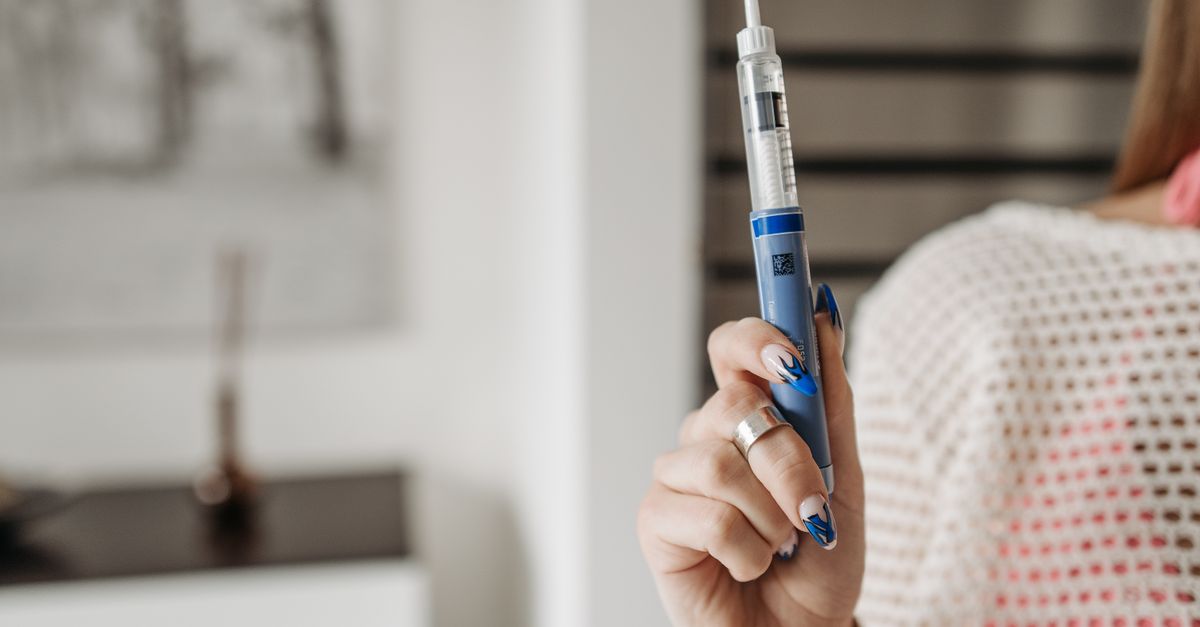
Ozempic is a prescription semaglutide injection licensed to manage type 2 diabetes. It imitates GLP-1, a gut hormone released after eating, so the stomach empties more slowly and the brain registers fullness sooner. People eat less without deciding to. The appetite effect lasts as long as the drug does, which is the part the headlines tend to skip.
🧬 What is Ozempic, and what is actually in it?
Ozempic is a brand name for semaglutide, an injectable medicine made by Novo Nordisk and licensed to manage type 2 diabetes. Semaglutide belongs to a class called GLP-1 receptor agonists, which is a mouthful meaning it copies a hormone your gut already makes several times a day for free.
The same molecule wears several names, which is where most kitchen table confusion begins. The NHS lists Ozempic and Rybelsus as brands used for type 2 diabetes, and Wegovy as the brand licensed for treating obesity. One molecule, three labels, and three fairly different conversations at the pharmacy counter.
What none of them are is a supplement. Every licensed version is prescription only, everywhere the medicine is properly regulated, and that is a fact about how strong it is rather than a conspiracy to keep it from you.
⚗️ How does Ozempic work in the body?
Your small intestine releases GLP-1 when food arrives. Natural GLP-1 is dismantled by an enzyme within a couple of minutes, which is perfectly sensible for a hormone with a short job to do. Semaglutide is built to resist that breakdown and stays in circulation for roughly a week, which is why it is injected weekly rather than being something you set six alarms for.
Once it is there, three things happen at the same time:
- The stomach empties more slowly. An ordinary meal keeps you full for longer than the same meal used to.
- Appetite signalling in the brain changes. People often describe the constant background commentary about food going quiet, which is where the phrase food noise came from.
- Insulin release becomes more responsive. Blood sugar stays steadier after eating instead of spiking and crashing.
The upshot is that people eat less without gripping the kitchen counter and negotiating with themselves. That is the whole trick, and it is a genuinely clever one, because it works on the drive rather than on the willpower holding the drive back. Worth noticing what is not on that list: nothing here burns fat directly. There is no furnace, no metabolic bonfire. The medicine changes how much goes in, and the body then does what bodies do when less goes in.
📈 Why did a diabetes drug become a weight loss phenomenon?
Semaglutide was approved in the United States in 2017 for type 2 diabetes, and nobody marketed it as anything else. Then clinicians kept noticing the same thing in follow up appointments: blood sugar was better, and so was the number on the scale. In 2021 a higher dose of the same molecule was approved for weight management under the name Wegovy. In 2023 NICE recommended semaglutide as an option for managing overweight and obesity in England, within a specialist weight management service rather than as something a GP hands out on request.
Then the internet did what the internet does. Transformation posts, knowing captions, an entire genre of celebrity denial delivered with a very steady face. Demand outran supply, pharmacies rationed stock, and people with type 2 diabetes who had been taking it for years struggled to fill an ordinary prescription. That part of the story got a fraction of the coverage the red carpet speculation did, and it was the part that mattered.
In the United States that chapter has formally closed. On 21 February 2025 the FDA declared the semaglutide injection shortage resolved, in a declaratory order reposted by the Alabama Board of Medical Examiners, and the grace periods that had let pharmacies make compounded copies during the shortage ran out on 22 April 2025 for state licensed pharmacies and 22 May 2025 for outsourcing facilities. Which is worth knowing when a website still sells a “compounded” version as a shortage workaround: the shortage it is working around ended well over a year ago.
The phrase Ozempic face arrived around the same time. It is not a mysterious new toxicity. Fat loss is not something the body performs selectively on request, so when it goes, some of it goes from the pads that hold a face up. Lose weight quickly by any route and the same thing happens, which is why the phrase says more about the pace than about the drug.
⚖️ How do Ozempic, Wegovy and Mounjaro differ?
| Brand | Active ingredient | Mainly licensed for | How it is taken | Worth knowing |
|---|---|---|---|---|
| Ozempic | Semaglutide | Type 2 diabetes | Weekly injection | Prescribed off licence for weight in some settings |
| Wegovy | Semaglutide, higher dose | Weight management in adults meeting the criteria | Weekly injection | The version NICE appraised for obesity |
| Rybelsus | Semaglutide | Type 2 diabetes | Daily tablet | Strict rules about taking it on an empty stomach |
| Mounjaro | Tirzepatide | Type 2 diabetes, plus weight management in some countries | Weekly injection | Acts on two receptors, GLP-1 and GIP |
| Zepbound | Tirzepatide | Weight management in the United States | Weekly injection | Same molecule as Mounjaro, different licence |
The differences that matter here are about licensing and access, not about which one wins an argument online. Tirzepatide pulling two hormonal levers instead of one is a real pharmacological difference. Whether that matters for a particular person depends on their health, what they can get, what they can tolerate and what their prescriber thinks, which is four more variables than any comparison thread accounts for.
What has changed since this was first published?
- A tablet for weight, not only for diabetes. On 22 December 2025 the FDA approved the Wegovy pill, a once daily oral semaglutide, as the first oral GLP-1 medicine licensed for weight management in adults with obesity, or overweight with at least one weight related condition, per Novo Nordisk’s approval announcement. The comparison table above predates it and lists Rybelsus as the only tablet, which is now true only for diabetes. As of September 2026 the NHS semaglutide page, last reviewed on 15 May 2026, still lists Wegovy for obesity and Ozempic and Rybelsus for type 2 diabetes, with no weight loss tablet among them.
- The United States shortage that drove the rationing described above was declared resolved by the FDA on 21 February 2025, and the compounding grace periods ended in April and May 2025.
- The NHS advice on private prescriptions is unchanged as of its May 2026 review: buy from a registered pharmacy, because some websites sell fake weight loss medicines.
📉 What happens when someone stops taking it?
This is the question the enthusiasm skips, and it has a clear answer. In the published extension of the STEP 1 trial, participants who came off semaglutide and the accompanying lifestyle programme had regained about two thirds of what they had lost a year later, and the improvements in their cardiometabolic measures drifted back toward where they began.
That is not a character flaw showing up on schedule. Appetite regulation simply returns to its previous setting once the drug is gone, and the body defends the weight it was at before. It is the reason obesity specialists describe these medicines as a long term treatment for a long term condition rather than a course you finish. Whether staying on treatment makes sense for any individual is a decision for them and their doctor, taking cost, side effects and health history into account.
⚠️ What are the side effects and the real risks?
The common side effects are gastrointestinal: nausea, vomiting, diarrhoea and constipation. They are common enough that treatment is started low and stepped up slowly to reduce them, and they are the reason a proportion of people stop.
Less common but more serious problems include gallbladder disease and pancreatitis. Semaglutide is not given to people with a personal or family history of medullary thyroid carcinoma or multiple endocrine neoplasia type 2, because of thyroid tumours seen in rodent studies. It is not used in pregnancy. Anyone taking insulin or a sulfonylurea needs their treatment reviewed, because the combination raises the risk of low blood sugar. The NHS page on semaglutide carries the full list, and the prescriber and the patient leaflet carry the version that applies to you.
One further point that gets lost between the enthusiasm and the alarm: weight lost during any large energy deficit includes lean tissue as well as fat. That is true of dieting and it is true here. It is why protein intake and resistance training come up in every serious clinical discussion of these drugs, and why what muscle actually does for your metabolism is a more useful question than it first looks.

💬 Who can actually get it, and what about the copies sold online?
On the NHS, semaglutide for weight is routed through a specialist weight management service, with BMI based eligibility criteria and a prescriber who assesses whether it is appropriate. Private prescriptions exist, and the NHS advice on those is blunt: buy from a registered pharmacy, because some websites sell fake weight loss medicines.
That advice is worth taking seriously, because a whole grey market grew in the gap between demand and supply. Vials labelled as research peptides, powders sold with a wink and a disclaimer, sellers offering to skip the boring consultation entirely. A product bought without a prescription is not the licensed medicine, and nobody, including the person selling it, can tell you what is actually in the vial or how much of it. If your treatment arrives in a padded envelope with a handwritten label, that is not a medical breakthrough, it is a stranger with a fridge.
The unglamorous version, a registered pharmacy and a prescriber who has your history in front of them, is the one worth having.
🧠 What has Ozempic actually changed?
The useful legacy is not the shot. It is what the shot proved. For decades appetite was treated as a personality trait, and people were told to want food less, as though wanting were a setting they had left switched on. A medicine that alters one hormonal signal reliably alters how much someone wants to eat. That settles an argument that should never have needed a randomised trial to settle.
It also draws a clean line under an entire shelf of retail promises. Nothing sold in a tub beside the checkout does this, and the fat burner promising the same result for the price of a sandwich is selling caffeine and optimism. The real thing is a prescription medicine with a licence, a monitoring plan, a list of contraindications and a bill, and it works on appetite rather than on fat directly. Everything else on this subject is either that, or marketing.
💡 This article is general information, not personal medical advice. Semaglutide is a prescription medicine with genuine contraindications and interactions, and whether it is suitable for you is a question for a qualified professional who knows your history.
Is Ozempic approved for weight loss?
Ozempic itself is licensed to manage type 2 diabetes. The version of semaglutide licensed for weight management is sold as Wegovy, and it uses a higher dose of the same molecule. Prescribing Ozempic for weight alone is off licence, which happens legally in some settings but sits outside what the medicine was approved for.
How quickly does Ozempic start working?
The change in appetite is usually noticed early, while treatment is still being stepped up gradually to limit nausea. Any figure quoted for how much weight changes and how fast comes from trial averages, and an average across thousands of people says very little about what happens to one of them.
Does the weight come back if you stop?
For most people in the published trial extension, a large share of it did. Participants who came off semaglutide and the lifestyle programme had regained about two thirds of what they lost a year later. Appetite returns to its previous setting once the drug clears, which is why these medicines are discussed as long term treatment.
Can you take Ozempic if you do not have diabetes?
Semaglutide is prescribed for weight management in people without diabetes, though usually as Wegovy rather than Ozempic, and only after an assessment against eligibility criteria. On the NHS that assessment happens through a specialist weight management service rather than on request at a routine appointment.
What are the most common side effects?
Nausea, vomiting, diarrhoea and constipation are the common ones. Gallbladder disease and pancreatitis are less common and more serious. It is not given to people with a personal or family history of medullary thyroid carcinoma or multiple endocrine neoplasia type 2, and anyone on insulin needs their treatment reviewed first.
Is compounded or online semaglutide the same medicine?
No. A product sold without a prescription is not the licensed medicine, and its contents, strength and sterility are unverified. NHS advice for anyone using a private prescription is to buy only from a registered pharmacy, because fake weight loss medicines are sold online.
Leave a Reply