
No single list of foods for insulin resistance has trial evidence behind it. What the evidence supports is a pattern: fibre rich carbohydrate from pulses, vegetables, fruit and whole grains, water in place of sugary drinks, and Mediterranean style fats such as olive oil. Cinnamon, vinegar and labelled supplements have much weaker evidence.
Listen to this article, about 12 minutes. A synthetic voice reads the article and announces each section title as it begins; tables are read row by row and the questions at the end are left out.
Recorded 4 October 2026 from the article as published that day. Press a chapter to jump there; the highlighted line is what is playing. A play button sits beside every section heading, and once you scroll past this player a bar at the bottom of the screen keeps the controls in reach. Tap or click any sentence to hear the reading start from there.
On this page: what the ADA guidance actually says, six foods and claims set against the trials that tested them with their sizes in one cited table, and the exact marketing phrases that drew FTC warning letters in 2021.
Think you already know this? Five questions, one minute.
Every answer is on this page. Answer from what you know now; the page fills in the rest.
-
1. What does the ADA Standards of Care say about the ideal share of calories from carbohydrate, protein and fat?
The ADA Standards of Care 2026, section 5 says there is no ideal macronutrient split and points clinicians towards whole eating patterns instead. Read the section
-
2. In the 2020 PLOS Medicine review of fibre in people managing blood glucose, how many trials were pooled?
The 2020 PLOS Medicine review pooled 42 trials with 1,789 adults and found lower HbA1c, fasting glucose, fasting insulin and HOMA IR with more fibre. Read the section
-
3. Who took part in the 2018 lentil trial?
The Journal of Nutrition trial tested single meals in healthy adults, 24 in each arm, so it shows what the swap does to one meal, not a treatment effect. Read the section
-
4. In the PREDIMED diabetes analysis, which arm showed a statistically significant drop in new diabetes?
In the Annals of Internal Medicine analysis the olive oil arm had 16.0 new cases per 1,000 person years against 23.6 on control; the nut arm’s difference was not significant. Read the section
-
5. What did the Cochrane review of cinnamon for diabetes conclude?
The Cochrane review pooled ten trials with 577 people and found no significant difference in HbA1c, insulin or post meal glucose. Read the section
Search for foods for insulin resistance and the results arrive as confident lists of ten or twelve foods, almost none citing a trial. This page starts from what the American Diabetes Association tells clinicians, then gives the trials their sizes.
One thing first, said plainly. Insulin resistance is a medical finding, and nothing here is a way to diagnose it, rule it out or treat it. If you have been told you have it, the conversation about what to eat belongs with your doctor or a registered dietitian, who knows your results and your medicines.
What does the ADA actually say about foods for insulin resistance?
The most useful sentence in the ADA guidance is the one that disappoints list makers. Its Standards of Care in Diabetes 2026, section 5, says there is no ideal percentage of calories from carbohydrate, protein or fat for people with diabetes or at risk of it, and asks clinicians to think in eating patterns, the whole of what someone eats and drinks, rather than in single nutrients or single foods.
Within that, three things are specific enough to check. Carbohydrate should come mainly from minimally processed, high fibre sources, at least 14 grams of fibre per 1,000 calories. Water is preferred over other drinks, and sugar sweetened drinks, juice included, are better replaced with water or low and no calorie drinks. And people with diabetes or at risk of it are encouraged to consider elements of a Mediterranean eating pattern, rich in fish, nuts and seeds. No superfood made the cut. The weight side of the question is covered in what the trials show about weight loss with insulin resistance.
Why is fibre the food factor with the most evidence?
Fibre is the food factor with the deepest evidence base, and it comes from two directions. In 2019 a series of reviews in The Lancet pooled 135 million person years of observational data and 58 clinical trials. People eating the most fibre had 15 to 30 percent lower rates of type 2 diabetes, heart disease and early death than people eating the least, with the biggest risk reduction between 25 and 29 grams a day. Observational data cannot prove cause, though.
The same group then looked only at people already managing their blood glucose. Their 2020 review in PLOS Medicine pooled 42 trials and 1,789 adults with prediabetes, type 1 or type 2 diabetes. Raising fibre lowered HbA1c, fasting glucose, fasting insulin and HOMA IR, the index researchers use to estimate insulin resistance, and the authors graded the fasting glucose evidence as high certainty. The effects were modest: fibre is a steady push, not a switch.
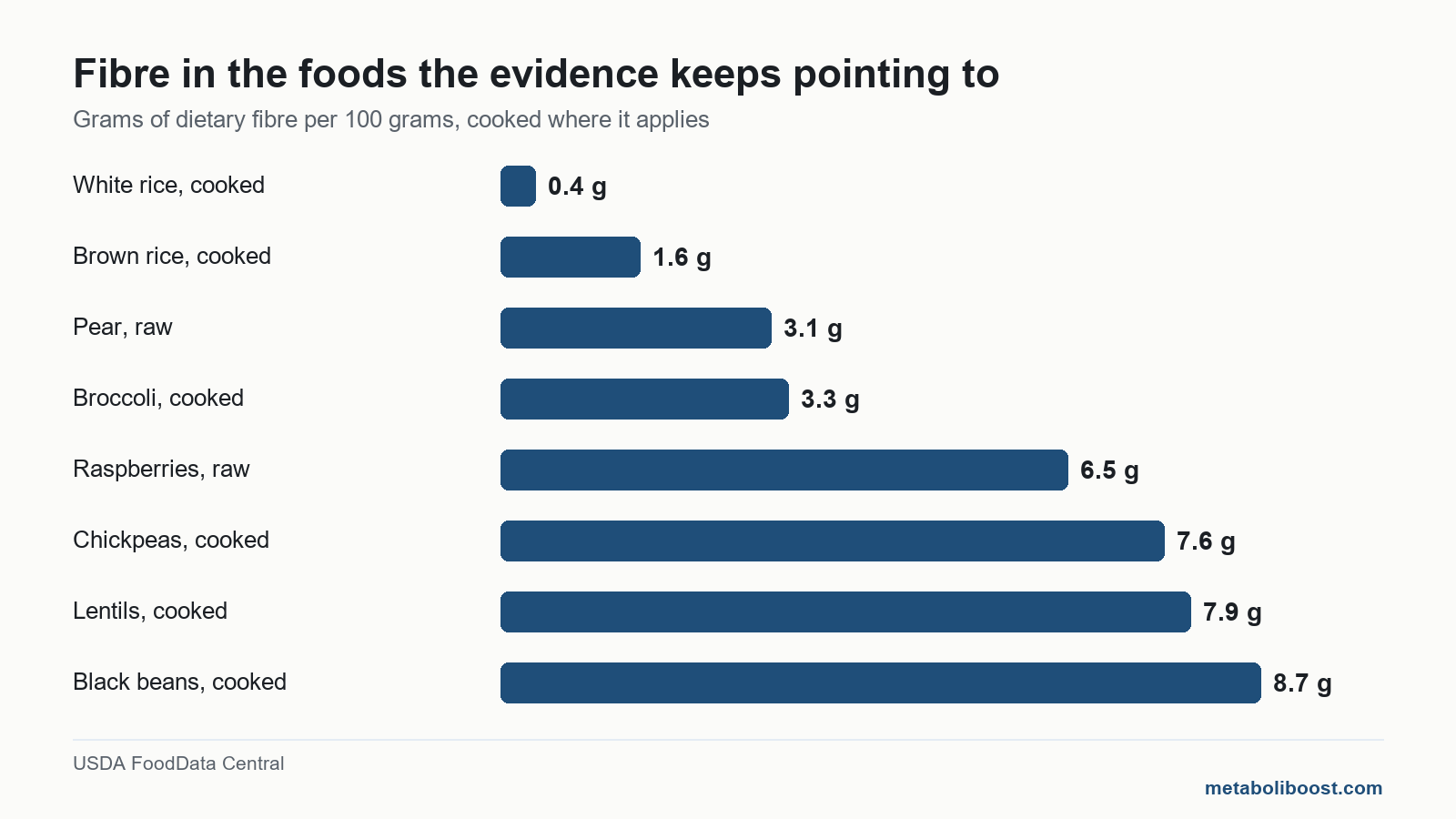
Where the fibre comes from changes how much of it lands on a plate. Per 100 grams, cooked black beans carry 8.7 grams and cooked lentils 7.9, against 1.6 for cooked brown rice and 0.4 for white rice, according to USDA FoodData Central.
What did the lentil study actually measure?
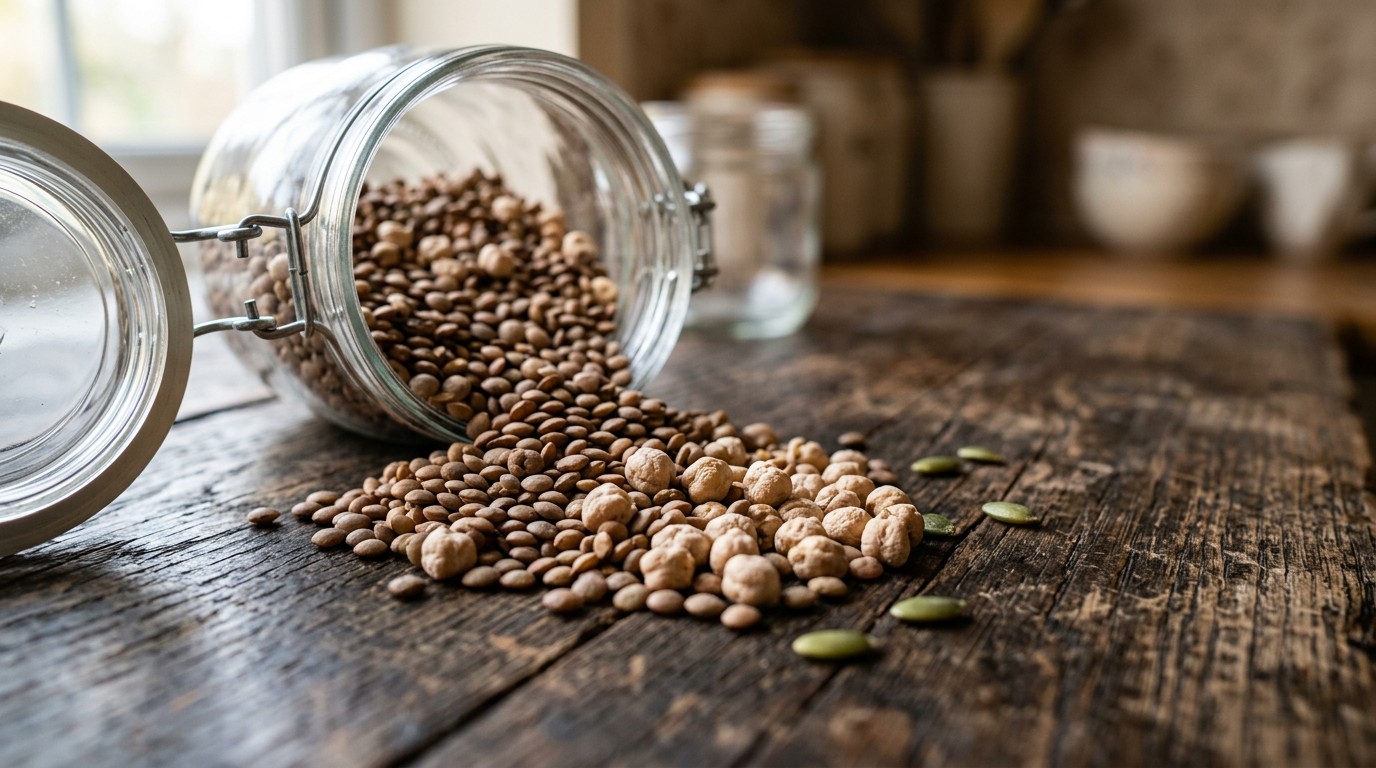
The lentil study is the one food lists love, so it is worth reading what it did. A 2018 trial in the Journal of Nutrition gave healthy adults a test meal of white rice or potato on its own, or with half the carbohydrate swapped for one of three lentil varieties, then tracked blood glucose. There were 24 people in the rice arm and 24 in the potato arm, each eating every version in turn.
Swapping in lentils lowered the glucose response by roughly 20 percent with rice and 35 percent with potato. Insulin dropped significantly with potato but not with rice. The edges matter: the volunteers were healthy, not insulin resistant, and each test was a single meal. What it supports is the swap itself, not the idea that lentils treat anything.
Does a Mediterranean diet help with insulin resistance?
The best known trial here is PREDIMED, run in Spain with adults at high cardiovascular risk. Its diabetes analysis in Annals of Internal Medicine followed 3,541 people who did not have diabetes at the start. They were assigned to a Mediterranean diet with extra virgin olive oil, the same diet with mixed nuts, or advice to eat a lower fat diet, and nobody was asked to cut calories.
New diabetes appeared at 16.0 cases per 1,000 person years in the olive oil group, 18.7 in the nut group and 23.6 on the control diet. The olive oil result was statistically significant; the nut result was not. Two cautions belong beside those numbers. The trial measured new diabetes, not insulin resistance directly. And in 2018 problems with randomisation at some sites led the main PREDIMED paper to be retracted and republished after reanalysis, which left its conclusions broadly intact but is a reason to hold any single PREDIMED number a little loosely.
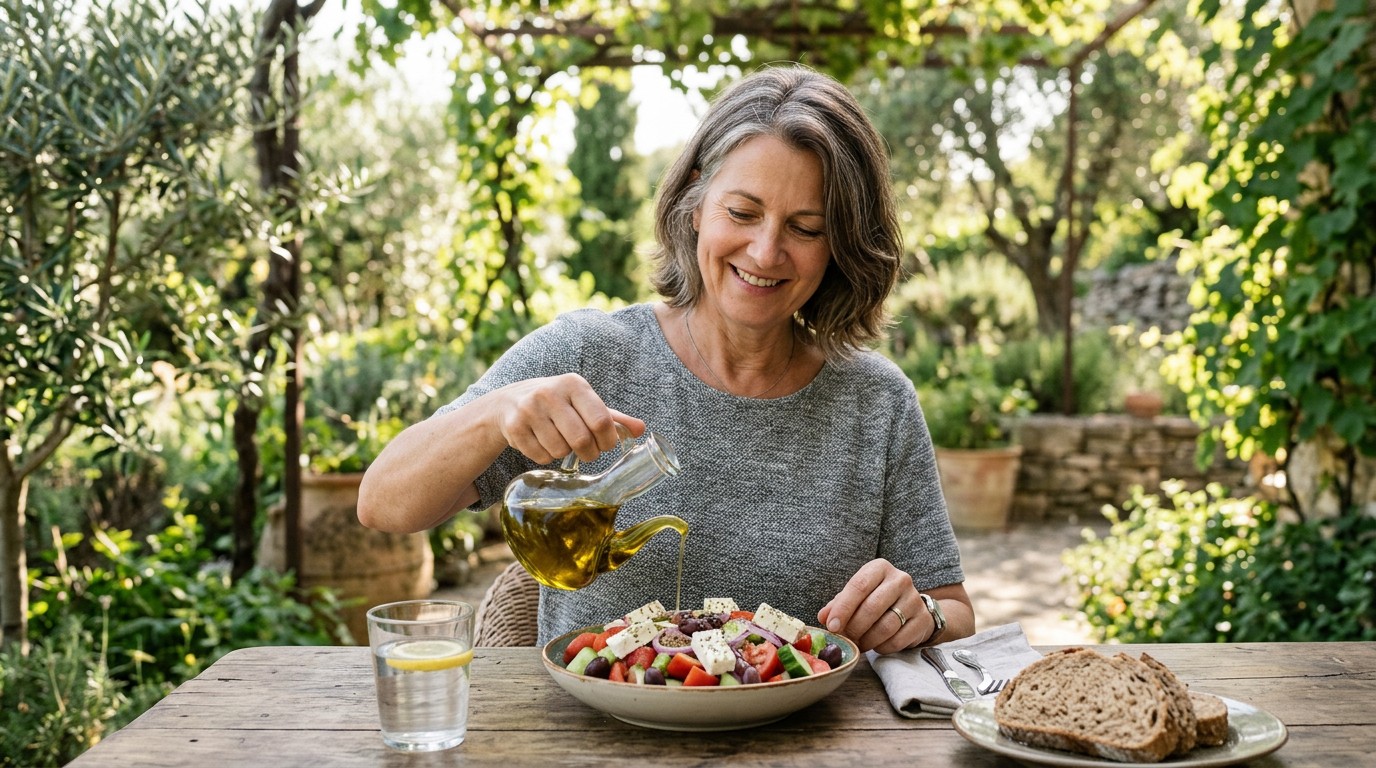
Mediterranean eating is a pattern rather than a food, which makes it hard to sell in a capsule. Our look at whether anti inflammatory foods burn fat comes at it from the inflammation side.
| Food or claim | What was measured | Who, and how many | What it found | Source |
|---|---|---|---|---|
| Higher fibre intake | Trials that raised fibre in people managing blood glucose | 42 trials, 1,789 adults with prediabetes or diabetes | Lower HbA1c, fasting glucose, fasting insulin and HOMA IR | Reynolds, PLOS Medicine 2020 |
| Lentils replacing half the rice or potato | Blood glucose after one test meal | 24 healthy adults in each arm | Glucose response about 20 percent lower with rice, 35 percent with potato | Moravek, Journal of Nutrition 2018 |
| Mediterranean diet with extra virgin olive oil | New cases of type 2 diabetes, no calorie restriction | 3,541 adults at high cardiovascular risk | 16.0 new cases per 1,000 person years against 23.6 on the control diet | PREDIMED, Annals of Internal Medicine 2014 |
| Mediterranean diet with mixed nuts | The same outcome, same trial | The same 3,541 adults | 18.7 per 1,000 person years; not a statistically significant difference | PREDIMED 2014 |
| Cinnamon capsules | HbA1c, insulin and glucose over 4 to 16 weeks | 10 trials, 577 people with diabetes | No significant difference; evidence judged insufficient | Cochrane review 2012 |
| Apple cider vinegar | Glucose measures in type 2 diabetes | 7 trials, 463 participants | Lower fasting blood sugar reported; small, short trials | Frontiers in Nutrition 2025 |
Which popular insulin resistance foods lack good evidence?
Cinnamon is the headline act of most insulin resistance lists, and it has been asked to carry far more than it can. The Cochrane review of cinnamon for diabetes pooled ten trials with 577 people and found no significant difference in HbA1c, insulin or post meal glucose, an inconclusive result for fasting glucose, and concluded that the evidence was insufficient. It remains a pleasant thing to put on porridge.
Apple cider vinegar has more to show, though less than its fans claim. A 2025 meta analysis in Frontiers in Nutrition pooled seven trials with 463 people with type 2 diabetes and reported lower fasting blood sugar. The trials were small and short, and a change in fasting sugar over weeks is not the same as reversing insulin resistance. Our earlier piece on apple cider vinegar pills explains why the pill version adds a label and removes most of the evidence.
The rest of the shelf, from bitter melon capsules to the green tea extract that promises to melt something, was not reviewed for this page, so nothing here is a verdict on any one of them. What holds across all of them is that an ingredient study is not evidence that a product works, and no capsule has outranked the plain finding that a fibre rich pattern helps. The kitchen metabolism boosters article runs the same check on ginger, chilli and green tea.
What did regulators find when supplements promised to fight insulin resistance?
Here the record is public, dated and specific, which is more than most food lists can say. In September 2021 the Federal Trade Commission sent cease and desist demands to 10 companies selling supposed diabetes treatments, issued jointly with warning letters from the Food and Drug Administration. Three records were read for this section, the FTC announcement and two of the letters dated 7 September 2021, and the pattern across them is the language of insulin resistance used as a sales pitch.
- The letter to Pharmaganics quotes marketing that said its blood sugar products would help insulin work better and cut through insulin resistance, and that one ingredient acted as a natural insulin sensitizer.
- The letter to Aceva quotes a product page that said its Sugar Balance supplement helps improve insulin sensitivity, and called it a clinically effective formula.
- The FTC announcement lists all ten companies and warns that disease claims need competent and reliable scientific evidence, with the companies given 15 days to stop.
These are regulators’ findings, not a verdict on every tub with similar words on it. But the phrases that drew the letters, insulin sensitizer, fights insulin resistance, clinically effective formula, are worth recognising on a label.
Label phrases that drew regulators’ letters
Phrases quoted in the 2021 FTC and FDA warning letters. Spotting one is a reason for caution, not proof a product is unsafe, and this site recommends no supplement, including its own.
Ticks are saved on this device only.
Where does the plate method fit, and when is a doctor the next step?
The plate method is what the CDC and the American Diabetes Association offer instead of a food list, and it is deliberately unexciting. Half of a roughly 9 inch plate is non starchy vegetables, a quarter is lean protein such as chicken, fish, eggs, tofu or beans, a quarter is carbohydrate foods, and the drink is water or something low calorie. It describes a meal, not a plan, and it carries every finding above.
Insulin resistance itself is not something a food list can confirm. The NIDDK notes that the direct test for it is used mainly in research, and that doctors usually look for prediabetes with blood tests such as A1C, fasting plasma glucose or an oral glucose tolerance test. Anyone who suspects a blood sugar problem, has symptoms such as unusual thirst or tiredness, or takes medicine that lowers blood glucose should talk to their doctor before changing how they eat, because food changes can alter how those medicines behave. Readers managing PCOS will find more in why the usual weight advice underdelivers with PCOS.
The plate method, as the CDC and ADA describe it
A way to read one meal against the published plate method. It is not a meal plan, it scores nothing, and it says nothing about your own health.
Ticks are saved on this device only. Anyone taking medicine that lowers blood glucose should talk to their doctor before changing how they eat.
Frequently asked questions
Is there one best food for insulin resistance?
No trial has identified one. The ADA guidance is built around eating patterns and fibre rich carbohydrate, and the strongest trials tested whole patterns such as the Mediterranean diet rather than single foods.
Are fruits bad for insulin resistance because they contain sugar?
Whole fruit is listed among the quality carbohydrate foods on the ADA plate method, and it brings fibre with it. The ADA advice to limit sugar applies to sugar sweetened drinks and juice, which lack that fibre.
Does eating low carb fix insulin resistance?
The ADA says there is no ideal share of calories from carbohydrate, protein or fat, and that the pattern should be based on the person’s current eating, preferences and metabolic goals.
Are rice and potatoes off limits?
The lentil trial did not remove them; it replaced half of the starch with lentils and saw a smaller glucose rise after the meal. Portion and what sits beside the starch both changed the result.
Can a supplement replace changes to food?
No supplement has shown that, and in 2021 regulators warned ten companies over diabetes and insulin sensitivity claims. This site does not recommend any supplement, including any it sells.
How would I know whether I have insulin resistance?
Only a clinician can say. The NIDDK notes the direct test is mainly a research tool, and doctors usually check for prediabetes with blood tests such as A1C or fasting plasma glucose.
Finished the page? The same five questions from the top, to see what stuck.
This article is general information, not medical advice, and is not a substitute for care from a qualified healthcare professional. Speak to your doctor about your own situation.
Leave a Reply