
Every calorie loss calculator walking page runs the same sum: a MET value for the pace, times body weight in kilograms, times hours. For a 70 kg adult, 30 minutes at about 3 mph comes to roughly 133 kcal in total, of which about 98 is extra to what the body burns at rest. The honest number is small.
Listen to this article, about 12 minutes. A synthetic voice reads the article and announces each section title as it begins; tables are read row by row and the questions at the end are left out.
Recorded 3 October 2026 from the article as published that day. Press a chapter to jump there; the highlighted line is what is playing. A play button sits beside every section heading, and once you scroll past this player a bar at the bottom of the screen keeps the controls in reach. Tap or click any sentence to hear the reading start from there.
On this page: the Compendium MET value for every walking pace turned into calories with the multiplication shown, a calculator that splits total from extra to rest, and five forum accounts on how far trackers drift.
Think you already know this? Five questions, one minute.
Every answer is on this page. Answer from what you know now; the page fills in the rest.
-
1. In the Compendium, what does one MET equal?
The 2024 Adult Compendium defines one MET as 1 kcal per kilogram per hour, so the sum is MET x weight x hours. Read the section
-
2. Which pace band does the Compendium label brisk?
The Compendium walking codes keep brisk for 3.5 to 3.9 mph at 4.8 MET and file 2.8 to 3.4 mph as moderate, while the NHS calls about 3 mph brisk. Read the section
-
3. For a 70 kg adult walking 30 minutes at 3.8 MET, roughly how much of the 133 kcal total is extra to rest?
One MET over 30 minutes at 70 kg is 35 kcal the body would burn anyway, so 133 minus 35 leaves about 98, using the Compendium values. Read the section
-
4. In the Stanford test of seven wrist worn devices, how did the best device do on energy expenditure?
Shcherbina and colleagues found median errors from 27 percent to 93 percent, with no device below 20 percent. Read the section
-
5. What did the Annals of Family Medicine meta-analysis of pedometer walking programmes exclude?
The meta-analysis of 9 studies excluded diet changes so the effect was walking alone, and described the result as modest. Read the section
Most walking calculators hand over a single confident number and keep the working to themselves. This page shows the working, because once the arithmetic is visible two things become obvious: the number depends heavily on which pace label gets ticked, and it is rather smaller than the fitness industry would like it to be. Neither is a reason not to walk. Both are reasons not to plan dinner around a watch.
How does a walking calorie calculator actually work?
Underneath the sliders, nearly every one uses the same reference book. The 2024 Adult Compendium of Physical Activities, published by Herrmann, Ainsworth and colleagues in the Journal of Sport and Health Science, lists energy costs for 1,114 activities as METs. One MET is defined as 1 kcal per kilogram of body weight per hour, roughly the cost of sitting still.
So the sum is: MET times weight in kilograms times hours. Take a 70 kg adult walking for 30 minutes at between 2.8 and 3.4 mph, which the Compendium’s walking codes rate at 3.8 MET. That is 3.8 times 70 times 0.5, or 133 kcal. Change the weight and the answer moves in proportion: the same walk at 90 kg is 3.8 times 90 times 0.5, or 171 kcal. There is no hidden metabolism score in it, and no calculator that asks only for steps can know the pace, so it is guessing one.
Two cautions sit inside the formula. The MET values are averages measured in adults aged 19 to 59, and a separate Older Adult Compendium was published for people aged 60 and over because energy costs differ with age. And the result is an estimate for a typical body, not a measurement of any one person. For how the same kind of averaging works for resting energy, see the step by step BMR formula.
How many calories does 30 minutes of walking burn at each pace?
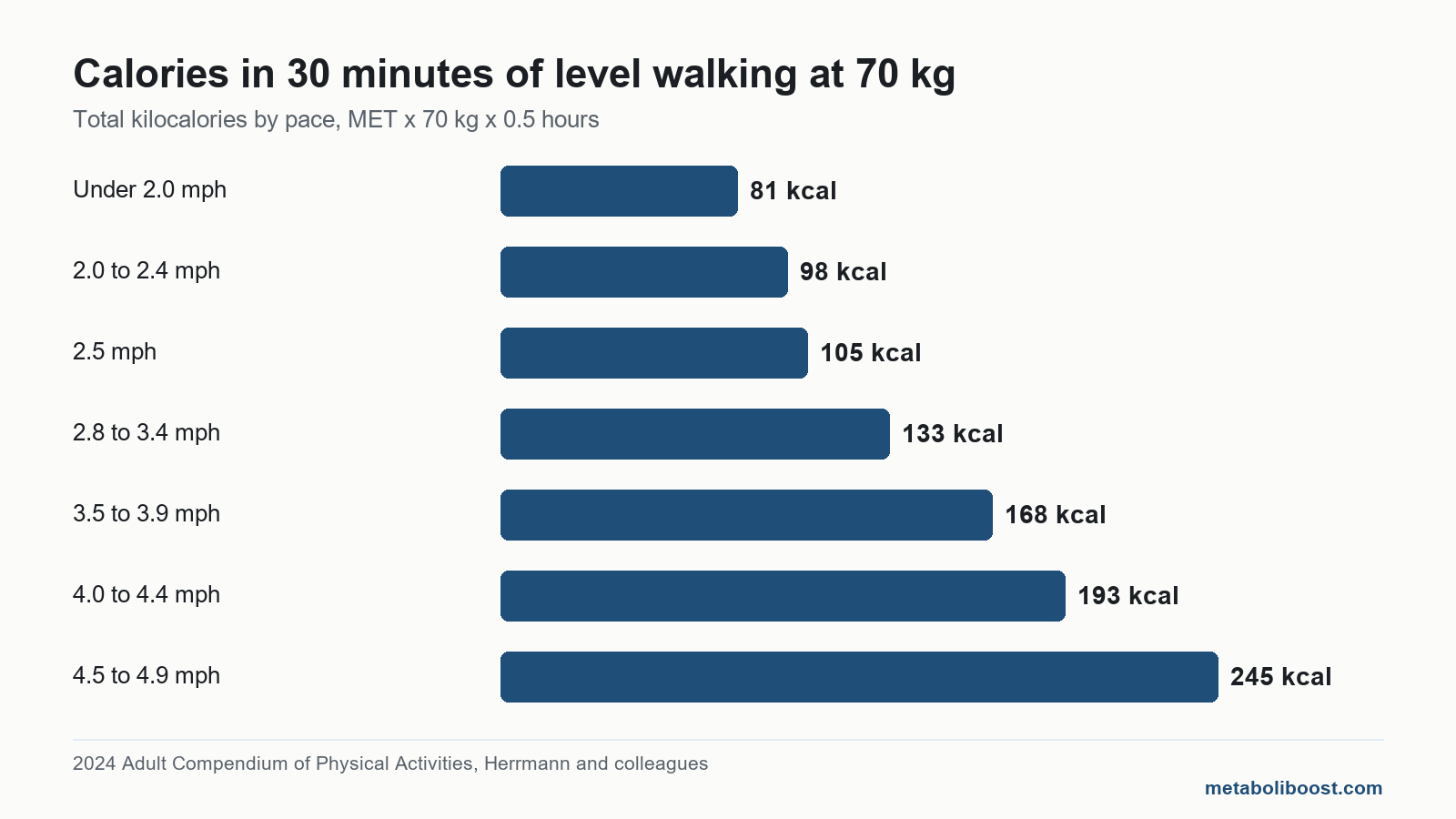
Here is the full ladder for level, firm ground at 70 kg. The jump that matters most is between the moderate and brisk bands, and it hides a labelling trap. The NHS describes a brisk walk as about 3 mph, a pace at which talking is possible but singing is not. The Compendium files 3 mph under moderate, at 3.8 MET, and keeps the word brisk for 3.5 to 3.9 mph, at 4.8 MET. Tick brisk in a calculator after an NHS brisk walk and the total comes out about a quarter too high, 168 kcal instead of 133.
| Pace, level ground | MET | Total kcal in 30 min, 70 kg | Extra to rest, kcal | Compendium code |
|---|---|---|---|---|
| Strolling, under 2.0 mph | 2.3 | 81 | 46 | 17151 |
| Slow, 2.0 to 2.4 mph | 2.8 | 98 | 63 | 17152 |
| 2.5 mph | 3.0 | 105 | 70 | 17170 |
| Moderate, 2.8 to 3.4 mph | 3.8 | 133 | 98 | 17190 |
| Brisk, 3.5 to 3.9 mph | 4.8 | 168 | 133 | 17200 |
| Very brisk, 4.0 to 4.4 mph | 5.5 | 193 | 158 | 17220 |
| Very, very brisk, 4.5 to 4.9 mph | 7.0 | 245 | 210 | 17230 |
Hills change the picture more than speed does. The Compendium rates uphill walking at a 1 to 5 percent grade at 5.3 MET and a 6 to 10 percent grade at 7.0 MET, so a steady incline at a moderate pace can cost as much as a very fast walk on the flat. A treadmill set to zero incline on a gym floor is about as flat as walking gets.

Why does the net figure matter more than the gross one?
Because the body was going to burn something anyway. A 70 kg adult sitting on the sofa for those same 30 minutes uses about 35 kcal, one MET. A gross figure counts that 35 as if the walk produced it; a net figure subtracts it. On a short brisk walk the difference is modest. On a two hour stroll at 2.3 MET it is the difference between 322 kcal gross and 182 kcal net, which is why slow, long walks are where calculators flatter most.
Speed also matters less per mile than per minute. Working the Compendium numbers through at 70 kg, a mile at 2.5 mph costs about 56 kcal net, a mile at around 3.1 mph about 63, and a mile at around 3.7 mph about 72. Walking faster gets the mile done sooner and costs somewhat more, but the distance is doing most of the work. Step counts are commonly quoted at around 2,000 a mile, though stride length varies enough that no calculator can know an individual’s figure without measuring it, and that conversion could not be confirmed against an official source.
Run the walking arithmetic on your own numbers
This multiplies a Compendium MET value by body weight and time, exactly as worked through above, and shows both the total and the part extra to rest. It is a population estimate, not a measurement, and it gives no target, no deficit and no timeline.
MET values from the 2024 Adult Compendium of Physical Activities, for adults aged 19 to 59. Wrist trackers and treadmills estimate the same quantity with their own errors.
How accurate are watch and treadmill walking calories?
Less accurate than the confident decimal suggests. A Stanford team led by Shcherbina tested seven wrist worn devices against measured energy expenditure, including walking. No device achieved an error below 20 percent, and median errors ranged from 27 percent for the best performer to 93 percent for the worst. The authors concluded the devices measured heart rate reasonably well but estimated energy expenditure poorly.
Treadmill consoles and phone apps were not part of that study, and whatever method they use, they still need a pace, a slope and a body weight that is right. A tracker’s number is best read as a rough estimate built on the same kind of sum shown here, with the sensor’s own uncertainty on top.
What do people comparing their tracker with the scale report?
This section reports what people say, not what was measured. One MyFitnessPal community thread from May 2024, on a Fitbit Charge 6 overestimating calories, carries five accounts worth summarising; two older threads from 2018 and 2021 said much the same but are too old to describe current devices and are left out.
The original poster reported the new tracker putting their total daily burn near 2,900 kcal, against roughly 2,400 from the Garmin they had worn before, for the same days of mostly indoor walking. A second member described every calorie burning gadget as an educated guess at best and preferred fixing a daily figure and reviewing it after a month. A third said their Garmin did better than their old Fitbit for most exercise, but that walking was still grossly overstated.
Two accounts cut the other way. One member said their Garmin underestimated their total burn, which they had confirmed with a spreadsheet of tracker data against regular weigh ins. Another said no device had ever been accurate for them, some over and some under, and that the useful skill was learning which way a given device leaned. That range matches the Stanford result closely: the error is large, and it does not always point the same way.
What did the walking trials actually find?
They found walking helps, modestly. A meta-analysis of pedometer based walking programmes in the Annals of Family Medicine pooled 9 studies with 307 participants, 73 percent of them women, lasting from 4 weeks to a year with a median of 16 weeks. Studies with a diet change were excluded, so the effect was walking alone. People added from just under 2,000 to over 4,000 steps a day. The authors summed it up as a modest amount of weight loss, with longer programmes producing more than shorter ones.
Why only modest? An energy balance analysis by Thomas, Bouchard, Church and colleagues in Obesity Reviews looked at 15 aerobic exercise interventions and found results usually came in below what the exercise calories predicted. Their explanation was mainly two things: the prescribed exercise dose was low to begin with, and people ate a little more. Walking does not stop working; the body and the kitchen quietly adjust around it.
None of that makes walking a poor choice. It means the case for it rests on more than the calorie sum, and the arithmetic in this article is the reason a routine like a simple daily walking routine is worth judging over months rather than per outing.
Why does this calculator stop at calories and not pounds?
Because the step from calories to pounds is where most calculators stop being honest. The usual conversion divides by 3,500 kcal a pound, and the paper Why is the 3500 kcal per pound weight loss rule wrong? sets out how that rule overstates change over time, because the body’s own energy use falls as weight does. Add the compensation found in the trials and any pounds figure attached to a walk is a guess dressed as a result.
The figures on this page are about energy, and energy is only one side of the ledger. How the other side behaves is covered in what the studies found behind a weight loss plateau, and how calculators disagree on daily needs is in why calorie deficit formulas keep disagreeing.
Anyone with a heart condition, joint problems, diabetes, or a condition that makes exertion risky should check with a GP before starting a new walking programme or making it much harder. Chest pain, unusual breathlessness or dizziness while walking is a reason to stop and seek medical advice.
Nothing sold as a calorie booster, from fat burners to detox teas, changes the MET value of a walk, and this site does not recommend any supplement, including the site’s own. The honest answer to what a walk burns is: it depends on weight, pace, slope and minutes, and this page shows the sum.
Frequently asked questions
Why do two walking calculators give different answers for the same walk?
Usually because one reports gross calories and the other net, or because they map the same pace to different MET values. A 3 mph walk filed as brisk rather than moderate adds about a quarter to the total.
Does a heavier person burn more on the same walk?
Yes. The formula multiplies the MET value by body weight, so at the same pace and time the estimate rises in direct proportion to weight. That is a property of the formula, not a measured fact about any one person.
Does walking uphill change the numbers much?
It can. The 2024 Compendium rates walking on a 6 to 10 percent grade at 7.0 MET, against 3.8 MET for a moderate pace on the flat, so a steady hill can nearly double the estimate.
Is the calorie figure different for people over 60?
The standard values come from adults aged 19 to 59. A separate Older Adult Compendium was published because energy costs differ with age, so a standard calculator may misjudge older walkers.
Do steps from a phone count the same as a planned walk?
Every step costs energy, but a step counter does not know the pace or slope, so the calories it attaches are an assumption. Pottering steps around the house sit at the slow end of the table.
Is walking worth doing if the calorie number is small?
The trials found walking programmes produced modest changes on their own, and walking carries benefits beyond energy balance. The small number argues against overeating on the strength of it, not against walking.
Finished the page? The same five questions from the top, to see what stuck.
This article is general information, not medical advice, and is not a substitute for care from a qualified healthcare professional. Speak to your doctor about your own situation.
Leave a Reply