
Most online tools run the same calorie deficit formula: a fixed 3,500 calories per pound, borrowed from a 1958 estimate that assumes your body holds still while you diet. It does not. Real weight loss slows as you lose it, which is why two calculators, and your own experience, rarely agree.
Listen to this article, about 9 minutes. A synthetic voice reads the article and announces each section title as it begins; tables are read row by row and the questions at the end are left out.
Recorded 1 October 2026 from the article as published that day. Press a chapter to jump there; the highlighted line is what is playing. A play button sits beside every section heading, and once you scroll past this player a bar at the bottom of the screen keeps the controls in reach. Tap or click any sentence to hear the reading start from there.
On this page: the exact arithmetic behind the number every calculator shows you, the 1958 assumption it rests on, a documented error in a national health calculator, and a worked comparison of what a static formula predicts against what NIH’s own dynamic model predicts for the same person.
Think you already know this? Five questions, one minute.
Every answer is on this page. Answer from what you know now; the page fills in the rest.
-
1. What is the actual arithmetic behind the “500 calories a day equals a pound a week” line?
It is simple arithmetic, not a measurement: multiply the daily calorie cut by seven and divide by 3,500, the estimate Today’s Dietitian traces to physician Max Wishnofsky in 1958. Read the section
-
2. What assumption produced Wishnofsky’s original 3,500 figure?
Today’s Dietitian’s account of the 1958 calculation describes the 87 percent fat assumption behind the number, a qualified estimate that lost its qualifications over decades of retelling. Read the section
-
3. What did a 2023 Lancet correspondence report about NHS England’s own calorie calculator?
A researcher wrote to The Lancet, indexed on PubMed, flagging an error in how NHS England’s tool applied activity level to its calorie output, which NHS England acknowledged. Read the section
-
4. In the worked comparison Today’s Dietitian reported, the static 3,500-calorie rule predicted 23 pounds lost in four months. How long did the NIH dynamic model predict for the same 23 pounds?
Today’s Dietitian’s comparison put the dynamic model’s estimate at roughly a year, more than double the static rule’s four months, for an identical 500-calorie daily cut. Hall and Chow explain why: the static rule never lets the deficit shrink as the body does. Read the section
-
5. What does this article say is the most reliable way to correct a calculator’s estimate?
No formula can account for an individual’s adherence or metabolism, so the most useful check is a reader’s own tracked data over time, the method set out in how to take consistent measurements. Read the section
What Formula Do Most Calorie Deficit Calculators Actually Use?
Type a number into almost any weight loss calculator and, underneath the friendly interface, it is running one piece of arithmetic: take a calorie deficit, multiply it by seven, divide by 3,500, and call the answer pounds a week. Cut 500 calories a day and the formula returns one pound. Cut 250 and it returns half a pound. That is the entire calorie deficit formula behind the “500 a day, a pound a week” line that shows up in almost every diet article written since, including one or two on this site before this piece was written. It is a unit conversion, not a measurement of your body, and it was never meant to be either.
The other half of the sum, working out how many calories you burn to begin with, is a separate and equally rough piece of arithmetic, covered at length in what a bmr calculator actually computes and why five published equations gave one woman five different numbers. This article is about what happens after that number exists, once a reader has a stated deficit in hand and wants to know what it is supposed to do.
Where Did the 3,500-Calorie Number Come From?
The figure is not a law of physics. It is a rounded estimate credited to physician Max Wishnofsky in 1958, who reasoned that a pound of human adipose tissue is roughly 87 percent fat, and that fat carries about 9.5 calories a gram, which lands close to 3,500 after rounding, as Today’s Dietitian’s account of the original calculation explains. Wishnofsky attached a caveat to his own number: it assumed steady, modest weight change in an otherwise stable body, and did not hold during fasting or the days right after one. That qualifier did not survive seventy years of being copied from one diet plan to the next, and today it survives in a hundred calculators as a bare constant, the diet world’s oldest game of telephone.
Why Do Two Calculators Give Different Numbers for the Same Person?

Ask the internet for a calorie deficit and you will get more than one kind of answer, because the question gets answered in more than one way. A national health service style calculator tends to work from a population level guideline, a deficit of a few hundred calories a day off an estimated maintenance figure. A popular tracking app instead asks the reader to pick a rate of loss, a pound or two a week, and works backward to whatever deficit that implies against its own maintenance formula. Those are not the same question, and the gap between the two answers can be large enough to look like one of them must be broken.
Sometimes one of them is. In March 2023 a UK obesity researcher wrote to The Lancet to flag an error in NHS England’s own BMI linked calorie tool, where the daily calorie figure it returned did not correctly account for the physical activity level the user had entered. The health service acknowledged the fault. The exact scale of the miscalculation is not detailed in what this research could reach without a subscription, so treat that part as reported rather than confirmed here, but the underlying point survives regardless: a national health calculator can be wrong for a stretch of time and nobody sees it happen, because the arithmetic is invisible to the person typing in their height and weight.
The disagreement shows up in reader accounts too, not just in a correction notice. One searcher on the Weight Loss Support community on HealthUnlocked reported that a popular tracking app had set a daily target of 1,320 calories, while the NHS’s own calculator for the same body suggested a range of 1,779 to 2,288 calories, a gap of several hundred calories with no obvious way to tell which one to believe. A second, separate post in the same community reported a near identical mismatch: 1,280 calories from the app against 1,700 to 2,100 from that same calculator. Neither post carries a date this research could confirm against the live page, so read them as recent community reports rather than dated to the day. What both threads settle on, once other members weigh in, is not that one calculator is broken, but that the two were never answering the same question: one is a general population guideline, the other is a specific instruction tuned to a chosen rate of loss, and mixing the two numbers together is where the confusion usually starts.
Does the 3,500-Calorie Rule Actually Predict What Happens?
Even inside a single calculator that applies the rule honestly, the arithmetic still gets the timeline wrong, and this is the part that has actually been tested. NIH metabolism researcher Kevin Hall and mathematician Carson Chow published a direct rebuttal of the constant in the International Journal of Obesity, arguing that its worst error is not the number 3,500 itself but the assumption that a deficit stays the same size for as long as someone diets. Hall and Chow’s letter points out that a lighter body needs fewer calories to run itself, so the same eaten amount produces a shrinking deficit as weight comes off, and a formula that never adjusts for that will keep predicting a straight line long after the real curve has bent.
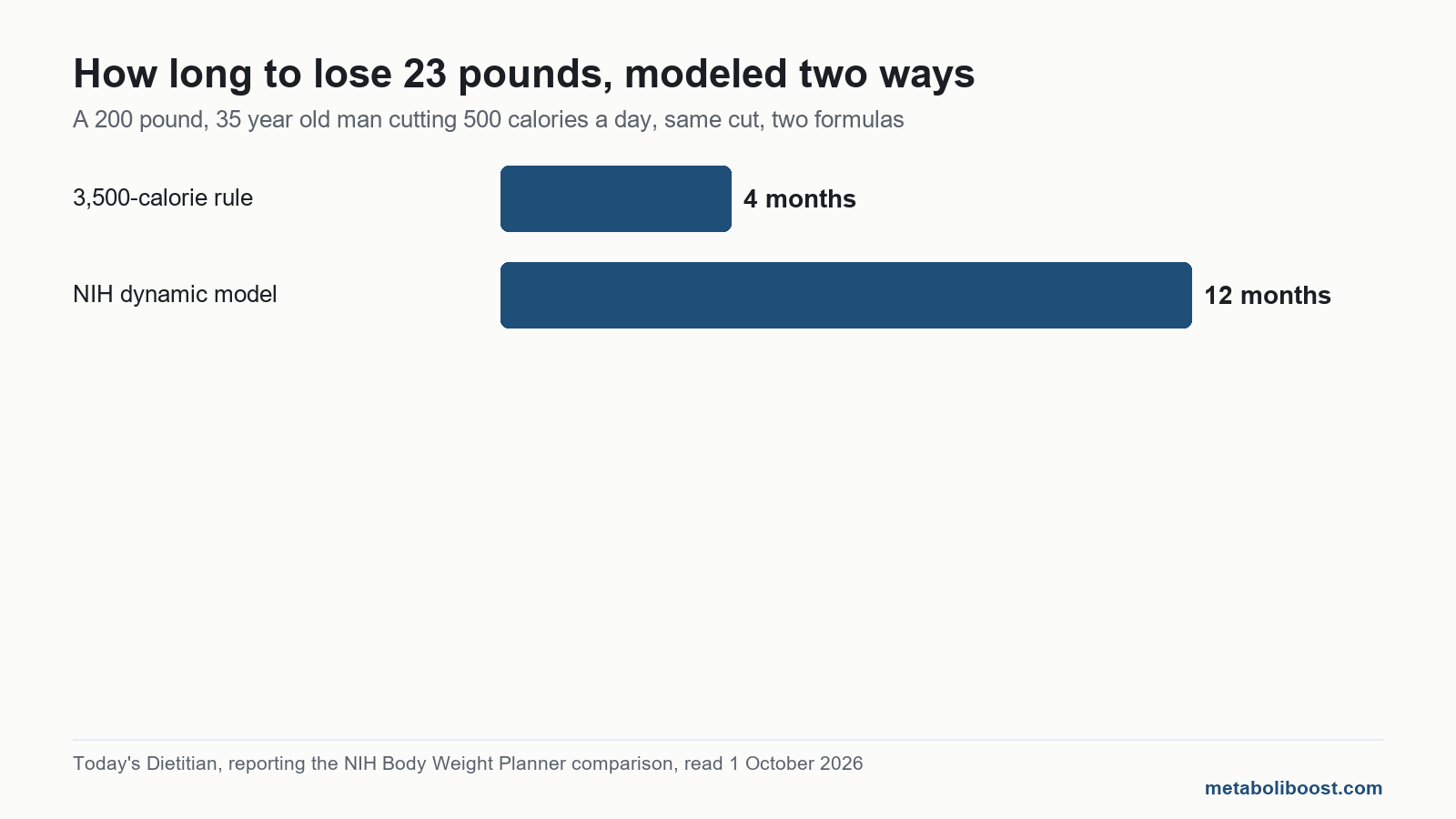
Hall’s group built the alternative: a dynamic model, now offered publicly as the NIH Body Weight Planner, that recalculates the deficit as the body changes rather than assuming it holds still. Today’s Dietitian ran exactly that comparison: a 200 pound, 35 year old man cutting 500 calories a day was projected by the static 3,500 rule to lose 23 pounds in four months, while the dynamic model put the same 23 pounds at roughly a year, more than double the wait for an identical daily cut.
The gap between arithmetic and outcome shows up outside the research literature too. On the Cronometer community forum in March 2025, a user on a stated 1,250 calorie a day plan wrote that the app’s own projection had promised a loss of about 1.5 pounds a week, and that a full month in, the scale had not moved. A moderator with dietetics credentials answered, but not with metabolic adaptation as the explanation: the more likely culprit, they said, was that food logging understates what is actually eaten while exercise trackers overstate what is burned, so the real deficit was smaller than the number on the screen long before any adaptation had the chance to matter. Both things can be true at once, an optimistic constant and an optimistic log, and a reader who blames only the formula is usually missing half of the answer.
What Does a More Honest Calorie Deficit Formula Look Like?

No formula that fits in a calculator can account for a reader’s actual adherence, their starting body composition, their sex, their age or how their particular metabolism responds to being underfed, so none of the numbers above, the static constant or the dynamic model, should be read as a promise. The most useful thing a reader can do with either one is treat it as a starting estimate, expect the real rate to run slower than the arithmetic suggests, and correct the estimate against their own tracked weight over several weeks rather than trusting either number outright, the approach this site sets out in how to take consistent measurements.
The tool below shows exactly what the static formula is doing with your own numbers, not because that arithmetic should decide anything, but so the assumption sitting underneath a calculator’s headline figure stops being invisible.
See the naive 3,500-calorie arithmetic on your own number
Enter a daily calorie reduction you are considering, just to see what the old rule does with it. This does not tell you what deficit to use, and it does not predict how long anything will actually take: the research above shows that real weight loss runs slower than this arithmetic and keeps slowing as it goes.
This is the 1958 static rule only, shown so its assumption stops being invisible. It is not a forecast, a target or a timeline, and it says nothing about what your own body will actually do.
The Static Rule Against the Dynamic Model
| The 3,500-calorie rule | The NIH dynamic model | |
|---|---|---|
| What it assumes | One pound of change always costs 3,500 kcal, no matter how far into the diet | The energy cost per pound and the size of the deficit both shift as weight and composition change |
| Does it slow down over time | No, it predicts a straight line to any target | Yes, it models the slowdown and a longer plateau |
| What it is good for | A quick, one line conversion of a stated deficit into a weekly figure | A closer forecast of how long a sustained deficit will actually take |
| Where it comes from | Max Wishnofsky, 1958, a single body composition assumption | Kevin Hall and colleagues’ published metabolic model, checked against controlled feeding studies |
Frequently asked questions
Is the 3,500-calorie rule completely wrong?
Not the number itself, which is a reasonable estimate of the energy stored in a pound of body fat. The error is treating that number as fixed for the length of a diet. Hall and Chow made exactly this distinction in their published critique, and it is why calculators built on the rule alone predict a straight line that real bodies do not follow.
Why does my fitness app disagree with a national health calculator?
They are usually answering different questions. A clinical or NHS style calculator tends to suggest a modest, population level deficit, while a consumer app asks you to choose a target rate of loss and works backward to a larger number from its own maintenance formula. Comparing the two outputs without checking what each one assumed is where the confusion usually starts.
Does the NIH Body Weight Planner give me a diet plan?
It models how weight is likely to change under different calorie and activity inputs, using the dynamic model published by Kevin Hall’s group, but it is general information rather than a personal plan, and it does not replace advice from your own doctor or a registered dietitian, particularly if a medical condition affects your weight.
What is TDEE, and why does it matter here?
TDEE, total daily energy expenditure, is the maintenance number a calorie deficit gets subtracted from. It is estimated with its own separate formula, and any error in that estimate carries straight through to whatever deficit figure a calculator hands you next, before the 3,500 rule even enters the picture.
Does a bigger calorie deficit always mean faster fat loss?
Not reliably, and not safely. A larger deficit raises the risk of losing lean muscle along with fat and makes a diet harder to sustain, and the size of an appropriate deficit is a question for a doctor or registered dietitian who knows your health history, not a number a web page should hand you.
Should I trust the exact number a calculator gives me?
Treat it as a rough starting estimate rather than a fact about your body. The most reliable correction is not a better formula but your own tracked weight over several weeks, compared honestly against what you actually ate, which is closer to what the forum accounts on this page describe than any single calculator output.
Finished the page? The same five questions from the top, to see what stuck.
This article is general information, not medical advice, and is not a substitute for care from a qualified healthcare professional. Speak to your doctor about your own situation.
Leave a Reply