
A bmr calculator estimates the energy your body uses at complete rest, using an equation built from population data, not a measurement of you specifically. The formula behind most of them, Mifflin-St Jeor, predicts resting energy within 10 percent of a lab measurement for a majority of people, though how large that majority is depends heavily on who was tested.
Listen to this article, about 9 minutes. A synthetic voice reads the article and announces each section title as it begins; tables are read row by row and the questions at the end are left out.
Recorded 29 September 2026 from the article as published that day. Press a chapter to jump there; the highlighted line is what is playing. A play button sits beside every section heading, and once you scroll past this player a bar at the bottom of the screen keeps the controls in reach. Tap or click any sentence to hear the reading start from there.
On this page: the Mifflin-St Jeor formula worked line by line on a real example, its 2025 validation numbers, what the rest of your daily energy is made of, and two Cronometer forum threads on what goes wrong when people distrust the number.
Think you already know this? Five questions, one minute.
Every answer is on this page. Answer from what you know now; the page fills in the rest.
-
1. What does an online bmr calculator actually estimate, technically speaking?
True BMR requires an overnight fast, a night of sleep and lab conditions. A calculator produces the resting metabolic rate version instead, the practical estimate described in the National Academies’ Dietary Reference Intakes report. Read the section
-
2. For a woman of 38, 165 centimetres and 70 kilograms, what does the Mifflin-St Jeor formula estimate her resting energy at?
9.99 times 70, plus 6.25 times 165, minus 4.92 times 38, minus 161, comes to 1,383 calories a day, using the coefficients from the original 1990 equation16698-6/abstract). Read the section
-
3. In a 2025 study of 148 young women, how often did Mifflin-St Jeor land within 10 percent of their measured resting energy?
Haroun and colleagues, 2025 report 60.1 percent for Mifflin St Jeor against 44.6 percent for Harris Benedict in the same 148 women. Read the section
-
4. According to the National Academies’ Dietary Reference Intakes report, roughly what share of total daily energy does resting metabolism account for?
The National Academies’ report sets resting metabolism at about 60 to 70 percent of total daily energy use, with physical activity making up the most variable share. Read the section
-
5. In the Cronometer forum thread, what did a registered dietitian tell a user who was manually lowering their BMR figure to try to match their weight loss?
In the January 2022 thread, the dietitian posting as Susan_RD_101 said BMR is an estimate from age, sex and body size, not something to tune, and warned that eating under it can itself slow measured metabolic rate. Read the section
What Does a BMR Calculator Actually Measure?
Type an age, a height and a weight into a bmr calculator and it does not measure anything. It runs those numbers through a published equation, one built by fitting a formula to how much energy several hundred real people burned lying still in a lab, then predicting yours from the same pattern. Basal metabolic rate, in its strict sense, is measured after an overnight fast, eight hours of sleep and total physical rest. What an online calculator actually produces is closer to resting metabolic rate: the energy used lying quietly awake, without that lab preparation, which runs slightly higher than true BMR and is the version any web page can realistically ask for.
| Term | What it is | How it is actually found |
|---|---|---|
| BMR | Energy used at complete rest: post fast, post sleep, no movement | Measured in a lab with indirect calorimetry under strict conditions |
| RMR | Energy used at rest under ordinary, less strict conditions | Measured with the same equipment more practically, or estimated with a formula such as Mifflin-St Jeor |
| TDEE | Everything burned in a day: resting energy, digesting food, and moving | Estimated by multiplying an RMR estimate by an activity multiplier; never measured directly by a calculator |

The Mifflin-St Jeor Formula, Worked Out Step by Step
Mifflin and colleagues published the equation in 1990, derived from 498 adults aged 19 to 78 with a range of body sizes. It comes in two lines, one per sex, and every coefficient is fixed:
Women: 9.99 times weight in kilograms, plus 6.25 times height in centimetres, minus 4.92 times age in years, minus 161.
Men: the same three terms, plus 5 instead of minus 161.
Take a woman of 38, 165 centimetres, 70 kilograms, as a worked example. 9.99 times 70 is 699.3. 6.25 times 165 is 1,031.25. Add those: 1,730.55. 4.92 times 38 is 186.96; subtract it: 1,543.59. Subtract 161 and the estimate lands at 1,383 calories a day. That is the whole calculation. No calculator is doing anything more sophisticated than this arithmetic on your own numbers, which the tool further down this page shows for whatever you enter.
Most calculators round the coefficients to 10, 6.25 and 5 rather than 9.99, 6.25 and 4.92. Run the same woman through the rounded version and the answer moves to 1,380, a difference of about 2 calories. The rounding some sites use is not something worth worrying about; the equation itself, and who it was built on, matters far more.
Run the Mifflin-St Jeor formula on your own numbers
This shows the arithmetic step by step, exactly as worked through above. It is a population estimate of resting energy, not a measurement of you, and it does not produce a calorie target, a deficit or a timeline.
Resting energy only, from the published Mifflin-St Jeor coefficients. Activity, food and everything else in your day sits on top of this number.
How Accurate Is the Number? What the Validation Study Found
Accuracy here means something specific: how often the formula’s prediction lands within 10 percent of what a person’s resting energy actually measures on indirect calorimetry, the lab standard. Haroun and colleagues, publishing in Archives of Public Health in September 2025, tested nine prediction equations against measured resting energy in 148 women aged 17 to 27. Mifflin-St Jeor landed within 10 percent for 60.1 percent of the group, the best result of the equations tested; Harris-Benedict, the older formula many calculators still offer, managed 44.6 percent.
Read that the honest way: the best commonly used equation still missed by more than 10 percent for around 4 in 10 women in that study. It is commonly reported, going back to a widely cited 2005 systematic review in the Journal of the American Dietetic Association, that Mifflin-St Jeor performs at least as well as the older alternatives across most populations it has been tested on; the exact hit rate moves with who was studied, so treat any single percentage, this one included, as a property of that study’s group rather than a guarantee for any one reader.
What Makes Up Your Total Daily Energy Use, Beyond BMR?
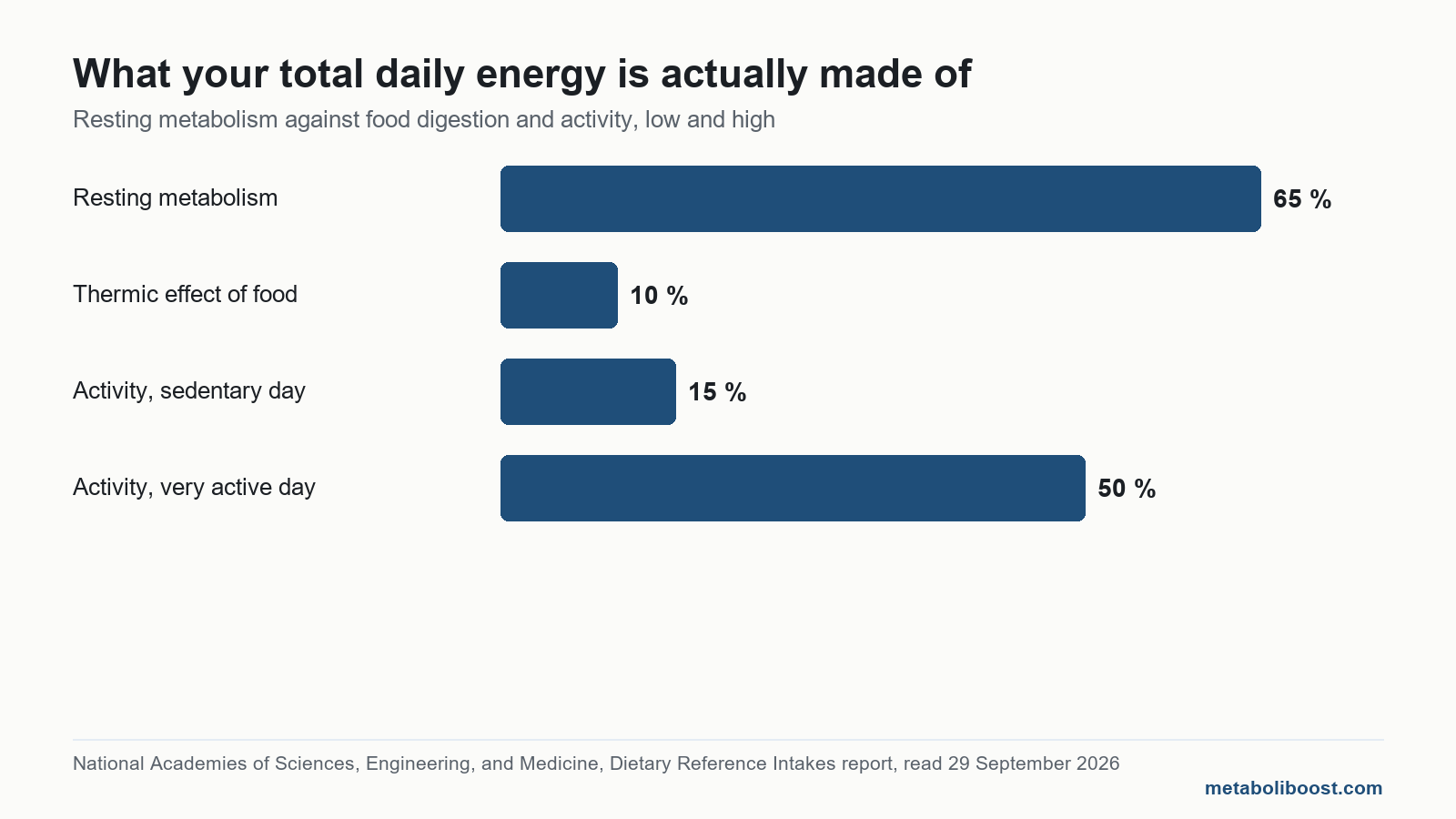
Resting energy is the largest share of what you burn in a day, but it is not the whole figure, and a bmr calculator only ever gives you the resting piece. The National Academies’ Dietary Reference Intakes report sets resting metabolism at roughly 60 to 70 percent of total daily energy use, the thermic effect of digesting food at around 10 percent, and physical activity at anywhere from about 15 percent in a sedentary day to 50 percent or more in a genuinely active one.
That last figure is the one that actually moves. Resting metabolism for a given body is fairly fixed from one day to the next; what you do with the rest of the day is not, and it is the largest lever anyone actually controls.

Why Do Two Calculators Give You Two Different Numbers?
Usually for one of three reasons. Different sites run different base equations: Mifflin-St Jeor, the older Harris-Benedict, or Katch-McArdle, which needs a body fat percentage most people are guessing at. Different sites also apply different activity multipliers to the same vague question about how much you exercise, and that single choice can move the final figure by hundreds of calories. And every equation carries its own error margin on top, the kind the validation study above describes. A companion piece on this site, the free calorie deficit calculator explainer, runs one profile through five published equations side by side and shows the spread in full.
What Do People Who Have Used a BMR Calculator Actually Report?
Two accounts from the Cronometer community forum, both public, dated and attributed by username, show the same pattern in different forms: a calculator’s estimate gets treated as something to argue with rather than a starting point.
In a January 2022 thread, a user posting as shrink, who has medicated hypothyroidism, reported that actual weight loss was not matching the app’s Mifflin-St Jeor based prediction, and proposed lowering the entered BMR figure by 100 calories every week until the scale agreed. A registered dietitian replying in the same thread, posting as Susan_RD_101, corrected the approach directly: BMR is not a dial to be tuned, since it is an estimate drawn from age, sex and body size, and eating under your resting estimate can itself slow measured metabolic rate. What can reasonably change, she wrote, is activity, not the resting number.
In an August 2020 thread, a user posting as Cabmonk, 6 foot 2 and 215 pounds after losing 120, reported a formula estimate of roughly 1,940 to 2,100 calories but an app assigned target of just over 900, despite a sedentary activity setting. Another user, MetalPirate, identified the likely cause from experience: a mistyped height field, a common and easy error that throws the whole formula off. Cabmonk confirmed making a near identical mistake on a different calculator. A dietitian in the thread recommended a slower target rate of loss rather than chasing the broken number.
Read together, what these two accounts show is not that the formula is untrustworthy; it is that people reach for the wrong fix when a number looks off. The formula is not adjustable to match a hoped for outcome, and the most common source of a wildly wrong personal result is a data entry mistake, not the equation.
What a BMR Calculator Cannot Tell You
It cannot tell you a deficit to eat, a date by which anything will change, or whether your own metabolism is unusually slow; a formula built on group averages has no way to know that about one person. The calorie deficit explainer on this site covers what a deficit actually is once you have an energy estimate to work from, and the piece on increasing BMR covers the honest, small size of the levers you actually control. If weight is changing without explanation, in either direction, or a thyroid or other metabolic condition is suspected, that is a question for a doctor and a blood test, not a bigger or smaller number typed into a web form.
Frequently asked questions
Is BMR the same as the calorie target I should eat to lose weight?
No. BMR or RMR is an estimate of what your body uses at rest, before any activity or any intentional reduction is added or subtracted. A calorie target for weight change is a separate decision built on top of that estimate, and this page does not set one.
Does building muscle raise my BMR by very much?
A little, not a lot. A companion piece on this site works through the measured tissue values: muscle at rest burns only a small amount more than fat, so even a significant gain adds a modest daily figure.
Should I track BMR or TDEE when logging food?
Most tracking apps ask for TDEE, which already folds in an activity estimate, so the number represents a full day rather than only the resting portion. Using BMR alone as a daily target ignores everything you do after getting out of bed.
Why did a calculator ask for my body fat percentage?
That is the Katch-McArdle equation, which estimates from lean mass rather than total weight. It can be more accurate for people who genuinely know their body fat percentage from a proper method, and less accurate for anyone guessing, since the equation is sensitive to that single number.
Does BMR change as I lose or gain weight?
Yes. Because the formula runs on current weight and height, resting energy estimates fall as body size falls, and rise as it rises. That is one reason a number that felt right six months ago may not fit today.
Can I get an exact figure instead of an estimate?
The lab method is indirect calorimetry, measuring the oxygen used and carbon dioxide produced at rest, which is what validation studies compare formulas against. It exists in clinical and research settings and some fitness facilities, but it is not something a free web page can offer.
Finished the page? The same five questions from the top, to see what stuck.
This article is general information, not medical advice, and is not a substitute for care from a qualified healthcare professional. Speak to your doctor about your own situation.
Leave a Reply