
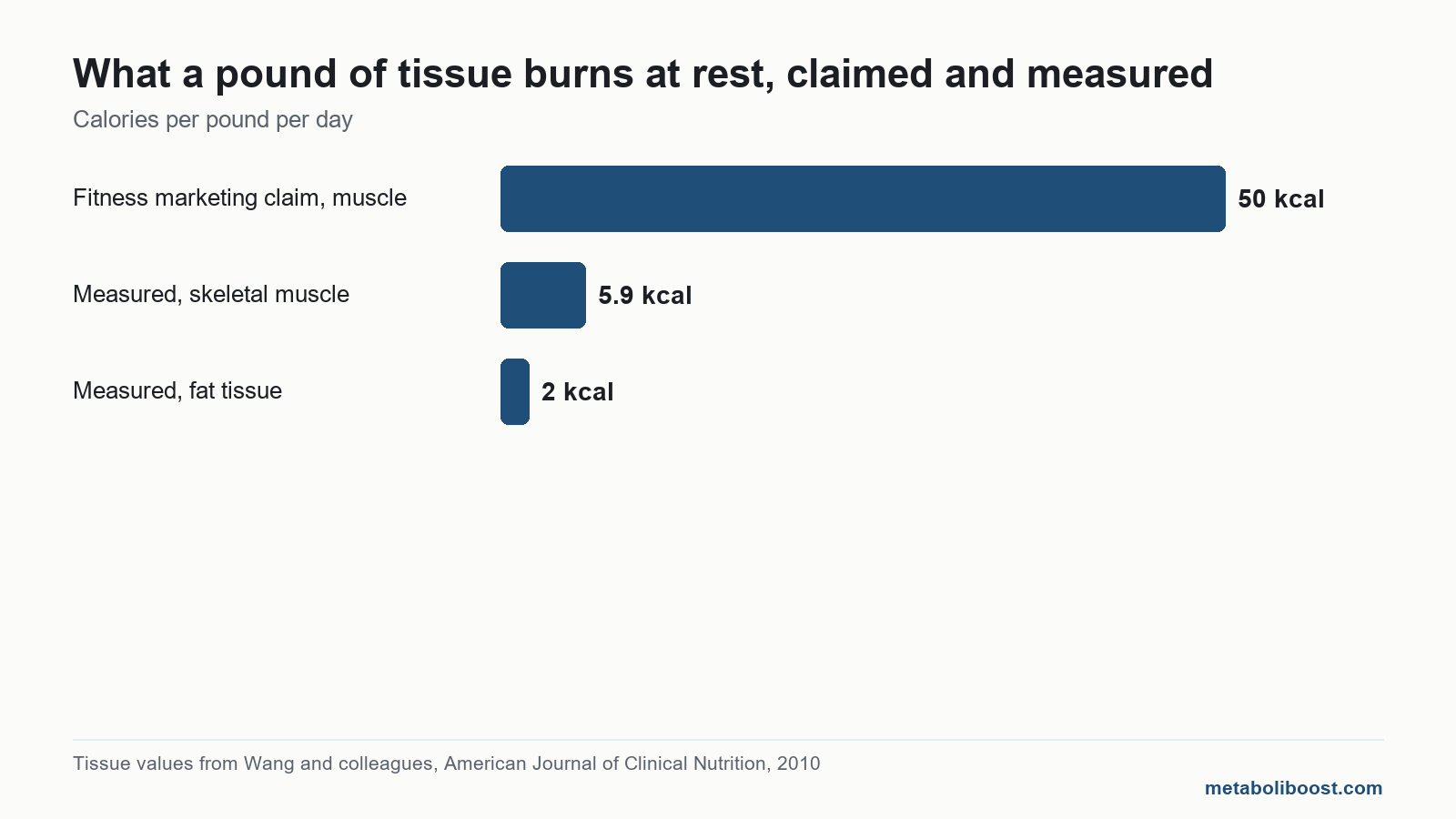
Does increased muscle mass increase metabolism? Yes, but by far less than the gym poster says. Measured skeletal muscle burns about 13 calories per kilogram a day at rest, roughly 6 per pound, not the 50 per pound fitness marketing repeats. Five kilograms of new muscle adds about 65 calories a day. The bigger metabolic payoff lies elsewhere.
Listen to this article, about 11 minutes. A synthetic voice reads the article and announces each section title as it begins; tables are read row by row and the questions at the end are left out.
Recorded 27 September 2026 from the article as published that day. Press a chapter to jump there; the highlighted line is what is playing. A play button sits beside every section heading, and once you scroll past this player a bar at the bottom of the screen keeps the controls in reach. Tap or click any sentence to hear the reading start from there.
On this page: the measured resting cost of every major tissue in one cited table, the 50 calories a pound claim set against it, three trials of what lifting did to resting metabolism, and a calculator that shows the arithmetic.
Think you already know this? Five questions, one minute.
Every answer is on this page. Answer from what you know now; the page fills in the rest.
-
1. Per kilogram at rest, roughly how much does skeletal muscle burn in the tissue values tested in 2010?
Wang and colleagues list 13 calories per kilogram a day for skeletal muscle, against 440 for the heart and kidneys and 4.5 for fat. Read the section
-
2. How far is the 50 calories a pound claim from the measured figure?
The measured value works out at about 5.9 calories a pound a day, from the 2010 tissue values, so 50 is about eight and a half times too high. Read the section
-
3. In the 2020 meta analysis, what did resistance exercise alone do to resting metabolic rate compared with controls?
MacKenzie Shalders and colleagues report 96 calories a day for resistance exercise, with a confidence interval of 45 to 147. Across all exercise types together the rise was not significant. Read the section
-
4. Roughly what share of insulin stimulated glucose uptake happens in skeletal muscle?
A 2020 review of skeletal muscle and insulin resistance puts it at about 80 percent under insulin stimulation. Read the section
-
5. In the 2021 Science study, what happened to size adjusted daily energy expenditure between ages 20 and 60?
Pontzer and colleagues found adjusted expenditure stable from about 20 to 60, declining only after that. Read the section
Muscle has been sold for years as a sort of internal furnace: build a little, and it quietly incinerates dinner while you watch television. The tissue is real and worth having. The furnace is a figure of speech that somebody put a number on, and the number does not survive contact with a measurement.
How many calories does a pound of muscle actually burn?
Resting metabolism is mostly the cost of running organs, not muscle. The standard tissue values are Elia’s, and a team led by ZiMian Wang tested them against measured resting energy expenditure in adults in a 2010 paper in the American Journal of Clinical Nutrition. They held up. Per kilogram, the heart and kidneys each burn about 440 calories a day, the brain 240 and the liver 200. Skeletal muscle burns 13. Fat burns 4.5.
| Tissue | Resting calories per kilogram per day | Per pound per day |
|---|---|---|
| Heart | 440 | About 199 |
| Kidneys | 440 | About 199 |
| Brain | 240 | About 109 |
| Liver | 200 | About 91 |
| Skeletal muscle | 13 | About 5.9 |
| Everything else, the residual mass | 12 | About 5.4 |
| Fat tissue | 4.5 | About 2.0 |
Muscle, in other words, runs at roughly one thirty fifth of the rate of the heart and kidneys, which the Wang paper points out directly. It matters to resting metabolism because there is a lot of it, not because each kilogram is busy. Divide 13 by 2.2046 and a pound of resting muscle comes to about 5.9 calories a day.
So the arithmetic for a realistic gain is short. Five kilograms of new muscle, which is a substantial amount for most adults to add, comes to 5 times 13, or about 65 calories a day. That is roughly a biscuit. If that muscle takes the place of five kilograms of fat, which burns 4.5 per kilogram, the net change is nearer 42 calories, because the fat you no longer carry was not free to run either. The calculator further down this page does the same sum on any figure you enter.
Where does the 50 calories a pound figure come from?
Nobody seems to know, which is itself the finding. The claim runs that each pound of muscle burns 30 to 50 calories a day, so ten pounds of it would buy an extra 500. The National Council on Strength and Fitness thought it common enough among trainers to write a continuing education paper whose title asks whether it is really true. The strength coaching site Stronger by Science calls it old school gym lore and traces it to no study at all. We looked for a primary source for 50 calories a pound and did not find one either.
Set against the measurement, the claim is out by a factor of about eight and a half: 50 against 5.9. Expressed per kilogram, the poster number is 110 calories a day, which would put resting muscle at more than half the rate of the liver. Nobody has measured that, because it does not happen.
Stronger by Science also makes a fair point in the claim’s favour, and it belongs here. A heavier, more muscular body costs slightly more to move around, so once activity is counted the total effect is a little above the resting figure. That site’s own estimate is about 9 to 10 calories a day per pound gained. It is an estimate from a coaching site rather than a trial, and it is still a fifth of the marketing number.
What does an amount of muscle cost to run at rest?
Enter an amount of muscle and see the measured tissue value applied to it, with the working shown, beside the figure the gym poster would give. It is arithmetic on published values, not a forecast.
Resting energy only. Activity and the training itself sit on top of this, and individual results in trials varied widely.
What happens to resting metabolism when people actually lift?
Here the story gets more interesting, because the measured changes in people who train do not quite match the tissue arithmetic. Wayne Westcott’s 2012 review in Current Sports Medicine Reports reports that ten weeks of resistance training may add 1.4 kilograms of lean weight and raise resting metabolic rate by 7 percent. At 13 calories a kilogram, 1.4 kilograms accounts for about 18 calories. Seven percent of a resting rate of 1,500 calories, a round figure we chose to illustrate, is 105.

The gap between 18 and 105 is not coming from the new muscle sitting there. The most likely source is the training itself: the repair and protein turnover that follow hard sessions cost energy for a while afterwards. That reading is ours, not the review’s, and it matters, because it means the effect fades when the training stops, whatever the mirror says about the muscle.
Longer trials show how uneven the result is. In a nine month study of 61 healthy adults who completed 96 supervised workouts, average resting metabolic rate rose from 1,653 to 1,726 calories a day, about 5 percent. The spread was the striking part: the change was 73 calories give or take 158, so some participants rose by a great deal and some fell. The authors could explain less than half of that variation, and a prediction built from each person’s scanned tissue did not track who changed.
Pool the trials and the picture sharpens. A 2020 systematic review and meta analysis in the Journal of Sports Sciences combined 18 exercise studies. Across every kind of exercise together, the rise in resting metabolic rate was not statistically significant, and aerobic exercise alone showed no significant effect. Resistance exercise on its own was the exception: it raised resting metabolic rate by about 96 calories a day compared with controls, with a confidence interval running from 45 to 147. That is several times what the added muscle alone could account for, which fits the idea that the training, not only the tissue, is doing the work.
If the resting number is small, why does muscle matter at all?
Because the resting number was never the best reason to build muscle. The stronger metabolic case is about what the tissue does, not what it costs to keep.
Muscle is the main place blood sugar goes. Under insulin stimulation, skeletal muscle takes up roughly 80 percent of glucose from the circulation, as a 2020 review of its role in insulin resistance sets out. More muscle, and muscle that is regularly used, gives that sugar somewhere to go. For anyone with diabetes or prediabetes this is a conversation for their doctor, because training can change how glucose lowering medication behaves.
Muscle also decides what a weight loss is made of. When people eat less, part of what they lose is lean tissue. A 2018 meta analysis of older adults with obesity found that adding resistance training to calorie restriction prevented about 93.5 percent of the lean mass loss that restriction alone produced, around 0.8 kilograms on average. That is where the meaningful metabolic effect lives: not in adding a furnace, but in not dismantling the one you have. The companion piece on who can really lose fat and gain muscle at the same time goes further into that.
Then there is the obvious one. Stronger people tend to move more, climb the stairs rather than avoid them, and keep doing so into later life. None of that shows up in a resting measurement, and all of it counts.
Does metabolism slow with age because muscle is lost?
Less than most people assume, and later. A 2021 study in Science led by Herman Pontzer pooled doubly labelled water measurements from people aged eight days to 95 years and found that daily energy expenditure, adjusted for body size and fat free mass, held steady from about 20 to 60 and declined only after that. The slowdown many people blame on their forties does not show up in that data as an intrinsic change; shifts in how much people move and how much lean tissue they carry are the likelier explanations.

The Wang paper adds a small wrinkle for older adults. In its over 50 group, the standard tissue values overestimated resting energy by about 3 percent, meaning each kilogram of tissue ran slightly slower. Losing muscle with age lowers resting energy a little, and the tissue that remains runs a touch cooler. Both effects are real and small. The piece on how to increase BMR and the honest size of the effect works through the rest of the levers, and what a genuinely slow metabolism looks like covers when a slowdown is worth a medical conversation.
What can more muscle realistically change, and what can it not?
Put the pieces side by side and the honest version looks like this.
| The claim | What the evidence shows | Source |
|---|---|---|
| A pound of muscle burns 50 calories a day | Measured at about 6 calories a pound at rest | Tissue values tested in adults by Wang 2010 |
| Lifting weights transforms resting metabolism | Resistance training raised it by about 96 calories a day on average; single trials vary widely | MacKenzie Shalders 2020, Aristizabal 2015 |
| Muscle is where much of the sugar from a meal goes | Skeletal muscle takes up about 80 percent of glucose under insulin stimulation | Merz and Thurmond 2020 |
| Training protects muscle while eating less | Supported in older adults with obesity, most of the lean loss was prevented | Sardeli 2018 |
| Metabolism slows steadily from your thirties | Size adjusted expenditure held steady from 20 to 60 in a large pooled dataset | Pontzer 2021 |
Muscle is not a furnace, and the numbers show why. What it can do is help the body handle sugar, keep lean tissue through a period of eating less, and make movement easier to keep up. The NHS physical activity guidelines already ask adults to do strengthening activity that works all the major muscle groups on at least two days a week, for reasons that have little to do with resting calories. Protein intake matters to how much muscle is built, which the protein for muscle growth guide covers without the supplement pitch.
Anyone who is losing weight without trying, losing strength quickly, or managing a condition such as diabetes, thyroid disease or kidney disease is better served by a doctor than by a calculator. Unexplained change in weight or muscle is a symptom worth having checked.
Frequently asked questions
Does muscle burn more calories than fat?
Yes, about three times as much per kilogram at rest: roughly 13 calories a day for muscle against 4.5 for fat, in the tissue values tested by Wang and colleagues in 2010. Both figures are small next to organs such as the liver and heart.
How much muscle can an adult realistically add?
It varies a great deal with age, sex, training history and how much protein and food are eaten. In one ten week programme described in Westcott’s 2012 review, participants added about 1.4 kilograms of lean weight on average, and gains usually slow as training experience grows.
Does cardio or weights raise metabolism more?
A 2020 meta analysis found that resistance exercise raised resting metabolic rate by about 96 calories a day against controls, while aerobic exercise alone showed no significant change. Both burn energy while they are being done, which is where most of the difference in daily expenditure comes from.
Does resting metabolism stay higher on days after lifting?
Energy use stays raised for a period after hard training as the body repairs tissue, which is one likely reason measured resting rates rise more than the added muscle alone explains. The effect depends on the training continuing.
Is a body scan reading of resting metabolism accurate?
Scanners that estimate resting metabolism from measured tissue are predictions, not measurements. In the nine month Aristizabal trial, a prediction built from scanned tissue did not track which individuals changed.
Do supplements that claim to build muscle raise metabolism?
This site does not recommend any supplement. Even if a product added muscle, the measured resting cost of that muscle would be small, so any claim of a large metabolic boost from a supplement deserves scepticism and a conversation with a doctor or pharmacist before use.
Finished the page? The same five questions from the top, to see what stuck.
This article is general information, not medical advice, and is not a substitute for care from a qualified healthcare professional. Speak to your doctor about your own situation.
Leave a Reply