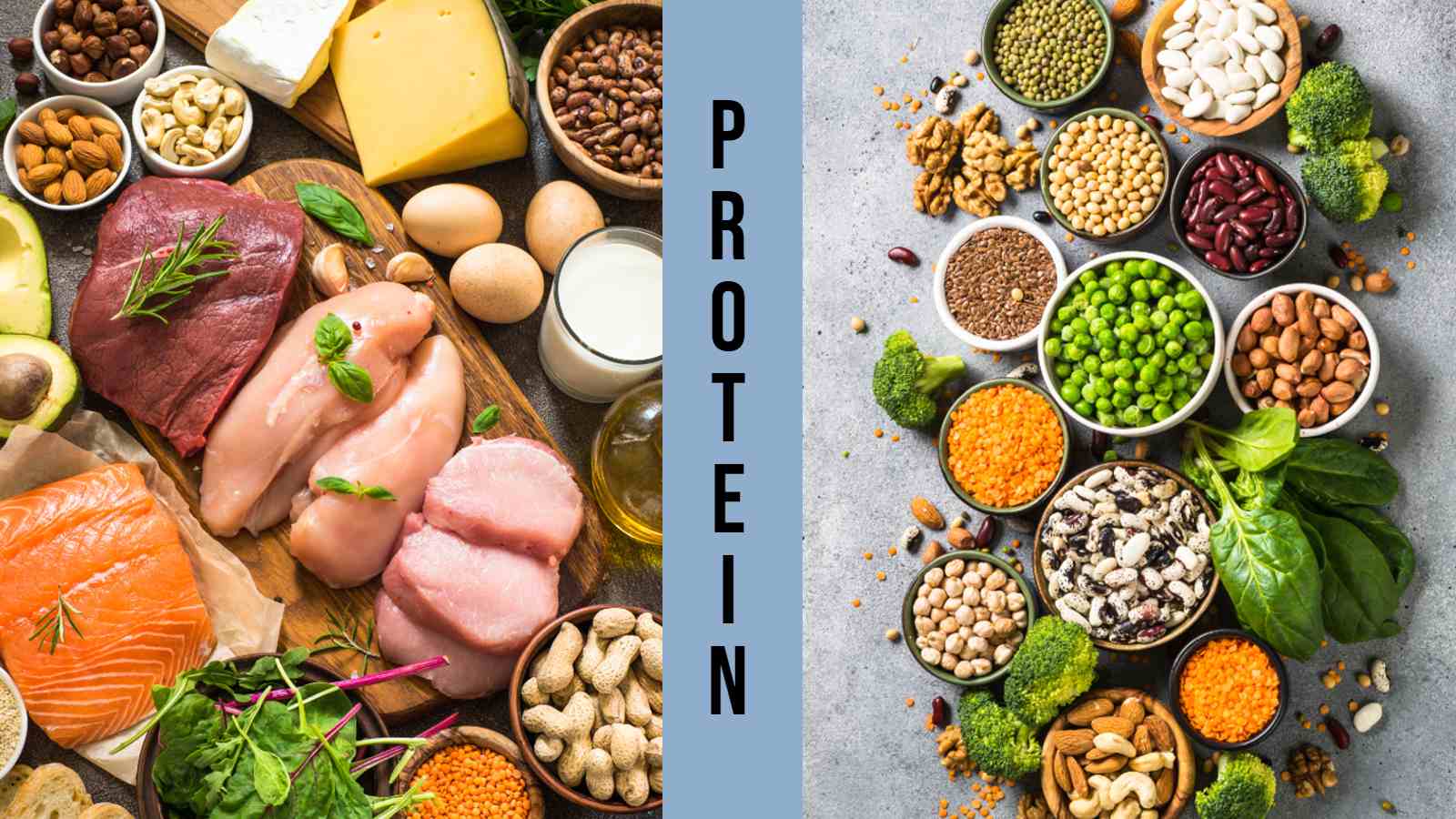
Protein supplies the amino acids your body uses to rebuild muscle fibres after training, so without enough of it a hard session produces soreness and not much else. In pooled trial data, gains stop improving once intake reaches roughly 1.6 grams per kilogram of body weight a day. Training, total calories and sleep decide the rest.
🧬 What does protein actually do inside a muscle?
Lifting something heavy does not build muscle. It breaks things slightly, then asks for them back bigger. Resistance training creates small and entirely normal disruption in muscle fibres, and that switches on a process called muscle protein synthesis, in which the body assembles new muscle protein out of amino acids.
Those amino acids come from what you ate. Nine of them the body cannot manufacture at all, which is why they are called essential and why for once the word is not packaging copy. If the amino acids are not there, the signal still fires and the building work simply stalls. That is the unglamorous reason protein matters. It is not magic. It is the only material on site.
One amino acid, leucine, behaves more like a switch than a brick. Foods rich in it, whey and eggs and dairy and soy among them, trigger the synthesis response more strongly per gram. That is a genuine effect, and a small one next to the far duller question of whether you ate enough protein today at all.
⚖️ How much protein does the evidence actually support?
This is where the internet loses its composure, so here is the tidy version. A systematic review and meta-analysis of 49 resistance training trials, published in the British Journal of Sports Medicine, found that gains in fat free mass improved as protein intake rose and then stopped improving at about 1.62 grams per kilogram of body weight a day. The confidence interval around that breakpoint ran from 1.03 to 2.20, which is a polite way of saying the real ceiling could sit well below or well above the headline figure.
For scale, the British Nutrition Foundation puts the general adult reference intake at 0.75 grams per kilogram a day. That covers being a functioning human, not adding muscle to one. A 2024 review in the Journal of the International Society of Sports Nutrition describes a range of 1.4 to 2.0 grams per kilogram a day for people who train.
| What the figure describes | Protein per kg of body weight per day | Source |
|---|---|---|
| General adult requirement, no training goal | 0.75 g | UK reference intake, British Nutrition Foundation |
| Point at which extra protein stopped adding muscle in pooled trials | about 1.62 g, interval 1.03 to 2.20 | Meta-analysis of 49 resistance training trials |
| Range cited for exercising populations | 1.4 to 2.0 g | Journal of the International Society of Sports Nutrition, 2024 |
| Intakes above the plateau | no further gain detected | Same meta-analysis |
Notice what those numbers are not. They are not a promise, they are not a dose, and they are not the same for everybody. They are the band the research operates in, with a wide interval around it, which is exactly the sort of nuance that gets flattened into a slogan on a tub.
🔥 Does the number change when you are eating less?
Yes, and it is the one place the answer genuinely moves. When you eat less than you burn, the body is content to meet part of the shortfall by breaking down muscle as well as fat, since it does not share your preferences about which. Keeping protein toward the higher end while continuing to train is the main lever that tilts what you lose toward fat rather than lean tissue. In some people, mostly beginners, returners and those carrying more body fat, that tilt goes far enough to add lean tissue while fat is coming off, which is the subject of who body recomposition actually works for.
Which is also why the same person can sit at a different figure in March than in September. The requirement tracks what you are currently asking your body to do.
🍳 Does it matter where the protein comes from?
A little, and considerably less than the arguments about it suggest. Animal sources arrive with all nine essential amino acids in generous proportions. Most single plant sources are short on one or another, which is where the old advice about pairing rice with beans came from.
That advice was over engineered. You do not need to combine complementary proteins within the same meal; eating a varied mix across the day covers it. What plant eaters do have to plan around is volume, because protein per hundred grams is usually lower, so the same daily total takes more food to reach.
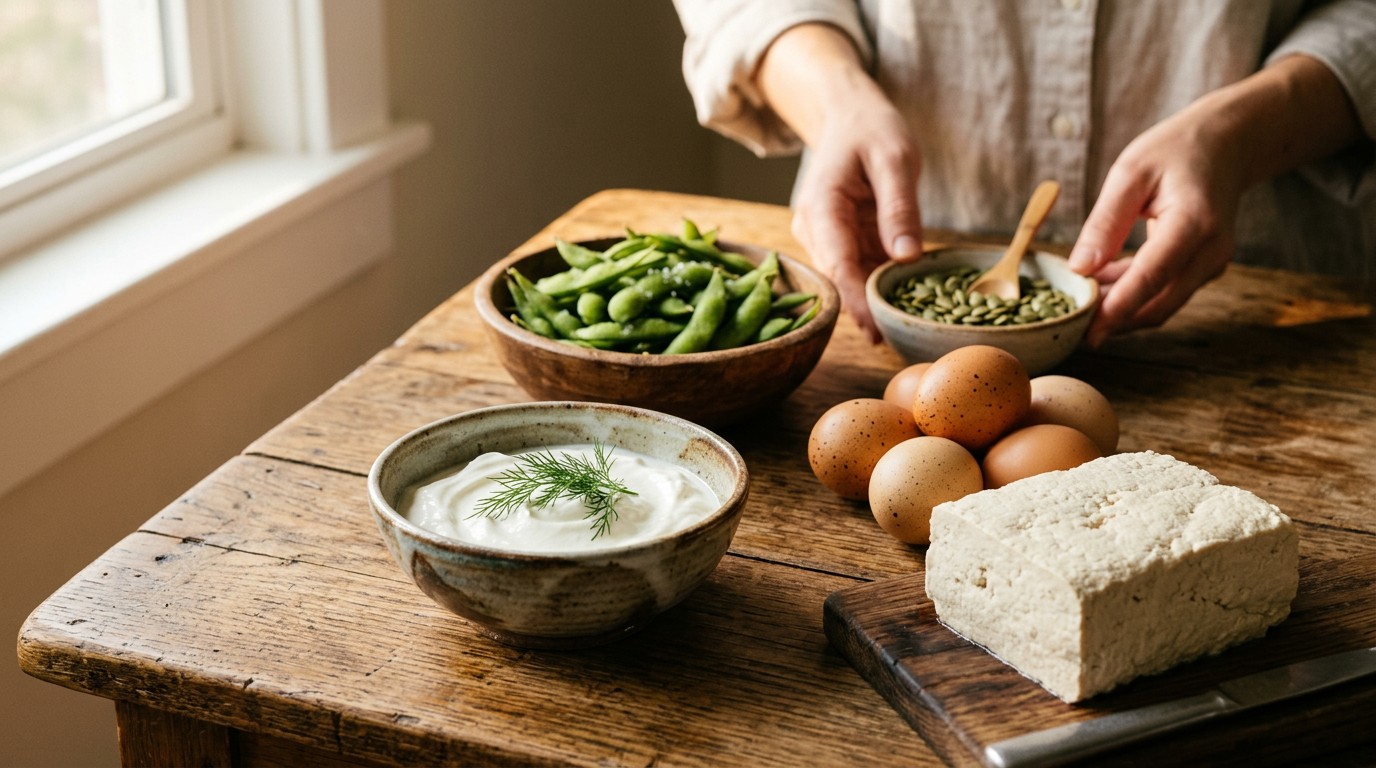
- ✅ Dense per serving: eggs, fish, poultry, lean meat, Greek yogurt, paneer, milk
- ✅ Plant sources worth knowing: lentils, chickpeas, beans, tofu, tempeh, edamame, soy chunks
- ✅ Quinoa gets its own line, being one of the few plant foods carrying the full amino acid set
- ❌ Not a protein source: most things marketed as protein bars once you read past the front of the wrapper
Powders are not a food group. They are a delivery format. The British Nutrition Foundation notes that most people already eat more than enough protein and do not need supplements or fortified products to reach it. Convenient is a fair description of a shaker. Superior is not.
🛒 How do you hit the number without living on shakes?
Most people who feel certain they eat plenty of protein are out by a wide margin, because rice and bread and a splash of milk in tea all feel like they are contributing and mostly are not. Three unremarkable habits move the total further than any product will.
- ✅ Anchor the meal on the protein first, then build the rest of the plate around it rather than hoping protein turns up as a side effect
- ✅ Read the back of the packet, not the front, where “high protein” is a marketing claim some time before it is a nutritional one
- ✅ Weigh a few of your usual portions once, so the estimate you carry in your head is calibrated to something
None of that is forever. A week of paying attention normally tells you whether you are near the range or nowhere close, after which the habit does the work without the spreadsheet.
🕒 Is there really a limit on how much one meal can use?
The claim that the body can only use 20 to 30 grams at a sitting has been repeated so often that it feels like physiology. It is not. It came from studies that measured the response for a few hours after a modest feeding, then stopped counting and called it a ceiling.
When researchers widened the measurement window, the picture changed. The 2024 sports nutrition review summarises work in which 100 grams of protein produced a larger and much longer anabolic response than 25 grams, running beyond twelve hours. Nothing was thrown away. It was simply used more slowly than the shorter studies were able to see.
This is not an argument for one enormous meal. Spreading protein across the day is easier to eat, easier to sit with and easier to keep up. But if most of yours lands at dinner because that is how your life is arranged, the ceiling you were worried about is not there.
⚠️ Can too much protein do harm?
The most persistent worry is the kidneys. In people whose kidneys are healthy, the evidence does not support it. The Journal of the International Society of Sports Nutrition review states that there is no evidence dietary protein harms the kidneys of otherwise healthy individuals, and that populations who habitually eat a lot of it show no raised rate of kidney disease.
That finding applies to healthy kidneys. Chronic kidney disease changes it completely, and protein intake then becomes a clinical decision rather than a nutrition one. If you have kidney disease, diabetes, liver disease, or you are pregnant, set your protein intake with your doctor or a registered dietitian rather than with an article.
The everyday costs are duller. A high protein diet is filling, which is usually welcome, and it can crowd fibre, fruit and vegetables off the plate if it takes over the whole thing.
💤 What has to be true before protein does anything?
Protein is a permission rather than an instruction. Nothing is built unless something asks for it to be built, and the thing doing the asking is training.
- 🏋️ Progressive resistance training. The load has to go up over time, or the body has no reason to spend energy adapting
- 🍚 Enough total energy. Building tissue costs calories, which is why adding muscle during a steep deficit is slow, possible and genuinely hard
- 😴 Sleep. Most of the repair happens while you are unconscious, and short sleep measurably reduces the return on the work you did awake
- 📅 Time. Muscle accrues over months. Anyone offering it in a fortnight is selling you water retention and good lighting

Get those four wrong and the protein has nowhere to go. Get them right and protein stops being the interesting variable at all, which is the honest answer to the question in the title. It matters enormously, and only in combination.
This article is general information about nutrition and training, not personal medical advice. Protein needs, and the safety of a higher intake, depend on your kidney function, medications and medical history. Speak to your doctor or a registered dietitian about your own situation before making a substantial change.
Frequently asked questions
How much protein do you need to build muscle?
A meta-analysis of 49 resistance training trials found that gains in fat free mass stopped improving once protein reached about 1.62 grams per kilogram of body weight a day, with a confidence interval from 1.03 to 2.20. A 2024 review in the Journal of the International Society of Sports Nutrition cites 1.4 to 2.0 grams per kilogram a day for people who train. Your own figure depends on your size, your training and whether you are eating at a deficit.
Can you build muscle without eating extra protein?
You can build some, badly. Resistance training is the signal and protein is the material, so a low intake caps what the training can produce. The British Nutrition Foundation notes that many adults already eat more protein than the general reference intake of 0.75 grams per kilogram a day, so for some people the gap is smaller than they assume. For others, particularly those eating in a deficit, it is the limiting factor.
Is plant protein worse than animal protein for muscle?
It is less concentrated rather than inferior. Most single plant foods are lower in one or more essential amino acids and carry less protein per hundred grams, so reaching the same daily total takes more food. Eating a varied mix of legumes, soy foods, grains and seeds across the day covers the amino acid profile. You do not have to combine them within a single meal, which is an older idea that has not held up.
Do you have to eat protein right after training?
No. Total daily intake matters far more than the clock. The idea of a narrow window after training came from short measurement periods, and the muscle stays responsive to protein for many hours afterwards. Eating within an hour is convenient and does no harm, but it is not the thing that decides whether you gain muscle.
Does a high protein diet damage your kidneys?
In people with healthy kidneys, the evidence does not show harm. The Journal of the International Society of Sports Nutrition review states there is no evidence that dietary protein harms the kidneys of otherwise healthy individuals. This does not extend to people with chronic kidney disease, for whom protein intake is a clinical matter. If you have kidney disease or any condition affecting your kidneys, discuss your intake with your doctor or a registered dietitian.
Why are you training hard and not gaining muscle?
Protein is one of four things that all have to be present. The others are progressive resistance training where the load actually increases, enough total energy to build tissue with, and adequate sleep, since most repair happens overnight. Muscle also accrues over months rather than weeks, so a few disappointing weeks is a normal reading rather than a verdict.
Leave a Reply