
PCOS does not put weight management out of reach, but it does change the odds, and most of the advice aimed at it is guessing. The 2023 international guideline found no diet composition and no exercise type better than any other for PCOS. What differs is insulin handling, appetite and the quality of care people receive.
Listen to this article, about 10 minutes. A synthetic voice reads the article and announces each section title as it begins; tables are read row by row and the questions at the end are left out.
Recorded 25 September 2026 from the article as published that day. Press a chapter to jump there; the highlighted line is what is playing. A play button sits beside every section heading, and once you scroll past this player a bar at the bottom of the screen keeps the controls in reach. Tap or click any sentence to hear the reading start from there.
On this page: why advice built around eating less misses a condition where insulin signalling is part of the problem, the popular diet claims checked line by line against the 2023 guideline, where inositol and metformin actually sit, what 1,385 women said about the care they got, and what is worth doing next.
Think you already know this? Five questions, one minute.
Every answer is on this page. Answer from what you know now; the page fills in the rest.
-
1. What does the 2023 international guideline say about clinically available insulin assays?
The guideline summary names insulin resistance as a pathophysiological factor and, in the same breath, says the insulin tests on offer are of limited clinical relevance, which is worth remembering the next time an online clinic offers to test yours and sell the answer. Read the section
-
2. What does recommendation 3.3.1 of the guideline say about diet composition?
The parallel recommendation on exercise says the same about intensity and type, and recommendation 3.1.5 states there are benefits to a healthy lifestyle even in the absence of weight loss. Improvements in blood pressure, lipids, sleep and mood do not wait for the scale. Read the section
-
3. How does the guideline describe inositol?
The review commissioned for the 2023 update found mostly low to very low certainty evidence. It is not the thing the evidence points at, and products sold for hormone balance rarely name a hormone, a mechanism or a trial. Read the section
-
4. In the survey of 1,385 women across 32 countries, how many were satisfied with the information they were given about treatment options?
The survey also found more than a third spent over two years seeking a diagnosis and many saw at least three providers. The guideline names the dissatisfaction directly, asks that weight bias be minimised, and asks that disordered eating be considered regardless of weight. Read the section
-
5. If PCOS is suspected rather than confirmed, what does this page say the useful next step is?
The WHO estimates 10 to 13 percent of women have PCOS and up to 70 percent are undiagnosed. Nothing written here can tell anyone which condition they have, and anything offering a number and a date is selling. Read the section
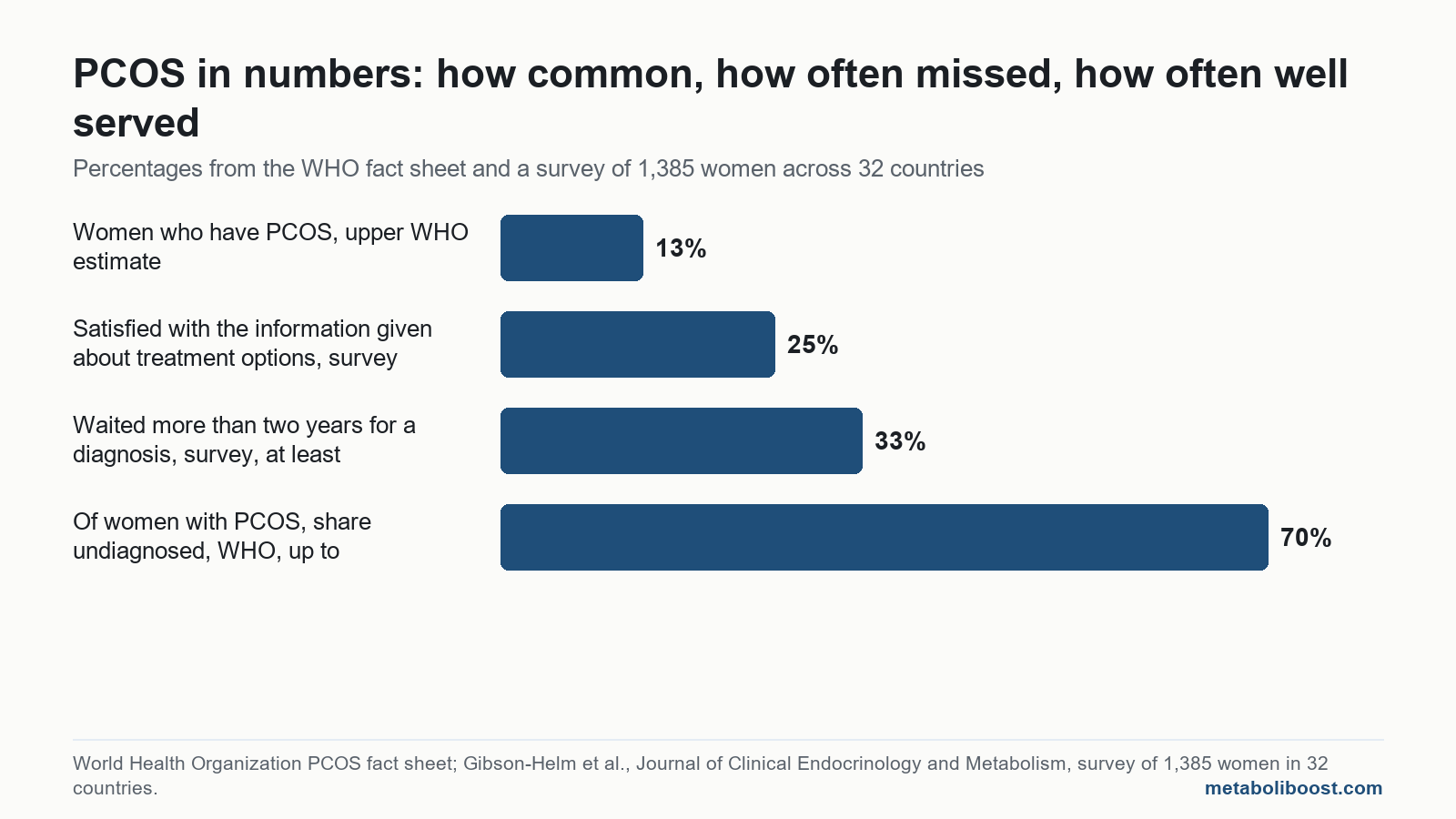
Polycystic ovary syndrome is common. The World Health Organization estimates that 10% to 13% of women have it, and that up to 70% of them are undiagnosed. It is also one of the conditions the weight loss industry circles hardest, because a large group of people who have been told their bodies are working against them is a large group of people who will buy something. This article is about what the clinical evidence actually says, including the parts where it says very little.
Why does ordinary weight advice underdeliver for women with PCOS?
Because the standard advice was not built for a condition in which insulin signalling is part of the problem. The 2023 International Evidence-based Guideline for the Assessment and Management of Polycystic Ovary Syndrome states plainly that insulin resistance is a pathophysiological factor in PCOS. That is not a statement about how many calories the body burns while resting, which is a separate question and one where the pooled evidence shows almost no gap at all. If that is the question you arrived with, the resting metabolic rate evidence is covered separately.
Insulin resistance shows up in women with PCOS across the range of body sizes, including in those who are not carrying excess weight. That is why the guideline tells clinicians to focus on healthy lifestyle and the prevention of excess weight gain in women who are not overweight, rather than on weight loss. It is also why advice built purely around eating less tends to miss. The same guideline warns that clinically available insulin assays are of limited clinical relevance and should not be used in routine care, which is worth remembering the next time an online clinic offers to test your insulin and sell you the answer. For the trial numbers on how much weight change actually shifts insulin sensitivity, and why some people improve far more than others, see what the research shows about losing weight with insulin resistance.
There is a second reason the advice underdelivers, and it has nothing to do with physiology. It usually arrives late, briefly, and from someone who was not given much to work with either.
Is there a best diet for PCOS?
No, and the guideline says so in unusually blunt language. Recommendation 3.3.1 states that there is no evidence to support any one type of diet composition over another for anthropometric, metabolic, hormonal, reproductive or psychological outcomes. The parallel recommendation on exercise says the same thing about intensity and type. Any pattern consistent with population healthy eating guidance carries benefit, and the guideline asks clinicians to tailor it to what the person will actually keep doing.
| Popular claim about PCOS eating | What the 2023 guideline supports |
|---|---|
| Low carbohydrate eating is required for PCOS | Not supported as superior. No diet composition outperformed another across metabolic, hormonal or reproductive outcomes. |
| Keto reverses PCOS | Not supported. There is no cure for PCOS, and no diet has been shown to outperform others. |
| Dairy and gluten must be removed | Not supported. The guideline warns against unduly restrictive and nutritionally unbalanced diets. |
| High intensity training is essential | Not supported. No type or intensity of exercise beat another on these outcomes. |
| Nothing helps unless you lose weight | Contradicted. Recommendation 3.1.5 states there are benefits to a healthy lifestyle even in the absence of weight loss. |
That last row is the one most often left out of the conversation. Improvements in blood pressure, blood lipids, sleep, mood and fitness do not wait for the scale to move, and a plan that only counts as working if a number falls is a plan most people abandon. The reasons weight change lags behind effort are general rather than specific to PCOS.
What does the evidence actually support?
Three things, and they are less dramatic than the marketing. First, lifestyle change is a core part of management, aimed at general health, quality of life and body composition rather than at a target figure. Second, where weight management is the goal, the guideline asks for an individually tailored approach with ongoing support, and it counts improvements in central adiposity and metabolic markers as real wins in their own right. Third, prescribing is a clinical decision, not a shopping decision.
Metformin appears in the guideline as a prescription option considered primarily for metabolic features. What dose, whether it suits a particular person, and what is monitored alongside it are all matters for the prescriber who knows that person’s history. No article can answer them, and any site that offers to is telling you something about itself.
The guideline is also honest about its own foundations. Its summary notes that evidence in PCOS is generally of low to moderate quality, and calls for greater priority, funding and research. Low certainty does not mean nothing is known. It means confident promises are not available from the evidence, so anyone making one is not getting it from there.
Do supplements like inositol earn their place?
Inositol is the supplement most often sold to women with PCOS, so it is worth being specific. A systematic review and meta analysis commissioned to inform the 2023 guideline update found that most outcomes sat at low to very low certainty. The guideline summary itself describes inositol as offering limited clinical benefit in PCOS. It is not banned, it is not dangerous in the way some things are, and it is also not the thing the evidence points at.
The wider supplement aisle is worse served. Products sold for hormone balance rarely name a hormone, a mechanism or a trial, and the ones that do usually cite a study on a single ingredient at a dose the product does not contain. That pattern is covered in more detail in the piece on what balancing hormones naturally does and does not mean. Supplement retailers and coaching programmes are not neutral sources on their own products, and evidence quoted by a seller should be read as advertising until it is traced back to the trial.
| Approach | Evidence position | Who decides |
|---|---|---|
| Healthy eating pattern the person can sustain | Recommended, with no composition favoured | The person, with support |
| Regular physical activity in line with population guidance | Recommended, with no type favoured | The person, with support |
| Inositol | Limited and low certainty, described as offering limited clinical benefit | Discussed with a clinician |
| Metformin | A guideline option considered mainly for metabolic features | Prescriber only |
| Detox teas, fat burners, hormone balancing blends | No guideline support | Nobody, on this evidence |

Why does the care itself so often feel like the problem?
Because for a lot of people it has been. A survey of 1,385 women across 32 countries, summarised in the Journal of Clinical Endocrinology and Metabolism, found that more than a third spent over two years seeking a diagnosis and many saw at least three separate medical providers before getting one. Only around a quarter were satisfied with the information they were given about treatment options, lifestyle change included. The guideline names this directly, noting that dissatisfaction with PCOS diagnosis and care is high.
Two further recommendations deserve more attention than they get. The guideline asks that weight bias and stigma be minimised, and that healthcare professionals seek permission before weighing someone and explain why. And it asks that eating disorders and disordered eating be considered in PCOS regardless of weight, especially in the context of weight management and lifestyle interventions. Those are not soft additions. They are there because repeated restriction and repeated failure leave marks, and because depression and anxiety are significantly more common in this group. If eating has become something you fight rather than do, the piece on the psychology of cravings and comfort eating covers that ground.
What is actually worth doing next?
If PCOS is suspected rather than confirmed, the useful next step is a clinician and a test, not a supplement and a rule. Irregular cycles, unwanted hair growth, acne and difficulty conceiving overlap with several other conditions, and they are managed differently. Nothing written here can tell anyone which one they have.
If a diagnosis is already in place, the guideline’s own framing is a reasonable thing to bring to an appointment: goals co-developed rather than handed down, support that continues past the first conversation, and screening for the metabolic and psychological features that travel with the condition. The ordinary levers of sleep, movement, protein and fibre still matter, and habits that support insulin sensitivity are worth understanding on their own terms rather than as a promise. What none of it comes with is a number or a date, and anything offering you both is selling.
What the guideline says an appointment should include
The 2023 international guideline’s own framing, as a list to bring. Tick what has happened; the gaps are the conversation.
Ticks are saved on this device only. Whether a prescription is right for anyone is the prescriber’s decision, and this page has no view on it.
Frequently asked questions
Does PCOS make it impossible to lose weight?
No. PCOS makes weight management harder for reasons connected to insulin handling, appetite and androgens, and it does not make change impossible. What the evidence does not support is any specific figure or timeline, for PCOS or for anyone else.
Is there a specific PCOS diet?
Not according to the 2023 international guideline, which states there is no evidence supporting one diet composition over another for metabolic, hormonal, reproductive or psychological outcomes. It asks for a sustainable pattern tailored to the individual instead.
Should I cut carbohydrates if I have PCOS?
That is a question for the clinician who knows your history. Low carbohydrate eating has not been shown to outperform other patterns in PCOS, and the guideline warns against unduly restrictive and nutritionally unbalanced diets.
Does inositol work for PCOS?
The review commissioned for the 2023 guideline update found mostly low to very low certainty evidence, and the guideline describes inositol as offering limited clinical benefit. Anyone considering it is better off discussing it with a clinician than acting on a seller’s claim.
Can lifestyle change help if my weight does not change?
Yes. The guideline states there are benefits to a healthy lifestyle even in the absence of weight loss, including for general health and quality of life. Improvements in fitness, sleep, blood pressure and mood do not depend on the scale.
Can PCOS be cured or reversed?
No. The World Health Organization states there is no cure for PCOS, though treatment can improve symptoms, support fertility and reduce longer term risks. Claims of reversal are not supported by any major health body.
Finished the page? The same five questions from the top, to see what stuck.
This article is general information, not medical advice, and is not a substitute for care from a qualified healthcare professional. Speak to your doctor about your own situation.
Leave a Reply