
You cannot choose the thighs. Fat leaves the body according to genetics, sex hormones and regional blood flow, not according to which muscle you trained. Leg work builds strength and shape in the thigh, and an overall energy deficit reduces fat everywhere, including there. Nothing reliably targets one area.
Listen to this article, about 11 minutes. A synthetic voice reads the article and announces each section title as it begins; tables are read row by row and the questions at the end are left out.
Recorded 25 September 2026 from the article as published that day. Press a chapter to jump there; the highlighted line is what is playing. A play button sits beside every section heading, and once you scroll past this player a bar at the bottom of the screen keeps the controls in reach. Tap or click any sentence to hear the reading start from there.
On this page: the one leg trial that tested spot reduction directly, why thigh fat is inherited and slow to release, what leg exercises genuinely change, what the evidence review found about cellulite treatments, and how to tell whether anything is working when the tape measure misleads.
Think you already know this? Five questions, one minute.
Every answer is on this page. Answer from what you know now; the page fills in the rest.
-
1. In the 2013 one leg training trial, where did fat come off after twelve weeks of training a single leg?
The trial had eleven young adults train only the non dominant leg, three sessions a week at 960 to 1,200 repetitions, and DEXA found no fat loss in it. A 2023 trial found a modest abdominal signal with its own listed caveats; nothing comparable exists for the thighs. Read the section
-
2. What did the Oxford measurements find about femoral fat?
The Oxford work shows the depot behaves as long term storage rather than day to day fuel. A genome wide meta analysis of about 695,000 people found hundreds of signals for waist to hip ratio, about a third behaving differently in women and men. Read the section
-
3. Why can the thigh measure slightly larger after weeks of hard leg training?
Nothing has gone wrong when that happens, and it is why a tape measure alone is a poor judge of progress in this region. Resistance training also retains more fat free mass than dieting alone while weight comes down. Read the section
-
4. What did the evidence review in the American Journal of Clinical Dermatology conclude about cellulite treatments?
The review found many studies did not even use cellulite severity as an endpoint. Cellulite involves the structure of connective tissue and skin rather than fat volume alone and appears across the whole range of body sizes. Read the section
-
5. Which signal does this page call the least ambiguous?
UK activity guidance asks for strengthening work on at least two days a week and names legs and hips. Weight as a weekly trend, how clothes sit at long intervals, and whether the eating pattern is still running complete the set. Anyone quoting a number of weeks for your thighs is guessing with confidence. Read the section
That is an unsatisfying answer, and it is why most pages on this search sell something instead. The physiology underneath is not complicated, though, and once you have it the offers sort themselves quickly.
Can you lose fat from your thighs specifically?
The idea has a name in the research literature. Spot reduction is the hypothesis that exercising a muscle draws fat preferentially from the fat sitting on top of it. It has been tested repeatedly, mostly with the same result.
The cleanest test used one leg. In a 2013 trial published in the Journal of Strength and Conditioning Research, eleven young adults trained only their non dominant leg for twelve weeks, three sessions a week, at 960 to 1,200 repetitions per session on the leg press. If training a limb stripped fat off that limb, this was the design to show it. DEXA scans found no fat loss in the trained leg. Fat came off the arms and the trunk instead, which is close to the opposite of the promise.
The evidence is not perfectly one sided, and it is worth saying so. A 2023 randomised trial gave sixteen overweight men either running plus abdominal exercise or running alone, matched for energy expenditure, over ten weeks. The abdominal group lost slightly more trunk fat. The authors listed the reasons for caution themselves: no dietary control, men only, and sessions of unequal length. One modest signal in the abdomen does not overturn the wider picture, and no trial has produced anything comparable for the thighs.
So the honest position is this. Targeted fat loss is unsupported for the thigh. The same logic applies to every other region people want to shrink on demand, which is why our piece on what belly fat exercises can and cannot do lands in the same place from the other end of the body, and the region by region record of the spot reduction trials collects what each one actually tested.
Why do thighs hold on to fat more than other places?
Two separate things are happening, and they are often confused with each other.
The first is where your body puts fat in the first place. Body fat distribution is substantially heritable. Twin and family estimates vary widely with the measure used, and a genome wide association meta analysis of roughly 695,000 people found hundreds of signals linked to waist to hip ratio independent of overall body size. About a third of those signals behave differently in women and men, and the genetic effect on fat distribution is generally stronger in women. Lower body storage is not a personal failing or a sign you trained wrong. It is largely inherited, and it is one reason two people eating and moving similarly end up shaped differently. We go into the sex difference in more detail in why men and women lose weight at different rates.
The second is how readily that fat comes back out. Fat in the hip and thigh region, called gluteofemoral fat, is measurably slower to release its contents than abdominal fat. Work from Oxford using direct measurement in living tissue found femoral fat markedly resistant to adrenaline, with lower blood flow and a blunted release of fatty acids compared with the abdomen. The depot behaves as long term storage rather than day to day fuel. That is the mechanism behind the feeling that thighs are last to change, and it overlaps with what makes the final few kilograms so stubborn.
There is a footnote worth knowing. In population studies, more gluteofemoral fat is associated with a better lipid and glucose profile and lower cardiovascular risk once total fat is accounted for, which is the reverse of the pattern for abdominal fat. The tissue people most want gone is the tissue with the least evidence against it.
What do thigh exercises actually change?
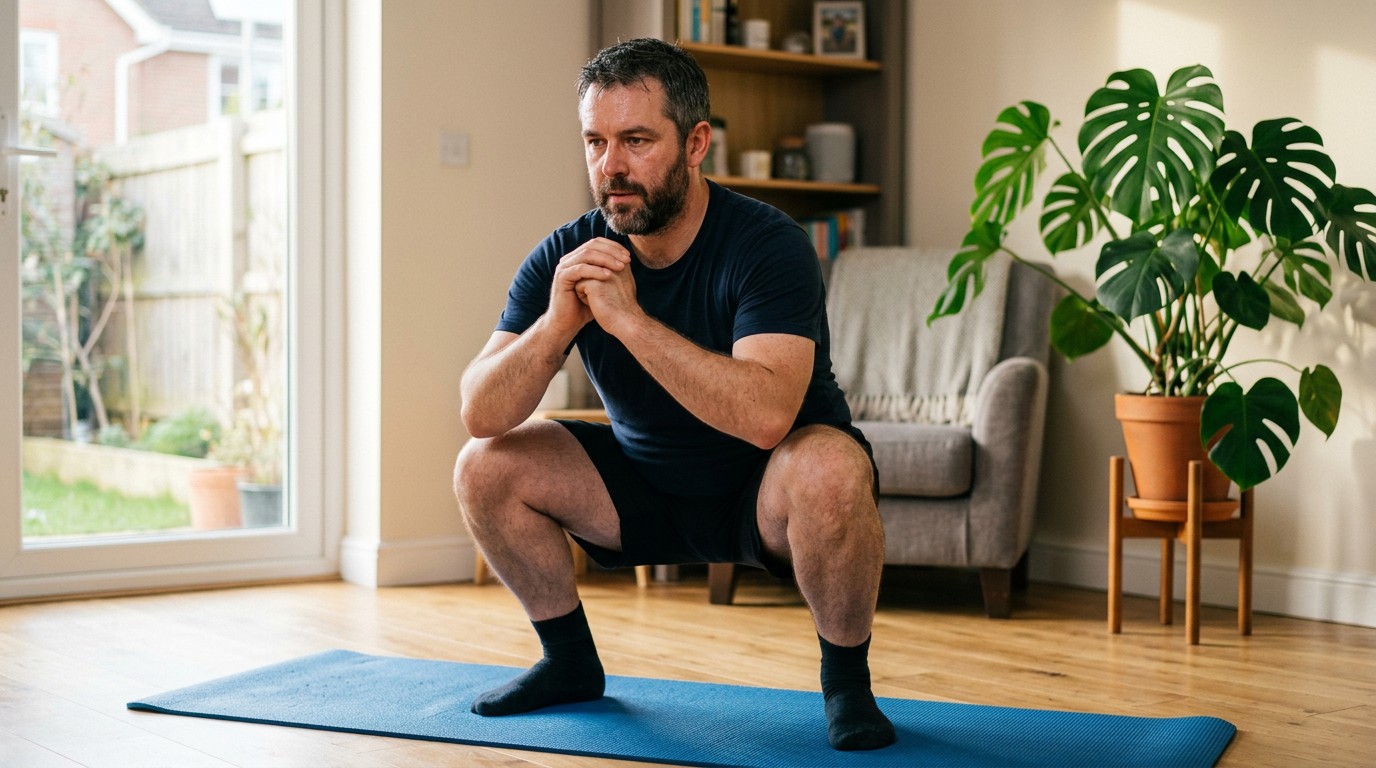
Quite a lot, just not the thing on the label. Squats, lunges, step ups, hip thrusts and leg press build strength in the quadriceps, hamstrings and glutes. That changes the shape of the leg, changes what the leg can do, and protects muscle while body weight is coming down.
That last point matters more than the cosmetic one. Reviews of training during energy restriction consistently find that resistance training retains more fat free mass than dieting alone or dieting with aerobic exercise alone. Trials pairing resistance training with higher protein intake, in the region of 2.4 grams per kilogram of body weight per day compared with 1.2, have reported a more favourable split of fat lost to lean tissue lost. Those are supervised research conditions with tightly controlled feeding rather than a target for anyone reading this, but the direction is consistent, and it is covered further in why protein matters for muscle.
One thing surprises people. Training legs hard can make the thigh measure slightly larger for a while, because muscle is being added underneath fat that has not yet gone. Nothing has gone wrong when that happens. It is the reason a tape measure alone is a poor judge of progress in this particular region.
Does cardio slim thighs faster than weights?
Neither is a targeting tool. They do different jobs, and the sensible reading is that they complement each other rather than compete.
| Approach | What it genuinely changes | What the evidence supports |
|---|---|---|
| High repetition inner and outer thigh work | Local muscular endurance | No fat loss in the trained limb in the twelve week unilateral trial |
| Progressive lower body resistance training | Strength, muscle, leg shape, bone loading | Strong for strength and lean mass retention during weight loss. Not a targeting method |
| Aerobic exercise, walking, cycling, running | Energy expenditure, cardiorespiratory fitness | Strong for health outcomes. Fat comes off in your own pattern, not the trained one |
| Overall energy deficit from food | Total body fat | The only lever with consistent evidence for reducing fat anywhere, thighs included |
| Creams, wraps, dry brushing | Short lived changes in skin appearance and water | Weak. Reviews report methodological flaws and effects that fade within weeks |
| Massage and manual techniques | Temporary appearance of smoother skin | Improvements are generally described as short lived |
UK physical activity guidance for adults aged 19 to 64 asks for at least 150 minutes of moderate intensity activity or 75 minutes of vigorous activity a week, plus strengthening activity working all major muscle groups on at least two days a week. Legs and hips are named in that list. That guidance exists for health, not for shaping one body part, which is exactly why it is a better starting frame than a thigh specific plan.
What about cellulite treatments and thigh creams?
Cellulite is a separate question from thigh fat, and it is where most of the money in this category sits. It is extremely common in women, involves the structure of connective tissue and skin rather than fat volume alone, and it appears in people across the whole range of body sizes.
An evidence based review in the American Journal of Clinical Dermatology found no clear evidence of good efficacy for any treatment it assessed, including laser and light based devices and radiofrequency. Many studies did not even use cellulite severity as an endpoint. Topical products showed statistically significant changes in some trials, but durability after stopping was unclear or measured in a couple of weeks. Acoustic wave therapy and one minimally invasive laser drew the least unfavourable assessments, and even there the reviewers were cautious. Where a product page pairs a smoother thigh with an affiliate link, the published reviews are far less confident than the advertising.

What does eating have to do with thigh fat?
More than any leg exercise does, because total fat loss is what eventually reaches the thigh. The mechanism is an energy deficit sustained long enough to matter, and the practical question is which way of eating a person can actually keep up.
Protein and fibre tend to help because they blunt hunger at the same calorie level, which makes the deficit less punishing. Alcohol and liquid calories work the other way. None of this is thigh specific, and no food redirects fat loss to a region.
The same reasoning applies to the lower belly pouch, which draws the same search behaviour and the same false promises. Different region, identical physiology.
Several measures at once, read over months
Thighs are the region where the usual measures mislead most. Log the four this page names, one row a week or a month, and read the trend rather than the reading.
Kept on this device only. Training legs hard can make the thigh measure slightly larger for a while, because muscle is being added under fat that has not yet gone.
How do you tell whether anything is working?
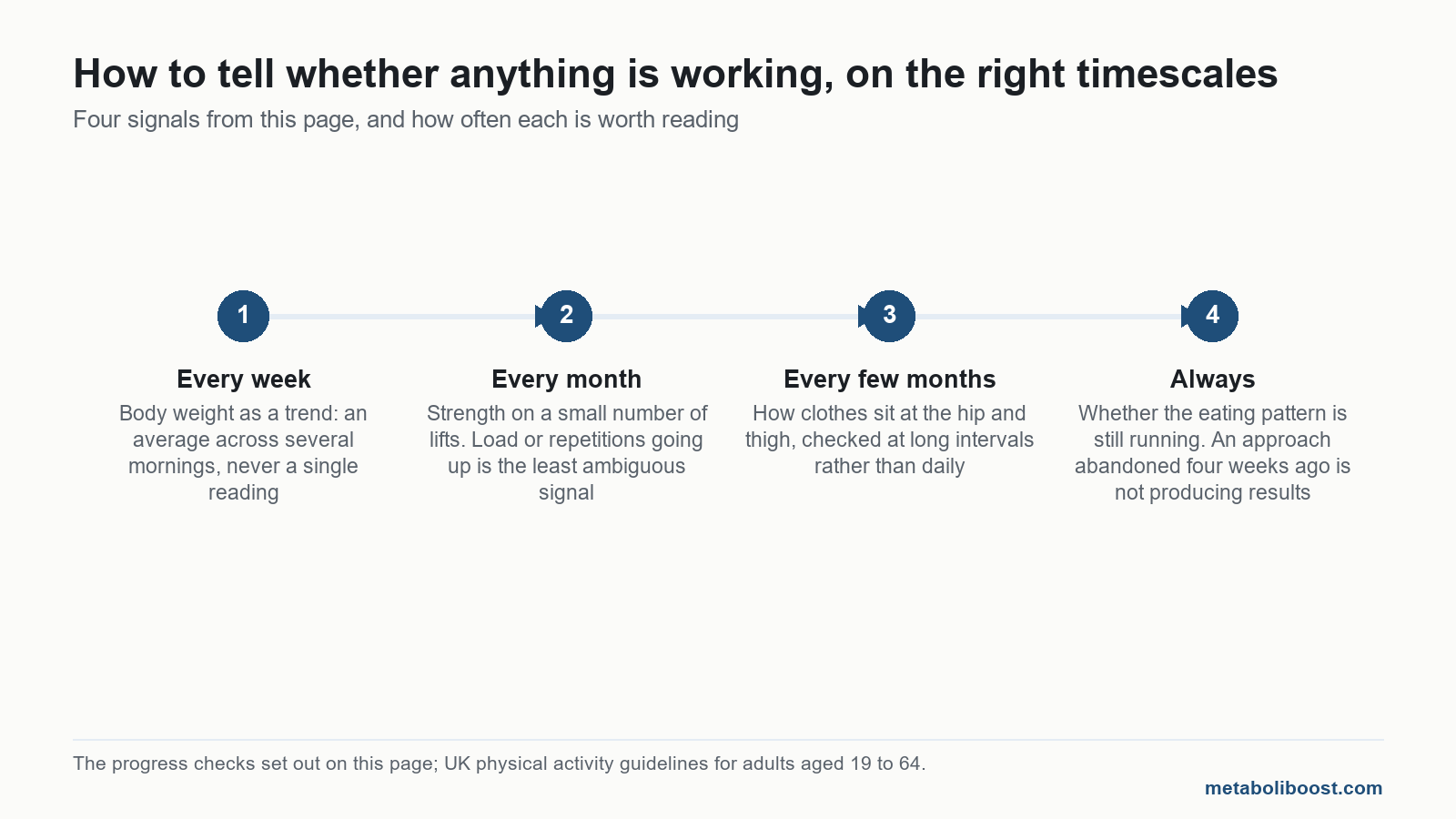
Thighs are the region where the usual measures mislead most, so it helps to watch several at once.
- Strength on a small number of lifts. Load or repetitions going up over months is the least ambiguous signal that training is doing something.
- Body weight as a trend, not a reading. A weekly average across several mornings tells you more than any single number.
- How clothes sit at the hip and thigh, checked at long intervals rather than daily.
- Whether the eating pattern is still running. An approach you abandoned four weeks ago is not producing results, whatever it promised.
Timelines are the part nobody can honestly give you. Rate of fat loss depends on starting body composition, size of deficit, adherence, sleep, medication and a genetic contribution nobody can read off in advance. Anyone quoting a number of weeks for your thighs is guessing with confidence.
If thigh size changed noticeably without a change in eating or activity, or if one leg is affected and the other is not, or if there is swelling, pain or skin change, that is a conversation for a doctor rather than a training question. Conditions affecting fat distribution and lymphatic drainage exist and they are diagnosed in person, not from an article.
Frequently asked questions
Do inner thigh exercises burn thigh fat?
No. They train the adductors, which is useful for strength and stability, but controlled trials of localised training have not found fat loss in the trained region. Fat loss follows total energy balance and your own genetically influenced pattern.
Why are my thighs the last place to change?
Fat in the hip and thigh region releases its stored fat more slowly than abdominal fat. Direct measurements in living tissue show lower blood flow and a blunted response to adrenaline in femoral fat, so it behaves as long term storage.
Will squats make my thighs bigger or smaller?
Squats add muscle to the thigh. If body fat is unchanged, the leg can measure slightly larger. Over a longer period with an energy deficit alongside, most people see a firmer shape. Neither outcome is a sign of doing it wrong.
Is thigh fat unhealthy?
Population research associates greater gluteofemoral fat with a more favourable lipid and glucose profile and lower cardiovascular risk once total body fat is accounted for. That is the opposite of the pattern seen with abdominal fat.
Do wraps, creams or massage reduce thigh fat?
There is no good evidence that they reduce fat. A published evidence review found no clear efficacy across the treatments assessed, and changes reported for topical products faded quickly after use stopped. Any immediate change is usually water and skin appearance.
How long does it take to lose thigh fat?
Nobody can answer that for an individual, and any specific figure should make you suspicious. Rate depends on starting body composition, the size and consistency of the energy deficit, sleep, medication and inherited fat distribution.
Finished the page? The same five questions from the top, to see what stuck.
This article is general information, not medical advice, and is not a substitute for care from a qualified healthcare professional. Speak to your doctor about your own situation.
Leave a Reply