
How to burn back fat has one honest answer: you cannot aim fat loss at your back. Trials that trained one limb or one region found fat left the whole body at a similar rate, and sometimes fastest where nothing was trained. The back follows total fat loss, and training changes the shape underneath it.
Listen to this article, about 14 minutes. A synthetic voice reads the article and announces each section title as it begins; tables are read row by row and the questions at the end are left out.
Recorded 25 September 2026 from the article as published that day. Press a chapter to jump there; the highlighted line is what is playing. A play button sits beside every section heading, and once you scroll past this player a bar at the bottom of the screen keeps the controls in reach. Tap or click any sentence to hear the reading start from there.
On this page: why fat is not burned where it sits, six trials that put an instrument on the trained region and what they found, the 60 percent of fat distribution that is inherited, the five things a mirror reports as one, and what a regulator found when it asked the product sellers for their evidence.
Think you already know this? Five questions, one minute.
Every answer is on this page. Answer from what you know now; the page fills in the rest.
-
1. Where does the fat released from a fat cell get used?
A contracting muscle raises release in the tissue immediately next to it, but the pool it draws on is shared, so a set of reverse flies draws on the same pool as a set of squats. Read the section
-
2. In the 1984 sit up study, what happened to fat cell diameter at the untrained site under the shoulder blade?
Per Katch and colleagues, 5,004 sit ups over 27 days; and the 2021 meta analysis of 37 comparisons found 17 favouring the trained side and 20 the untrained, which is what a coin does. Read the section
-
3. How heritable is waist to hip ratio, even after adjusting for body mass index?
Per the review in Arteriosclerosis, Thrombosis, and Vascular Biology; losing fat changes how much is in each depot without renegotiating the ranking between them. Read the section
-
4. In the 2018 assessment of bras women had chosen for themselves, how common was an oversized band?
Per Coltman, Steele and McGhee; a band that rides up or has stretched past its useful life creates a ridge above it, and that ridge is a report on the garment. Read the section
-
5. What does the FTC’s Gut Check guide say about products worn or applied to the skin?
Per the FTC’s Gut Check reference guide; the Nivea, L’Occitane and shapewear orders on this page all turned on the same point. Read the section
Search the phrase and you get bra line burners, back fat blasters and a banded pull apart that allegedly melts whatever it is pointed at. The exercises are usually perfectly good exercises. The promise stapled to them is the problem, and it happens to be one of the most thoroughly tested claims in fitness.
Can you burn fat off your back on purpose?
No, and the reason is closer to plumbing than to willpower. Fat is not burned where it sits. Stored triglyceride is broken down inside the fat cell, released into the bloodstream as fatty acids and glycerol, then used wherever demand happens to be, mostly in working muscle anywhere in the body. A contracting muscle does raise fat release in the tissue immediately next to it, but the pool it draws on is shared.
So a set of reverse flies draws on the same pool as a set of squats, and the back has no special claim on it. We have made that argument for the middle in what belly fat exercises can and cannot do and for the legs in what leg exercises really do to thigh fat. What is new here is the evidence for the back itself, which exists, because two trials measured it.
What did the spot reduction trials find, region by region?
The ranking pages prescribe exercises and cite nothing. Here is the record instead, one row per trial. Read the fourth column before the first.
| Trial | What was trained | What was measured | What happened | Source |
|---|---|---|---|---|
| Katch and colleagues, 1984 | Abdominal muscles, 5,004 sit ups across 27 days, 13 men trained and 6 controls | Fat cell diameter by needle biopsy at the abdomen, the subscapular site under the shoulder blade, and the buttock | Cell diameter fell at all three sites, and no faster at the trained abdomen than at the untrained back or buttock | Katch 1984 |
| Kostek and colleagues, 2007 | Non dominant arm, supervised resistance training, 12 weeks, 104 adults | Subcutaneous fat in both arms by MRI and by skinfold caliper | The two methods disagreed: skinfolds suggested a fall in the trained arm in the men, MRI showed no trained arm advantage | Kostek 2007 |
| Vispute and colleagues, 2011 | Seven abdominal exercises, five days a week for six weeks, 24 adults held on an isocaloric diet | Abdominal subcutaneous fat, anthropometry, body composition | Abdominal endurance improved. Abdominal fat did not fall | Vispute 2011 |
| Ramirez Campillo and colleagues, 2013 | Non dominant leg press only, 960 to 1,200 repetitions per session, three sessions a week for 12 weeks, 11 adults | Regional fat mass by DXA | Fat mass fell 10.2 percent in the arms and 6.9 percent in the trunk, significantly more than in the trained leg | Ramirez Campillo 2013 |
| Paoli and colleagues, 2021 | Mixed circuit of crunches, overhead triceps extensions and aerobic phases, three times a week for eight weeks, 14 adults | Ultrasound at eight regions plus four skinfolds | Fat over the upper abdomen fell 18.9 percent and over the spinal erectors 19.5 percent, while the trained triceps site did not change | Paoli 2021 |
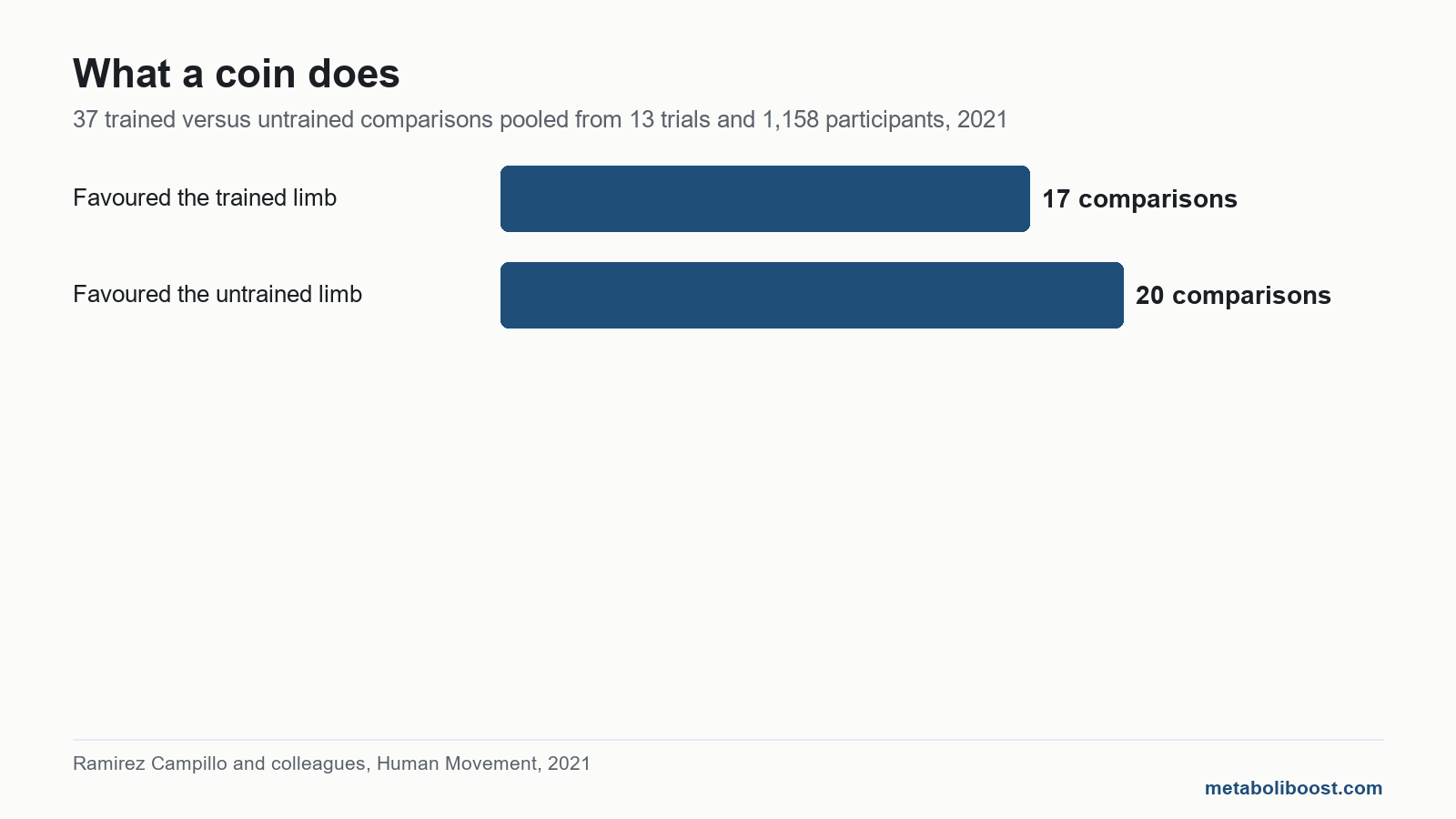
| Ramirez Campillo and colleagues, 2021, meta analysis | 13 trials pooled, 1,158 participants aged 14 to 71, 37 trained versus untrained comparisons | Localised fat in the trained limb against the untrained one | Pooled effect size 0.03 below zero, 95 percent CI 0.10 below to 0.05 above, p = 0.508. Of 37 comparisons, 17 favoured the trained limb and 20 the untrained one | Ramirez Campillo 2021 |
Two rows put an instrument on an actual back. Katch and colleagues, in Research Quarterly for Exercise and Sport in 1984, took fat biopsies from the abdomen, the subscapular site just below the shoulder blade and the buttock, then had participants perform 5,004 sit ups over 27 days. Fat cell diameter fell at all three sites, and no faster at the abdomen, the only region trained. Training the front of the trunk shrank fat cells on the back at the same rate.
Paoli and colleagues went the other way in a 2021 trial in the International Journal of Environmental Research and Public Health. Their circuit trained the abdomen and the triceps, and ultrasound found the fat over the spinal erectors, which nobody trained, fell 19.5 percent while the trained triceps site did not change. Fourteen people finished, so take the size of those numbers loosely and the direction seriously: the back moved and the trained arm did not.
Pooling the field, a 2021 review and meta analysis in Human Movement gathered 13 trials and 1,158 participants and found an effect indistinguishable from zero: of 37 trained versus untrained comparisons, 17 favoured the trained side and 20 the untrained one, which is what a coin does. The authors put the belief down to wishful thinking and convenient marketing, and it is hard to improve on that.

Why does fat sit on your back in the first place?
Largely because of things nobody picked. Waist to hip ratio, the usual stand in for fat distribution, is heritable to around 60 percent even after adjusting for body mass index, according to a review in Arteriosclerosis, Thrombosis, and Vascular Biology, which also notes that distribution is more strongly heritable in women and that the sex differences appear at puberty.
The pattern of storage is a trait, much like where you freckle. Losing fat changes how much is in each depot without renegotiating the ranking between them, which is why the region someone likes least often looks unchanged the longest. More on the hormonal side in why fat burns differently for men and women, and on the same problem at the flanks in what controls where fat sits around the waist.
Worth separating: fat on the back is subcutaneous, between skin and muscle, and it is not the depot most metabolic risk research concerns. That is visceral fat, packed around the organs, covered in our piece on the kind of fat that actually matters for health.
How much of what you see is fat, and how much is band, posture and skin?
This is the part the workout lists skip entirely, and it is the part that changes fastest. At least five different things show up in a mirror as one thing.
| What you are looking at | How it behaves | What actually changes it |
|---|---|---|
| Subcutaneous fat over the back | Falls only as total body fat falls, in a pattern largely set by sex and genes | Nothing regional. The whole body energy balance, over months |
| Muscle under the skin | Latissimus, trapezius and the spinal erectors change size and tone with training | Resistance training, which changes the contour without changing the fat over it |
| Bra band or waistband fit | A band that is too large, too worn or riding up creates a visible ridge above it | Fit, not fat. An oversized band was among the three most common faults found in self selected bras |
| Posture and shoulder position | Thoracic curve and scapular position change the surface geometry across the upper back | Mobility and strength work, and this one is mechanics rather than a measured effect on appearance |
| Skin | After very large weight loss the dermis is structurally weaker and retracts less | Not exercise. Documented after bariatric scale loss, not after losing a few kilos |
The band point is more than a quibble. When Coltman, Steele and McGhee assessed bras that women had chosen for themselves in 2018, an oversized band was one of the three most common faults, found in 29 percent of cases. A 2025 analysis in the International Journal of Fashion Design, Technology and Education assessed 24 women reporting fit problems against professional criteria: all 24 failed, with 77 faults between them. A band that rides up, or has stretched past its useful life, creates a ridge above it. That ridge is a report on the garment.
Posture works on the same surface. A review in the Journal of Chiropractic Medicine found forward head posture, rounded shoulders and increased thoracic curvature travel together, with scapular resting position shifting alongside. Change the curve of the upper spine and you change the geometry the skin is stretched over. No trial has measured whether that changes how back fat is perceived, so this is mechanics rather than evidence, and it is offered as such.
Skin is the third. A 2015 study in Eplasty compared samples from 30 people in three groups and found that after massive weight loss the dermis showed lower collagen density, fragmented elastic fibres and tensile strength of 13.31 MPa against 23.93 MPa in the normal weight group. That was loss on a bariatric scale, it should not be read onto someone who has lost a few kilos, and it is a matter for a doctor rather than a workout plan.
Before you blame fat: the band check
An oversized band was one of the three most common faults in bras women chose for themselves. Run these checks before deciding what the ridge is.
Fit checks drawn from the professional criteria cited on this page, not a measurement of fat. Ticks are saved on this device only.
What does the public record say about products that promise to target one area?
Nobody sells a trial. They sell a cream, a wrap or a garment, so the useful question is what happened when a regulator asked those sellers for their evidence. Three United States Federal Trade Commission records, read in full on 24 September 2026, answer it, and being records rather than personal accounts they are dated, attributable and countable.
In June 2011 the FTC settled with Beiersdorf over Nivea My Silhouette, a cream sold with the suggestion it could slim the waist. The company had bought sponsored search results against terms including stomach fat and thin waist, which is targeting a region about as literally as it can be done. The order bars any claim that a product applied to the skin causes substantial weight or fat loss or a substantial reduction in body size, unless two randomised double blind placebo controlled trials back it up.
L’Occitane settled in January 2014 over Almond Beautiful Shape and Almond Shaping Delight, creams advertised as clinically proven to reshape the silhouette. In March 2015 the FTC posted 10,620 refund cheques totalling more than 416,000 dollars, averaging about 39 dollars each, to people who had paid 44 and 48 dollars a jar.
Closest to the back specifically, final orders issued on 10 November 2014 barred Wacoal America and Norm Thompson Outfitters from unsubstantiated slimming claims for caffeine infused shapewear, with 1.3 million dollars and 230,000 dollars set aside for refunds. A garment can hold a shape while it is on. That was never the claim at issue.
The agency’s own media guidance, the Gut Check reference guide, published in January 2014 and still posted, puts it in one line: “Nothing you wear or apply to the skin can cause substantial weight loss.” Record and trials agree completely on direction. They differ only in scope: the trials tested honest exercise and found no regional effect, while the enforcement files concern sellers who claimed one anyway.
Consumer review platforms were searched too, and Reddit could not be reached by any route available here. The review sites returned refund disputes rather than dated, verifiable accounts of outcomes, so nothing from them is used above.

What actually changes the back, if not back exercises?
Two things, and neither is regional. Fat over the back falls when total body fat falls, which is a question of sustained energy balance and has no postcode. And the muscle under it changes with training, which changes the contour without touching the fat. Vispute’s participants got measurably better at abdominal work while their abdominal fat stayed put: the same result read from the other end.
Resistance training earns its place for a different reason. A 2022 meta analysis in the Scandinavian Journal of Medicine and Science in Sports found an energy deficit blunts lean mass gains from resistance training, pooled effect size 0.57 below zero, while strength gains held up. A systematic review in older adults with obesity found resistance training prevented the muscle loss calorie restriction otherwise caused. So rows and pull downs are not burning back fat. They protect the tissue underneath while fat comes off everywhere at once, which is a better deal than the one advertised. Our guide to six upper body movements done properly covers the mechanics.
If back or shoulder pain is part of the picture, or if weight is changing without any change in eating or activity, that is a reason to see a doctor rather than to start a programme. The same applies to anyone with an existing condition or taking regular medication before making a significant change to training or diet.
Frequently asked questions
Are back exercises pointless for back fat?
They do not remove the fat over the back, and no trial has shown that they can. They build the muscle underneath, which changes the shape of the area, and they help protect lean tissue while overall fat loss happens. Those are real returns, just not the advertised one.
Why does back fat seem to be the last to go?
Because where fat is stored, and the order in which depots give it up, is largely a heritable trait rather than a choice. Overall loss reduces every depot, but it does not rearrange the ranking, so the region someone notices most tends to look unchanged the longest.
Is fat on the back a health warning sign?
Fat over the back is subcutaneous, between skin and muscle, and it is not the depot that most metabolic risk research concerns. That research is largely about visceral fat around the organs. Any concern about health is a question for a doctor, not for a mirror.
Do creams, wraps or caffeine shapewear reduce back fat?
The regulatory record says no. The FTC has taken action against a cream marketer, a skincare brand and two shapewear companies over exactly these claims, and its media guidance states that nothing worn or applied to the skin causes substantial weight loss.
Does skin tighten again after losing weight?
It retracts to some degree, and how much depends on age, how much was lost and how long it was carried. Research on people after very large weight loss found the dermis structurally weakened, with fragmented elastic fibres. That is a surgical conversation, not an exercise one.
Is the roll above a bra band the same thing as back fat?
Often not, or not only. Research assessing self selected bras found an oversized band among the most common fit faults, and a band that rides up or has stretched creates a ridge in soft tissue regardless of how much fat is there. Changing the band changes the ridge without changing anything about you.
Finished the page? The same five questions from the top, to see what stuck.
This article is general information, not medical advice, and is not a substitute for care from a qualified healthcare professional. Speak to your doctor about your own situation.
Leave a Reply