Six movements cover the whole upper body: a horizontal push, a horizontal pull, a vertical pull, an overhead press, a side shoulder raise and a triceps extension. Learning those six properly beats collecting ten. None of them will remove fat from your arms or your back, which is a separate question with a separate answer.
Why six movements and not ten?
A list of ten exercises at forty words each is a list of names. It tells you what to search for and nothing about how to do it, and the how is the entire difference between a row that builds your back and a row that irritates your lower back.
The upper body has four jobs: push something away in front of you, pull something toward you, press something overhead, pull something down from overhead. Cover those four, add the two small muscles the big patterns undertrain, and nothing is missing. Everything else on the usual list is a variation. A chest press is a push-up with the load in your hands.
How do you actually perform each of the six?
The push-up, or the chest press when you want load in your hands
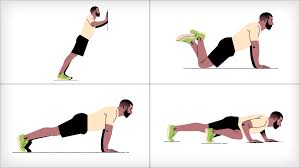
Set your hands slightly wider than your shoulders and level with the middle of your chest, not up under your chin. Squeeze your glutes, tuck your ribs down, hold one line from ear to ankle. Lower until your chest is a fist’s height off the floor, elbows travelling back at around 45 degrees from your ribs rather than flaring out to the sides. Press up without letting your hips sag or your head lead the way down.
If a full push-up is not there yet, raise your hands instead of dropping your knees: a kitchen counter, then a table, then a bench, then a low step. Each drop in height is a small increase in load.
The single arm dumbbell row
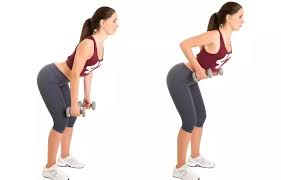
Put one knee and the same side hand on a bench, or stand and rest your free hand on something fixed. Hinge at the hips until your torso is close to parallel with the floor, back flat, neck in line with your spine. Let the dumbbell hang, then pull your elbow back past your ribs.
Drive the elbow rather than curling the weight, and let your shoulder blade slide toward your spine at the top instead of holding it locked. If your torso is rotating to help the weight up, the dumbbell is too heavy.
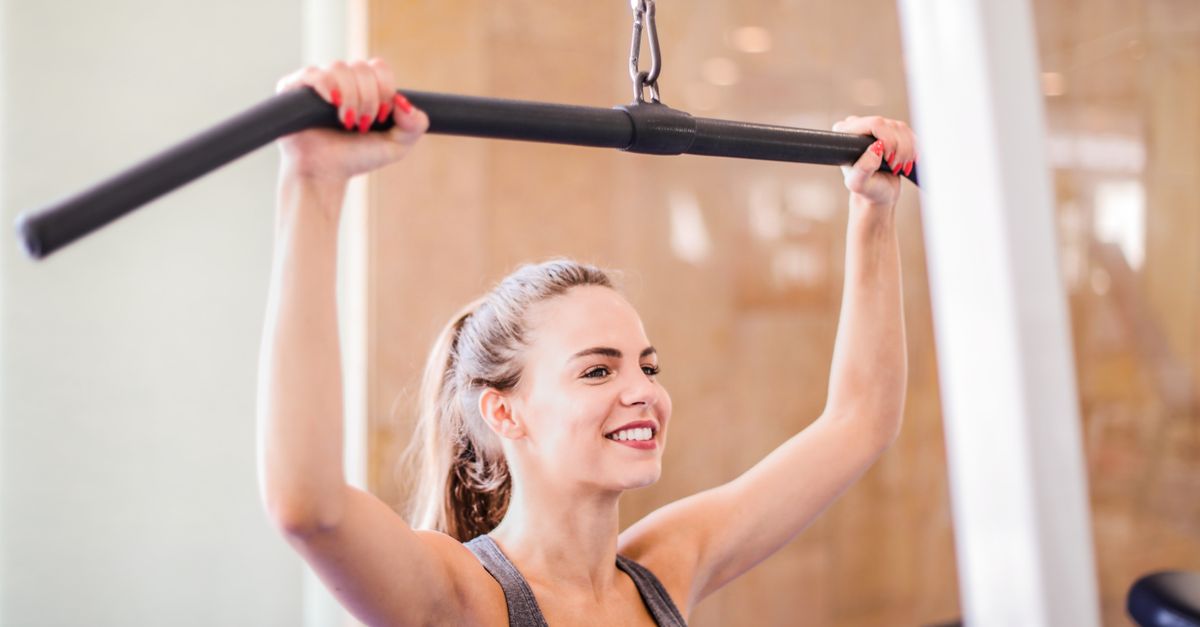
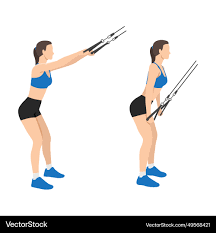
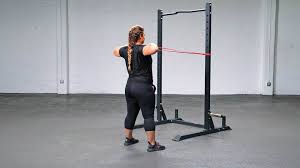
The lat pulldown, or a band pulldown at home
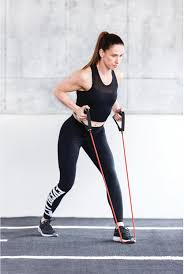
Grip slightly wider than your shoulders, anchor your thighs under the pad, lean back only 10 to 20 degrees. Pull the bar to your upper chest by driving your elbows down and back, as if into your back pockets, then let it travel all the way up so your shoulder blades rise at the top. Never pull behind your neck: it forces the shoulder into a position most people cannot hold well and trains nothing extra. At home, anchor a band overhead and use the same path.
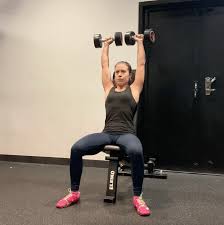
The overhead dumbbell press
Start with the dumbbells at shoulder height. Brace your abs and squeeze your glutes so your lower back does not arch as you press. Push up and very slightly in, until your arms are straight and your upper arms are beside your ears, then lower under control to about ear height.
The error to watch for is the lean. When the weight gets heavy, people tip backwards and quietly turn an overhead press into an incline chest press, which a bench with a back rest largely prevents.
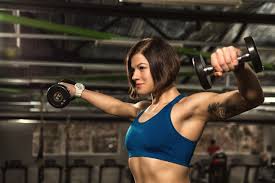
The lateral raise
Hold light dumbbells at your sides, lean forward a few degrees, keep a small fixed bend in your elbows. Lead with the elbows and raise to shoulder height, no higher, then lower over about two seconds. This is the one exercise where going lighter makes it work better. If your traps shrug toward your ears or the weights swing up, there is too much in your hands.
The triceps extension
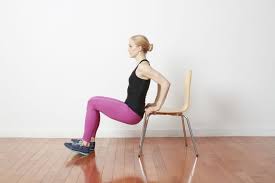
Overhead is the version worth learning, because the long head of the triceps is stretched in that position and gets trained more thoroughly. Hold one dumbbell in both hands behind your head, elbows pointing forward and kept narrow, upper arms still, only the forearms moving. Lower until you feel a stretch behind your upper arm, then straighten without slamming into a hard lockout. Bench dips put the shoulder into deep internal rotation that plenty of people do not tolerate, and a band pushdown is a safer swap.
Movement
Pattern it covers
Where to start
The error to watch for
Push-up or chest press
Horizontal push
Hands on a kitchen counter
Hips sagging, head leading
Single arm row
Horizontal pull
Light dumbbell, hand supported
Torso rotating to help
Lat or band pulldown
Vertical pull
Band from an overhead anchor
Pulling behind the neck
Overhead press
Vertical push
Seated, back supported
Leaning back under load
Lateral raise
Side of the shoulder
Lighter than you expect
Shrugging and swinging
Triceps extension
Back of the upper arm
One dumbbell, both hands
Elbows drifting wide
Does upper body training reduce fat on your arms and back?
No. Training a muscle does not empty the fat sitting on top of it, and no amount of arm work changes that.
A 2021 systematic review with meta-analysis in the journal Human Movement, led by Ramirez-Campillo, pooled 37 comparisons of trained against untrained limbs and found no localized fat loss. The pooled effect was essentially zero, at -0.03 with a 95 percent confidence interval of -0.10 to 0.05. Seventeen comparisons favoured the trained limb and twenty favoured the untrained one, which is what a coin flip looks like.
A few small trials since, mostly using abdominal work, have reported local effects, so the question is not entirely closed. What is not in dispute is the size of anything reported, which is nowhere near enough to plan around. Fat comes off across the whole body, in a pattern set largely by genetics and hormones, as how belly fat comes off covers in detail.
Building muscle changes your shape. It does not remove fat from the area you trained. Those are two different outcomes, and the second one is what most people asking this question actually want.
Train the upper body because muscle is worth having on its own terms: carrying, lifting and pushing get easier, and resistance training during weight loss helps you keep muscle that would otherwise leave alongside the fat.
Will lifting weights make your arms bulky?
Not by accident, and not quickly. The useful distinction is between absolute and relative gains. A 2025 systematic review with Bayesian meta-analysis published in PeerJ found that men gain more muscle in absolute terms, particularly in the upper body, while relative gains, meaning the percentage increase from wherever each person started, are similar between the sexes.
That cuts both ways. Women are not poor responders to strength training, they start with less upper body muscle and add less of it in kilograms. Visibly muscular arms are the product of years of deliberate, heavy, high volume training paired with eating to support it. Nobody arrives there by accident.
How often should you train, and how many sets?
The NHS physical activity guidelines for adults recommend strengthening activities working all the major muscle groups on at least two days a week, alongside 150 minutes of moderate aerobic activity. Two sets of each exercise is a workable minimum and three gives more benefit. That is a sensible floor and most people never reach it.
Rep ranges anywhere from roughly 6 to 15 build muscle, provided the set is taken close to the point where reps slow and form is about to go. A meta-analysis comparing lighter and heavier training loads found similar muscle growth across that spread, with the heavier end better for building strength. Then make something increase over the following weeks: one more rep, a heavier dumbbell, one more set. That progression is the mechanism, and without it you are maintaining.
What does one session look like?
Push-up or chest press. 3 sets of 6 to 12 reps.
Single arm row. 3 sets of 8 to 12 reps per side.
Lat pulldown or band pulldown. 3 sets of 8 to 12 reps.
Overhead press. 2 to 3 sets of 8 to 12 reps.
Lateral raise. 2 to 3 sets of 12 to 15 reps.
Triceps extension. 2 to 3 sets of 10 to 15 reps.
Rest 60 to 120 seconds between sets. Two of these a week, with the weight or the reps creeping up, is a complete upper body programme in about 40 minutes a session.
When is it worth asking a professional first?
Pain is not a form cue to push through. Sharp or pinching shoulder pain during pressing, pain that lingers well after a session, or numbness and tingling down the arm are worth taking to a physiotherapist or a doctor rather than training around.
The same goes for starting resistance training while pregnant or recently postpartum, recovering from surgery, or with a diagnosed joint or blood pressure condition. Not as a reason to avoid training, but because someone who knows your history can adapt the specifics better than an article can.
Frequently asked questions
Do arm exercises get rid of arm fat?
No. Training a muscle does not remove the fat sitting above it. The largest pooled analysis of trained against untrained limbs found no localized fat loss, with an effect close to zero. Fat comes off across the whole body in a pattern set largely by genetics and hormones, and no exercise choice redirects that.
Will lifting weights make me bulky?
Not by accident. Women gain less muscle than men in absolute terms while gaining a similar percentage from their own starting point. Visible muscularity is the result of years of heavy, deliberate training and eating to match it. You would notice the change long before anyone would call it bulky.
How heavy should the weights be?
Heavy enough that the last two or three reps are genuinely hard while your technique still holds. If you could comfortably do five more, it is too light. If your form falls apart before the target rep count, it is too heavy. That point keeps moving as you get stronger, which is the entire idea.
Can I train my upper body at home without a gym?
Yes. Push-ups against a counter or the floor, resistance band pulldowns and rows, and one pair of adjustable dumbbells cover all six patterns. The limit you eventually run into is available load rather than variety of equipment, and that takes a long time to arrive.
How often should I train upper body?
The NHS recommends muscle strengthening work on at least two days a week covering all the major muscle groups. Two upper body sessions a week at two to three sets per exercise meets that comfortably and leaves enough recovery between them.
My shoulder pinches on the overhead press. What now?
Switching to a neutral grip press with the palms facing each other, or an incline press, trains the same muscles in a position most shoulders tolerate better. If the pain persists, is sharp, or arrives with weakness or tingling, a physiotherapist or your doctor is the right next step rather than working around it.
This article is general information, not medical advice, and is not a substitute for care from a qualified healthcare professional. Speak to your doctor about your own situation.


Leave a Reply