
Is walking 3 miles a day good? For most adults, yes. Three miles is roughly 6,000 to 7,500 steps and about an hour at 3 mph, which clears the 150 minute weekly guideline on its own and lands near where large step studies saw the drop in death rates level off. Weight is a separate question.
Listen to this article, about 12 minutes. A synthetic voice reads the article and announces each section title as it begins; tables are read row by row and the questions at the end are left out.
Recorded 14 October 2026 from the article as published that day. Press a chapter to jump there; the highlighted line is what is playing. A play button sits beside every section heading, and once you scroll past this player a bar at the bottom of the screen keeps the controls in reach. Tap or click any sentence to hear the reading start from there.
On this page: where three miles sits on the 2022 step count curves with the hazard ratios and their confidence intervals, the calories at four body weights with the sum shown, the likely source of the 40 percent heart figure, and what 97 forum comments from walkers describe.
Think you already know this? Five questions, one minute.
Every answer is on this page. Answer from what you know now; the page fills in the rest.
-
1. Roughly how many steps is three miles for most adults?
A mile is 5,280 feet, and an adult stride of 2.1 to 2.6 feet gives about 2,000 to 2,500 steps a mile, so three miles is roughly 6,000 to 7,500. Read the section
-
2. In the 2022 pooled analysis, what was the hazard ratio for death in the quarter with a median of 5,801 steps, compared with the lowest quarter?
Paluch and colleagues in The Lancet Public Health report 0.60, with a 95% confidence interval of 0.51 to 0.71, against a median of 3,553 steps. Read the section
-
3. Which part of the adult activity guidelines does a daily walk not cover?
The NHS physical activity guidelines count brisk walking as moderate activity but ask separately for strengthening work on two days. Read the section
-
4. What MET value does the 2024 Compendium give walking at 2.8 to 3.4 mph on level ground?
Code 17190 in the Compendium walking list is 3.8 MET, so an hour at 3 mph is 3.8 times body weight in kilograms. Read the section
-
5. What did Hall and Chow say is the most serious error of the 3,500 kcal per pound rule?
In Why is the 3500 kcal per pound weight loss rule wrong? they wrote that this failure leads to overestimation of weight loss. Read the section
Most pages answering this list eight benefits and a heart statistic nobody links. Few say where three miles sits on the curves researchers actually drew, which is the interesting part, because three miles lands right where the curve bends.
How many steps is walking 3 miles a day?
Somewhere between about 6,000 and 7,500, depending on your stride. A mile is 5,280 feet. An adult stride of 2.1 to 2.6 feet works out at roughly 2,000 to 2,500 steps a mile, so three miles is three times that. Taller walkers land near the bottom of the range and shorter walkers near the top.
Time is easier to picture. A 2018 review of walking cadence in the British Journal of Sports Medicine found that about 100 steps a minute is a consistent and reasonable marker for moderate intensity in adults. At around that cadence a mile takes about 20 minutes, which is 3 mph, so three miles is close to an hour of walking.
One detail matters for everything below. The big step studies counted every step of the day: the walk to the car, the kitchen, the queue. A dedicated three mile walk sits on top of whatever you already do, so your daily total is higher than the walk alone.
What do the step count studies say about 6,000 steps?
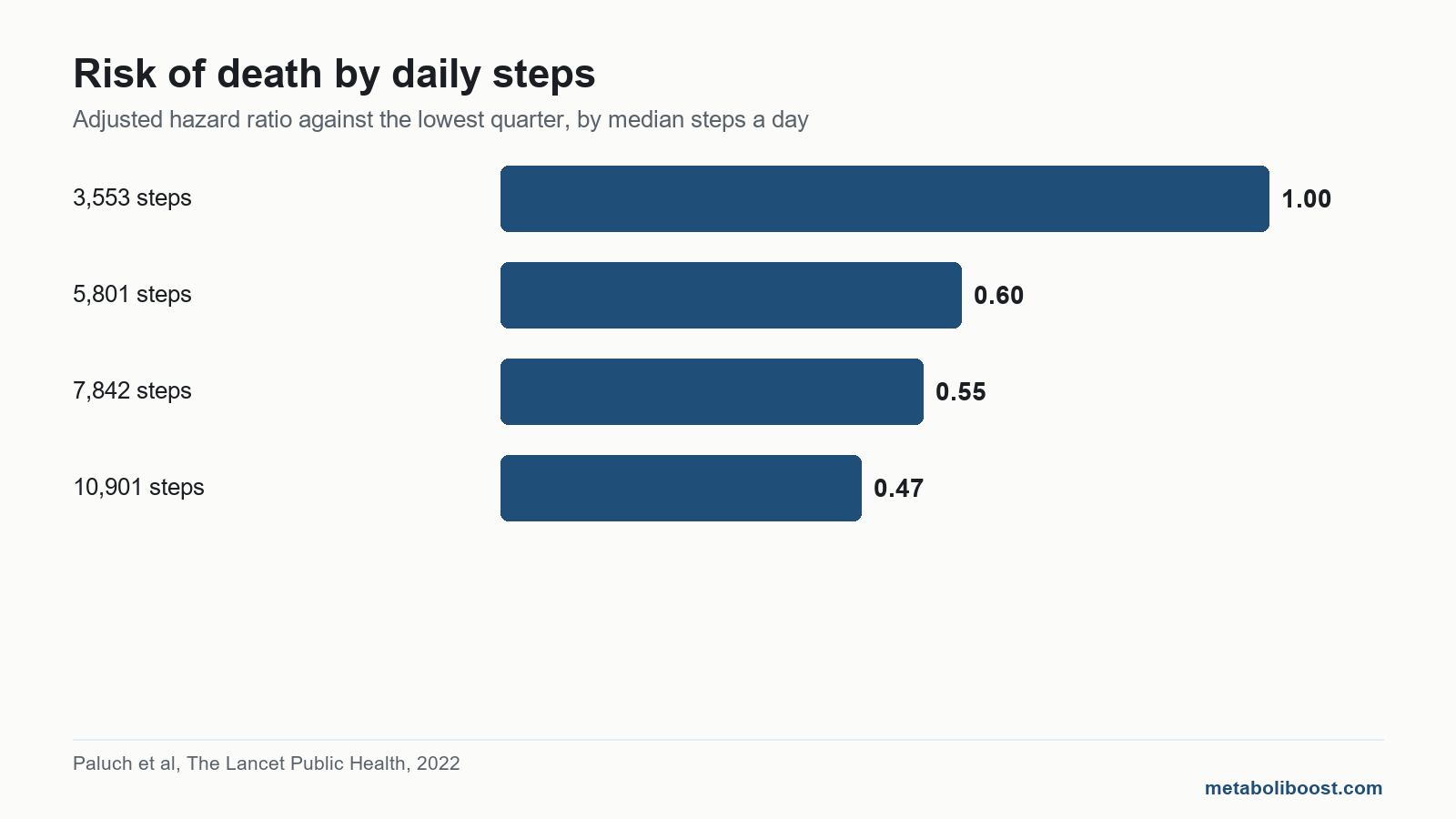
The best known answer is a pooled analysis by Paluch and colleagues in The Lancet Public Health in 2022. It combined 15 cohorts, 47,471 adults and 3,013 deaths, and split people into quarters by daily steps. Compared with the lowest quarter, at a median of 3,553 steps, the next quarter up, at a median of 5,801 steps, had a hazard ratio of 0.60, with a confidence interval of 0.51 to 0.71.
| Median steps a day in the quarter | Hazard ratio for death (95% CI) | What that means |
|---|---|---|
| 3,553 | Reference, 1.00 | Lowest quarter of the cohorts |
| 5,801 | 0.60 (0.51 to 0.71) | About 40 percent lower risk of death in follow up |
| 7,842 | 0.55 (0.49 to 0.62) | About 45 percent lower |
| 10,901 | 0.47 (0.39 to 0.57) | About 53 percent lower |
Most of the drop arrives between the first two rows. Nearly doubling from 5,801 to 10,901 steps moved the ratio only from 0.60 to 0.47: still a gain, but a smaller one per step.
The paper also found that age changed where the curve flattened. For adults aged 60 and over, the risk kept falling up to about 6,000 to 8,000 steps a day. For adults under 60, it kept falling up to about 8,000 to 10,000. The authors drew those age curves in a figure rather than printing a ratio at 6,000 steps, so we have not read a number off a picture and called it a finding.
A later review agrees on the shape. Ding and colleagues, writing in The Lancet Public Health in 2025, pooled studies of device measured steps and found that 7,000 steps a day, compared with 2,000, went with a hazard ratio for death of 0.53, with a confidence interval of 0.46 to 0.60. They placed the bend in the curve at around 5,000 to 7,000 steps.
All of this is observational. People who walk more also differ in health, income and a dozen other ways, and the authors adjust for what they can. These studies show that more steps went with lower risk, not that a given walk buys a given amount of life. That caveat is boring, which is exactly how you know it is important.
Does a daily 3 mile walk meet the exercise guidelines?
Comfortably, for the aerobic part. The NHS physical activity guidelines for adults aged 19 to 64 ask for at least 150 minutes of moderate intensity activity a week, or 75 minutes of vigorous activity, and list brisk walking as moderate. An hour a day, seven days a week, is 420 minutes. That is nearly three times the floor.
The same guidelines also ask for activities that strengthen the major muscles on at least two days a week, and walking does not count for that part. So a three mile habit covers one half of the advice very generously and the other half not at all. If you were hoping the walk could do everything, it is a very good walk, not a gym membership.
How many calories does a 3 mile walk use?
For most adults, somewhere between about 230 and 380 kcal in total, depending mainly on body weight. The 2024 Compendium of Physical Activities lists walking at 2.8 to 3.4 mph on level ground, code 17190, at 3.8 MET. One MET is roughly the cost of sitting still, about 1 kcal per kilogram per hour. So an hour at 3 mph is 3.8 times your weight in kilograms.
| Body weight | Total kcal, 3 miles at 3 mph | Extra to what rest would burn |
|---|---|---|
| 60 kg (132 lb) | 228 kcal | 168 kcal |
| 70 kg (154 lb) | 266 kcal | 196 kcal |
| 85 kg (187 lb) | 323 kcal | 238 kcal |
| 100 kg (220 lb) | 380 kcal | 280 kcal |
The second column is the one people forget. You would have burned roughly 1 MET in that hour anyway, sitting on the sofa, so the walk’s own contribution is the extra column, not the total. Fitness trackers usually show the total. For more paces and body weights, and the sum laid out, see our walking calorie calculator with the Compendium values.
Is walking 3 miles a day good for weight loss?
It helps, but not in the way calculators suggest, and nobody can honestly tell you how much it will move your own weight. The American College of Sports Medicine position stand from 2009 concluded that 150 to 250 minutes a week of moderate activity provides only modest weight loss on its own. What happens to food intake matters more.
The usual shortcut is to divide the calories walked by 3,500 and call the answer pounds. That rule has been taken apart. Kevin Hall and Carson Chow of the NIH, in a 2013 paper titled Why is the 3500 kcal per pound weight loss rule wrong?, wrote that its most serious error is its failure to account for dynamic changes in energy balance, and that it leads to overestimation of weight loss in individuals and populations. The body adapts, appetite shifts, and the neat arithmetic stops being neat.
Where walking does show up is in the long run. Trials of people who had already lost weight tend to find that the ones who stayed more active regained less, a pattern covered in our piece on what the walking trials found about regain. A daily walk is a decent tool for keeping a change, and a poor one for forcing it.

Where does the 40 percent heart figure come from?
Several pages ranking for this question say the American Heart Association states that walking three miles a day cuts heart attack and stroke risk by 40 percent. None of them links to it, and we could not find that statement. The likeliest source is a real study published in the American Heart Association journal Circulation in 2023, again led by Amanda Paluch.
That analysis pooled eight studies and 20,152 adults. In adults aged 60 and over, the University of Massachusetts summary reports, those taking about 6,000 to 9,000 steps a day had a 40 to 50 percent lower risk of cardiovascular disease than those taking about 2,000. It was not about three miles, it was not about everyone, and the comparison was with very low activity. The figure is real. The way it gets quoted is a game of telephone.
What do people who walk this much every day report?
We read two recent public threads, 97 comments in all, for what walkers describe once the habit is in place. This is what people report, not evidence, and nothing here is a result anyone should expect for themselves.
In a May 2026 r/loseit thread asking how much walking really helps, the most repeated point was that tracker calorie numbers vary a lot: one person’s watch credited about 200 kcal for a walk, another’s about 130, and a commenter advised eating back no more than half of any estimate. Several shorter women said the main gain was room in their day to eat a bit more and feel less hungry. One found walking outdoors far easier to keep up than a treadmill. Another uses a walk to get away from boredom snacking. Many put mood first. A good number of replies also leaned on the 3,500 calorie arithmetic that Hall and Chow say overstates the result.
In a July 2026 r/xxfitness thread, a 22 year old described knee and foot pain after a period of about 10,000 steps a day. The replies split in an instructive way. Many said they walk 15,000 to 25,000 steps without trouble, a couple said soreness eased once they built up gradually, and most pointed to footwear or gait, assessed by a podiatrist or physiotherapist, rather than the step count itself.
Where this agrees with the research: walking is easy to repeat, and repeatability is what the step curves reward. Where it does not: the forum arithmetic for weight is far more confident than any trial.

When is a daily 3 mile walk not the right plan?
Pain that comes on during walking and does not settle, chest discomfort, unusual breathlessness, dizziness or calf pain that stops you walking are reasons to stop and get checked by a doctor before building up. Anyone with a heart condition, diabetes affecting the feet, or recent surgery should ask their own clinician how much walking suits them.
From 2,000 or 3,000 steps a day, three miles daily is a big jump, and the curves above say the first few thousand extra steps carry most of the benefit anyway. If summer heat is part of the picture, our piece on what summer walking does and does not change covers the warning signs of heat illness.
So, is walking 3 miles a day good? Yes, as a health habit it sits in a well supported spot on the curve. Treat the weight side as a bonus you cannot schedule, and add something for your muscles twice a week.
Frequently asked questions
Is walking 3 miles a day enough exercise?
For the aerobic part of the guidelines, yes: about an hour a day is roughly 420 minutes a week against an NHS minimum of 150. It does not cover the two days of muscle strengthening the guidelines also ask for.
How long does it take to walk 3 miles?
About an hour at 3 mph, the pace the Compendium files as moderate. At a brisker 3.5 to 4 mph it takes roughly 45 to 50 minutes, and at a gentle 2.5 mph about 72 minutes.
Is it better to walk 3 miles at once or split it up?
The big step studies counted total daily steps and found inconsistent evidence that intensity mattered beyond the total. Splitting it into two or three walks is a reasonable way to reach the same number.
Does walking faster make 3 miles better?
A faster pace uses more energy per minute and finishes sooner. In the 2022 pooled analysis, the link between faster stepping and lower mortality weakened once total steps were accounted for, so the total carried most of the weight.
Is walking 3 miles a day good for older adults?
In the 2022 analysis, the benefit for adults aged 60 and over kept growing up to about 6,000 to 8,000 steps a day, which three miles plus normal daily movement often reaches. Balance, joints and heart health are worth discussing with a GP before a big increase.
Should I walk 3 miles every day or take rest days?
Walking is low impact and many people do it daily. Persistent pain is the signal to ease off and have it assessed rather than push through.
Finished the page? The same five questions from the top, to see what stuck.
This article is general information, not medical advice, and is not a substitute for care from a qualified healthcare professional. Speak to your doctor about your own situation.
Leave a Reply