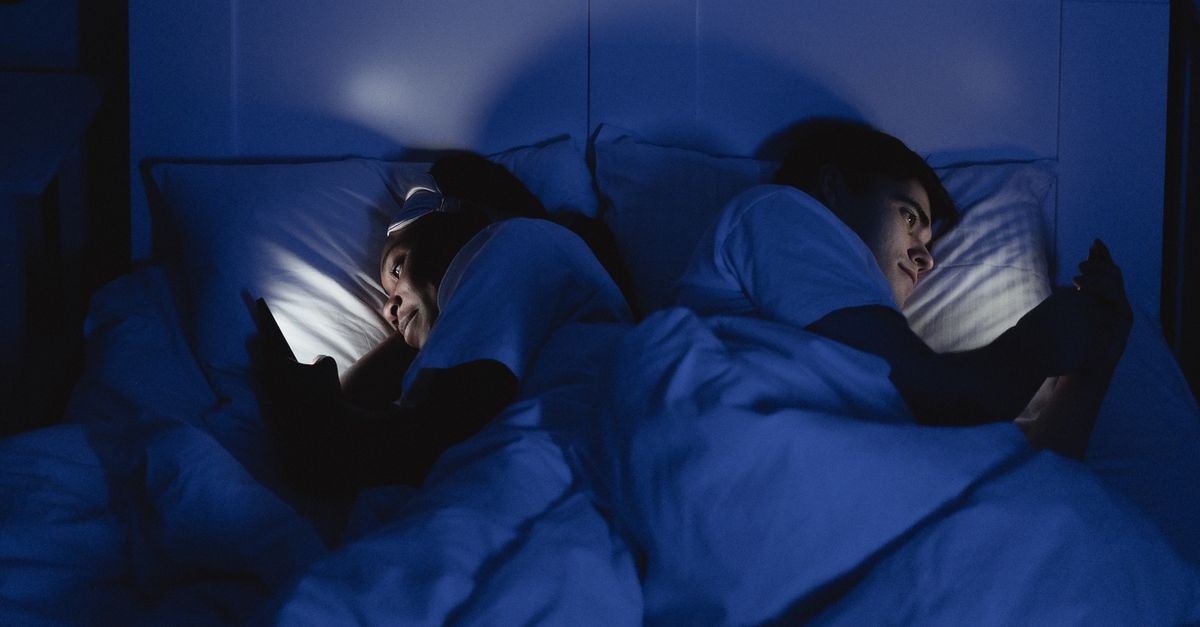
Screens at night affect your weight mainly by pushing bedtime later and shortening sleep, not by the blue wavelength itself slowing your metabolism. Short, irregular sleep raises appetite, cuts next day movement and adds waking hours for eating. Darkness and a consistent bedtime matter far more than blue light filters.
What does screen light actually do at night?
Your body clock reads light as a signal about the time of day. Short wavelength light, the blue enriched light that fills daylight and pours out of most screens, is the strongest signal it responds to. Late in the evening that signal tells your brain it is still afternoon, so melatonin release is delayed and the whole clock drifts later.
That much is solid. In a controlled trial, people who read from a light emitting e-reader for four hours before bed took longer to fall asleep, released less melatonin, had their circadian clock shift later and were measurably less alert the next morning than when they read a printed book under dim light. The results are published in full as Evening use of light emitting eReaders negatively affects sleep, circadian timing, and next morning alertness.
So the first half of the popular story holds up. Evening screen light really does delay your body clock. It is the second half, the part about fat burning, that falls apart.
Does blue light cause weight gain, or is it the lost sleep?
It is the lost sleep. There is no human evidence that blue light slows fat burning or flips your body into a storage mode. Melatonin is a timing hormone, not a fat burning hormone, and suppressing it for one evening does not make your body cling to calories.
What the evidence does support is a chain, and every link in it runs through sleep rather than through light:
- Screen light and engaging content push your bedtime later
- A later bedtime against a fixed wake time means less total sleep
- Short sleep raises appetite, adds waking hours in which eating is possible, and lowers how much you move the following day
- Less movement and more intake, repeated across months, changes weight
The wavelength is only the first domino, and it is the smallest one. What is on the screen matters at least as much as its colour temperature. A tense group chat or a cliffhanger episode at midnight will keep you awake whatever filter you have switched on.
Why does short sleep make you eat more the next day?
Laboratory studies that restrict sleep under controlled conditions find fairly consistently that people eat more when they sleep less, often a few hundred extra calories, and mostly in the evening. Our breakdown of the trials that counted calories after short sleep sets those figures side by side, study by study. The effect is real. The usual explanation for it is shakier than it sounds.
That explanation is hormonal: ghrelin, which signals hunger, rises, and leptin, which signals fullness, falls. Both changes have been measured, but they are small, and researchers have argued that they are too small to account for the extra eating on their own. That argument is set out in Increased food intake by insufficient sleep in humans: are we jumping the gun on the hormonal explanation?.
Plainer explanations do much of the work. More waking hours mean more chances to eat. Tiredness lowers your resistance to food you would otherwise walk past. Short sleep also reduces insulin sensitivity the following day and quietly cuts spontaneous movement, the walking and fidgeting that make up a real share of daily energy use. None of this is dramatic on any single night. That is exactly why it goes unnoticed for months.
Do blue light glasses and night mode actually work?
This is where popular advice and the evidence separate most sharply, because the two fixes people reach for first are the two with the least behind them.
Cochrane pooled 17 randomised trials of blue light filtering spectacle lenses and found the effect on sleep quality inconclusive, with trials reporting mixed results across different groups of people, and no advantage over ordinary lenses for eye strain from computer use. The plain language summary is Blue light filtering spectacle lenses for visual performance, macular protection and improving sleep quality. The trials were mostly small and ran for five weeks at most, so this is not proof that filters do nothing. It is a clear signal that they are not the lever they are sold as.
Phone night modes have a related problem. They shift the display warmer, which does cut short wavelength output, but they barely touch brightness and they do nothing at all about the reason the phone is still in your hand at one in the morning.
| What you change | What the evidence actually shows | Effort against payoff |
|---|---|---|
| Blue light filtering glasses | Cochrane found effects on sleep quality inconclusive across 17 trials | Easy to do, weak support |
| Phone night mode or warm screen | Cuts short wavelength output but leaves brightness and content untouched | Free, weak support |
| An earlier and consistent bedtime | The route every documented weight effect actually travels through | Hardest to do, strongest support |
| A properly dark bedroom | Sleeping with a light or television on is linked to more weight gain in a large cohort | Free, moderate support |
| Phone charging outside arm reach | Removes the trigger instead of filtering it, so screen time falls rather than changing colour | Easy, reliable in practice |
| Dimmer room lighting after dark | Ceiling LEDs are often brighter at your eye than a phone held at reading distance | Cheap, plausible and overlooked |
Does the light in your bedroom while you sleep matter?
Possibly, and it gets far less attention than screens do. Researchers followed 43,722 women in the Sister Study and found that those who slept with a light or a television on in the room were 17 percent more likely to have gained 5 kilograms or more over the follow up than women who slept in the dark. A small nightlight showed no association at all, and light coming from outside the room showed a weaker one. The finding is summarised by the National Institute of Environmental Health Sciences as Exposure to light at night and obesity.
This is observational, so it cannot show that the light caused the weight gain. People who fall asleep with the television on may differ in other ways that also affect weight. But the study is large, the association tracks the dose, and switching a light off costs nothing and risks nothing, which is a rare combination.
How do you fix late night screens without giving up your phone?
Screen abstinence almost nobody sustains, so it is a poor plan. The realistic goal is to protect two things: the last hour before sleep, and the hours you are actually asleep.
- Anchor the wake time before the bedtime. A fixed wake time every day, weekends included, drags bedtime earlier on its own. Trying to fall asleep earlier while your wake time floats rarely holds.
- Cut the arousing content, not all screens. A calm episode affects sleep very differently from an argument in a comment thread. Decide what stops at a set hour rather than banning the device.
- Charge the phone across the room. This does more than any filter, because it removes the decision rather than softening it.
- Dim the room, not only the screen. Switch to lamps and warm bulbs after dark and leave the ceiling lights off.
- Make the bedroom genuinely dark. Curtains, no standby lights, no television left running. A small nightlight appears to be fine.
- Move your last real meal earlier. Most of the extra eating that follows short sleep happens late at night, so an earlier finish removes the window rather than relying on willpower inside it.
The NHS guidance on sleep and tiredness covers the same ground on routine, caffeine and daylight, and is a reasonable place to start if the basics are not in place yet. It is also worth reading alongside our piece on how better sleep supports fat loss, which goes deeper on the sleep side.
When is this worth raising with a doctor?
Persistent trouble falling or staying asleep despite a stable routine, loud snoring or gasping at night, daytime sleepiness that more sleep does not fix, or weight change you cannot explain are all worth taking to a doctor rather than treating as a discipline problem. Sleep apnoea in particular is common, frequently missed, and tied to weight in both directions, so it is one of the more useful things to rule out early.
This article is general information, not medical advice, and is not a substitute for care from a qualified healthcare professional. Speak to your doctor about your own situation.
Does blue light directly slow your metabolism?
No. There is no human evidence that blue light changes how fast you burn energy. What it does is delay your body clock, and the weight effects follow from sleeping less and later, not from the light acting on your metabolism.
Are blue light blocking glasses worth buying for weight management?
Cochrane pooled 17 trials and found the effect on sleep quality inconclusive. The glasses are unlikely to do harm, but nothing supports them as a weight tool. An earlier and more consistent bedtime has far more behind it.
Is night mode on my phone enough?
It reduces short wavelength output but leaves brightness and content unchanged. Most of the sleep lost to evening phone use comes from staying engaged, so night mode addresses the smaller half of the problem.
How much sleep does weight management actually need?
Most adults need roughly seven to nine hours. Consistency matters as much as the total: the same wake time every day, weekends included, does more for appetite and daytime activity than chasing a number on some nights and not others.
Does sleeping with the television on affect weight?
In a large observational study of women, sleeping with a light or a television on in the room was linked to a higher chance of gaining 5 kilograms or more. That design cannot prove cause, but a dark room is free and carries no downside.
Will fixing my sleep on its own reduce my weight?
Not by itself. Better sleep makes appetite easier to manage and next day movement more likely, which supports whatever else you are doing about diet and activity. Treat it as a foundation rather than a treatment, and speak to a doctor about your own situation.
Leave a Reply