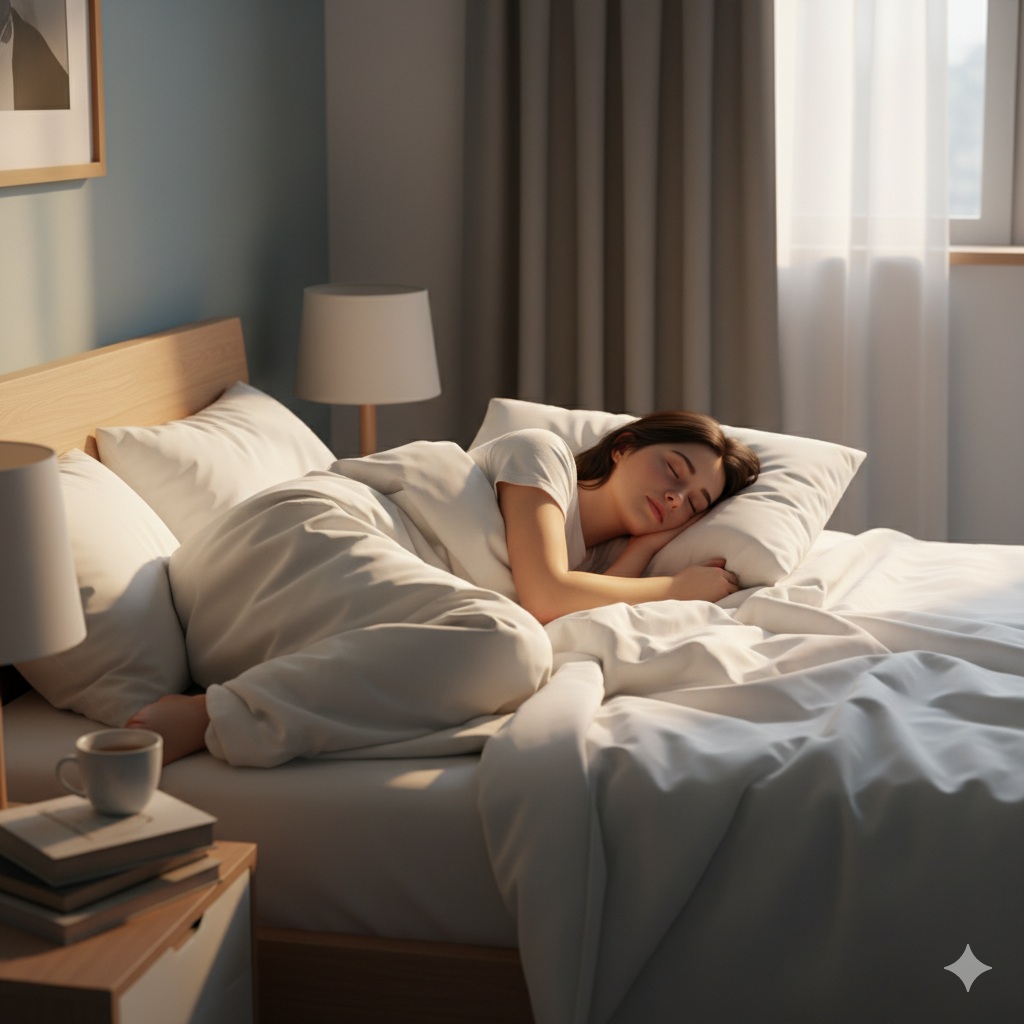
Sleep does not burn fat. What it changes is how much you eat the next day and what your body gives up when you are in a deficit. In trials, short sleepers who slept longer ate measurably less, and dieters kept short of sleep lost a smaller share of their weight as fat.
Does sleeping more actually burn fat?
Not directly, and the direct version is worth taking apart before anything else. A sleeping body uses less energy per hour than a waking one. On the narrow question of calories burned, more sleep burns fewer of them, not more.
A controlled study makes the point cleanly. In this inpatient study published in the Proceedings of the National Academy of Sciences, five nights of insufficient sleep raised the total daily energy expenditure of sixteen adults by about 5 percent, simply because staying awake longer costs energy. They still gained weight across those days. Food intake, particularly in the hours after dinner, rose by more than the extra expenditure did.

So the popular claim has the arrow pointing the wrong way. What sleep influences is the other side of the ledger: how much people eat, when they eat it, and what the body draws on while they are eating less than they need. Those are the effects with trial evidence behind them, and they are quite enough on their own without inventing an overnight furnace.
What happened when short sleepers were given more sleep?
The most useful trial in this area recruited people who were already short of sleep rather than people sleeping normally, which turns out to be the distinction that decides who benefits. In a randomised clinical trial in JAMA Internal Medicine, 80 adults with overweight who habitually slept under 6.5 hours a night received either one session of personalised sleep counselling or no change, then went home and lived ordinarily for two weeks.
Sleep in the extension group rose by roughly 1.2 hours a night. Energy intake, measured objectively rather than collected from food diaries, fell by around 270 kcal a day relative to the control group. Nobody in the trial was told to eat less. The instruction concerned sleep, and the eating followed on its own. A write up from the National Institutes of Health sets out the design and the caveats.
Read the entry criteria before generalising from it. Everyone enrolled was carrying extra weight and sleeping under 6.5 hours, which is precisely the group with room to extend. Two weeks is a short window, individual responses varied widely around that average, and it ran at a single centre. Nothing in it says a person already sleeping seven or eight hours gains anything by adding a ninth.
Does short sleep change what you lose on a diet?
This is the finding that reframes the whole question, and it is not about the number on the scale. Ten overweight adults completed two separate 14 day periods on the same moderate calorie restriction, once with 8.5 hours in bed each night and once with 5.5. The crossover study in Annals of Internal Medicine matched the calories in both conditions. Only the sleep differed.
Total weight lost came out similar either way. Where that weight came from did not. Under short sleep the proportion of weight lost as fat fell by about 55 percent, with more of the loss arriving from fat free mass, the muscle and tissue that somebody dieting is usually trying to hold on to. Reported hunger ran higher in the short sleep condition as well.
The caveat is the sample. Ten people, in a laboratory, for a fortnight. It is the most quoted result in this field and it rests on a very small study, which is worth carrying with you whenever you see it stated as settled fact. It has not been contradicted, but nor has it been repeated at scale.
Are ghrelin and leptin really the explanation?
The version that travels furthest is hormonal: short sleep raises ghrelin, which drives hunger, and lowers leptin, which signals fullness, so you eat. It is tidy, it is easy to remember, and the evidence underneath it is considerably messier than the telling.
Systematic reviews disagree with one another. A systematic review and meta analysis in Obesity Reviews found ghrelin higher in short sleepers, while other pooled analyses report no clear effect of sleep loss on either hormone. The proposed reasons are methodological: whether participants ate freely or on a fixed schedule while blood was being drawn, how often and at what hour it was drawn, and the body weight of the people enrolled.

The behaviour is far more reliable than its supposed mechanism. That people eat more after short nights shows up repeatedly across designs, and the controlled studies that measured extra eating after short nights put a calorie figure on each one. Which hormone is responsible, and whether a hormone is responsible at all rather than a longer evening with food within reach, is unresolved. The gap matters commercially, because a neat hormonal mechanism is exactly what gets attached to products, and it is the least solid part of the picture.
How much sleep is enough, and does going to bed before midnight matter?
NHS guidance on sleep and tiredness puts most healthy adults at around 7 to 9 hours a night, and is careful to add that the figure varies with age, health and daily routine. The practical test it offers is how you feel and function during the day, rather than a score produced by a wearable overnight.
The midnight rule is the piece with least behind it. Deep slow wave sleep is loaded into the first cycles of a sleep episode, whichever hour that episode happens to begin. Starting at eleven does not unlock a repair window that starting at one slams shut.
What genuinely travels with late nights is everything else about them: a longer evening, food available for more of it, and a wake time usually fixed by work regardless of when you got in. Consistency has better support than clock time. A schedule that stays roughly the same across the week is what produces the sleep those trials were extending.
Which sleep changes are worth making?
Ordered by evidence rather than by how often each one appears in a list of tips.
| What people try | What it actually changes | How much it is worth |
|---|---|---|
| Extending sleep when you habitually get under 6.5 hours | Lowered measured daily energy intake in a randomised trial, with no diet advice given | Large, and the only row with a trial behind it |
| Treating pain, reflux or disordered breathing that wakes you | Removes the thing fragmenting the night, which no bedtime routine offsets | Large where it applies |
| Keeping sleep and wake times roughly consistent | Makes the hours you get more reliable, which is the variable the trials moved | Real, and costs nothing |
| A dark, cool, quiet room | Reduces the awakenings that quietly shorten total sleep | Modest and worth having |
| Cutting screens or late caffeine | Helps some people fall asleep sooner. Effect sizes are modest and vary a lot | Modest |
| Going to bed before midnight specifically | Nothing by itself. Deep sleep loads the early cycles of whichever night you have | Close to nothing as a rule |
| Magnesium rich foods taken for sleep | Evidence in people who are not deficient is weak and mostly short term | Small |
| Sleeping longer when already getting 7 to 9 hours | No trial shows a gain. The trials recruited habitual short sleepers | Nothing to expect |
| Watching a sleep tracker score | Measures something, changes nothing on its own, and can add anxiety about sleep | None directly |
The top three rows carry almost all of the effect. Notice how much of the familiar advice sits in the modest and small bands. That is not a reason to skip it, but it is a reason not to expect much from a pillow spray when the actual reason you are awake is a small child or a rotating shift.
Short sleep is a plausible contributor to weight that is not moving, and it is rarely the only one. Treating it as the single missing key tends to end in disappointment, since the trial that changed intake changed it by a moderate amount, in people genuinely short of sleep to begin with.
When is poor sleep a medical question rather than a habit one?
Some sleep problems do not respond to routines, because a routine is not what is breaking them. Loud snoring with pauses in breathing, waking unrefreshed after a full night in bed, or sleepiness that intrudes on driving and ordinary daytime tasks is the pattern that prompts assessment for obstructive sleep apnoea. It is more common in people carrying extra weight, and it is identified by a sleep study rather than a symptom checklist.
Trouble falling or staying asleep on most nights for three months or more is chronic insomnia, and the recommended first line treatment is a structured cognitive behavioural programme rather than sleeping tablets. Both of these are conversations with a doctor, and putting one off usually costs more than the lost sleep does.
The honest summary is narrower than the usual promise and rather more useful. Sleep does not burn fat. Among people genuinely short of it, extending sleep lowered how much they ate without anyone raising the subject of food, and restricting sleep during a diet appears to shift the loss away from fat and toward tissue nobody wants to lose. If you are already getting seven to nine hours, this particular lever has been pulled, and the reason the weight is not moving lies somewhere else entirely.
Frequently asked questions
Does sleeping more burn more calories?
No. A sleeping body uses fewer calories per hour than a waking one. Inpatient research found that five nights of insufficient sleep actually raised total daily energy expenditure by about 5 percent, because extra waking hours cost energy, and participants still gained weight because they ate more than that difference. Sleep acts on intake and on body composition, not on overnight burn.
How many hours of sleep do adults need?
NHS guidance puts most healthy adults at around 7 to 9 hours a night and stresses that the right amount differs from person to person depending on age, health and routine. The practical test it suggests is how you feel and function during the day rather than a number reported by a tracker, which measures sleep less accurately than most people assume.
Will sleeping longer help if I already get eight hours?
There is no trial evidence that it will. The sleep extension research recruited adults who habitually slept under 6.5 hours, which is the group with room to gain, and its results do not transfer to people already sleeping adequately. Spending more time in bed than you can actually sleep tends to fragment the night rather than lengthen it.
Does poor sleep cause belly fat specifically?
There is no good evidence that sleep targets one fat depot. Where the body stores fat is influenced largely by genetics, sex and age, and no habit directs it to a particular area. What controlled work does show is that restricting sleep during calorie restriction shifted the composition of the loss, with a smaller share of it coming from fat.
Is it true that sleep before midnight counts double?
No. Deep slow wave sleep is concentrated in the first cycles of a sleep episode whenever that episode starts, so the clock hour is not doing the work the saying gives it credit for. Regularity has better support than bedtime. What does travel with late nights is a longer evening with food available and a wake time still fixed by work.
When is it worth seeing a doctor about sleep?
Loud snoring with pauses in breathing, waking unrefreshed after a full night, or sleepiness that intrudes on driving and daytime tasks are the signs that prompt assessment for obstructive sleep apnoea, which is diagnosed with a sleep study. Trouble sleeping on most nights for three months or more is chronic insomnia, where the first line treatment is a cognitive behavioural programme. Both are worth raising with a doctor rather than working through habit lists.
This article is general information, not medical advice, and is not a substitute for care from a qualified healthcare professional. Speak to your doctor about your own situation.
Leave a Reply