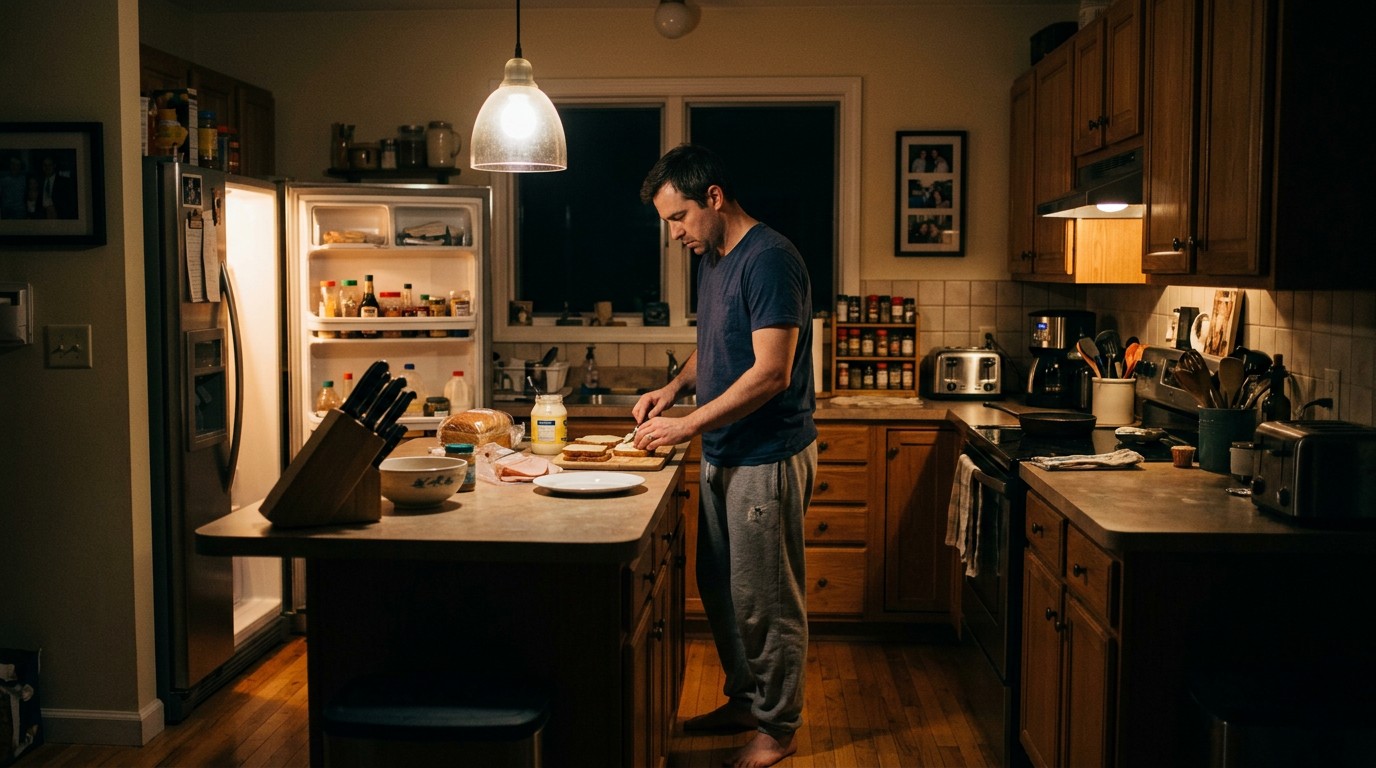
Does lack of sleep cause weight gain? It can, and mostly by making people eat more rather than burn less. In controlled trials, adults kept short of sleep ate roughly 300 to 550 extra calories a day, much of it late at night, while their energy use barely moved. The popular hormone explanation is far shakier.
Listen to this article, about 10 minutes. A synthetic voice reads the article and announces each section title as it begins; tables are read row by row and the questions at the end are left out.
Recorded 6 October 2026 from the article as published that day. Press a chapter to jump there; the highlighted line is what is playing. A play button sits beside every section heading, and once you scroll past this player a bar at the bottom of the screen keeps the controls in reach. Tap or click any sentence to hear the reading start from there.
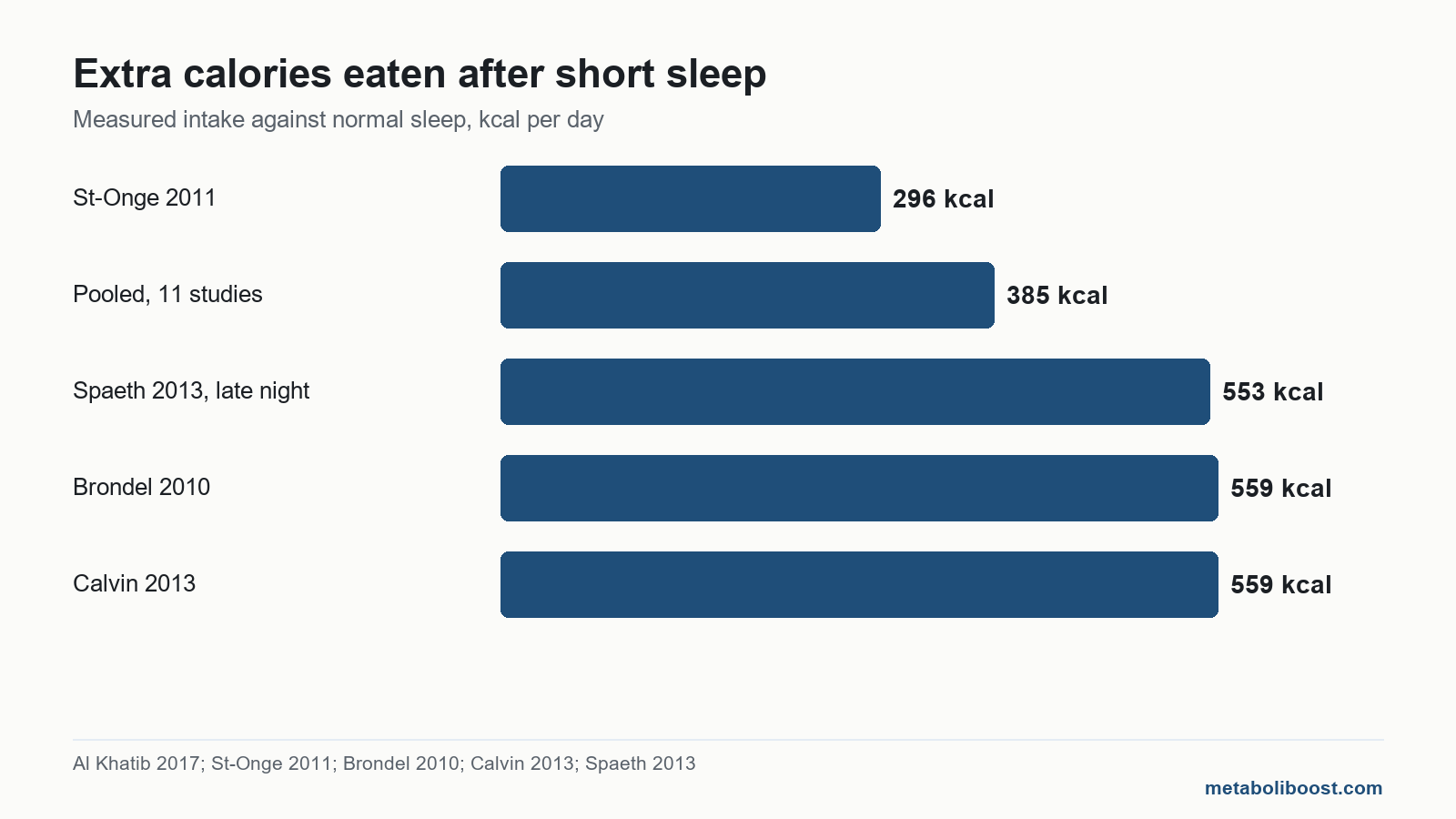
On this page: five controlled trials that counted every calorie eaten after short sleep in one table, a chart of the extra intake they measured, the 2026 trial that found leptin rising instead of falling, and a week long sleep and late eating log.
Think you already know this? Five questions, one minute.
Every answer is on this page. Answer from what you know now; the page fills in the rest.
-
1. In the 2017 meta-analysis of 11 studies, what happened when people were short of sleep?
Al Khatib and colleagues found intake rose by about 385 kcal a day with no significant change in energy expenditure. Read the section
-
2. In the 2026 Columbia pooled trial, what changed when sleep was restricted for six weeks?
In the Zuraikat analysis energy expenditure measured with doubly labelled water barely differed, while sedentary time rose by about 17 minutes a day. Read the section
-
3. What did the 2026 Columbia trial find for leptin under sleep restriction?
Leptin was higher with sleep restriction in the pooled trial, the opposite of the 2004 finding in 12 young men. Read the section
-
4. What can the 2008 meta-analysis of more than 600,000 adults show about short sleep and obesity?
Cappuccio and colleagues pooled mostly cross sectional data, which show short sleepers had higher odds of obesity but cannot establish cause. Read the section
-
5. According to the NHS, which of these is a main sign of obstructive sleep apnoea?
The NHS page lists breathing stopping and starting, loud snoring and feeling very tired in the day, and advises seeing a GP. Read the section
Most pages answering this question tell the same tidy story about two hunger hormones. The trials that actually weighed people’s food tell a plainer and more useful one, and they disagree with the hormone story in ways worth knowing before anyone sells you a fix for it.
What happens to eating when sleep is cut short?
Researchers have tested this the hard way: put adults in a lab or a closely monitored setting, cut their sleep, offer food freely, and count every calorie eaten against a normal sleep condition. The results line up unusually well for nutrition science.
| Study | Who and how | Sleep compared | What happened to eating |
|---|---|---|---|
| Al Khatib and colleagues, 2017 | Meta-analysis of 11 studies, 172 people | Partial sleep loss against normal sleep | About 385 kcal more a day; no change in energy burned |
| St-Onge and colleagues, 2011 | 30 normal weight adults, crossover | 4 hours against 9 hours in bed, 5 nights each | About 296 kcal more on day 5, mostly from fat |
| Brondel and colleagues, 2010 | 12 young men, crossover | One night of about 4 hours against about 8 | 559 kcal more the next day, with wide spread between men |
| Calvin and colleagues, 2013 | Randomised, 8 days and nights | Two thirds of usual sleep against usual sleep | 559 kcal a day more; activity energy unchanged |
| Spaeth and colleagues, 2013 | Lab study, 5 restricted nights | 4 hours in bed, awake until 4am | About 553 kcal eaten between 10pm and 4am alone |
The pooled figure from the 2017 meta-analysis in the European Journal of Clinical Nutrition is the one to hold on to: about 385 extra calories a day, with fat intake up and protein intake down, and no measurable change in how many calories people burned. The single studies scatter around it, which is what small studies do.
The timing matters as much as the total. In the Spaeth study published in Sleep, people kept up until four in the morning ate around 553 calories in the late night window alone. That is not a hormone doing something exotic. That is a person awake at 1am, near a kitchen, with nothing much to do and a brain that is tired of making good decisions.

Does losing sleep slow down your metabolism?
No, and this is where a lot of popular advice has the arrow backwards. Being awake costs slightly more energy than being asleep. In a controlled study in PNAS, five nights of short sleep raised daily energy expenditure by about 5 percent, yet people still ended up eating more than the extra they burned.
The bigger, newer data say the same. In a 2026 pooled analysis of two Columbia University trials, total daily energy expenditure measured with doubly labelled water was essentially identical under short and adequate sleep. What did change was sitting: sedentary time rose by about 17 minutes a day when sleep was cut. So the metabolism is not slowing down. The person is moving a little less and eating a little more, which is less dramatic and far more fixable.
Anyone selling a product that promises to repair a sleep damaged metabolism is fixing a problem the measurements did not find. The same pattern shows up with stress: the behaviour moves before the metabolic rate does.
Are ghrelin and leptin really the reason people eat more?
This is the explanation nearly every ranking page repeats. It traces back largely to a 2004 study in the Annals of Internal Medicine in which 12 young men, after two nights of about four hours in bed, had leptin about 18 percent lower, ghrelin about 28 percent higher and hunger about 24 percent higher. It is a real finding. It is also twelve men over two nights.
Later work has not kept the story tidy. In a 2014 review titled, pointedly, “are we jumping the gun on the hormonal explanation?”, Jean-Philippe Chaput and Marie-Pierre St-Onge argued that the hormone shifts are inconsistent across studies and that reward driven eating, the pull of palatable food when tired, may explain more of the extra calories than hunger signals do.
The 2026 Columbia data then went the other way entirely: with sleep restricted for six weeks, leptin went up, not down, and ghrelin trended lower without reaching significance. If the classic story were the whole explanation, those people should have felt less full and hungrier. The measured extra eating is solid. The mechanism is open.
| The popular claim | What the evidence shows | Source |
|---|---|---|
| Short sleep makes people eat more | Strong and repeated across controlled trials | Al Khatib, 2017 |
| Short sleep slows your metabolism | Not supported; energy burned stays level or rises slightly | Zuraikat, 2026 |
| Ghrelin rises and leptin falls, so you eat | Mixed; one 2026 trial found leptin went up instead | Chaput and St-Onge, 2014 |
| Short sleepers are heavier | Consistent in population data, but it cannot show cause | Cappuccio, 2008 |
| Everyone reacts the same way | No; some people reliably eat more and some do not | Spaeth, 2015 |
Why this matters in practice: a neat hormonal mechanism is exactly the shape a supplement label likes, and it is the least settled part of the whole picture. The eating is the bit with the evidence. Our piece on why sugar cravings land at night covers the evening side of this in more detail.
Do weeks of short sleep actually add weight?
Short lab studies show the calories. The harder question is whether weeks of ordinary, modestly short sleep changes a body. The Columbia pooled trial is the closest test so far: 95 adults at raised cardiometabolic risk who normally slept seven hours or more went to bed later for six weeks, losing about 78 minutes a night. Body weight and waist size rose slightly compared with their adequate sleep weeks, while total body fat measured by MRI did not change significantly. The authors say six weeks may have been too short to see fat redistribute.
Population data point the same way but prove less. A 2008 meta-analysis in Sleep of more than 600,000 adults found short sleepers had about 1.55 times the odds of obesity. That association cannot say which came first: poor health, shift work, depression, pain and sleep apnoea all shorten sleep and affect weight at the same time.
And people differ. When Spaeth and colleagues brought the same adults back for a second round of sleep restriction, months or years later, the men who ate a lot more the first time tended to do it again, and those who did not, did not. Some people appear reliably vulnerable to this, others reliably resistant.
Could sleep apnoea be part of the picture?
Sometimes the short sleep is not a choice at all. Obstructive sleep apnoea, where the airway repeatedly narrows or closes during sleep, fragments the night without the sleeper necessarily knowing. The NHS page on obstructive sleep apnoea lists obesity among its risk factors and losing weight among its treatments, which makes the relationship run in both directions: extra weight can worsen apnoea, and the broken sleep of apnoea is the kind of short sleep the trials above describe.
The main signs the NHS lists are breathing that stops and starts during sleep, loud snoring and feeling very tired during the day. Anyone with those signs, or who always feels very tired during the day, is advised to see a GP, who can arrange a sleep study, usually worn at home overnight. Untreated apnoea also affects driving, and in the UK it may need to be reported to the DVLA. This is a medical question, not a willpower one, and no change in eating substitutes for having it checked.
Which part of this is worth acting on?
Pulling the evidence together, the thing short sleep reliably changes is eating, especially late in the evening, plus a small drop in movement. That points at something checkable: the hours awake after the evening meal, and what happens in them. The role of late night screens fits here too, mainly because they push bedtime later.
The reverse direction has been tested as well. A trial that helped habitually short sleepers sleep longer saw their measured food intake fall without anyone being told to eat less; our article on what sleep extension trials found for fat loss covers that study and its limits. Nothing here sets a number of hours that guarantees anything, and nothing here is a reason to skip a doctor’s visit for persistent tiredness, snoring or a sudden change in weight.
A week of honest notes, how long the night was and whether there was eating after 10pm, usually says more than any hormone panel sold online. The log below is for exactly that, and it keeps the numbers on your own device.
A week of sleep and late eating
Note the night before and whether there was eating after 10pm. It records only; it does not score, interpret or predict anything.
Kept on this device only. Persistent tiredness, loud snoring or pauses in breathing are worth raising with a GP.
Frequently asked questions
Can one bad night of sleep make the scale go up?
A single night mostly shows up as appetite. In one crossover study, young men ate more the day after a short night. Day to day scale changes also reflect water and food in the gut, so one reading after one night says very little.
Does sleeping in at the weekend cancel out short weeknights?
Catch up sleep has been studied, and the results do not show that it fully reverses the effects of a short week. The evidence here is limited and mixed, so it is better treated as unknown than as a fix.
Is napping during the day a way to make up for lost sleep?
A nap can ease sleepiness, but the trials in this article measured total sleep at night, not naps. Long or late naps can also push bedtime later. There is no good evidence that naps protect against the extra evening eating.
Do sleep supplements help with weight?
No sleep supplement has been shown to cause weight loss, and the trials here did not test any. Melatonin is a timing signal, not a fat burner. Anyone considering a sleep aid is best served by talking to a pharmacist or doctor, especially alongside other medicines.
Does shift work count as lack of sleep?
Often it combines short sleep with eating at odd hours, which makes its effects hard to separate. Night shift workers in population studies tend to weigh more, but those studies cannot show which part causes it.
How many hours of sleep do adults need?
Public health bodies generally put the adult range at about seven to nine hours, with individual variation. Persistent tiredness despite enough time in bed is worth raising with a GP.
Finished the page? The same five questions from the top, to see what stuck.
This article is general information, not medical advice, and is not a substitute for care from a qualified healthcare professional. Speak to your doctor about your own situation.
Leave a Reply