
A free calorie deficit calculator does not measure anything. It runs one of several published equations on your height, weight, age and sex, then multiplies the result by an activity figure you picked yourself. Change only the equation and the same person can get answers hundreds of calories apart, which is why the output needs correcting against reality.
Listen to this article, about 13 minutes. A synthetic voice reads the article and announces each section title as it begins; tables are read row by row and the questions at the end are left out.
Recorded 26 September 2026 from the article as published that day. Press a chapter to jump there; the highlighted line is what is playing. A play button sits beside every section heading, and once you scroll past this player a bar at the bottom of the screen keeps the controls in reach. Tap or click any sentence to hear the reading start from there.
On this page: one worked profile run through five published equations with every output shown, the measured hit rate of the best of them, and what three MyFitnessPal threads report about correcting the number.
Think you already know this? Five questions, one minute.
Every answer is on this page. Answer from what you know now; the page fills in the rest.
-
1. On the worked profile in this article, changing only the equation moved the daily estimate by roughly how much?
The five estimates ran from 2,294 to 2,550 calories a day for the same woman at the same activity setting. Three of them came straight off calculator.net by moving the formula dropdown. Read the section
-
2. In 148 women aged 17 to 27, how often did Mifflin St Jeor land within 10 percent of measured resting energy?
Haroun and colleagues, 2025 report 60.1 percent for Mifflin St Jeor and 44.6 percent for Harris Benedict in the same 148 women. Read the section
-
3. In the standard published ladder, which multiplier is labelled moderately active?
NASM publishes the ladder as 1.2, 1.375, 1.55, 1.725 and 1.9. Stepping one rung up from 1.55 moved this article’s worked profile by 259 calories a day. Read the section
-
4. What did responders tell the poster who had been given a calculator figure and an app figure that would not reconcile?
Every responder in the August 2023 thread said the same thing. These are accounts from a forum, not evidence about what anyone else needs. Read the section
-
5. What does NIDDK say about the straight line assumption behind those weight loss tables?
NIDDK, describing the NIH Body Weight Planner, says the body responds in a way that offsets the deficit over time and that weight loss slows as a result. Read the section
Why does every free calorie deficit calculator give a different number?
Because none of them is measuring you. The tool takes the numbers you type in, runs them through an equation somebody published decades ago, and multiplies the answer by a figure representing how much you move. Two of those steps are estimates and the third is a guess you made about yourself. The result still arrives to four significant figures, which is easily the most confident thing about it.
The equations are not secret, and three of them do most of the work on page one of the search results. Mifflin St Jeor, published in the American Journal of Clinical Nutrition in 1990, is the default almost everywhere, and the BMR calculator guide works its exact coefficients line by line on a single profile. Harris Benedict dates from 1919 and survives in a revised 1984 form. Katch McArdle asks for a body fat percentage and works from lean mass instead. A fourth approach is not an equation at all: the NIH Body Weight Planner runs a dynamic model that changes its own prediction as weight changes.
What almost none of them tell you is which one is running. Checked on 26 September 2026, calculator.net names all three and lets you switch between them in a dropdown, though it publishes no numeric activity multipliers. NASM names Mifflin St Jeor and does publish its multipliers, with no error band anywhere on the page. FatCalc names the NIH model and the researcher behind it. Several of the rest, including an exact match domain that exists purely to own this phrase, just produce a number and an email field.
Which equation is your calculator actually running?
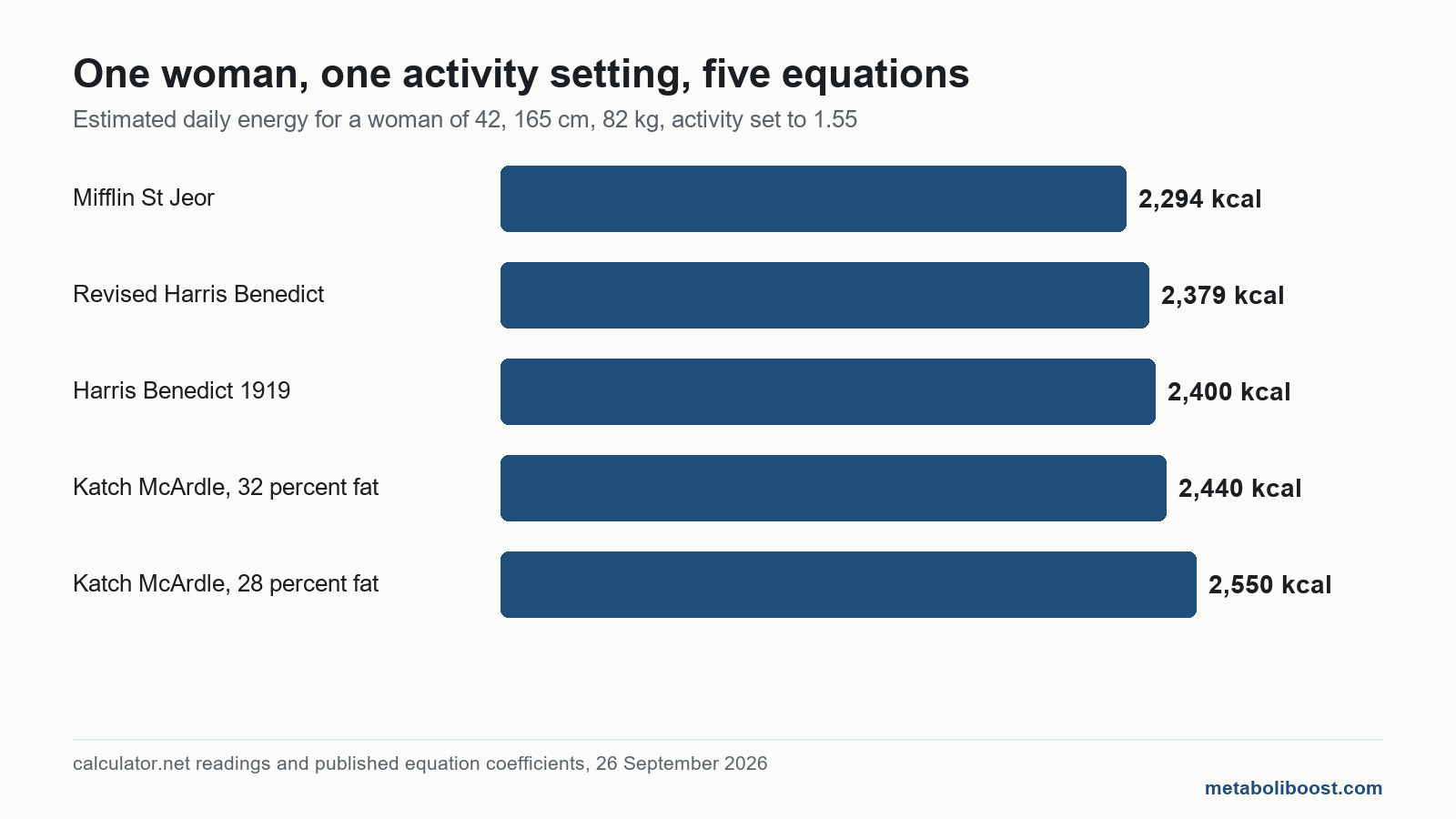
So here is one person through all of them. A woman of 42, 165 centimetres, 82 kilograms, activity left at 1.55, which most tools label moderately active. These are not her requirements. They are five estimates of one body, produced in one sitting, where the only thing changing is which equation the tool picked.
| Equation | Resting estimate | At the 1.55 setting | Where this figure came from |
|---|---|---|---|
| Mifflin St Jeor, 1990 | 1,480 kcal | 2,294 kcal | calculator.net, Mifflin setting, read 26 September 2026 |
| Revised Harris Benedict, 1984 | 1,535 kcal | 2,379 kcal | same tool, same inputs, revised Harris Benedict setting |
| Original Harris Benedict, 1919 | 1,548 kcal | 2,400 kcal | computed here from the coefficients tabulated by Haroun and colleagues |
| Katch McArdle, body fat entered as 32 percent | 1,574 kcal | 2,440 kcal | same tool, Katch McArdle setting |
| Katch McArdle, body fat entered as 28 percent | 1,645 kcal | 2,550 kcal | same tool, same equation, one input changed |
Top to bottom, 256 calories. Three of those figures came off a single website one after another, by moving a dropdown the reader has no particular reason to touch. The last two are the same equation with two plausible guesses at a body fat percentage, which is worth sitting with: the equation that looks the most rigorous is the one demanding the input you are least able to supply. A member of the MyFitnessPal community put that plainly in a March 2024 thread, saying he has no idea what his own body fat percentage is and would not trust most estimates of it either.

How often does the equation land within 10 percent of a measurement?
This is the question the calculators never answer, and it does have answers. Resting energy can be measured directly, by indirect calorimetry, and researchers do exactly that and then check what the equations predicted for the same people.
| Population measured | Equation | Landed within 10 percent | Study |
|---|---|---|---|
| 148 women aged 17 to 27, mixed BMI | Mifflin St Jeor | 60.1 percent | Haroun and colleagues, 2025 |
| The same 148 women | Harris Benedict | 44.6 percent | Haroun and colleagues, 2025 |
| 85 adults with obesity, mean age 73, 144 measurements | Mifflin St Jeor | 43.1 percent | Griffith and colleagues, 2022 |
The review that made Mifflin St Jeor the clinical default, Frankenfield and colleagues in 2005, found it the most reliable of the equations tested with the narrowest error range. Most reliable of the available options is not the same claim as accurate: in the young women above it landed inside 10 percent about six times in ten, and in the older adults, fewer than five times in ten.
Carry that through and the honest reading of the output is a band, not a figure. Ten percent either side of our 42 year old’s 1,480 resting estimate is 1,332 to 1,628, which at the same 1.55 setting is roughly 2,065 to 2,525 calories a day, with a real chance of falling outside even that. Printing the middle of that band to the nearest calorie is a design decision.
Run the same body through the equations
Each line below is a population estimate of resting energy with its working shown. It is not a measurement, not a calorie goal and not a target. Nothing here subtracts a deficit, because the size of a deficit is not something a web page can decide for anyone.
Resting energy only. Activity, food and everything else sits on top of these figures, and the spread between them is the point of the exercise.
Why is the activity multiplier the weakest input?
Because you chose it, and the categories are enormous. The standard ladder, as NASM publishes it, runs 1.2 for sedentary, 1.375 lightly active, 1.55 moderately active, 1.725 very active and 1.9 for a physical job. For this profile, stepping one rung from 1.55 to 1.725 adds 259 calories. One dropdown has now moved the answer further than the choice of equation did. If much of that activity is walking, the Compendium arithmetic for each walking pace shows how modest a single walk’s share of the day tends to be.
Measured activity levels in free living adults run from about 1.1 to 2.5, according to Westerterp’s review of doubly labelled water studies. Five rungs summarise that range fairly. They do not tell you where in it you personally sit, and the honest answer to whether you are lightly or moderately active is usually that you do not know.
There is a sharper version of the trap. A TDEE style calculator builds your workouts into the multiplier. MyFitnessPal, by its own documentation, does not: it estimates your needs before intentional exercise and expects the exercise to be logged separately and eaten on top. Mix the two and you have counted your workouts twice and quietly deleted your deficit.
What do people who used these calculators report?
Three threads on the MyFitnessPal community from the last three years carried about 40 comments between them. The pattern in those comments is consistent, and it is not the one the calculator pages describe.
Double counting is the most common failure. In August 2023 a poster asked how the deficit worked at all: a TDEE calculator had given her about 1,700 calories as maintenance at a moderate exercise setting, while she had separately been told to eat the app’s figure plus her exercise calories. She could not reconcile the two and was not losing weight. Every responder said the same thing, which was to pick one accounting method and stop mixing them. In March 2023 a man found his app suggesting 1,500 calories while TDEE calculators put him near 3,100; the replies traced it to the app’s floor for men colliding with a loss rate he had set far too fast.
The second pattern is the size of the individual miss. A long standing community helper on that forum reports the app’s estimate was off for her by roughly 25 to 30 percent in the upward direction, and that once she adjusted for it her results became predictable. In the February 2024 thread another member described doing the arithmetic over six weeks of tracking, found she was spending about 250 calories a day more than the app estimated, moved up one activity rung worth around 200 calories, and reported that the predictions then matched what the scale did.
The third gives the whole game away. A poster in that same thread opened a tool running six formulas at once and reported back that the answers were quite different from one another, asking which to pick. What two experienced members told her, in effect, was that it does not matter which one you pick, because the number is a hypothesis to be tested.
These are accounts, not evidence. Nobody’s reported burn rate is a measurement, and a forum cannot tell you what your own needs are. What they do show, and no calculator page shows, is that the people who have used these tools longest do not treat the output as an answer.
How do you correct the estimate against your own weight data?
The arithmetic is not hard, and it is the only part of this subject that uses your body rather than a population average. Track what you eat for four to six weeks, weigh yourself under consistent conditions at each end, and compare what happened with what the estimate predicted. The gap is the equation’s error for you, and once you know its size you can stop guessing at it. None of that changes the mechanism, which the plain explainer on how a calorie deficit behaves sets out, and measurements make the comparison steadier than the scale alone, which is the argument in how to take measurements for weight loss.
Two cautions, and neither is decoration. Four to six weeks is the minimum, because water, glycogen and, for anyone having menstrual cycles, hormonal fluctuation all move the scale more over a fortnight than a modest deficit does. And the correction is not permanent: your requirement falls as you get lighter, which is arithmetic rather than a broken metabolism, and the honest size of what you can change about your BMR is smaller than most pages selling the idea suggest.

What does the weight loss table underneath the calculator not tell you?
Every one of these tools prints a table under the result, offering rates of loss with a calorie figure beside each. Two things are missing from it.
The first is that the table is straight line arithmetic, built on the idea that a fixed deficit produces a fixed loss indefinitely. NIDDK, describing the Body Weight Planner, says plainly that the body is not that simple, that it responds in a way that offsets the deficit over time, and that loss slows as a result. A static table cannot represent that. The dynamic model FatCalc runs exists because of it, and why that old straight line rule gets the timeline wrong works through the arithmetic on a single worked example.
The second is that nothing checks whether the bottom row is sensible. Our 42 year old, asked for extreme weight loss, is offered 1,294 calories a day. The NHS describes a safe and achievable rate as around 1 to 2 pounds a week, produced by eating roughly 600 calories a day less than you need, and cautions against restricting much further without medical supervision. A tool that knows nothing about you will print a figure well below that without hesitating. It is not being malicious. It is doing arithmetic, which is all it was ever doing. Seeing what a day of food in a deficit actually adds up to tells you more than another four digit figure, and why the starting number is higher for men is the same size logic run the other way.
If your weight will not move over several months on an honestly tracked deficit, if it changes in a way you cannot explain, or if you live with diabetes, thyroid disease or an eating disorder, the next step is a doctor rather than a different calculator. The NHS guidance on calories is a better starting reference than any tool that wants your email address first.
Frequently asked questions
Which free calorie deficit calculator is the most accurate?
None of them is accurate in the sense of measuring you, and the differences between the reputable ones are smaller than the difference between any of them and your real requirement. Pick one that tells you which equation it runs, then correct its number against four to six weeks of your own weight and intake data.
Why did two calculators give me numbers hundreds of calories apart?
Almost always because they ran different equations, or because you selected different activity levels, or because one built your workouts into the multiplier and the other did not. For one worked profile on this page, switching equation alone moved the answer 256 calories and stepping one activity rung moved it 259.
Is Mifflin St Jeor better than Harris Benedict?
On the evidence, yes, which is why clinical tools default to it. A 2005 systematic review found it the most reliable of the equations tested with the narrowest error range, and a 2025 validation study in young women had it inside 10 percent of measured resting energy 60.1 percent of the time against 44.6 percent for Harris Benedict.
Do I need to know my body fat percentage to use one of these?
Only for the Katch McArdle equation, and that is a mixed blessing. It uses lean mass rather than total weight, which is more relevant in principle, but it is only as good as the body fat figure you feed it. On one worked profile, entering 28 percent instead of 32 percent moved the daily figure by 110 calories.
Should I eat back the calories my tracker says I burned?
That depends entirely on which accounting method your calorie figure used, and getting it wrong is the most common error on weight loss forums. If your activity setting already includes your workouts, logging them again double counts. If it excludes them, as MyFitnessPal’s instructions say it should, then they are meant to be added.
How long before I know whether the calculator’s number was right for me?
Four to six weeks of consistent tracking, and a full menstrual cycle for anyone having them. Shorter than that and water weight and glycogen swamp the signal, which is why a fortnight of disappointing scale readings tells you almost nothing about whether the estimate was any good.
Finished the page? The same five questions from the top, to see what stuck.
This article is general information, not medical advice, and is not a substitute for care from a qualified healthcare professional. Speak to your doctor about your own situation.
Leave a Reply