
A calorie deficit diet for men works exactly as it does for anyone else: energy out has to exceed energy in. What differs is the starting number. Men usually carry more lean mass and a larger frame, so maintenance sits higher. The mechanism is body size, not a separate male metabolism.
Listen to this article, about 9 minutes. A synthetic voice reads the article and announces each section title as it begins; tables are read row by row and the questions at the end are left out.
Recorded 25 September 2026 from the article as published that day. Press a chapter to jump there; the highlighted line is what is playing. A play button sits beside every section heading, and once you scroll past this player a bar at the bottom of the screen keeps the controls in reach. Tap or click any sentence to hear the reading start from there.
On this page: why the male maintenance figure starts higher and how little of that is sex rather than size, the Mifflin St Jeor working shown line by line, what testosterone actually does and the seam every booster is sold through, the trial that measured men against women on the same protocol, and the advice aimed at men with no evidence behind it.
Think you already know this? Five questions, one minute.
Every answer is on this page. Answer from what you know now; the page fills in the rest.
-
1. In the Journal of Applied Physiology research, what explained most of the individual variation in resting metabolic rate?
The NHS puts the average man at around 2,500 kcal a day and the average woman at around 2,000, as population averages that move with age, weight, height and activity. Small is the word that almost never survives the trip into a men’s fat loss article. Read the section
-
2. In the Mifflin St Jeor equation, what is the entire contribution of the sex term?
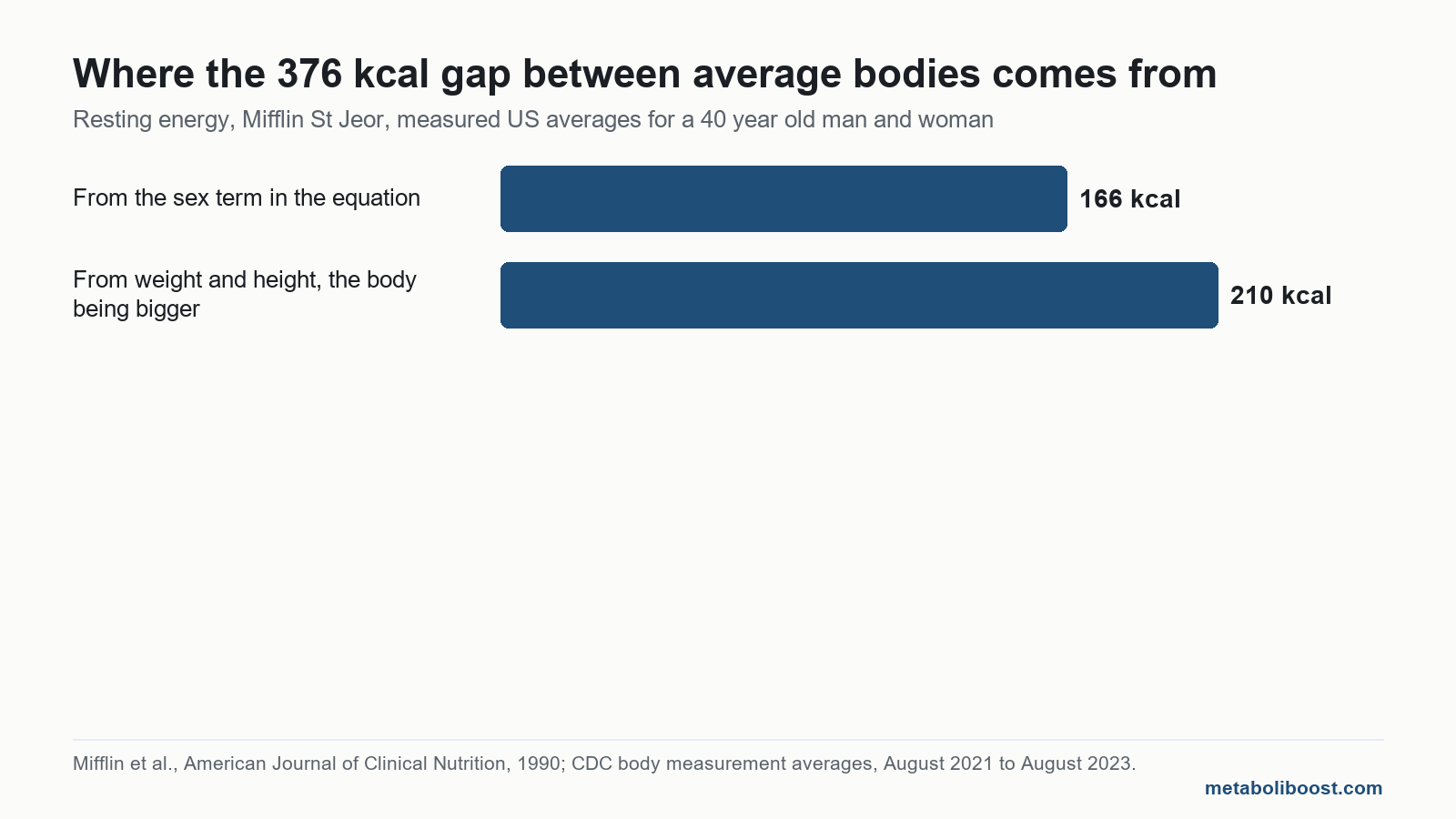
The 1990 equation gives men plus 5 and women minus 161. Using measured US averages for weight and height, the gap between average bodies is 376 kcal, of which 210 comes from weight and height and 166 from the sex term, which itself stands in for lean mass. Read the section
-
3. How does testosterone raise energy expenditure, according to this page?
A hormone acting through body composition cannot be short circuited by a capsule and a photograph of a jawline. If a product genuinely moved lean mass enough to move maintenance, it would show up over months as measurable body composition, and it would have been measured. Read the section
-
4. In the DiOGenes trial analysis, how did men and women compare during the low calorie phase?
The 2021 analysis in Nutrients reported men losing more weight and showing larger improvements in several cardiometabolic markers. As a percentage of starting weight the picture is much closer, and the first fortnight exaggerates it further because larger bodies store more glycogen and water. Read the section
-
5. Which of these does this page list as having no good evidence?
The mechanism runs through body composition on a timescale of months, so a product promising a metabolic effect within days is describing something that does not happen. A higher maintenance figure means a larger absolute error when you guess, not immunity from guessing. Read the section
Why does a calorie deficit for men start from a higher number?
Every calculator you have ever used estimates maintenance, meaning the energy your body spends in a day. Estimates come out higher for men for an unglamorous reason: on average, men are bigger, and a bigger body costs more to run. The NHS puts the average man at around 2,500 kcal a day and the average woman at around 2,000, while saying plainly that the figure moves with age, weight, height and activity. Those are population averages, not targets, and the gap between them is doing less work than it appears to.
The larger contributor is lean tissue. Measured resting metabolic rate is higher in men, but in research published in the Journal of Applied Physiology most of the individual variation was explained by fat free mass, fat mass and aerobic capacity rather than by sex itself. After adjusting for those, a small residual difference remained. Small is the operative word, and it is the word that almost never survives the trip into a men’s fat loss article.

How much of the gap is sex, and how much is just body size?
This is the part nobody shows their working for, so here is the working. The Mifflin St Jeor equation, published in the American Journal of Clinical Nutrition in 1990 and still the one most clinical calculators run on, predicts resting energy from weight, height, age and a single sex term. Men get plus 5. Women get minus 161. The entire contribution of sex, in the most widely used equation in the field, is 166 calories a day.
Hold every other input identical and that 166 is the whole difference. Then let the bodies be the sizes bodies actually are, using measured United States averages from the CDC for August 2021 to August 2023, and watch what happens.
| Comparison | Man | Woman | Gap |
|---|---|---|---|
| Identical inputs: 80 kg, 175 cm, age 40 | 1,699 kcal | 1,533 kcal | 166 kcal |
| Measured averages: 90.3 kg and 175.0 cm for men, 77.9 kg and 161.3 cm for women, age 40 | 1,802 kcal | 1,426 kcal | 376 kcal |
| What the 376 kcal is made of | 166 kcal from the sex term | 210 kcal from weight and height | 376 kcal |
So of a 376 calorie gap between average bodies, weight and height account for 210 of it. And the remaining 166 is not evidence of a male furnace either. The equation takes no body composition input at all, so its sex constant is standing in for the one thing it cannot measure, which is the difference in lean mass. Read it that way and very little of the gap is left over for anything mysterious.
Two caveats, and they are not decoration. These are resting figures, not daily intake. And every equation of this kind is a group average with genuine individual spread around it, which is why the general explainer on how a calorie deficit actually behaves argues for adjusting from what your weight does over a few weeks rather than from what a calculator predicted on day one. Which equation a tool happens to run moves the answer as well, which a side by side comparison of five calculator equations sets out for one worked profile.
Does testosterone make a calorie deficit easier for men?
Testosterone does something real, and it is less thrilling than the supplement aisle would like. It supports building and holding lean tissue. Lean tissue is metabolically expensive. So testosterone raises energy expenditure by the long route, through how much muscle there is, rather than by burning fat directly.
That distinction is exactly the seam every testosterone booster is sold through. A hormone acting through body composition cannot be short circuited by a capsule and a photograph of a jawline. If a product genuinely moved lean mass enough to move maintenance, that change would show up over months as measurable body composition, and it would have been measured. Why fat burns differently for men and women goes further into the hormonal side.
Run the Mifflin St Jeor sum yourself
The equation behind most clinical calculators, with its working shown. The output is a population estimate of resting energy, not a target and not a measurement, which is why the page says to adjust from what your weight does over a few weeks instead.
Resting energy only, before activity. The equation takes no body composition input, so its sex constant stands in for the lean mass it cannot measure. Group averages carry real individual spread.
Do men lose weight faster than women on the same diet?
In absolute kilograms, frequently yes. As a percentage of starting weight the picture is much closer, and those two answers get swapped for each other constantly. An analysis of the DiOGenes randomised controlled trial, published in Nutrients in 2021, reported that men lost more body weight than women during the low calorie phase and showed larger improvements in several cardiometabolic markers. Larger bodies shedding more mass on a comparable protocol is close to arithmetic.
The first fortnight exaggerates it further. A larger person stores more glycogen and the water bound to it, and that leaves early, leaves quickly and is not fat. It also returns the first time carbohydrate does. Anyone who has watched the scale swing four pounds across a weekend has met this, usually feeling either triumphant or cheated depending on the direction.
What actually differs day to day, and what does not?
| Genuinely differs by sex | Does not differ at all |
|---|---|
| The maintenance figure, driven by body size and lean mass | The mechanism, which is energy out exceeding energy in |
| Absolute protein in grams, because the target scales with body weight | Protein expressed per kilogram of body weight |
| Where fat is preferentially stored, and reportedly where it leaves from first | How badly almost everyone estimates their own intake |
| How much early scale movement comes from glycogen and water | That consistency beats precision over any useful timescale |
Protein is the row worth pausing on. A systematic review and meta analysis in adults with overweight or obesity found that higher protein intake during weight loss helped maintain muscle mass. Because those figures are expressed per kilogram of body weight, a larger man ends up eating more protein in absolute grams than a smaller woman while following the identical rule. That is not a men’s rule. It is one rule with a bigger number falling out of the end of it.

Which advice aimed at men has no good evidence behind it?
A short list, offered without apology, because men get sold a distinct flavour of nonsense and it is worth naming.
- Testosterone boosters marketed for fat loss. The mechanism runs through body composition and the timescale is months, so a product promising a metabolic effect within days is describing something that does not happen.
- Fat burner formulas sold specifically to men. There is no good evidence for a sex specific thermogenic effect, and the difference from the version sold to everyone else is usually the colour of the tub.
- Any plan attaching a fixed timeline to a specific body part. Where you store fat is not something the person selling the programme knows about you.
- The idea that men can skip tracking because they have more room to play with. A higher maintenance figure means a larger absolute error when you guess, not immunity from guessing.
None of that means tracking has to be forensic. It means the honest version of this advice is boring, and boring does not sell tubs.
When is weight worth taking to a doctor?
Some of what looks like a metabolism problem is not one. Weight change you cannot explain, weight that will not move over several months despite a consistently and honestly tracked deficit, or ongoing symptoms such as persistent fatigue, are all reasons to speak to a doctor rather than to a calculator. The same applies before changing intake if you live with diabetes, thyroid disease or heart disease, or take prescribed medication, since some of these interact with how you eat.
It also applies if eating has started to feel controlling or frightening, or if tracking has become difficult to stop. That is common, it is treatable, and it is not a failure of discipline. A doctor is the right first call, not a stricter plan.
If your interest in all this started with your waistline specifically, the diet that works best for belly fat covers why regional fat loss cannot be aimed and what changes anyway.
Frequently asked questions
Can men use a standard calorie calculator, or is a men’s version needed?
A standard calculator is already a men’s calculator. The Mifflin St Jeor equation behind most of them takes sex as an input and adds its own term for it, so a separate tool adds nothing. What any calculator cannot do is know your body composition or your real activity level, which is where most of the error lives.
How many calories does the average man need in a day?
The NHS gives around 2,500 kcal a day as an average for men and around 2,000 for women, while stating that the figure changes with age, weight, height and how active you are. Treat it as a population average rather than a personal number, because the spread around it is wide.
Does a man’s calculated requirement fall with age?
In the standard equation, yes. Mifflin St Jeor subtracts 5 calories for every year of age, so the predicted resting figure for a 50 year old is 50 calories below the same person at 40. Real world change is usually larger than that, because lean mass and daily activity tend to fall alongside it.
Do men lose belly fat before other fat?
Research on regional fat loss reports men tending to lose more from the trunk than women do during energy restriction, though the pattern varies a lot between individuals. It is not something diet choice can direct. Fat leaves in the order your body decides, and that order is not on the menu.
Does a man need more protein than a woman in a deficit?
More grams, usually. Not a different rule. Protein targets during weight loss are expressed per kilogram of body weight, so a heavier person arrives at a larger absolute number from the same guidance. Higher protein during weight loss is associated with better maintenance of muscle mass in both sexes.
Why did the scale drop quickly in the first week and then stall?
Early loss includes glycogen and the water stored with it, which comes off fast and is not fat. Larger bodies store more of both, so the early drop looks more dramatic. The apparent stall that follows is usually the point at which the scale starts reporting fat loss instead, which is slower and much less flattering.
Finished the page? The same five questions from the top, to see what stuck.
This article is general information, not medical advice, and is not a substitute for care from a qualified healthcare professional. Speak to your doctor about your own situation.
Leave a Reply