
When people drop water weight, they are losing fluid, not fat. Cut carbohydrates or salt sharply and your body sheds stored glycogen along with the water bound to it. The scale falls quickly, then stalls. It returns just as fast when you eat normally again.
Listen to this article, about 10 minutes. A synthetic voice reads the article and announces each section title as it begins; tables are read row by row and the questions at the end are left out.
Recorded 25 September 2026 from the article as published that day. Press a chapter to jump there; the highlighted line is what is playing. A play button sits beside every section heading, and once you scroll past this player a bar at the bottom of the screen keeps the controls in reach. Tap or click any sentence to hear the reading start from there.
On this page: why each gram of glycogen carries at least three grams of water, why the first week of a diet goes so well and week three feels like failure, the weekly weight rhythm measured in more than 1,400 adults, what detox teas actually do, and when fluid is a reason to see a doctor.
Think you already know this? Five questions, one minute.
Every answer is on this page. Answer from what you know now; the page fills in the rest.
-
1. How much water is stored with each gram of glycogen?
Per the 2015 study in the European Journal of Applied Physiology; empty a share of your glycogen and the water leaves with it, with nothing about your fat changed. Read the section
-
2. Which two mechanisms drop the scale in the first week of a low carbohydrate diet?
Both are plumbing rather than fat, and both reverse over a weekend when carbohydrate returns, which is the honest explanation for the rebound. Read the section
-
3. In the 2020 PLOS ONE analysis of daily weights from more than 1,400 adults, on which day was weight highest?
Per Turicchi and colleagues: weekly fluctuation averaged about 0.35 percent of body weight, lowest on Friday, and across Christmas the group gained about 1.35 percent. Read the section
-
4. What did the 2026 mini review on diet and detox teas conclude?
Per Noor, Chalise and Tran, which also documents undeclared pharmaceutical ingredients, including sibutramine, in products sold as natural. Read the section
-
5. When does NHS guidance on oedema say to see a GP?
Per the NHS oedema page; sudden or severe swelling, swelling in one leg only, breathlessness or chest pain need urgent attention. Read the section
What is water weight, and why does it move so fast?
Most of your body is water, and the amount is not fixed. It shifts with what you ate, what you drank, how warm it was, how much you moved, where you are in your cycle and whether you slept. None of that is fat arriving or leaving. It is fluid moving around, and fluid moves in hours.
The part that surprises people is glycogen. Your muscles and liver store carbohydrate as glycogen, and glycogen does not sit there dry. A 2015 study in the European Journal of Applied Physiology measured muscle water and glycogen during recovery from prolonged exercise and found that each gram of glycogen is stored with at least three grams of water. A review of glycogen metabolism written for coaches and athletes describes the same relationship, which is why athletes who deliberately load glycogen watch the scale climb without gaining a gram of fat.
Run that arithmetic in the other direction and the famous first week of any diet stops being mysterious. Empty a meaningful share of your glycogen and the water it was holding leaves with it. Nothing about your fat has changed. Your storage cupboard is simply less full.

Why does the first week of a new diet go so well?
Because the first thing most diets cut is carbohydrate, and the first thing carbohydrate restriction does is drain glycogen. Lower insulin also tells the kidneys to hold on to less sodium, and sodium takes water with it when it goes. Two mechanisms, same direction, and both of them are plumbing rather than fat.
This is the honest explanation for the pattern that makes people quit in week three. The scale drops hard, then flattens, and it feels as though the diet stopped working. The diet did not stop working. The one off water loss finished, and what is left is the slower signal underneath, which is the only one that ever mattered. We have written separately about why weight comes off slowly even when you are clearly eating less, and water weight is the front half of that answer.
It also explains the rebound. Eat a normal amount of carbohydrate again and glycogen refills, water returns with it, and several days of apparent progress vanish over a weekend. Nobody regained fat that fast. The same mechanism runs in both directions during a water fast and during very low carbohydrate approaches such as the egg fast, where the early number on the scale does a lot of marketing the food never promised.
Water weight or fat: how do you tell them apart?
You cannot tell from a single reading, which is the whole problem with single readings. You can tell from the shape of the change over time.
| Question | Water weight | Fat loss |
|---|---|---|
| How fast does it show up? | Hours to days | Weeks |
| What drives it? | Carbohydrate and salt intake, hormones, heat, illness, sitting still on a long flight | A sustained gap between energy in and energy out |
| How fast does it reverse? | As fast as it arrived, and usually by itself | Slowly, and only if the habits behind it change back |
| What does the scale do? | A sharp step down or up, then a flat line | A slow drift downward with plenty of noise on top of it |
| What else do you notice? | Rings and waistbands feel tighter or looser within a day | Clothes fit differently over a month or more |
| What does it tell you about progress? | Almost nothing | Nearly everything |
If you take one thing from that table, take the last row. A scale measures the total mass of a person, breakfast included, and it has no way of reporting what that mass is made of. That is the argument for tracking fat loss rather than weight loss, using tape measurements, photographs at fixed intervals and how clothes fit, instead of asking one number to carry more information than it contains.
Why does one salty meal move the scale overnight?
Eat more sodium than usual and your body holds more fluid to keep the concentration in range. You also drink more, because salt makes you thirsty. Both turn up on the scale the next morning, and both clear over the following few days as your kidneys catch up.
The specific figures that circulate here deserve suspicion. The claim that a salty dinner adds a kilogram or two by morning is commonly quoted, but it traces back to coaching sites rather than trials, and the research on sodium and fluid balance is messier than the confident version suggests. Some studies find the body can store sodium without holding a matching amount of extra fluid. Treat the direction as real and the number as decoration.
The same goes for the drink of the week. Warm water, lemon water and apple cider vinegar all get credited with flushing fluid out, and the evidence for that is thin. We looked at one of these claims in detail in a piece on warm water versus cold water for weight loss. The short version is that your kidneys were already on it.
How much does the scale move on its own?
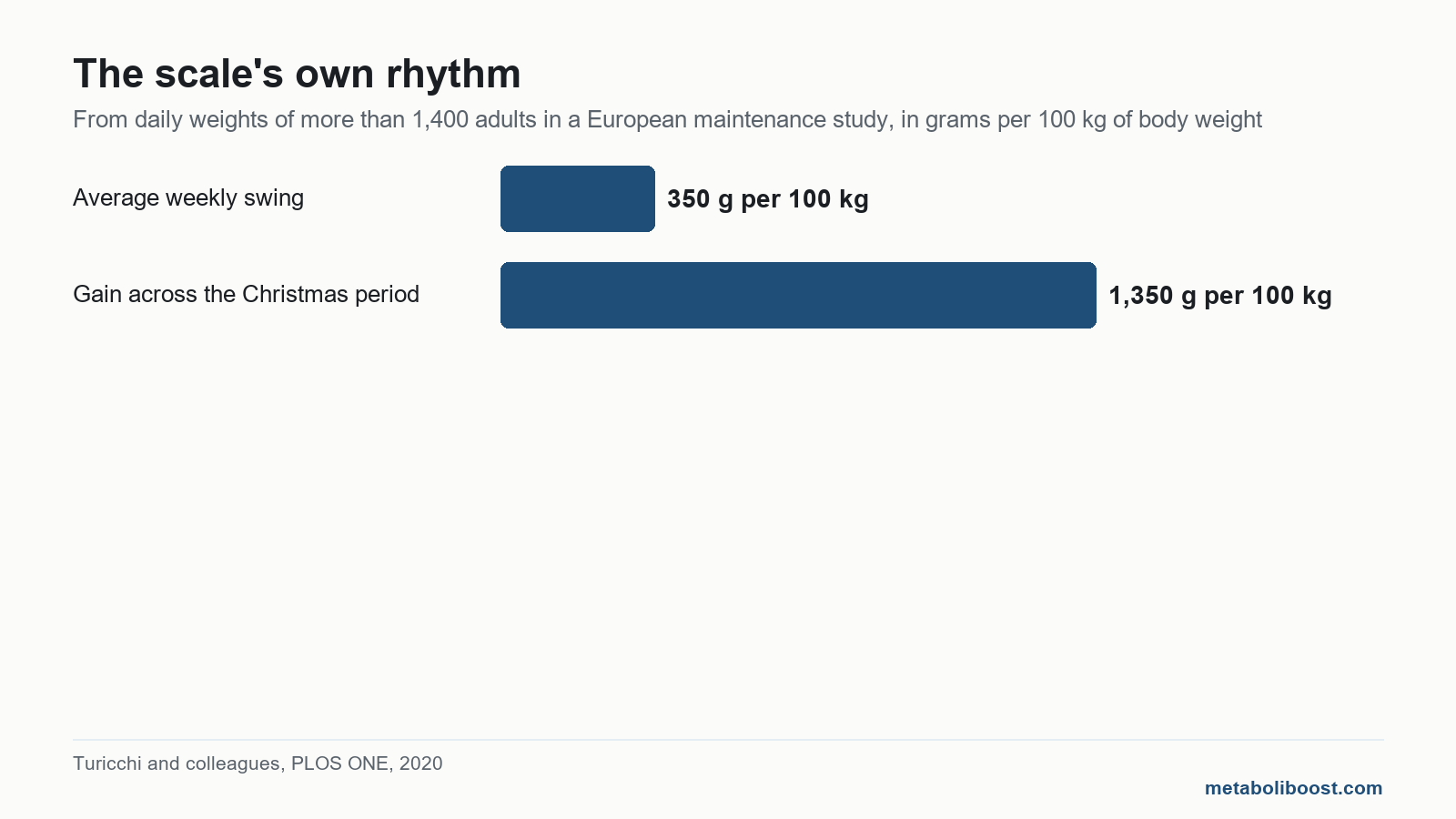
More than most people expect, and on a schedule. A 2020 analysis in PLOS ONE by Turicchi and colleagues tracked daily weights from more than 1,400 adults in a European weight loss maintenance study. Weekly fluctuation averaged about 0.35 per cent of body weight, roughly 0.3 kg in that group, with weight highest on Monday and lowest on Friday. Men swung slightly more than women. Across the Christmas period the same participants gained about 1.35 per cent of body weight, and had not fully returned to their pre Christmas weight by March.
Two useful things follow. Your weight has a weekly rhythm that has nothing to do with your effort, so comparing a Monday reading with last Friday is comparing two different points on a wave. And the honest way to read a scale is as a trend across several weeks, not as a verdict delivered each morning before coffee. A tape measure has the same weekly noise and the same fix, which our guide to taking measurements for weight loss consistently works through landmark by landmark.

Do detox teas and water pills help you drop water weight?
They can move the number, yes, in the sense that a diuretic makes you urinate and urine has mass. That is the entire trick, and it reverses the moment you drink a glass of water.
The safety question is the one that matters. A 2026 mini review in Frontiers in Nutrition by Noor, Chalise and Tran examined the published evidence on diet and detox teas and concluded that the benefits in humans are extremely limited. The same review documents case reports of liver injury, severe hyponatremia, low potassium and cardiac arrhythmias in otherwise healthy people, and analytical studies that found undeclared pharmaceutical ingredients, including sibutramine, in products sold as natural. Over the counter diuretics carry a related risk of electrolyte disturbance and interact with several common medications. If you take any prescription medicine, or you have a heart, kidney or liver condition, this is a conversation with your doctor or pharmacist before it is a purchase.
There is also the matter of the goal. Deliberately dehydrating yourself to reach a number has no upside, because the number was never the thing you wanted.
Does your cycle change what the scale says?
For many people, yes. After ovulation, progesterone rises and the hormonal signals governing sodium and water reabsorption shift with it, so the body tends to hold more fluid through the second half of the cycle. Bloating and a heavier feeling are commonly reported alongside it, and the effect usually settles once the period starts.
The size of the change varies a great deal between individuals and the published estimates come from small studies, so treat any specific figure you see with caution. The practical answer does not depend on the figure. If you menstruate and you track your weight, compare like with like across cycles rather than reading a mid cycle rise as failure.
When is holding fluid a reason to see a doctor?
Fluid retention after a salty meal, a long flight or a hot day is ordinary and settles by itself. Swelling that does not settle is a different question. NHS guidance on oedema advises seeing a GP if swelling in the ankles, feet or legs does not go away, if you do not know what is causing it, or if you are worried, and it lists heart, liver and kidney conditions among the causes that need investigating. Sudden or severe swelling, swelling in one leg only, breathlessness or chest pain need urgent medical attention rather than a wait and see approach.
Medication is worth raising with a pharmacist too, because several common drugs cause fluid retention as a side effect. None of that is something to manage with a tea.
So what do you actually do about it?
Mostly, nothing. Water weight is not a problem to be solved, it is noise to be recognised. Drink normally, salt your food at a sensible level rather than staging a purge, weigh yourself under the same conditions if you weigh yourself at all, and read the trend rather than the reading. Gentle movement and not standing still for hours help with the everyday puffiness that follows a long day.
The rest is patience, which sells terribly and works anyway.
Same conditions, every time
A scale reading is only comparable with another reading taken the same way. Log the conditions with the number, and read the trend across weeks rather than the verdict each morning.
A log for reading the trend, not the reading. It scores nothing and cannot tell fat from fluid on any single day. Kept on this device only.
Frequently asked questions
Is water weight the same as bloating?
Not quite. Bloating is usually gas and distension in the digestive tract, which changes how your abdomen feels and looks without changing your mass much. Water weight is fluid held in the body, which does change what the scale reads. They often turn up together, which is why the words get used interchangeably.
How long does water weight take to come back after a low carbohydrate diet?
Glycogen refills over a few days once carbohydrate returns, and the water that binds to it comes back at the same time. That is why the scale can climb quickly after a weekend of normal eating. It is a storage change, not fat regained.
Does drinking more water make you hold more water?
Generally the opposite. Healthy kidneys excrete what is surplus, and mild dehydration is more likely to encourage the body to conserve fluid. Drinking to thirst is a reasonable default for most people, though anyone with a heart or kidney condition should follow the fluid advice they were given.
Can you tell whether a weight change is water by how fast it happened?
Speed is the strongest clue available. A change of a kilogram or more inside a day or two is almost always fluid, food in transit or both, because fat cannot accumulate or disappear that quickly. Changes that hold their direction across several weeks are more likely to be real.
Do saunas and sweat suits get rid of water weight?
They remove fluid through sweat, and it returns as soon as you rehydrate. Combat athletes use this to make a weigh in, under supervision, and it carries real risks including heat illness and cardiovascular strain. It does nothing to body fat and is not a sensible tool for everyday weight management.
Should you weigh yourself daily or weekly?
Either works as long as you read the average rather than the individual number. Daily weighing gives a better trend line because it captures the noise instead of accidentally landing on it, but it suits people who can see a higher morning reading without it colouring the day.
Finished the page? The same five questions from the top, to see what stuck.
This article is general information, not medical advice, and is not a substitute for care from a qualified healthcare professional. Speak to your doctor about your own situation.
Leave a Reply