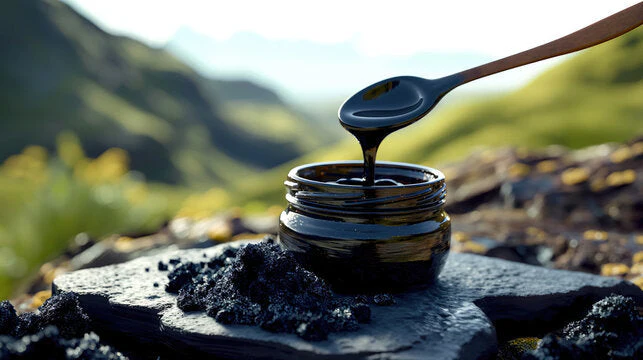
Shilajit is a mineral rich resin with real but narrow human evidence behind it. Small placebo controlled trials point to less strength loss after fatiguing exercise and a change in a collagen turnover marker. Claims about fat loss, testosterone, memory and anti aging rest on animal work, laboratory findings or trials too small to settle anything.
What is shilajit and where does it come from?
Shilajit is a dark, sticky exudate that seeps out of cracks in rock at altitude, mostly in the Himalaya, the Altai, the Caucasus and the Hindu Kush. It forms slowly from plant material trapped inside rock and only partly decomposed, which is why its chemistry looks less like a plant extract and more like soil humus.
Analytically it is dominated by humic substances, and fulvic acid is the fraction that collects almost all of the attention. Alongside it sit trace minerals, dibenzo alpha pyrones, small organic acids and resinous material. The much repeated figure of 84 minerals is not invented, but it is easy to misread. Trace means trace: those elements sit at microgram levels, far below the dose used when a mineral is actually supplemented to correct a shortfall.
Shilajit is also not one standardised material. Its composition shifts with the mountain range, the altitude, the season it was collected in and how thoroughly it was purified. Two jars carrying the same word on the label can differ substantially inside.
Does shilajit help with weight loss?
No human trial has shown shilajit on its own changing body weight or body fat.
The most relevant recent study is a 12 week randomised, double blind, placebo controlled trial published in Nutrients in 2025. It recruited adults with risk factors for metabolic syndrome, average body mass index around 34, starting an exercise and diet programme, and 109 completed it. Shilajit appeared only inside a combination, at 6 or 12 mg a day alongside chromium and Phyllanthus emblica fruit extract.
Two things follow from that design. Nothing in the results can be traced back to shilajit, because it was never given alone. And the body composition changes that reached statistical significance showed up in the higher chromium and higher amla arms, since no shilajit only arm existed. The authors also note that the exercise and diet programme underneath the trial may have masked some effects. Six to twelve milligrams a day is in any case a fraction of what most shilajit products suggest.
So the honest answer is that body weight is still governed by what has always governed it: total energy intake, protein and fibre, sleep, muscle mass, and whether any of it is sustained long enough to matter. A resin that may help you hold strength through a hard session does not change that arithmetic. If your metabolism feels slower than it used to, the levers that actually move are set out in how to fix a slow metabolism naturally.
What have human trials on shilajit actually measured?
The clearest placebo controlled result comes from a 2019 trial in the Journal of the International Society of Sports Nutrition. Sixty three active young men took 250 mg, 500 mg or a placebo daily for eight weeks. The outcomes were how much strength they lost after a fatiguing protocol, and serum hydroxyproline, a marker of collagen breakdown. In the stronger half of the group, the 500 mg arm lost noticeably less strength after fatigue than the low dose and placebo arms, and finished with lower hydroxyproline.
That is a genuine finding and a narrow one. It was measured in healthy young men, over eight weeks, using concentric contractions only, and the researchers could not tell whether the collagen signal came from muscle or tendon. It says something about fatigue resistance and nothing about metabolic rate, appetite or fat loss.
| Claim | Human evidence | How far it goes |
|---|---|---|
| Less strength loss after fatigue | One 8 week placebo controlled trial, 63 young men | Suggestive, one narrow group |
| Fat loss or weight loss | Only tested inside a combination, at 6 to 12 mg | Cannot be attributed to shilajit |
| Higher testosterone | A few short trials in healthy men, not widely replicated | Unsettled |
| Memory and cognitive decline | Cell and animal models only | Hypothesis |
| Better nutrient absorption | Laboratory chemistry on fulvic acid | Not a clinical outcome |
| More cellular energy | Animal and cell models | Mechanism, not outcome |
Why does the mineral and fulvic acid list not settle anything?
Ingredient lists are the most persuasive thing about shilajit and the least informative. Knowing that something contains fulvic acid, iron and dibenzo alpha pyrones tells you what is in the jar, not what happens after you swallow it, at what dose, or whether the effect survives a placebo group.
Fulvic acid does do interesting things in a test tube. It binds metals, behaves as an antioxidant, and in cell and animal models interferes with the way tau protein clumps together. That is the basis for the procognitive hypothesis set out in a 2012 review in the International Journal of Alzheimer’s Disease, and the review is careful to present the idea as something needing clinical trials rather than something those trials have shown. More than a decade later, they still have not arrived.
The same gap applies to the mitochondrial energy story. Cells producing energy more efficiently in a dish is a mechanism. Feeling less flattened by a week of short sleep is an outcome, and the two are joined by assumptions nobody has tested end to end in people. What shows up reliably in human research on daytime energy is duller: sleep timing, iron and vitamin D status where they are genuinely low, and regular training. The hidden engines of your energy covers the mitochondrial side properly.
How much shilajit do studies use compared with what is sold?
| Form | Daily amount | Source of the number |
|---|---|---|
| Purified standardised extract | 250 to 500 mg | The 8 week strength and fatigue trial |
| Shilajit inside a combination | 6 to 12 mg | The 12 week cardiometabolic trial |
| Retail resin or capsules | 300 to 500 mg | Manufacturer labels, not trial data |
| Raw, unpurified resin | Not established | No safe intake characterised |
The spread across studies is more than fiftyfold, so the field has not converged on a dose, let alone an optimal one. And a serving size printed on a label is a commercial decision, not a trial result, even when the number lands inside a studied range.
Resin, powder, capsule and standardised extract are also not interchangeable. A standardised extract is made to hit a stated fulvic acid content, so it can be compared with the material used in research. A raw resin is whatever came out of the rock, minus whatever processing removed.
Is shilajit safe, and what about heavy metals?
This deserves more attention than any benefit claim. Shilajit is a geological material, so whatever the rock holds, the resin can carry. Contamination is structural here, not an occasional scandal.
A 2025 analysis in BMC Chemistry measured thallium in 13 crude shilajit samples from Iran, India, Nepal, Russia and Kyrgyzstan, and in five commercial supplements. It reached 0.226 micrograms per gram in the crude material and up to 0.5 micrograms per gram in the finished supplements, meaning processing had concentrated the contaminant in some products rather than removing it. Thallium accumulates in the kidneys and bone, and the authors note there are no shilajit specific regulatory limits to test against.
Independent testing of retail products has been more reassuring on lead, cadmium, arsenic and mercury, with several popular products measuring below levels of concern at one daily serving. Both findings can be true at once: many products are clean, the raw material can carry contaminants, and the packaging never tells you which one you are holding.
In practice, a batch specific certificate of analysis from an independent laboratory covering heavy metals is the only reassurance worth anything. Raw unpurified resin marketed as more authentic is the opposite of reassuring, since purification is the step that removes contaminants.
Speak to a doctor before starting shilajit if you are pregnant or breastfeeding, if you have kidney or liver disease, if you have haemochromatosis or any condition involving iron overload, or if you take regular medication. The same applies if weight or metabolic symptoms are what brought you here, because those deserve a proper assessment rather than a supplement. General guidance on managing weight safely is on the NHS healthy weight pages.
So what is a reasonable way to think about shilajit?
Shilajit is neither a fraud nor a breakthrough. It is a traditional preparation with one decent but narrow placebo controlled result behind it, preclinical work not yet tested in people, and a purity problem that varies product by product. The defensible framing is a possible modest effect on fatigue resistance during training, from the kind of purified, batch tested preparation the research used, and nothing promised about the size of it.
If what you are really after is a change in body composition, that comes from the unglamorous, well evidenced side of the ledger, and no resin substitutes for it. The nutrient and hormone part of that is worked through in magnesium, hormones and metabolism.
This article is general information about shilajit, not personal medical advice. Supplements interact with medication and existing conditions, and weight or metabolic concerns are worth discussing with a doctor, pharmacist or registered dietitian who knows your history.
Does shilajit burn fat?
No human trial has shown shilajit on its own changing body fat. The one recent trial that measured body composition gave shilajit only inside a combination with chromium and amla extract, at 6 to 12 mg a day, so none of its results can be traced to shilajit alone.
How much shilajit is used in research?
The placebo controlled fatigue trial used 250 or 500 mg a day of a purified standardised extract for eight weeks. A combination cardiometabolic trial used 6 to 12 mg a day. Retail products commonly suggest 300 to 500 mg, which is a label instruction rather than a tested dose.
Is shilajit safe to take every day?
Purified, independently tested shilajit has generally been well tolerated in trials lasting eight to twelve weeks. Long term daily safety has not been studied, and unpurified resin can carry heavy metals including thallium, lead and arsenic.
Does shilajit raise testosterone?
Testosterone is the claim most often attached to shilajit online, and the human data behind it is thin: a small number of short trials in healthy men, no broad replication, and no evidence that a hormonal change translates into any change in body weight or body fat. Treat it as unsettled rather than established.
Can shilajit be taken alongside other supplements or medication?
There is very little interaction research to draw on. Because fulvic acid binds metals, taking it at the same time as an iron, zinc or magnesium supplement may not be sensible, and anyone on prescription medication should ask a pharmacist or doctor before starting.
How can you tell whether shilajit has been purified properly?
Ask for a batch specific certificate of analysis from an independent laboratory showing heavy metal results, and look for a stated fulvic acid content. Words such as pure, authentic, Himalayan or raw carry no testing behind them.
Leave a Reply