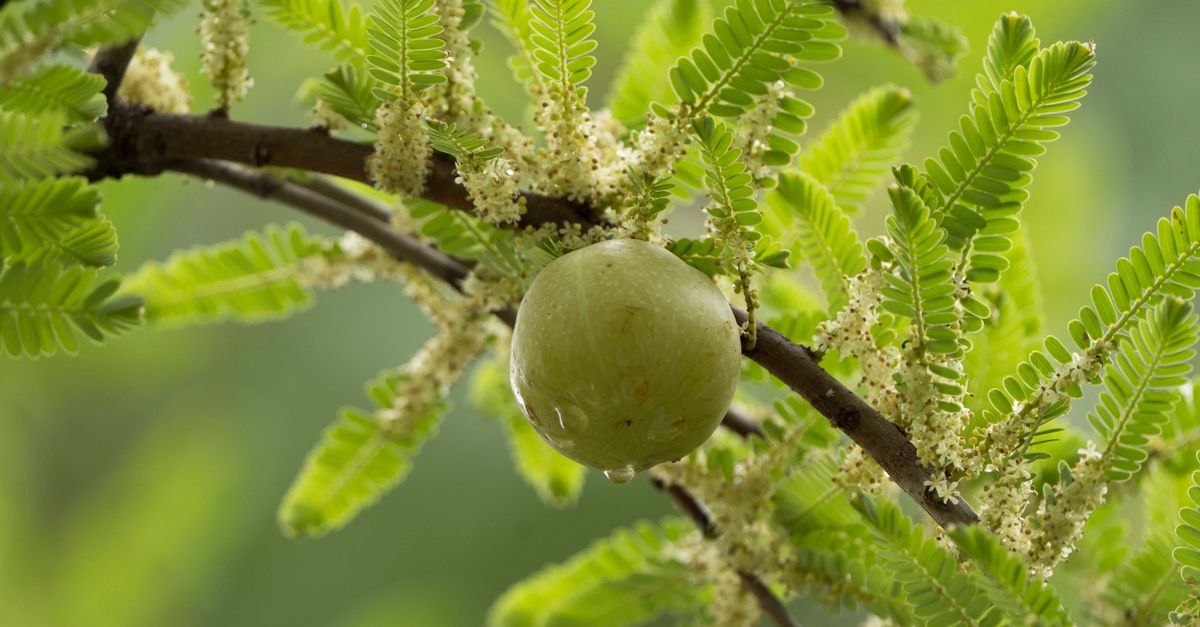
Amla is a genuinely vitamin C rich fruit with a small body of human trial evidence behind it, almost all of it about blood fats. Pooled results from nine randomised trials show modest drops in LDL and triglycerides. Those same trials found no change in body weight. Everything beyond that is tradition rather than measurement.
What is amla, and what is actually in it?
Amla is the fruit of Phyllanthus emblica, a tree native to India and grown across South and Southeast Asia. In Ayurvedic practice it is called amalaki, and it is one of the three fruits in the triphala blend. Despite the English name Indian gooseberry, it is not botanically related to the European gooseberry at all.
The fruit is small, pale green, hard and aggressively sour, which is why very few people eat it plain. It reaches most of us as juice, dried powder, a sugar preserve called murabba, a pickle, or a standardised extract in a capsule. Those forms are not interchangeable, and that difference matters far more than most writing on the subject admits.
Nutritionally, amla behaves like a fruit. It supplies water, fibre, a little sugar, and a set of polyphenols and tannins, chiefly the ellagitannins emblicanin A and B. Its calorie contribution is trivial. What makes it unusual is the vitamin C, and even that number is less settled than it looks.
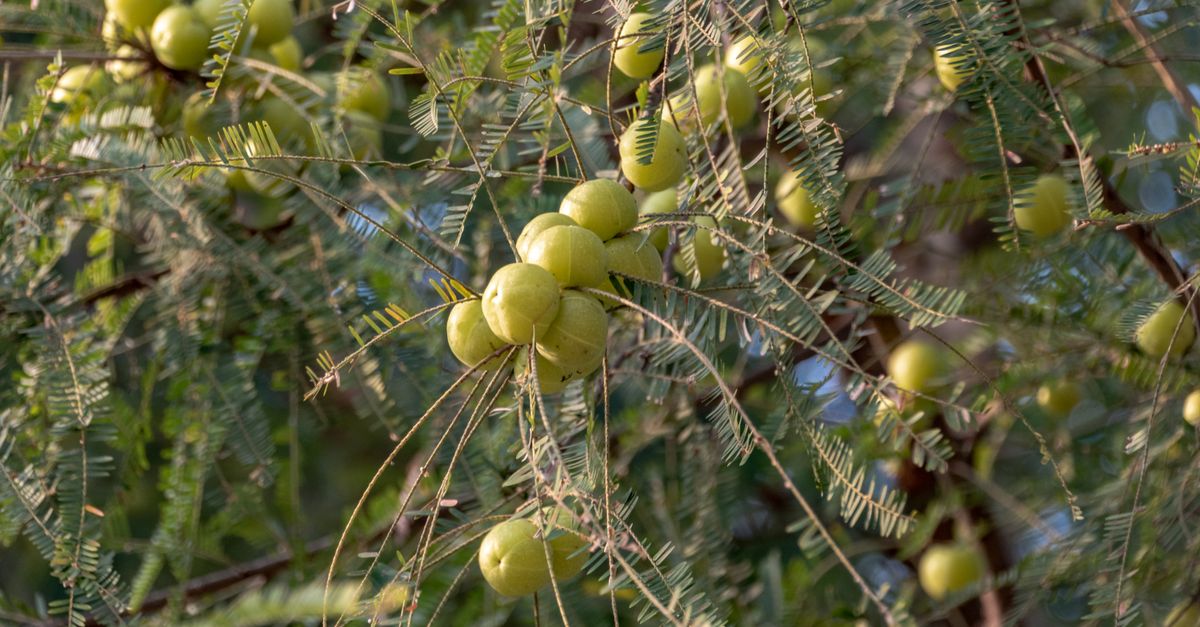
Does amla really have twenty times the vitamin C of an orange?
Not reliably, and the comparison hides a bigger problem. Published figures for amla put its vitamin C anywhere from roughly 300 to 900 milligrams per 100 grams of fresh fruit. That spread is not sloppy measurement. Ascorbic acid content varies genuinely with cultivar, ripeness at harvest, growing region and storage time, and different laboratory methods return different answers on the same fruit.
An orange sits at roughly 50 milligrams per 100 grams. So depending on which amla figure you pick, the multiple lands somewhere between six and eighteen, and the tidy twenty times that circulates online sits above the top of the plausible range. Any single number quoted as a constant is really one measurement of one batch, wearing a lab coat.
The more useful question is whether the multiple matters. The NHS puts the daily requirement for adults aged 19 to 64 at 40 milligrams, and notes that most people get everything they need from ordinary food. Vitamin C helps protect cells and supports skin, blood vessels, bones and cartilage, and it helps wounds heal. It does those jobs once you have enough of it. It does not do them harder when you have more. Moving from deficient to adequate changes something visible. Moving from adequate to abundant does not.
So the vitamin C headline is true and largely beside the point for anyone already eating fruit and vegetables. If amla turns out to do something worth noticing, the polyphenols are a more likely explanation than the ascorbic acid.
What have human trials on amla actually measured?
Less than the marketing suggests, but not nothing, and what exists points consistently in one direction. A 2023 systematic review and meta analysis in BMC Complementary Medicine and Therapies pooled nine randomised controlled trials covering 535 people. The trials used amla fruit extract at 500 to 1,500 milligrams a day, with one using dried fruit powder, over periods running from two to twelve weeks.
| What was measured | What the pooled trials found | How much weight it carries |
|---|---|---|
| LDL cholesterol | Lower by about 15 mg/dL on average | Consistent direction, but the trials were small and varied widely |
| Triglycerides | Lower by about 22 mg/dL | Same caveat, and the confidence interval is wide |
| HDL cholesterol | About 2 mg/dL higher, not statistically significant | No reliable effect demonstrated |
| hsCRP, an inflammation marker | Lower by about 1.7 mg/L | Measured, but a marker is not the same as an outcome |
| Blood pressure | Under 3 mmHg lower systolic, not statistically significant | No reliable effect demonstrated |
| Body weight and BMI | Unchanged in the largest placebo controlled trial | No evidence of any weight effect |

Two things stand out. Blood fats moved, and body weight did not. The confidence you can place in the size of those movements is also limited. The review reported high statistical heterogeneity across most outcomes, three of the nine trials enrolled only twelve or thirteen people each, and seven of the nine were run in India, with one each in Japan and Iran. The reviewers said plainly that the findings should be interpreted with caution.
The largest single study is worth reading on its own terms. A 2019 multicentre, double blind, placebo controlled trial gave 98 adults with dyslipidaemia 500 milligrams of amla extract twice a day for twelve weeks. Total cholesterol, LDL and triglycerides all fell further in the amla group than in the placebo group. HDL did not improve. Neither did weight or BMI. The study was sponsored by an extract manufacturer, which does not make the result wrong, but it is the sort of thing worth knowing before treating one trial as the last word.
Does amla do anything for weight loss?
There is no evidence that it does, and the study that looked hardest for it found nothing.
It is worth being precise about why that matters. The placebo controlled trial above ran for twelve weeks, in people who already had a metabolic problem, at a dose near the top of what supplements supply, and reported no significant change in body weight or BMI. The pooled review did not report weight as an outcome at all, which tells you it was never what the field was chasing.
What amla appears to move is a set of numbers on a blood test. Lower LDL and lower triglycerides are worth having in their own right, but they are not weight loss, and they do not become weight loss because a product page prints them next to each other. Body weight is governed by energy intake and expenditure sustained over months, by sleep, by medication, and by how much of a diet is built from things people keep eating past fullness. The NHS healthy weight guidance sets out the same unglamorous levers. A sour fruit does not touch any of them, and the same pattern shows up with jeera in the folk claims made for other kitchen staples.
The detox framing fails in the same way, only louder. Claims that amla flushes heavy metals, purifies the blood or resets the metabolism describe a body that does not exist. The liver and kidneys clear metabolic waste continuously, and no food switches that process on or off.
Does the form of amla change what you get?
Yes, more than any other single variable, and this is where most of the confusion lives.
Every trial described above used a standardised extract rather than fruit. An extract is manufactured to hit a stated polyphenol content, which is exactly what makes a trial repeatable. Fresh amla, home dried powder, bottled juice, murabba and pickle vary enormously in polyphenol content, and the sweetened forms carry added sugar that a capsule does not.
That cuts in both directions. Evidence from a standardised extract does not transfer to a spoonful of powder, and a fruit’s long traditional use does not validate a capsule. Anyone presenting a study as proof that a particular product works is skipping the step where the product has to be the thing that was studied.
Supplements are also not assessed for safety and content before sale in the way medicines are. Nothing external verifies what is in the bottle unless the manufacturer pays for it. Independent third party testing, a traceable batch number and a stated extract standardisation are the signs that someone has actually looked. Their absence is not proof of a problem, but it does mean no one has checked.
Who should be cautious with amla?
As a food, amla is well tolerated, and the trials reported no serious adverse effects. Concentrated forms raise different questions.
- It is strongly acidic, and people living with reflux or gastritis often find sour concentrates uncomfortable.
- The NHS notes that vitamin C above 1,000 milligrams a day can cause stomach pain, diarrhoea and wind, and some amla products pack a large dose into a single capsule.
- Anything that lowers blood glucose or blood lipids can add to medication already doing that job. For anyone taking drugs for diabetes, cholesterol or blood clotting, the interaction is worth raising with the prescriber first.
- Evidence in pregnancy and breastfeeding is thin enough that concentrated extracts have not been properly studied in either group.
None of that makes amla risky. It makes it a food with a modest, real and narrow evidence base, which is a more interesting thing to be than a miracle.
This article is general information, not personal medical advice. Anyone with questions about cholesterol, blood sugar, weight or a supplement they are considering should discuss them with a doctor, pharmacist or registered dietitian who knows their history.
Is amla the same thing as a gooseberry?
No. Amla is the fruit of Phyllanthus emblica, often called Indian gooseberry, and it is not botanically related to the European gooseberry. The shared English name is a historical convenience rather than a family connection, and the two differ in taste, texture and nutrient content.
Does amla burn fat or speed up metabolism?
No trial has shown that. The largest placebo controlled study of amla extract ran for twelve weeks and found no significant change in body weight or BMI. The effects that have actually been measured are on blood fats and an inflammation marker, not on body composition.
Is amla powder as good as amla extract?
They are not equivalent. Almost all of the trial evidence used a standardised extract with a stated polyphenol content. Powder made from dried fruit varies widely depending on the fruit and the drying method, so a result from an extract cannot be assumed to apply to it.
How much amla did the studies actually use?
Trials in the pooled review used 500 to 1,500 milligrams a day of amla fruit extract for two to twelve weeks, and the largest single trial used 500 milligrams twice daily for twelve weeks. That is a record of what was tested, not a recommendation. A doctor or registered dietitian can advise on an individual situation.
Can amla be taken alongside medication?
That is a question for a prescriber. Amla extract has been shown to lower LDL and triglycerides, so it can add to the effect of drugs doing the same job. Anyone taking medication for cholesterol, diabetes or blood clotting is best raising it before starting anything concentrated.
Does amla prevent grey hair or hair loss?
There is no reliable human trial evidence for either. Amla oil has a long history in hair care and many people like how it feels, but greying is driven mainly by genetics and age, and no food has been shown to reverse it.
Leave a Reply