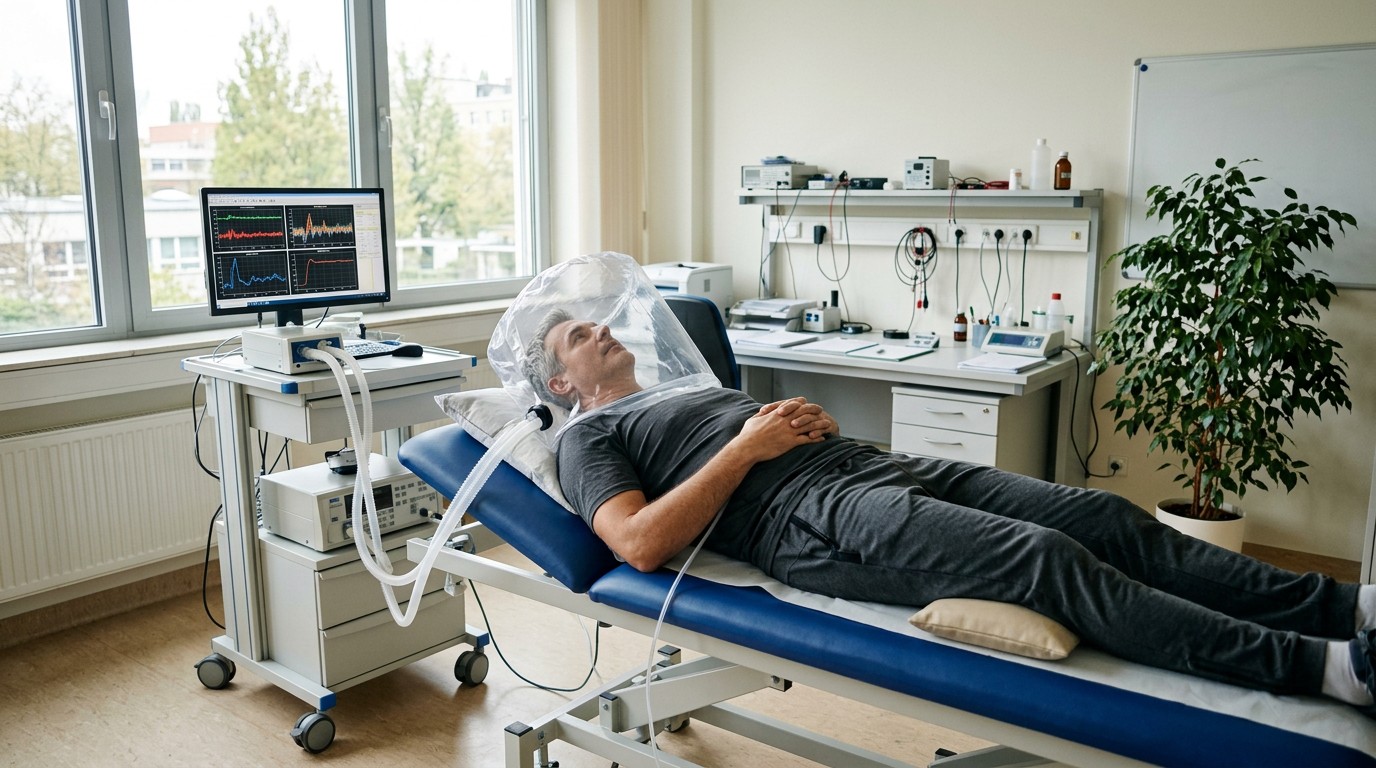
A resting metabolic rate test measures the oxygen you breathe in and the carbon dioxide you breathe out while lying still, then converts that into calories burned at rest. A well run lab test repeats within about 5 percent from one day to the next. The free formula and cheap handheld devices can miss by more.
Listen to this article, about 11 minutes. A synthetic voice reads the article and announces each section title as it begins; tables are read row by row and the questions at the end are left out.
Recorded 9 October 2026 from the article as published that day. Press a chapter to jump there; the highlighted line is what is playing. A play button sits beside every section heading, and once you scroll past this player a bar at the bottom of the screen keeps the controls in reach. Tap or click any sentence to hear the reading start from there.
On this page: the error of a lab metabolic cart, a handheld device and the free Mifflin St Jeor formula set side by side from their validation studies, the preparation the published protocol asks for, and what university labs charge.
Think you already know this? Five questions, one minute.
Every answer is on this page. Answer from what you know now; the page fills in the rest.
-
1. What does a metabolic cart actually measure during a resting metabolic rate test?
Indirect calorimetry converts breath gases into calories at rest, as described in the 2015 Academy evidence review. Read the section
-
2. How long a fast did the 2015 evidence review ask for before the test?
The 2015 review by Fullmer and colleagues concluded people should be fasted for at least 7 hours and rest for 30 minutes before the test. Read the section
-
3. In the 2021 study of 14 men measured on two days, how much did resting results vary on average?
The Nutrients study reported an inter day coefficient of variation of 4.85 percent for resting metabolic rate. Read the section
-
4. In the 2014 study of 88 adults, how did the MedGem handheld compare with the lab cart?
Anderson and colleagues found the handheld overestimated resting energy by 111 calories a day on average. Read the section
-
5. What did the University of Rhode Island lab list as its price for the general public?
The URI lab page listed $80 for the general public and $40 for university staff and students when read on 9 October 2026. Read the section
Most pages ranking for this are booking pages, written by the lab or the clinic selling the test, so they describe the mask and the price and stop there. The question a reader actually has is simpler: will a paid test tell me something the free calculator cannot? The answer depends on two numbers nobody puts side by side, how far the formula misses and how far the test itself wobbles. Both are below, with their studies.
What does a resting metabolic rate test actually measure?
A resting metabolic rate test uses indirect calorimetry. You lie or sit still with a mask, mouthpiece or clear hood over your face, and a machine called a metabolic cart measures how much oxygen you use and how much carbon dioxide you make. Burning fuel uses oxygen in a known ratio, so the cart converts the gas figures into calories a day. It is the only fitness test you pass by doing nothing and fail by fidgeting.
What comes out is your resting figure only: the energy your body spends keeping the lights on while you lie quietly awake. It is not the calories you burn in a day. Movement and digestion sit on top of it, which the BMR calculator guide breaks down share by share. A test result is also not a metabolic age, whatever the printout calls it; what a metabolic age score measures is a separate story.
How should you prepare for an RMR test?
Preparation decides whether the number means anything, because almost everything you do raises resting energy for a while afterwards. The Academy of Nutrition and Dietetics reviewed the evidence twice. Its 2015 update, Fullmer and colleagues in the Journal of the Academy of Nutrition and Dietetics, concluded that people “should be fasted for at least 7 hours and rest for 30 minutes” in a quiet, dimly lit room at a comfortable temperature before the test, without reading, music or fidgeting. It found that the effects of caffeine last longer than 240 minutes and nicotine longer than 140 minutes, and that the test can be done at any time of day if those conditions are met.
Two honest caveats sit inside that review. It found no studies at all on how long to wait after moderate or hard exercise, and only 5 of its 21 conclusions earned the two strongest evidence grades. It also disagrees with the earlier version: the 2006 systematic review said 10 to 20 minutes of rest was enough, where the update asks for 30. So labs fill the gaps with caution. The University of Rhode Island lab asks for a 12 hour fast and no exercise for 12 hours, stricter than the review, which is the lab playing safe rather than contradicting it.
Temperature matters more than people expect. One study in that review found resting energy measured 6 to 9 percent higher after a winter night in a 20 degree room than in a 25 degree one. The pre test checklist further down this page lists every condition, so you can tick them off the night before.

Pre test checklist, from the published protocol
The conditions the 2015 evidence review and lab instructions ask for. Your lab’s own instructions come first where they are stricter.
Ticks are saved on this device only. This list scores nothing and predicts nothing.
How accurate is a measured RMR compared with the free formula?
Here is the comparison the booking pages leave out. A formula like Mifflin St Jeor is an estimate built from the average person. A 2005 systematic review by Frankenfield and colleagues found it landed within 10 percent of the measured figure for more people than any other common equation, and also had the narrowest error range. The share is commonly quoted at about 82 percent of adults without obesity; the review’s abstract does not print it, so treat it as approximate. In a 2025 study of young women covered in the BMR calculator guide, the hit rate was 60 percent.
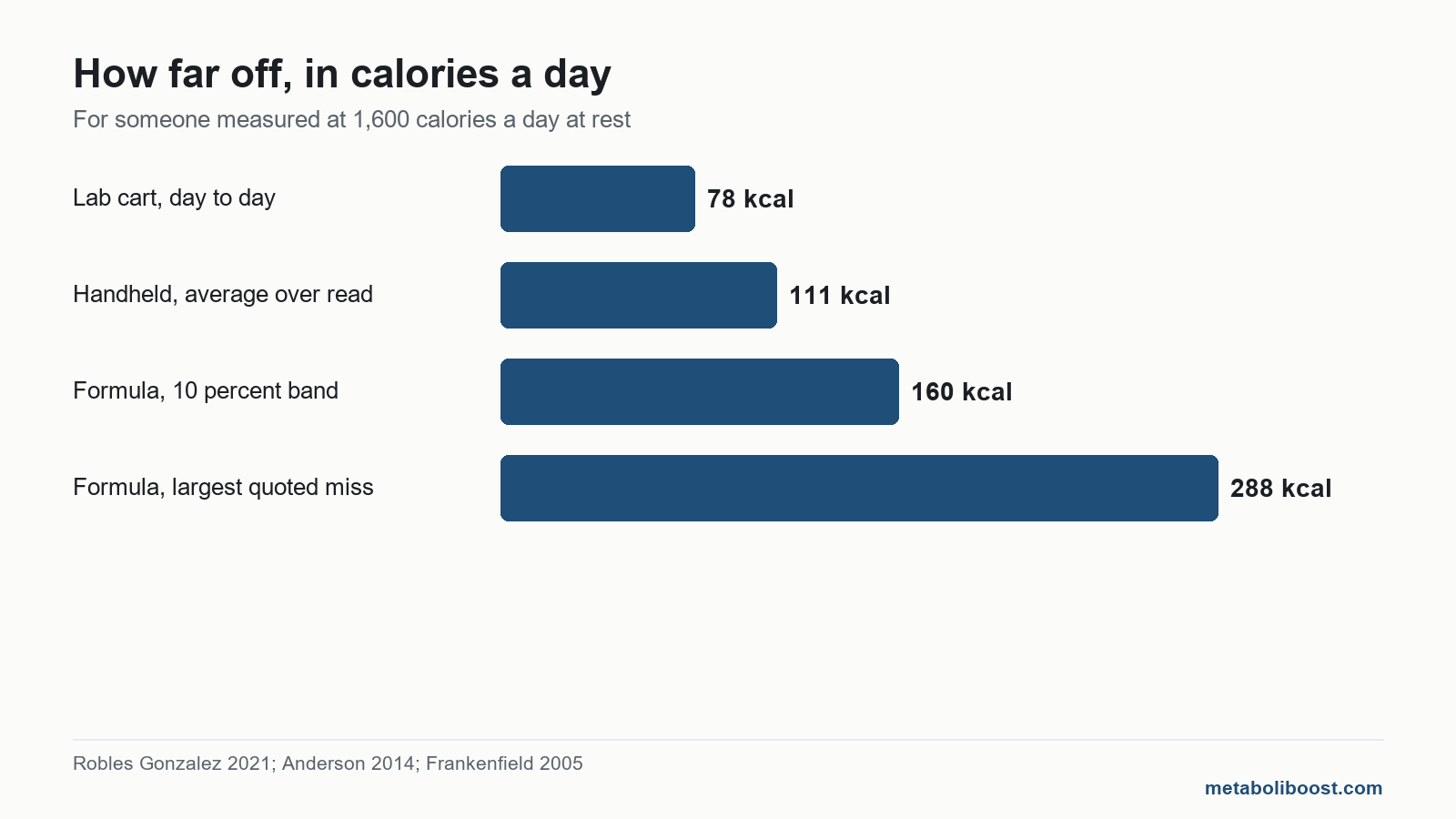
A good lab test is not perfect either. In a 2021 study in Nutrients, 14 healthy men were measured on two separate days with the same cart, and their results varied by 4.85 percent on average. So a well run test usually lands within about 5 percent of itself, and the formula usually lands within about 10 percent of the test. For most people that is the whole gap a paid test can close.
| Method | What the study found | Source |
|---|---|---|
| Mifflin St Jeor formula, free online | Estimate from age, height, weight and sex. Within 10 percent of the measured figure for more people than any other equation tested; misses beyond that are commonly quoted as reaching about 18 percent low | Frankenfield and colleagues, 2005 |
| Lab metabolic cart, same person on two days | Day to day variation averaged 4.85 percent in 14 healthy men | Robles Gonzalez and colleagues, 2021 |
| Handheld device (MedGem) against a lab cart | Read 111 calories a day higher on average in 88 adults; repeat reliability 0.70 against 0.84 for the cart | Anderson and colleagues, 2014 |
| Same handheld device in adolescents with overweight | Read 127 calories a day lower on average; individual results ranged from 203 above to 457 below | Woo and colleagues, 2016 |
Put in calories for someone who measures 1,600 a day: the cart’s day to day wobble is about 78 calories, the formula’s 10 percent band is 160, and the largest misses commonly quoted for the formula run to about 288. The chart beside this section draws those figures. Even the data processing moves the answer: one study comparing ways of selecting the breath data found that different selection methods produced significantly different resting figures from the same recordings, so ask the lab which method it uses.
Are handheld breath devices as good as a lab metabolic cart?
The cheaper route is a handheld device you breathe into for a few minutes, offered by some gyms and clinics. These measure oxygen and assume a fixed ratio for carbon dioxide rather than measuring both. In Anderson and colleagues’ 2014 study of 88 adults with overweight, the MedGem handheld read 111 calories a day higher than the lab cart on average. When 10 of them repeated the test three times, the handheld’s reliability score was 0.70 against 0.84 for the cart, which the authors called moderate.
The errors do not even go the same way in every group. In a 2016 study of 39 adolescents with overweight, the same device read 127 calories a day lower than the cart, and individual results ranged from 203 above to 457 below. A device that can miss by 457 calories in one person is not obviously better than a free equation that costs nothing and takes a minute. Body composition scales that print a resting figure do not measure breath at all; they run your estimated lean mass through a formula, which makes them another estimate.
How much does a resting metabolic rate test cost?
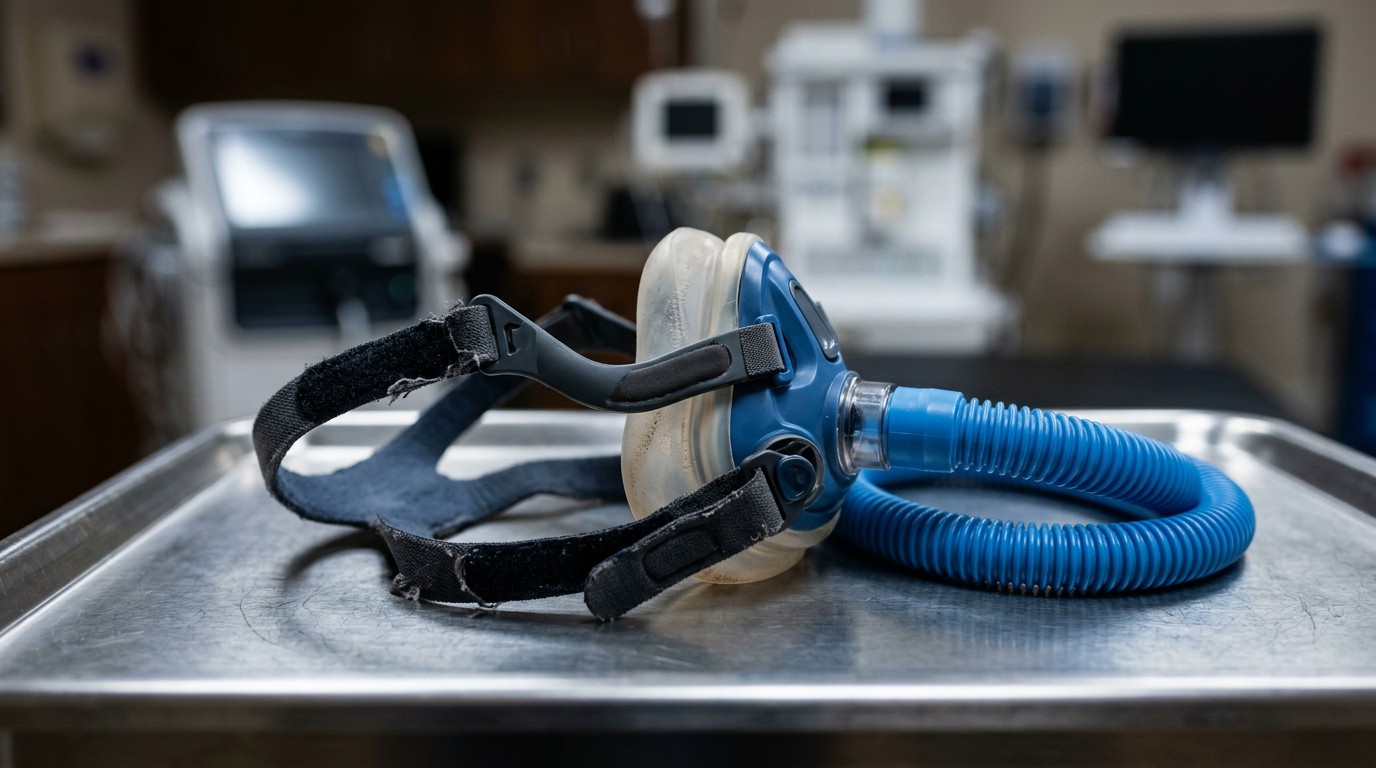
University exercise labs are the cheapest place to find a cart run by trained staff, and several publish their prices. Private clinics and fitness studios also offer the test, often bundled with a body scan, and charge more; no single typical price could be confirmed for them.
| Lab | Listed price | Preparation asked for | Source |
|---|---|---|---|
| University of Rhode Island | $80 general public, $40 university staff and students | 12 hour fast, no exercise for 12 hours | URI lab page |
| East Carolina University | $35 with an operator, 30 minute protocol | Not stated in the price list | ECU price list, July 2024 |
Before paying anywhere, three questions are worth asking: is it a metabolic cart or a handheld, how long is the measurement and how much of it is discarded, and what preparation do they ask for. A provider that cannot answer the first is selling a printout, not a measurement.
Who gets something useful from a measured number?
Formulas are built on averages, so they miss most for people who are far from the average. The 2005 review noted that older adults and ethnic minorities living in the US were underrepresented in both building and checking the equations. A 2023 meta-analysis of athletes found Mifflin St Jeor and several other common equations significantly over or underestimated resting energy in that group. Someone very muscular, someone much older or much larger than average, or someone whose careful food logs keep disagreeing with the calculator has the best chance of learning something new.
Some medical conditions and medicines change resting energy use, and that is a conversation for a doctor or registered dietitian, who can order a clinical test and read it alongside everything else. A gym printout is not a diagnosis, and a low number on one is not a reason to change a medicine or eat much less.
What can a measured RMR not tell you?
It cannot tell you what you burn on a Tuesday, because movement varies by hundreds of calories a day between people and between days. It cannot tell you whether your metabolism is “broken”, a phrase that sells a lot of capsules and is not a clinical diagnosis. And it cannot be raised much by anything sold to raise it: the honest size of the effect of muscle, protein and the rest is tens of calories, which trials of muscle and metabolism confirm.
Where a measured figure helps is as a better starting point than the formula, nothing more. Anyone who then builds a calorie plan on it is still estimating everything above rest, the same way every calorie deficit calculator does. If the free estimate and your own steady records already agree, a paid resting metabolic rate test is likely to confirm what you know.
Frequently asked questions
Is an RMR test the same as a BMR test?
Not quite. Basal rate is measured under stricter conditions, usually straight after waking in a lab, while resting rate allows a short rest after arriving. Resting figures run slightly higher, and most commercial tests measure resting rate.
How long does a resting metabolic rate test take?
Most take 10 to 30 minutes of breathing into the mask or hood, plus the rest period before it. The 2006 review recommended discarding the first 5 minutes of a 10 minute measurement.
Can I drink water before an RMR test?
Ask the lab: the published reviews deal with food, caffeine and nicotine rather than water. Coffee, tea and energy drinks are a different matter, because the effect of caffeine lasts longer than four hours.
Does a resting metabolic rate test hurt?
No. There are no needles and no exercise. You breathe normally through a mask, mouthpiece or clear hood while lying or sitting still, and the main challenge is keeping still.
Should the test be repeated after weight change?
Resting energy tracks body size, so a figure measured at one weight goes out of date as weight changes. Whether a repeat is worth paying for depends on how the first number is being used.
Why did my test differ from my smart scale?
A smart scale or body composition scale does not measure breath. It estimates lean mass from an electrical signal and runs that through an equation, so it is another estimate, not a second measurement.
Finished the page? The same five questions from the top, to see what stuck.
This article is general information, not medical advice, and is not a substitute for care from a qualified healthcare professional. Speak to your doctor about your own situation.
Leave a Reply