Does walking after eating help with weight loss? Not in any special way that research has shown. A short walk soon after a meal reliably blunts the rise in blood sugar, and pooled trials confirm it. The weight loss claim traces back to a 2011 report on two women. For weight, an after dinner walk counts like any other walk.
Listen to this article, about 11 minutes. A synthetic voice reads the article and announces each section title as it begins; tables are read row by row and the questions at the end are left out.
Recorded 7 October 2026 from the article as published that day. Press a chapter to jump there; the highlighted line is what is playing. A play button sits beside every section heading, and once you scroll past this player a bar at the bottom of the screen keeps the controls in reach. Tap or click any sentence to hear the reading start from there.
On this page: the 2011 walking after eating study read at the source, with its two participants stated, set beside the pooled trials of 116 people and a table showing which source measured weight and which measured only blood sugar.
Think you already know this? Five questions, one minute.
Every answer is on this page. Answer from what you know now; the page fills in the rest.
-
1. How many people took part in the 2011 study most often cited for walking straight after a meal?
The 2011 paper by Hijikata and Yamada studied the 60 year old author and one 67 year old volunteer, and said itself that more studies were needed. Read the section
-
2. In the 2023 review of 8 trials, what did exercise before a meal do to the blood sugar rise compared with sitting?
The 2023 Sports Medicine review found pre meal exercise did not significantly lower post meal glucose, while walking after the meal did. Read the section
-
3. How many of the 8 trials in the 2023 review measured weight change?
The trials in the 2023 review measured blood sugar after a meal; none of them assessed weight change. Read the section
-
4. Using the Compendium figures on this site, about how many calories above resting does a 10 minute walk at about 3 mph use for a 70 kg adult?
Thirty minutes comes to about 98 kcal above resting in the Compendium of Physical Activities arithmetic, so ten minutes is about a third of that. Read the section
-
5. Across the two forum threads read for this page, what did posters report?
On threads at Diabetes.co.uk and the Diabetes UK forum, most testers reported a flatter rise while some reported no effect or a temporary rise; these are reports, not findings. Read the section
Search the question and the pages that come back are cheerful. A stroll after dinner, they say, steadies blood sugar and trims the waistline, and a Japanese study gets cited as proof. Some of them have rebranded the whole thing the fart walk, which is at least honest marketing. What none of them mention is how many people were in that study. The number is two.
The blood sugar evidence is genuinely good. The trouble is that two claims have been glued together, one strong and one barely tested, and this page pulls them apart.
What did the 2011 walking after eating study actually test?
The paper is Walking just after a meal seems to be more effective for weight loss than waiting for one hour to walk after a meal, by Yasuyo Hijikata and Seika Yamada, published in the International Journal of General Medicine in 2011. The title is where most citations stop reading.
The participants were the first author, aged 60 with a family history of diabetes, and one volunteer aged 67. Each walked for 30 minutes after lunch and dinner, either straight away or starting an hour later. The runs took place in spring 2002 and late summer 2006, about a month each. The author walked briskly; the volunteer strolled.
On blood sugar the result was clear for these two women: the rise after a meal was smaller when they walked straight away than when they waited an hour. The paper also reports weight changes for both of them. We are not repeating those figures, because a number from two people over a month cannot tell anyone what walking will do for them, and repeating it is how it became a promise in the first place.
The authors were frank: more studies were needed “because this experiment included only two subjects”. That sentence rarely makes it into the articles that cite them.
What does the larger research say about walking after meals?
Here the evidence gets much stronger, but notice what it measures. A 2023 review in Sports Medicine by Engeroff, Groneberg and Wilke pooled 8 randomised trials with 116 participants, 47 of them with type 2 diabetes. Exercise after a meal, mostly walking, lowered the blood sugar rise compared with sitting still. Exercise before the meal did not. The sooner the walk started, the bigger the effect, and the authors concluded that walking helps most “as soon as possible after a meal”.
A 2022 review by Buffey and colleagues looked at people who broke up long sitting with a few minutes of standing or light walking every 20 to 30 minutes. Both helped blood sugar after meals, and walking beat standing. The pooled figures are commonly quoted as about 17 percent lower glucose with walking breaks and about 9.5 percent with standing breaks, compared with sitting through.
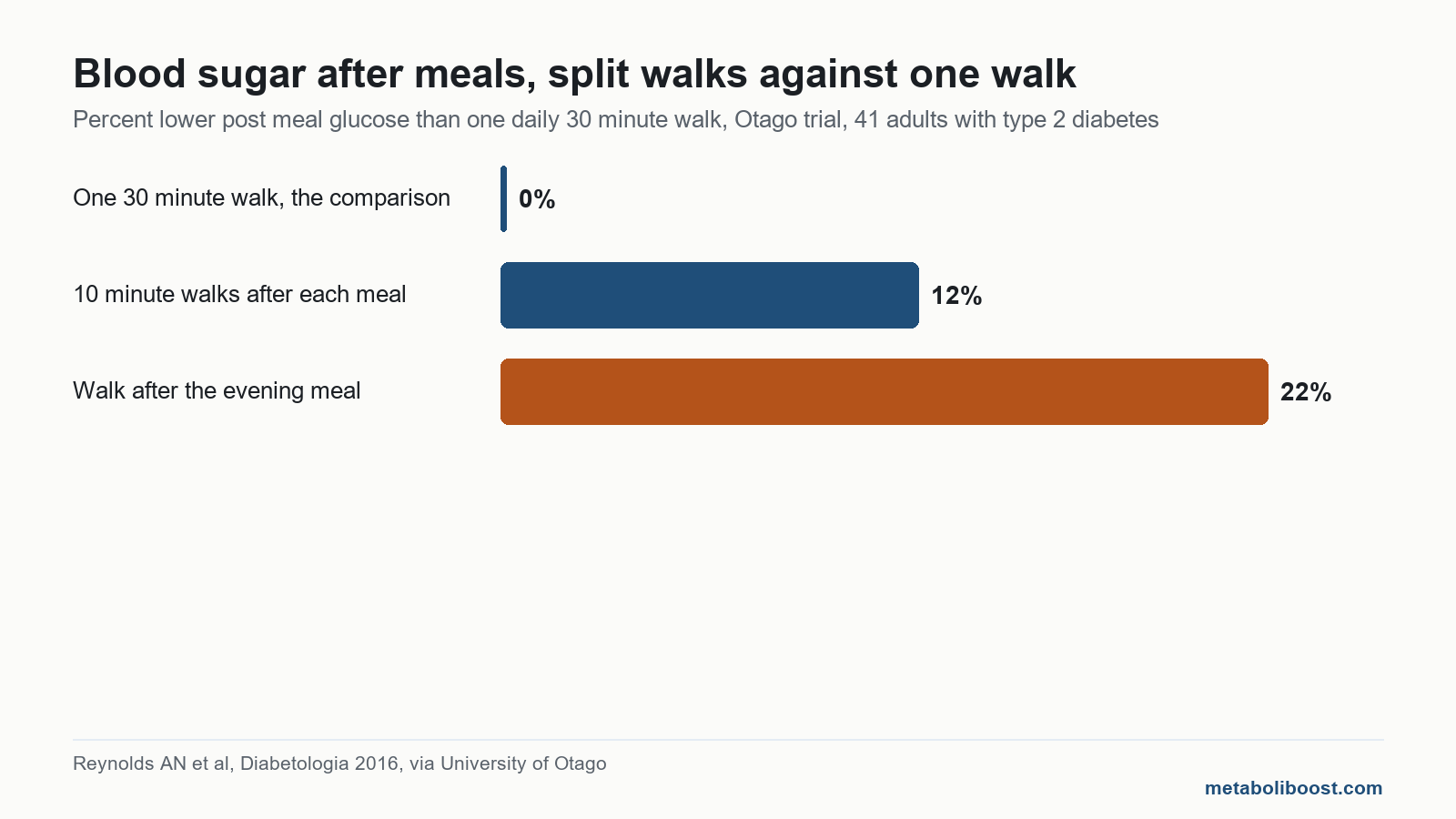
Then there is the trial most relevant to real life. Reynolds and colleagues at the University of Otago asked 41 adults with type 2 diabetes to walk 30 minutes a day whenever they liked, and in a separate phase to split the same time into 10 minute walks started within five minutes of each meal. Blood sugar after meals averaged 12 percent lower with the split walks, and 22 percent lower after the evening meal, which tends to be the biggest and is followed by the most sitting.
The American Diabetes Association’s 2026 Standards of Care have taken this on board. They state that brief bouts of activity of 3 to 15 minutes acutely reduce blood sugar after meals in people with prediabetes and diabetes, and that prolonged sitting should be interrupted at least every 30 minutes.
| Source | Who was studied | What was measured | Did it measure weight? |
|---|---|---|---|
| Hijikata and Yamada, 2011 | 2 women, aged 60 and 67, one of them the author | Blood sugar and body weight, two runs of about a month | Yes, but only in two people with no control group |
| Engeroff and colleagues, 2023 | 8 randomised trials, 116 people | Blood sugar after a single meal | No; none of the trials measured weight change |
| Buffey and colleagues, 2022 | 7 studies of sitting broken up by standing or walking | Blood sugar and insulin across a day | No |
| Reynolds and colleagues, 2016 | 41 adults with type 2 diabetes | Blood sugar after meals, 10 minute walks against one 30 minute walk | No |
| American Diabetes Association, 2026 | Clinical guideline | Recommends breaking up sitting at least every 30 minutes | Makes no weight claim for timing |
Does a smaller blood sugar spike mean more weight loss?
This is the jump the ranking pages make without looking. The argument runs like this: a big sugar spike means a big insulin response, insulin encourages storage, so a smaller spike must mean less fat stored. None of the trials above tested where it ends up.
Look at the table again. The 2023 review found that none of its eight trials measured weight change, which makes sense, because they were testing what happens to blood sugar over a few hours after one meal. Weight is decided over weeks and months by how much energy goes in and how much goes out. A walk changes the second number. When in the evening it happens has never been shown to change it in any trial large enough to count.
So the honest answer is that walking after eating helps weight in the ordinary way walking helps: it adds movement to a day. If the after dinner walk is the walk that actually happens, because the dishes can wait and the sofa has not yet claimed anyone, that is a real advantage. It is a habit advantage, though, not a metabolic one.
Steadier blood sugar is worth having on its own terms, especially with prediabetes or type 2 diabetes, and our guide on what changes weight when insulin resistance is in the picture covers that. It is just not the same thing as losing weight.
Reading a walking after eating claim
Five questions to ask of any page, video or post that says walking after meals causes weight loss. They come from the sources in the table above. Ticking them checks the claim, not anyone’s body.
Ticks are saved on this device only. This checklist does not assess health, set a goal or predict any result.
How many calories does a walk after dinner burn?
Less than the internet would like. Our walking calorie calculator works through the arithmetic from the Compendium of Physical Activities: a 70 kg adult walking 30 minutes at about 3 mph uses roughly 133 kcal in total, of which about 98 is extra to what the body would have burned sitting still.
A 10 minute walk at the same pace is a third of that: roughly 44 kcal in total and about 33 extra. Three of those a day, one after each meal, add up to the same 30 minutes and the same calories as one longer walk. The clock on the kitchen wall does not change the sum.
None of this is an argument against walking. The NHS physical activity guidelines ask adults for at least 150 minutes of moderate activity a week, and three 10 minute walks a day covers that by themselves. If splitting the walking around meals is what makes the total happen, that is a good reason to do it. Our piece on what the step count trials actually found shows where daily walking does seem to matter for weight: keeping it off once it has gone, more than taking it off.
What do people who check their glucose after a walk report?
People with diabetes who own a glucose meter are the closest thing to a natural experiment here, because they can test the same meal with and without a walk. We read two public forum threads on exactly this question, one on the Diabetes.co.uk forum from April 2025 and one on the Diabetes UK forum from March and April 2026, covering 13 people. What follows is what they report, not a finding.
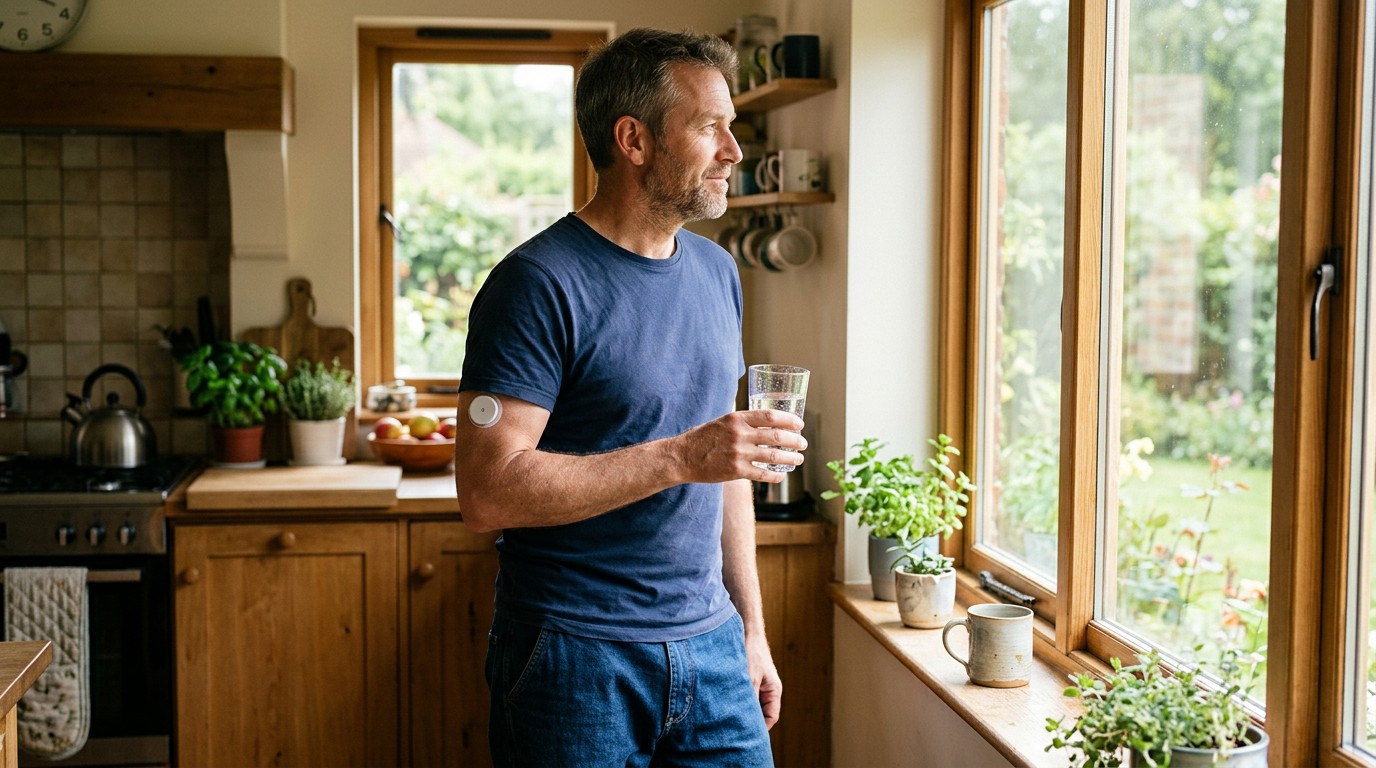
- One poster on the Diabetes.co.uk thread, April 2025, ate the same main meal on two days and tested two hours later. After a 20 minute walk the reading barely rose; without the walk it was roughly 2 mmol/L higher.
- Another poster in the same thread, April 2025, reports that exercising soon after eating shortens the spike for them, and warns that long or hard sessions can push readings the wrong way.
- Cutting against the pattern, one poster in April 2025 says exercise temporarily raises their readings, and another on a very low carbohydrate diet sees no discernible effect over the medium term.
- On the Diabetes UK thread, April 2026, one member reports readings about 1 to 1.5 mmol/L lower after 20 minute brisk walks, started 30 to 60 minutes after the meal rather than immediately.
- Another member there, April 2026, deliberately waits 30 minutes before exercising, which shows how unsettled the question of exact timing still is among people doing it every day.
Where these accounts agree with the trials: most people who tested found a walk flattened the rise. Where they diverge: a few saw no effect or the opposite, and the timing people settled on ranged from straight away to an hour later. On weight, only one poster mentions it at all, and that person had also changed their diet and was walking twice a day, which is exactly why a single account cannot isolate the walk.
Who should be careful about walking straight after eating?
Anyone taking insulin or a sulfonylurea such as gliclazide can have blood sugar fall too low with exercise, and a walk timed to flatten a spike is still exercise. The ADA guidance linked above discusses adjusting medication and food around activity, and that is a conversation for the doctor or diabetes team who prescribed the medicine, not a forum.
The same applies to anyone with a heart or lung condition, anyone who feels faint, breathless or has chest pain when walking, and anyone whose weight is changing without an obvious reason. Unexplained weight change is a reason to see a GP, not a reason to walk more.
For everyone else: a short walk after meals is cheap, pleasant and good for blood sugar. It is not a weight loss method of its own. Our look at which foods have evidence behind them for insulin resistance is the better next read if blood sugar is the real worry.
Frequently asked questions
Is it better to walk before or after a meal for blood sugar?
After. The 2023 Sports Medicine review found walking after a meal lowered the blood sugar rise compared with sitting, while exercise before the meal made no significant difference in the trials it pooled.
How soon after eating should a walk start to help blood sugar?
The trials found the effect was larger the sooner the walk began, and the Otago trial started walks within five minutes of finishing a meal. People on glucose lowering medication should ask their diabetes team about timing.
Does a slow walk after dinner still count?
For blood sugar, yes. The sitting reviews used light walking, and one of the two women in the 2011 study strolled rather than walked briskly. For calories, a slower pace burns less per minute.
Does walking after eating cause stomach cramps or indigestion?
Some people find brisk walking on a full stomach uncomfortable. The trials mostly used an easy pace, and anyone with ongoing reflux or abdominal pain should mention it to a doctor rather than push through it.
Is the fart walk a real weight loss method?
It is a social media name for an after dinner walk. The blood sugar benefit of walking after meals is well supported. A weight loss effect beyond the calories walking uses has not been shown in any adequate trial.
Is walking after lunch as useful as walking after dinner?
Both lowered blood sugar in the trials. In the Otago study the biggest difference came after the evening meal, which the authors linked to it being the largest meal and the one followed by the most sitting.
Finished the page? The same five questions from the top, to see what stuck.
This article is general information, not medical advice, and is not a substitute for care from a qualified healthcare professional. Speak to your doctor about your own situation.
Leave a Reply