
Whey isolate for weight loss works only as a protein source, not as a fat burner. Gram for gram it is about the most protein per calorie you can buy, near 24 g per 100 kcal before flavouring, but chicken breast and plain nonfat Greek yogurt sit close behind, and what decides the outcome is still the whole diet.
Listen to this article, about 14 minutes. A synthetic voice reads the article and announces each section title as it begins; tables are read row by row and the questions at the end are left out.
Recorded 26 October 2026 from the article as published that day. Press a chapter to jump there; the highlighted line is what is playing. A play button sits beside every section heading, and once you scroll past this player a bar at the bottom of the screen keeps the controls in reach. Tap or click any sentence to hear the reading start from there.
On this page: a table of protein per 100 calories for whey isolate, concentrate and eight foods from USDA records, the cost of 25 g of protein at September 2026 US prices, and what two r/loseit threads report.
Think you already know this? Five questions, one minute.
Every answer is on this page. Answer from what you know now; the page fills in the rest.
-
1. What does whey isolate actually contribute to a weight loss diet?
It is milk protein with most lactose and fat filtered out; the ADPI isolate standard defines it by protein content alone. Read the section
-
2. What minimum protein content defines whey protein isolate in the ADPI standard?
The ADPI isolate standard sets at least 90% protein on a dry matter basis; 25% is the floor for concentrate in the ADPI concentrate standard. Read the section
-
3. USDA record 173177 is named whey protein powder isolate. How does it compare with plain nonfat Greek yogurt on protein per 100 kcal?
The USDA record works out at 16.2 g per 100 kcal against 16.9 for nonfat Greek yogurt. Read the section
-
4. At the September 2026 BLS average egg price, roughly what does 25 g of protein from eggs cost?
A dozen large eggs averaged $2.272 per the Bureau of Labor Statistics; twelve 50 g eggs carry about 75.6 g of protein, so 25 g costs about $0.75. Read the section
-
5. In the Astbury whey preload study, what happened as the protein share of the drink rose?
In Astbury and colleagues, intake at the later meal fell as protein rose, while appetite ratings did not differ between drinks. Read the section
Search this phrase and you get shops, a press release dressed as news, and pages that call a milk by product a metabolism booster. None of them does the one sum that matters: how much protein you get for the calories, and what it costs, set beside ordinary food. This page does that sum from the USDA’s food records, the dairy industry’s own ingredient standards and the US government’s September 2026 shop prices, and it promises no number on your scale, because nothing honest can.
Does whey isolate help with weight loss at all?
Not directly. Whey isolate contains no ingredient that burns fat, speeds up metabolism or does anything at night that the rest of your food does not. It is milk protein with most of the lactose and fat filtered out. Weight still follows the energy balance of the whole diet over weeks and months.
What protein does is real but indirect. It fills you up more than the same calories of carbohydrate or fat, it costs a little more energy to digest, and it helps you keep muscle while you eat less. Our piece on what higher protein diets did in the trials covers those three effects and their honest size. Whey isolate is one convenient way to get protein. It is not a different kind of help. Collagen powder is marketed the same way but is an incomplete protein, which is why what the collagen peptide trials actually measured matters before counting a scoop toward your target.
What separates whey isolate from whey concentrate?
Both start as the watery whey left over from cheese making. The American Dairy Products Institute’s isolate standard defines isolate as whey with enough removed that the dry product is “at least 90% protein on a dry matter basis”, with typical lactose and fat each at 0.5 to 1.0%. Its concentrate standard only requires “not less than 25% protein”, and the common WPC 80 grade runs at a typical 80 to 82% protein with 4 to 10% lactose and 4 to 8% fat.
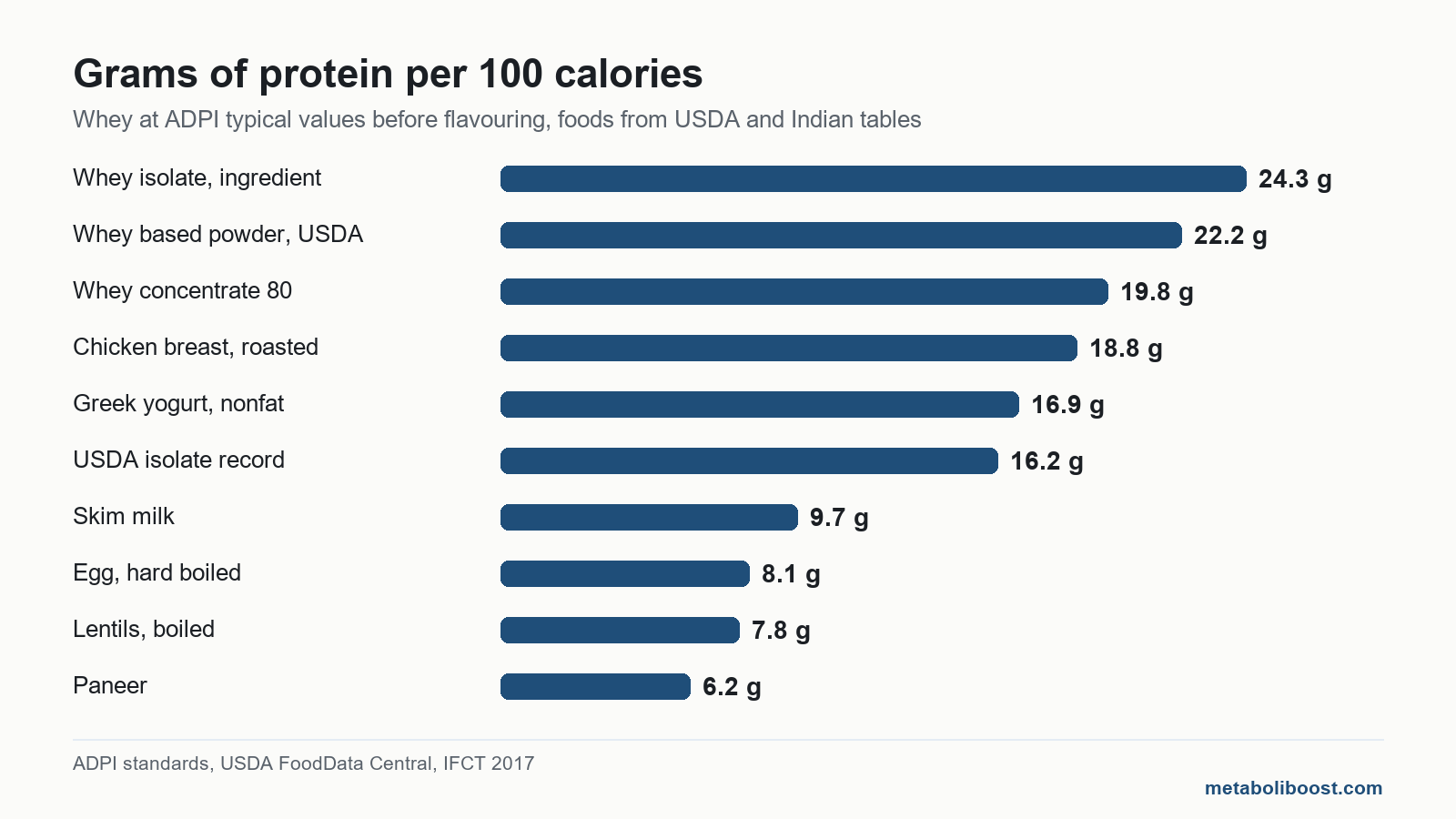
Run those typical figures through the standard calorie factors and the gap is smaller than the price gap suggests: about 24.3 g of protein per 100 kcal for isolate against 19.8 for concentrate 80. Isolate’s real advantage is the lactose, which matters if milk gives you trouble. For weight it is a modest difference, and our comparison of sattu and whey shows how much bigger the gap is between whey and a food that is mostly starch.
How much protein per calorie does whey isolate give next to food?
Here is the table none of the shop pages computes. Every food row is a USDA FoodData Central record read on 18 October 2026, except paneer, from India’s national tables. The two ingredient grade rows are my arithmetic from the ADPI typical values, at 4 kcal per gram of protein and lactose and 9 per gram of fat; they describe the powder before anyone adds flavour or sweetener.
| Food, as the source names it | Source | kcal per 100 g | Protein g per 100 g | Protein g per 100 kcal |
|---|---|---|---|---|
| Whey protein isolate, ingredient grade, before flavouring | ADPI WPI standard, typical values | 357 | 86.9 | 24.3 |
| Beverages, protein powder whey based | USDA FDC 173180 | 352 | 78.1 | 22.2 |
| Whey protein concentrate 80, ingredient grade | ADPI WPC standard, typical values | 392 | 77.6 | 19.8 |
| Chicken breast, meat only, roasted | USDA FDC 171477 | 165 | 31.0 | 18.8 |
| Yogurt, Greek, plain, nonfat | USDA FDC 330137 | 61 | 10.3 | 16.9 |
| Beverages, whey protein powder isolate (a sweetened product) | USDA FDC 173177 | 359 | 58.1 | 16.2 |
| Milk, fluid, nonfat | USDA FDC 169868 | 35 | 3.4 | 9.7 |
| Egg, whole, hard boiled | USDA FDC 173424 | 155 | 12.6 | 8.1 |
| Lentils, boiled, without salt | USDA FDC 172421 | 116 | 9.0 | 7.8 |
| Paneer | Indian Food Composition Tables 2017 | 305 | 18.9 | 6.2 |
Two things stand out. First, the best case for isolate is only a few grams ahead of roast chicken breast and plain nonfat Greek yogurt. Second, look at USDA record 173177. It is called whey protein powder isolate, and it is 58.1% protein with 29.1 g of carbohydrate per 100 g, so it lands below the yogurt. The word isolate on a tub describes one ingredient, not the tub. A chocolate fudge flavour with added sugar can sit closer to a milkshake than to the standard.
The ranking of lean meats by protein per 100 calories runs the same sum across 18 cooked cuts, and the paneer page explains why a food with a quarter of its weight in fat comes last here without being a bad food.

What does 25 grams of protein cost from powder, eggs and chicken?
Protein per calorie is half the story; the other half is the receipt. The US Bureau of Labor Statistics publishes monthly average shop prices, and its September 2026 figures give a dozen large eggs at $2.272 and a pound of boneless chicken breast at $4.203. Whey prices have no official series, so the powder rows use two listings for one unflavoured 5 lb isolate tub that turned up in US search results on 18 October 2026. I could not confirm either on the retailer’s own page, and no brand is named because none is being recommended.
| Food | Price used | Protein in that amount | Cost per 25 g of protein |
|---|---|---|---|
| Large eggs, grade A, one dozen | $2.272, US city average, September 2026, BLS | 75.6 g (12 eggs of 50 g at 12.6 g per 100 g) | $0.75 |
| Boneless chicken breast, raw, one pound | $4.203, US city average, September 2026, BLS | 102 g (453.6 g at 22.5 g per 100 g, USDA FDC 171077) | $1.03 |
| Unflavoured whey isolate, 5 lb tub, cheaper listing | $45.59, a US listing seen 18 October 2026, not confirmed | 1,950 g (65 scoops of 30 g, as labelled) | $0.58 |
| The same tub, dearer listing | $80.95, a US listing seen 18 October 2026, not confirmed | 1,950 g | $1.04 |
So 25 g of protein from isolate costs somewhere around $0.58 to $1.04, eggs about $0.75 and chicken about $1.03. Powder is not the luxury option it looks like, nor the bargain the shops claim. The calculator below does the same sum for any tub in your cupboard or basket, beside the egg and chicken rows. Those egg rows are whole eggs; separating out the whites more than doubles the protein per calorie and leaves most of the choline behind, as the comparison of egg whites with whole eggs works through.
What does 25 g of protein cost from this tub?
Enter the price of any protein powder and what its label says about servings and protein per serving. The box works out the cost of 25 g of protein and prints it beside the egg and chicken rows from the table. It is arithmetic on your numbers only: it does not rate, rank or recommend any product.
Reference rows use US city average prices for September 2026 from the Bureau of Labor Statistics: a dozen large eggs at $2.272 and a pound of boneless chicken breast at $4.203, with protein from USDA FoodData Central. The reference rows are US dollars; your own figure is in whatever currency you enter.
What did the whey trials actually measure?
The most cited summary for people with excess weight is a 2018 meta analysis by Wirunsawanya and colleagues in the Journal of the American College of Nutrition, pooling nine randomised trials. The pooled results favoured whey on body weight and fat mass, and on several heart risk markers including blood pressure and cholesterol. The differences were small, the trials were short, and in most of them whey came alongside a diet or exercise programme, so the powder was never working alone.
On fullness, Astbury and colleagues gave lean adults 400 ml whey drinks 90 minutes before a meal they could eat freely. The more of the drink’s energy came from protein, the less people ate at the meal, yet their hunger ratings did not differ between the drinks. That is an effect on one meal in a lab, not a diet. Across longer studies, the 2012 meta analysis by Wycherley and colleagues of 24 trials found that higher protein diets during energy restriction protected more lean mass than standard protein diets. None of those trials needed whey to do it; food protein counted the same.
What no trial shows is a whey drink causing weight loss on top of an unchanged diet. The calories in a scoop are calories. Add one to everything you already eat and you have added food.

What do people who use whey while losing weight report?
Forum posts are testimony, not evidence. I read two r/loseit threads from 2026 and about 40 comments between them, from people describing how powder fitted into their eating rather than any result.
- In a June 2026 thread, the most upvoted reply described a roughly 120 kcal shake that kept the writer full for two hours or more, while also crediting exercise and the overall diet for the actual loss.
- In an August 2026 thread, several people said liquids do not fill them up and that they reach for cottage cheese or other solid food when they are actually hungry.
- The same August thread carried the warning most often repeated: it is easy to drink the shake on top of normal meals instead of in place of something, and then it simply adds calories.
- Others in the June thread used unflavoured powder as an ingredient, stirred into oats, yogurt or coffee, and counted it like any other food.
The pattern fits the trials better than the marketing. People who found it useful used it as a convenient protein inside a calorie budget they were already tracking. Nobody in either thread credited the powder on its own, and the accounts split on whether a drink is filling, which matches the lab finding that fullness ratings did not always follow intake.
Who needs to be careful with whey protein powder?
Protein powder is sold in the United States as a dietary supplement, and the FDA states that it does not approve dietary supplements for safety and effectiveness before they are sold. Quality depends on the maker.
Contamination is a documented problem. In October 2025 Consumer Reports tested 23 protein powders and shakes and found that more than two thirds contained more lead in one serving than its experts consider safe in a day. Dairy based products, whey included, generally had the lowest levels, and plant based products the highest. Products with independent third party testing are the ones to look for.
If you have kidney disease, the amount of protein you eat is part of your treatment, and the National Kidney Foundation advises working out the right amount with your care team. A protein supplement is something to raise with them first. People with a milk allergy should avoid whey entirely, since it is milk protein. Lactose intolerance is different: isolate carries very little lactose, though flavoured products may add other ingredients. If you take medicine for diabetes or for weight, or have a history of disordered eating, speak to your doctor or a registered dietitian before changing how you eat.
Frequently asked questions
Is whey isolate better than whey concentrate for weight loss?
Only slightly on paper. By the ADPI typical values, isolate gives about 24 g of protein per 100 kcal against about 20 for concentrate 80. The bigger difference is lactose, which matters for people who do not tolerate milk well.
Is it fine to replace a meal with a whey shake?
A scoop in water is mostly protein and lacks the fibre, vitamins and minerals of a meal. People on r/loseit reported mixed fullness from drinks. A doctor or registered dietitian can advise on meal replacement plans for your own situation.
Does whey isolate burn belly fat?
No food or supplement burns fat from one part of the body. The trials measured small changes in total fat mass alongside diet changes, not targeted fat loss.
Does clear whey work differently from milky whey?
Clear whey is an isolate processed to mix into a thin, juice like drink. The protein is the same milk protein; what changes is texture, flavour and whatever is added for taste.
How do I read a protein powder label for protein per calorie?
Divide the grams of protein per scoop by the calories per scoop and multiply by 100. Unflavoured isolate usually lands above 20. A result far lower means added sugar, fat or fillers.
Is whey protein safe for my kidneys?
For people with kidney disease, protein intake is part of treatment and should be set with their care team before any supplement is added. Anyone unsure about their kidney health should ask their doctor.
Finished the page? The same five questions from the top, to see what stuck.
This article is general information, not medical advice, and is not a substitute for care from a qualified healthcare professional. Speak to your doctor about your own situation.
Leave a Reply