
The evidence on collagen peptides for weight loss is thin. Four small placebo trials found a little more body fat lost with collagen, two of them only alongside supervised strength training, and none compared it with the same amount of ordinary protein. Most were tied to collagen makers, and as protein, collagen ranks below whey, eggs or fish.
Listen to this article, about 12 minutes. A synthetic voice reads the article and announces each section title as it begins; tables are read row by row and the questions at the end are left out.
Recorded 25 November 2026 from the article as published that day. Press a chapter to jump there; the highlighted line is what is playing. A play button sits beside every section heading, and once you scroll past this player a bar at the bottom of the screen keeps the controls in reach. Tap or click any sentence to hear the reading start from there.
On this page: a table of the five controlled collagen trials with who took part, what they took against what, the exercise involved and who supplied or paid, a chart of how small they were, eight r/loseit comments on counting collagen as protein, and a checklist for reading a collagen label.
Think you already know this? Five questions, one minute.
Every answer is on this page. Answer from what you know now; the page fills in the rest.
-
1. Which indispensable amino acid does collagen protein lack, according to the 2019 review in Nutrients?
The 2019 review states that collagen protein lacks tryptophan and is therefore classed as an incomplete protein source. Glycine is one of its main amino acids. Read the section
-
2. In the two German collagen trials, what did the placebo group take?
Both the 2015 trial and the 2019 trial used silica, so neither can separate collagen from simply adding protein. Read the section
-
3. What did the 2025 correction to the 2015 collagen and sarcopenia trial add?
The correction in the British Journal of Nutrition added to the acknowledgements that part of the costs were paid by GELITA AG. Read the section
-
4. In the 2020 trial giving older women whey or collagen, what happened to muscle protein synthesis over the week with collagen?
Oikawa and colleagues found longer term synthesis rose with whey but was not significantly elevated with collagen, at rest or after exercise. Read the section
-
5. In the 2009 breakfast study comparing a whey derived protein with gelatin, what happened at lunch afterwards?
The British Journal of Nutrition study found hunger was suppressed more by the whey derived protein, but energy intake at the next lunch was similar. Read the section
What is actually in a collagen peptide powder?
Collagen is the main structural protein in skin, tendon and bone. The powder in the tub is that protein boiled down and cut into short chains, usually from cow hide, pig skin or fish skin. Chemically it is close cousin to the gelatin in a jelly dessert, minus the wobble and plus a much higher price per gram.
Its amino acids are unevenly distributed. Collagen is mostly glycine, proline and hydroxyproline, and a review written by researchers from the collagen industry in Nutrients in 2019 states that collagen protein lacks one vital amino acid, tryptophan, and is therefore classed as an incomplete protein source. That matters later, when the question becomes whether a scoop does the job of a chicken breast.
What did the controlled collagen trials measure?
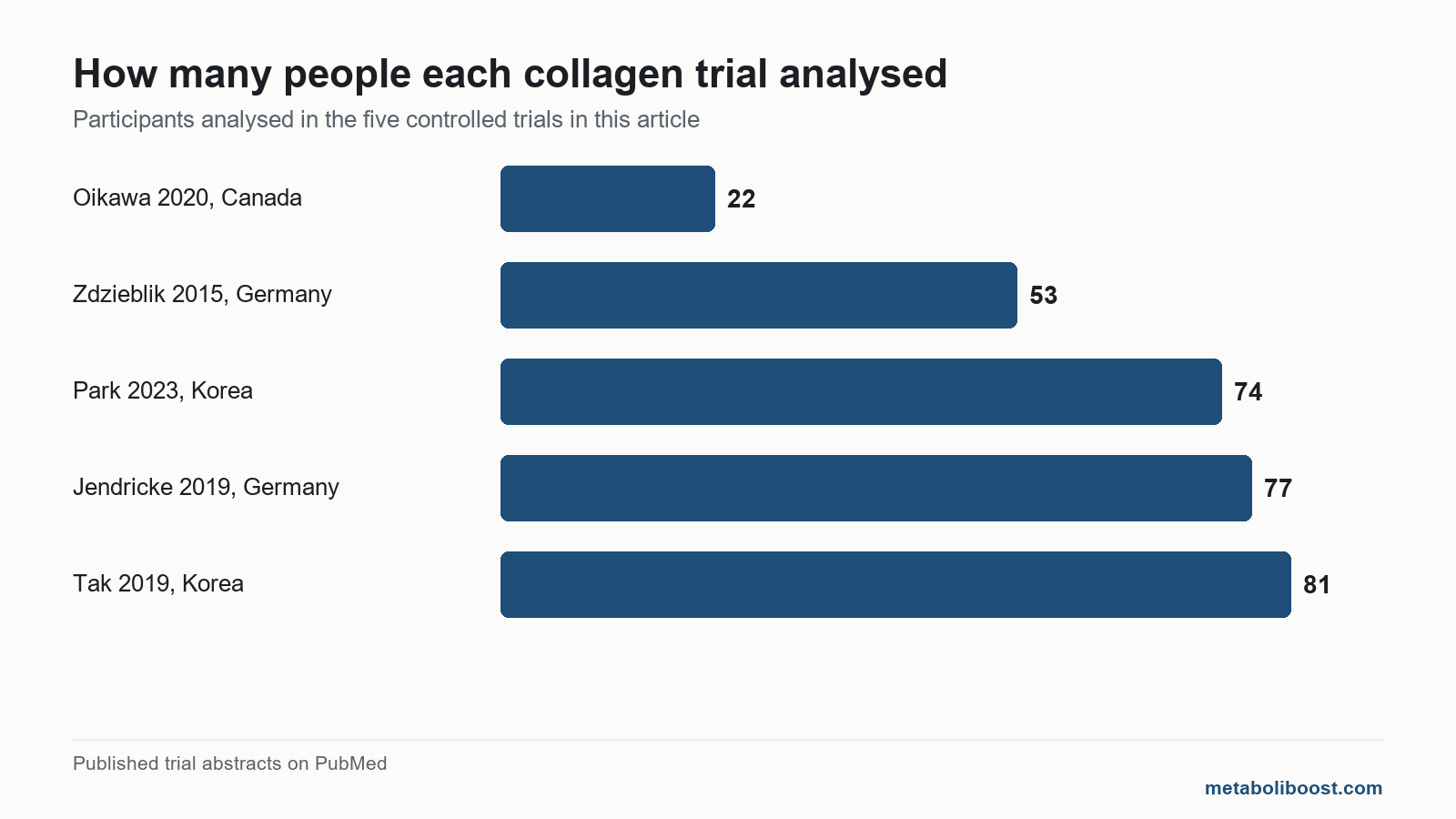
Five controlled trials sit behind most of the claims, and they measured different things in different people. The table lists what each one actually did. Doses are what the participants took in the trial, reported here so the designs can be compared, not a suggestion of what anyone else should take.
| Trial | Who took part | What they took, and against what | Exercise | Body composition result | Product and money |
|---|---|---|---|---|---|
| Tak and colleagues, Marine Drugs, 2019 | 90 overweight adults in Korea, 81 finished; 12 weeks | Participants took 2,000 mg a day of skate skin collagen in capsules, against placebo capsules | None added | Fat mass by DEXA scan fell more with collagen than placebo (p = 0.025) | Capsules supplied by Serom Co.; paper states no external funding |
| Park and colleagues, Clinical Nutrition Research, 2023 | Adults aged 50 and over, 74 analysed; 12 weeks | Participants took a 15 g collagen drink a day, against a placebo drink | None added, normal daily activity | Total fat mass fell more with collagen (p = 0.041 by DEXA) | Funded partly by Cosmax; the collagen was GELITA’s BODYBALANCE |
| Zdzieblik and colleagues, British Journal of Nutrition, 2015 | 53 older men with sarcopenia in Germany; 12 weeks | Participants took 15 g a day of collagen peptides, against silica, which has no protein and no calories | Guided resistance training, three sessions a week | Both groups lost fat; the collagen group lost more and gained more fat free mass (p under 0.05) | Product from GELITA; a 2025 correction added that GELITA paid part of the costs |
| Jendricke and colleagues, Nutrients, 2019 | 77 premenopausal women in Germany; 12 weeks | Participants took 15 g a day of collagen peptides, against silica | Resistance training, three days a week | Body fat percentage fell in both groups, more with collagen (p under 0.05) | Product from GELITA; paper states no external funding |
| Oikawa and colleagues, American Journal of Clinical Nutrition, 2020 | 22 healthy women aged about 69 in Canada; 6 days | Participants took 30 g twice a day of whey or of collagen, protein matched | Single leg resistance exercise | Not body fat: muscle protein synthesis rose with whey, and over the week not with collagen | Academic trial comparing two proteins |
Read the exercise column first. The two German trials that get quoted most gave everyone a supervised strength programme, and the training did most of the work: both groups lost fat and both gained lean mass. The collagen groups did somewhat better, which is a real result, but the comparison was collagen against a powder with no protein and no calories at all. So the trial cannot say whether collagen did something special or whether any extra 15 g of protein after training would have done the same.
The two Korean trials had no exercise added and still found a difference in fat mass by scan. They are also small, single centre and relatively short, which is exactly where chance findings live. Body weight on the scale was not the headline outcome in any of them.
When a 2024 meta-analysis in Sports Medicine pooled 19 trials with 768 participants, the body composition result it pooled was fat free mass, which favoured collagen when combined with training, with moderate certainty. It did not pool fat loss, and its trials were mainly in people who were also training. A tub sold for fat loss to someone who is not lifting anything sits outside most of this evidence.

Who paid for the collagen weight loss research?
The money trail is short. Three of the five trials in the table used the same branded peptide from one German collagen maker, GELITA. The 2015 sarcopenia trial, the most cited of them, was published without part of its funding note; a correction published in the British Journal of Nutrition in 2025 added that part of the costs were paid by GELITA AG, and one of its authors works at a collagen research institute. The 2023 Korean trial lists Cosmax, a supplement manufacturer, among its funders.
Industry money does not make a result false. It does mean the results deserve independent repeats before anyone builds a marketing campaign on them, and those repeats are mostly missing. Product pages, influencer videos and affiliate review sites that quote these trials are weaker evidence again, because they choose which trials to mention.
Does collagen count toward your daily protein?
This is the question that matters most if you are eating less, because protein helps protect muscle during weight loss. Grams of collagen are real protein grams on the label, but the body cannot build muscle well from a protein that is short of essential amino acids.
The cleanest test is the 2020 trial by Oikawa and colleagues, which gave older women the same amount of whey or of collagen. Whey raised muscle protein synthesis at rest and after exercise. Over the week, collagen did not lift it above baseline in either leg. A 2024 trial in young men found that collagen during a week of hard training did not raise muscle or connective tissue protein synthesis compared with a placebo, despite its reputation for tendons.
The fairest reading is that collagen can sit inside a varied diet without harm. The same industry authored review calculated that it could replace up to 36 percent of protein in a typical American diet before essential amino acids ran short. What it cannot do is stand in for the main protein foods. If the real goal is more protein for fewer calories, our guides to whey isolate measured against real food and to low calorie, high protein meals cover the options that count in full.

Does collagen make you feel fuller than other protein?
Protein is the most filling of the macronutrients, so it is reasonable to ask whether collagen helps with hunger. The direct evidence is old, small and pulls in two directions.
A 2009 respiration chamber study in the Journal of Nutrition found that a low protein diet built on gelatin suppressed hunger 44 percent more than the same diet built on casein, but it also left people in a more negative protein balance. A breakfast study in the British Journal of Nutrition the same year found the opposite pattern: a whey derived protein suppressed hunger more than gelatin, and what people ate at lunch afterwards did not differ. Gelatin is not identical to collagen peptides, and neither study measured weight. Mixed is the honest word.
What do people on r/loseit report about collagen?
We read three r/loseit threads from July 2025 to May 2026 and eight comments in them that discussed collagen. Nobody in them credited collagen with weight loss. The argument was about whether it counts toward a protein target. These are what people report, not findings.
In a December 2025 thread about hitting a daily protein goal, one commenter said a 10 g scoop of collagen in coffee was the only way they reached their number, and another, a woman in her sixties, described adding powdered collagen to bone broth. A third said they take collagen for other reasons and do not count it. A fourth questioned why a protein would need to be complete to count, which drew the longest reply in the thread, explaining that collagen is the outlier among animal proteins because its main amino acids are not essential.
Elsewhere, a May 2026 comment on food noise listed protein as a lever and added in passing that gelatin and collagen do not count, and a July 2025 reply in a loose skin thread defended collagen for skin while still advising against counting it as protein.
The pattern sits close to the trial evidence: the forum treats collagen as a top up at most, and the people who lean on it for their protein total are the ones the Oikawa result is most relevant to. For the bigger job of keeping muscle while losing fat, the training matters far more, which our piece on losing fat and gaining muscle at the same time goes into.
How do you read the weight claims on a collagen tub?
Collagen marketing has borrowed the full fat burner vocabulary: metabolism support, belly targeting, the creamer that turns a latte into a plan. None of the trials above tested a coffee creamer, and none tested whether collagen takes fat from one chosen area. The same habit of turning a small trial into a big promise turns up in the injectable peptides sold for fat loss, with higher stakes.
The checklist below is for reading a label or an advert. It does not rank products and it cannot tell you that one is right for you. It only helps separate what was tested from what was implied.
If you have kidney disease or have been told to limit protein, are pregnant, take medicines that affect appetite or weight, or have a history of an eating disorder, talk to your doctor or a registered dietitian before adding any protein supplement, collagen included. Collagen is also made from fish, cow or pig, which matters for allergies and for religious or dietary rules.
Reading a collagen label or advert
Tick each point you can confirm from the label or the seller’s own page. It does not rate the product and it does not tell you whether to take it.
Ticks are saved on this device only.
Frequently asked questions
Is collagen the same as gelatin?
They come from the same protein. Gelatin is collagen that has been partly broken down and sets when cooled. Collagen peptides are broken down further so they dissolve in cold drinks and do not set.
Does the type of collagen on the label matter for weight?
No trial in this article compared collagen types for body fat. Labels listing type I, II or III describe where the collagen came from, not a tested effect on weight.
Can collagen replace a protein shake?
Not like for like. Collagen lacks tryptophan and is low in other essential amino acids, and in a direct comparison whey raised muscle protein synthesis while collagen did not over a week.
Does bone broth count as collagen?
Bone broth contains gelatin, so it carries some of the same protein, but the amount varies widely by recipe. None of the body composition trials here tested bone broth.
Is collagen safe to take?
The trials reported it as well tolerated, with no notable side effects in the 2019 Korean trial. That covers short trials in healthy adults, not everyone, and a doctor is the person to ask about your own health.
Why do so many collagen adverts mention metabolism?
Because metabolism sells. None of the five trials in this article measured metabolic rate as an outcome of collagen, so the word on the tub is marketing rather than a tested result.
Finished the page? The same five questions from the top, to see what stuck.
This article is general information, not medical advice, and is not a substitute for care from a qualified healthcare professional. Speak to your doctor about your own situation.
Leave a Reply