
Almost certainly not, and not as fat. Losing five pounds of fat tissue in a week would need a daily energy deficit larger than most people eat in a day. The fast numbers people report in week one are mostly glycogen, water and gut contents, which is why they stall and why they return.
Listen to this article, about 10 minutes. A synthetic voice reads the article and announces each section title as it begins; tables are read row by row and the questions at the end are left out.
Recorded 25 September 2026 from the article as published that day. Press a chapter to jump there; the highlighted line is what is playing. A play button sits beside every section heading, and once you scroll past this player a bar at the bottom of the screen keeps the controls in reach. Tap or click any sentence to hear the reading start from there.
On this page: the arithmetic that rules five pounds of fat a week out for most adults, why the 3,500 calorie rule is generous to fast claims, what actually leaves in a fast first week and why it comes back, what the TEMPO trial measured in lean tissue and bone, and the four things that govern pace.
Think you already know this? Five questions, one minute.
Every answer is on this page. Answer from what you know now; the page fills in the rest.
-
1. Taking 3,500 calories per pound at face value, what daily deficit does five pounds of fat a week need?
17,500 calories over seven days. For an adult who burns around 2,200 a day there is nothing left to subtract, and eating literally nothing would not get there. That is a statement about arithmetic, not about any diet. Read the section
-
2. What mostly leaves in a fast first week?
A well fed adult holds roughly 500 grams of glycogen, each gram stored with about three grams of water, so the store plus its water sits on the order of two kilograms. Cut carbohydrate hard and it leaves in days; refeed and it returns, sometimes inside two days, and no fat was regained at that speed. Read the section
-
3. In the TEMPO trial, how did the severe restriction group compare on hip bone mineral density lost?
The TEMPO randomised trial compared 65 to 75 percent energy restriction with 25 to 35 percent in postmenopausal women with obesity, both with matched protein. Lean mass loss was about 1.5 times higher in the severe group, handgrip strength did not differ, and it was one trial in one population. Read the section
-
4. What does the NIDDK say about fast weight loss and gallstones?
The NIDDK page describes changes in bile composition alongside reduced gallbladder emptying. Specific per week thresholds quoted elsewhere could not be confirmed against a primary source, so treat any cutoff figure as unverified. Very low calorie diets have a clinical use, under supervision. Read the section
-
5. What pace does NHS guidance tell people to aim for?
The NHS guidance gives one to two pounds a week as a rate to aim for, not a prediction of what anyone will see. Pace is an output: you pick behaviours and a rate falls out, filtered through size, physiology and how much of the plan survives a bad week. Read the section
What would losing 5 pounds of fat a week actually require?
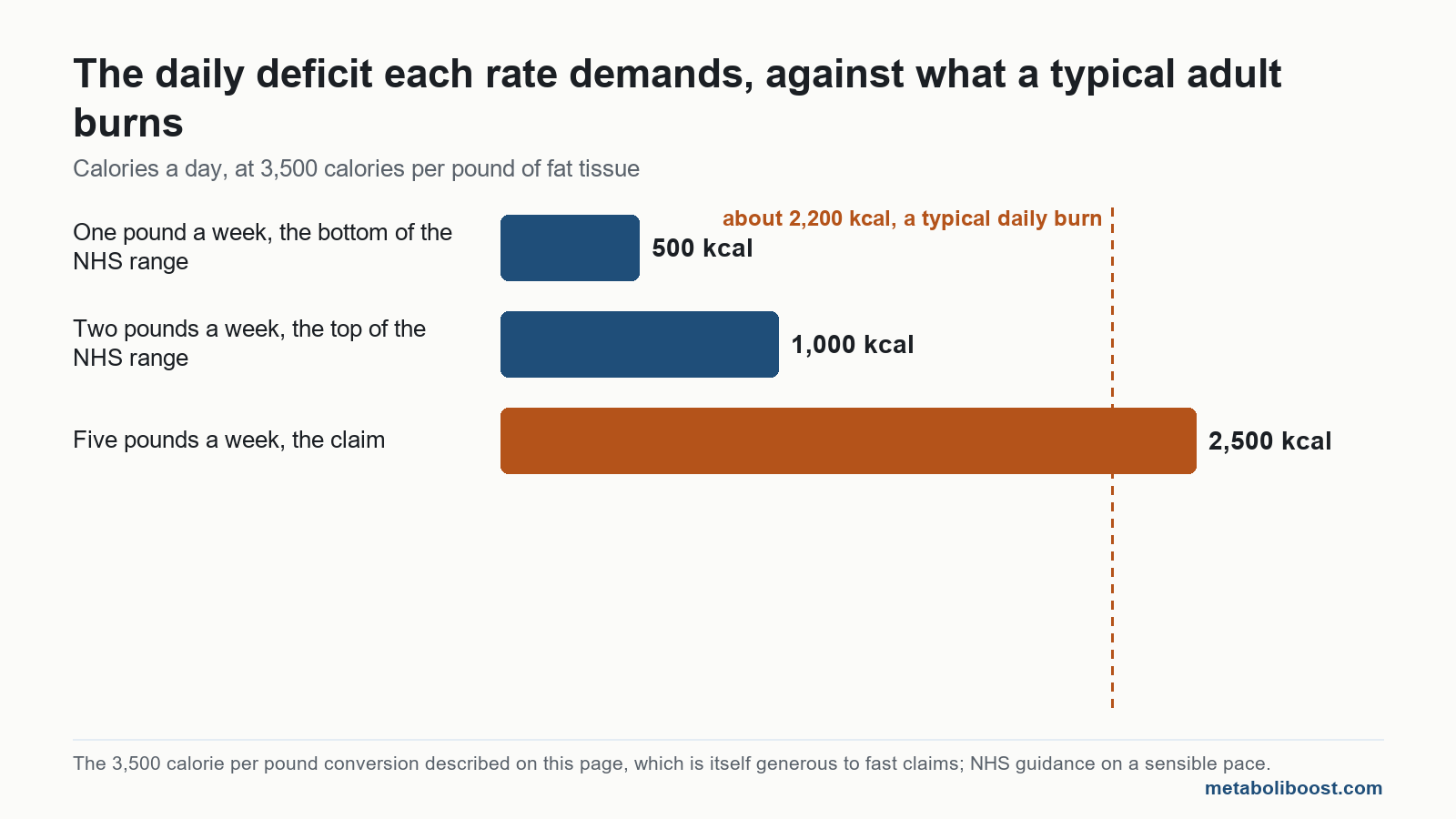
Body fat tissue is not pure fat. It is mostly lipid, with water and protein making up the rest, which is where the familiar figure of roughly 3,500 calories per pound of fat tissue comes from. Take that figure at face value and five pounds a week works out at 17,500 calories over seven days. That is a deficit of about 2,500 calories a day, every day, with no time off.
For most adults that is larger than everything they burn in a day. Someone whose total daily energy expenditure is around 2,200 calories cannot run a 2,500 calorie deficit. There is nothing left to subtract, and eating literally nothing would not get there. That is the entire answer, and it does not depend on which diet is chosen, because it is a statement about arithmetic rather than about method.
The exception is people carrying a great deal of weight, because a larger body burns more at rest. Even then it means an extreme restriction, with the costs described further down. For the underlying idea in full, see calorie deficit, simple arithmetic and difficult practice.
Why is the 3,500 calorie per pound figure itself unreliable?
Because it is a static answer to a dynamic problem. Researchers who model body weight change point out that the rule treats your energy deficit as though it stays the same size forever, when it shrinks as you do. A lighter body costs less to carry and less to maintain, so the meals that produced a large deficit in week one produce a smaller one by week ten. The rule predicts a straight line that never plateaus, which is not what happens to anyone.
The same literature is blunt that the 3,500 figure is a reasonable approximation for modest changes in people who are overweight, and an overestimate in others. So the arithmetic above is being generous to the five pound claim. Run it through a model that accounts for adaptation and the required deficit gets worse, not better. It is also a large part of why the tail end of any attempt feels different from the start, covered in why the last few kilograms are the hardest.

So why does the scale drop so fast in the first week?
Because much of what you weigh is not fat, and the parts that are not fat move quickly.
Glycogen is stored carbohydrate, held in the liver and in muscle. A well fed adult holds somewhere in the region of 500 grams of it, and each gram is stored alongside roughly three grams of water, so the store plus its bound water sits on the order of two kilograms. That number describes how big the store is. It is not a forecast of what anyone’s scale will show, and how much of it moves depends on how sharply carbohydrate is cut and on what was being eaten before.
Cut carbohydrate hard and that store is drawn down, and the water leaves with it. Add the contents of the digestive tract, which shrink when less food goes in, and ordinary shifts in the fluid the body holds, and a first week can look spectacular while very little stored fat has been touched. This is the honest explanation behind almost every rapid results claim, including the ones attached to short programmes like the seven day GM diet.
| What moves | How fast | Is it fat? | Does it come back? |
|---|---|---|---|
| Glycogen and its bound water | Days | No | Yes, as soon as carbohydrate returns |
| Contents of the digestive tract | Days | No | Yes, when normal food volume returns |
| Fluid shifted by sodium and hormones | Days, and it fluctuates both ways | No | It moves in both directions, week to week |
| Stored body fat | Weeks and months | Yes | Only if energy balance changes back |
Why does rapid loss stall, and why does some of it come back?
Two separate reasons, and they get confused with each other constantly.
The first is that the fast part was finite. Once glycogen is down, it cannot go down again. The mechanism that produced the impressive first week has been spent. What is left is the slow business of oxidising stored fat, which is governed by the size of the energy gap and not by how motivated anyone is.
The second is that refeeding restores the store. Eat carbohydrate again and glycogen and its water return, and the scale climbs, sometimes inside a couple of days. Nothing has gone wrong and no fat has been regained at that speed, because fat regain requires an energy surplus and a surplus that large is not physically plausible over two days. But this rebound is precisely where people conclude the diet failed, and where a lot of them stop. Understanding it in advance is most of what separates people who keep weight off from people who cycle.
What does forcing the pace actually cost?
Two documented costs. One is a trade off worth understanding, the other is a genuine medical risk.
Lean tissue and bone
The TEMPO randomised trial compared severe energy restriction, 65 to 75 percent of energy needs removed using total diet replacement, against moderate restriction of 25 to 35 percent using ordinary food, in postmenopausal women with obesity. Both groups were given matched protein. Over twelve months the severe group lost roughly one and a half times as much whole body lean mass as the moderate group, and around two and a half times as much bone mineral density at the hip.
The lean mass finding needs a caveat most summaries drop: the loss was proportional to total weight lost, and the severe group lost more weight overall. Handgrip strength did not differ significantly. The bone density result is harder to wave away, and the share of the severe group meeting the threshold for low bone density at the femoral neck rose across the trial while the moderate group’s did not. This was one trial in one population, so it is not settled for everyone.
| Severe restriction | Moderate restriction | |
|---|---|---|
| Design used in the TEMPO trial | 65 to 75 percent energy restriction, total diet replacement | 25 to 35 percent energy restriction, ordinary food |
| Whole body lean mass lost | About 1.5 times the moderate group | Reference group |
| Hip bone mineral density lost | About 2.5 times the moderate group | Reference group |
| Handgrip strength | No significant difference between groups | No significant difference |
| Medical supervision | Yes, this is a clinical protocol | Standard dietary support |
Gallstones
This one is better established than most of what gets said about fast weight loss, though the guidance itself is careful. The US National Institute of Diabetes and Digestive and Kidney Diseases says diets and surgeries that cause fast weight loss may be more likely to lead to gallstone problems than ones producing slower loss. The mechanism involves a change in the composition of bile alongside reduced gallbladder emptying. Specific per week thresholds are quoted widely in secondary sources but could not be confirmed against a primary one for this article, so treat any particular cutoff figure you see as unverified.
Very low calorie diets and total diet replacement programmes do have a legitimate clinical use, which is exactly why they are run under medical supervision. If one is being considered, that is a conversation to have with a doctor or a registered dietitian rather than a decision to make alone.

What actually governs how fast anyone loses weight?
Not the name of the diet. Four things, roughly in order of how much they matter.
Starting size. Maintenance energy scales with body mass and lean tissue, so a larger person has more room to create a meaningful deficit without going to extremes. This is most of the reason two people on an identical plan see different numbers, and why comparing your rate against someone else’s is close to meaningless. Body composition plays into this too, as covered in what testosterone and body fat actually do.
Adherence. In head to head diet trials, how much of the plan people actually follow explains more of the variation in outcome than which plan they were assigned to. The least glamorous finding in the field, and among the most consistently replicated. That same spread between individuals is where the honest arithmetic behind losing 20 lbs has to start.
Adaptation. Energy expenditure falls as body weight falls, partly because there is simply less body to run and partly because movement becomes cheaper. The deficit you set at the start is not the deficit you have three months in, which is the subject of why weight comes off slowly even when you are eating less.
What you are measuring. Weigh daily and you are largely measuring body water. The fat signal is real but small against the noise, and only visible across weeks.
What does a sensible pace look like instead?
NHS guidance tells people to aim to lose one to two pounds, or half a kilogram to a kilogram, a week. Be precise about what that figure is. It is a recommendation about how fast to aim to go, not a prediction of what any particular person will see, and this article is not making one.
The more useful reframe is that pace is an output, not an input. You do not pick a rate. You pick behaviours, and a rate falls out of them, filtered through your size, your physiology, and how much of the plan survives a bad week. Choosing a target rate first and reverse engineering a deficit to hit it is how people end up eating 800 calories a day, thoroughly miserable, and no further along after three months than a slower approach would have taken them.
What a target rate actually demands
Pick a rate and the tool runs the same arithmetic this page runs: 3,500 calories per pound of fat tissue, divided across seven days, set against what a body burns in a day. It is arithmetic, not a plan, and the 3,500 figure is generous to fast claims.
The daily burn figure is a population style estimate you enter, not a measurement, and the result describes fat tissue only. Water and glycogen move faster and come back. The NHS recommendation of one to two pounds a week is a pace to aim for, not a prediction for anyone.
Frequently asked questions
Is it ever possible to lose 5 pounds in a week?
The number on the scale can certainly move that far, particularly in the first week and particularly in a larger body. What it is made of is the issue. A large share of an early drop is glycogen, the water bound to it, and the contents of the digestive tract. Losing five pounds of fat tissue in seven days would require a daily deficit larger than most people’s entire daily energy expenditure.
Does cutting carbohydrate burn fat faster?
It empties glycogen faster, which shows up on the scale quickly and feels like rapid fat loss. Trials that match energy intake between diets do not find a meaningful fat loss advantage for low carbohydrate approaches over the longer term. The early difference is largely a water difference.
Why did I gain three pounds overnight?
Almost certainly fluid and food volume rather than fat. Gaining fat requires an energy surplus, and a surplus large enough to add three pounds of fat in a day is not physically plausible. Carbohydrate intake, salt, hormonal cycles and how much food is currently in the gut all move body weight day to day.
Are very low calorie diets safe?
They are used clinically, under supervision, and they carry documented risks. The US National Institute of Diabetes and Digestive and Kidney Diseases states that very low calorie diets can lead to rapid weight loss and raise the risk of gallstones. They are not something to start on your own, and a doctor or registered dietitian is the right person to ask about whether one is appropriate.
Does the 3,500 calories per pound rule work at all?
As a rough conversion for the energy content of a pound of fat tissue in someone who is overweight, it is serviceable. As a planning tool it fails, because it assumes the deficit stays constant while the body shrinks. That is why it predicts steady linear loss with no plateau, which nobody experiences.
How can I tell fat loss from water loss?
Look at the trend across several weeks rather than at individual days, and pay attention to how clothes fit and to tape measurements alongside the scale. No home method separates the two precisely. Body composition scales give estimates, and their day to day changes are not reliable enough to act on.
Finished the page? The same five questions from the top, to see what stuck.
This article is general information, not medical advice, and is not a substitute for care from a qualified healthcare professional. Speak to your doctor about your own situation.
Leave a Reply