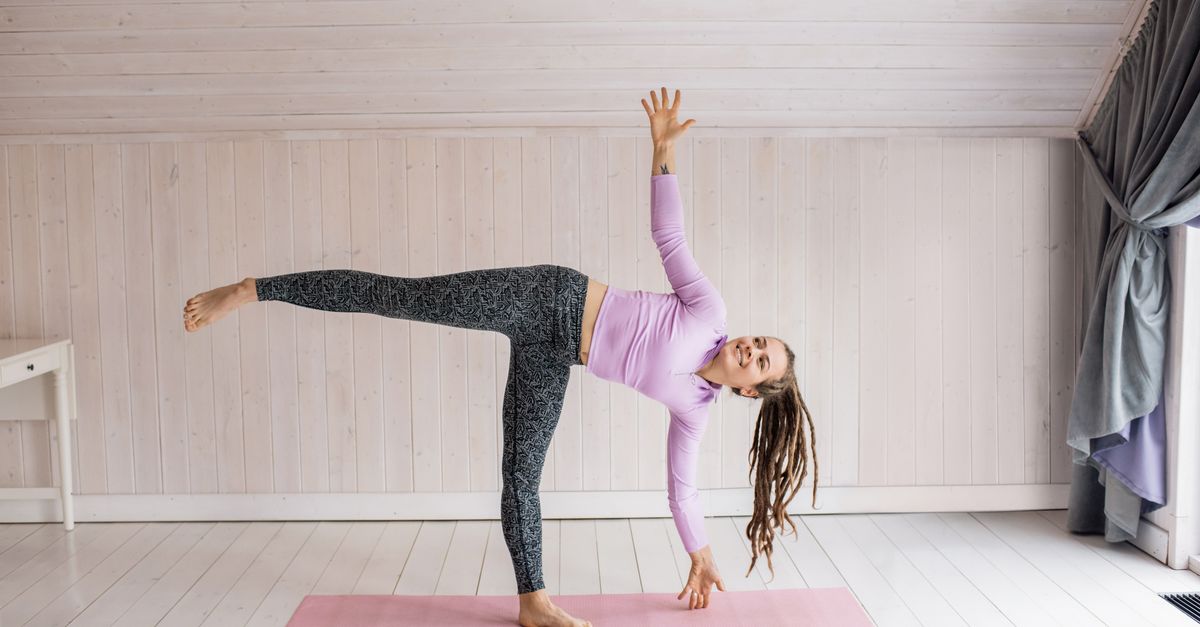
Ardha Chandrasana, or Half Moon Pose, is a single leg balance. It trains ankle and hip stability, hamstring and side body length, and the concentration it takes to stay upright. Yoga as a whole practice has reasonable evidence behind balance, stress and back pain. No trial has ever tested this one posture, so pose specific promises are guesses.
Almost every list of Half Moon benefits repeats the same dozen items with nothing behind any of them. The pose is genuinely useful. It is just useful for narrower reasons than the lists suggest.
What is Ardha Chandrasana actually doing to your body?
The name is literal. Ardha is half, chandra is moon, asana is pose. From Triangle Pose you shift your weight onto the front foot, bring the same side hand down to the floor or a block, straighten the standing leg, and lift the back leg until it is roughly parallel with the ground. The top arm reaches for the ceiling. The finished shape is one long line from the raised heel to the raised fingertips.
Underneath that shape, three demands land at once. The standing ankle and the gluteus medius on the standing side work continuously to stop the pelvis dropping toward the lifted leg. The hamstring of the standing leg sits near its full length while carrying body weight, which is why tight hamstrings make this pose feel impossible rather than merely hard. And the whole thing is a balance task, so the inner ear, the eyes and the position sense in the foot and hip have to agree with each other for as long as the hold lasts.
The balance element is the part with real research behind it. Balance is trainable and it is specific, meaning you improve at the tasks you actually practise. Standing on one leg with the trunk rotated and the gaze moving is a harder version of that task than standing still and looking ahead.
Which Half Moon Pose benefits hold up, and which do not?
It helps to separate what has been measured for yoga as a whole practice, what follows from the mechanics of this posture, and what is simply asserted.
| Common claim | What the evidence actually shows | How to read it |
|---|---|---|
| Improves balance | A review summarised by NCCIH found 11 of 15 studies, covering 688 healthy participants, reported balance improvements from yoga | The strongest item on the list, measured for yoga programmes rather than one pose |
| Eases back pain | A 2022 Cochrane review of 21 trials and 2,223 people found small improvements against no exercise that the reviewers called clinically unimportant, and probably little or no difference against other back exercise | Real but modest, and not unique to yoga |
| Reduces stress | Reviewed studies report beneficial effects on perceived stress | Supported for the practice. Nobody has measured a single 30 second hold |
| Improves digestion | No trial evidence that an individual posture changes bowel function | Tradition, not a finding |
| Relieves sciatica | Untested for this pose. Sciatic pain has several distinct causes that need identifying first | A symptom to get assessed, not to stretch at |
| Relieves period pain | Never tested for this posture. Any effect would belong to the whole practice | Possible, unmeasured, and not a reason to expect much |
| Burns fat | A brief isometric hold costs very little energy | Not what this pose is for |
Notice what survives: balance, mobility, a general stress effect and a modest back pain effect, all belonging to regular practice rather than to any single asana. The specific promises about digestion, nerves and cramps are the ones with nothing behind them.
Does Ardha Chandrasana help with weight loss?
Not directly, and it is worth being blunt about that. Holding a static balance for half a minute is close to the cheapest thing you can do with your muscles in terms of energy cost. If the reason you are here is body composition, the pose is not the lever.
What it can do is support the things that are. Balance and hip mobility make heavier resistance training feel available rather than intimidating, and that is where most of the useful adaptation happens. The NHS physical activity guidelines ask adults for at least 150 minutes of moderate activity a week plus muscle strengthening on two days, and separately recommend balance work for people at risk of falls. Half Moon Pose fits the balance line and contributes almost nothing to the other two. If you want control and core work rather than load, Pilates covers similar ground.
How do you get into the pose without toppling over?
Most people fail this pose in the transition, not the hold. The usual error is lifting the back leg before the standing leg is straight and loaded, which turns the whole thing into a hop.
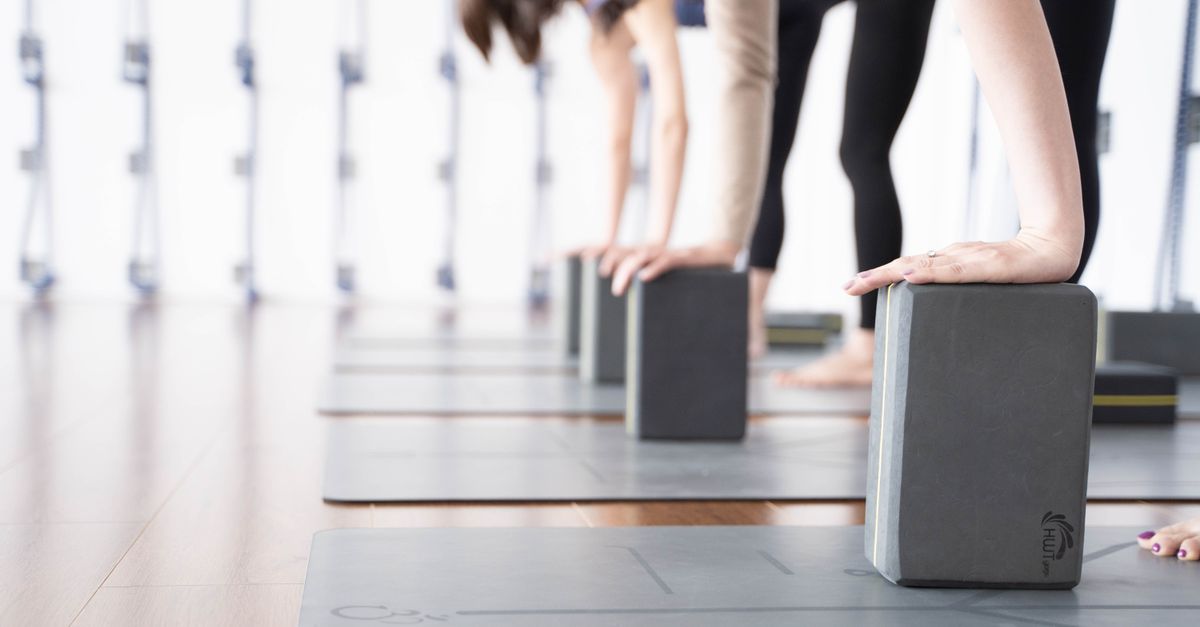
- Start in Triangle Pose with the right leg forward, both legs straight.
- Bend the right knee slightly and walk your right hand about a foot forward of the right foot, onto a block. Fingertips on the floor is a flexibility test, not a virtue.
- Shift your weight into the right foot, pressing through the big toe mound and heel together.
- Straighten the right leg and let the left foot leave the ground as a consequence, rather than kicking it up.
- Bring the lifted leg to roughly hip height and flex the foot so the toes point out to the side.
- Stack the left hip over the right, then open the chest. Hips first, chest second.
- Reach the left arm up. Keep the gaze on the floor until the shape is steady, then look at the side wall, then at the top hand if you want the hardest version.
- Hold for five or six breaths, come down the way you went up, and repeat on the other side.
The gaze is the cheapest dial you have. Looking down keeps the vestibular demand low; looking up raises it sharply. Change the gaze before you change anything else.
What is the safest way to build up to it?
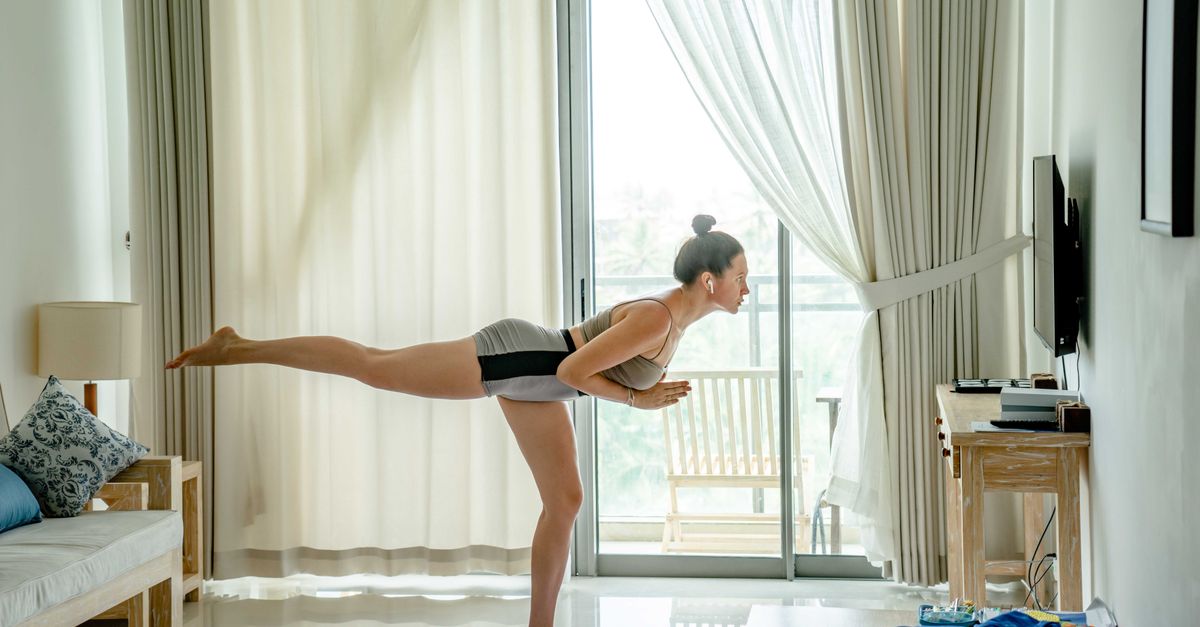
If the full pose collapses immediately, the cause is usually the standing ankle, the hamstrings, or a balance task too far ahead of your practice. Working through the stages below tends to be faster than repeatedly attempting the finished shape.
| Stage | What you practise | What tells you to move on |
|---|---|---|
| One | Standing on one leg, both hands free, eyes open, 30 seconds a side | You can do it without the standing foot gripping or the hip swinging |
| Two | The same, with the gaze moving slowly left and right | The wobble no longer follows your eyes |
| Three | Half Moon with the bottom hand on a block and the lifted foot resting on a wall | The standing leg stays straight for the full hold |
| Four | Half Moon with the block, foot off the wall, gaze on the floor | You can hold five breaths without the block sliding or the hip collapsing |
| Five | Half Moon with the gaze lifted toward the top hand | This is the finished pose. Nothing after it is worth chasing |
The wall is not a concession to abandon quickly. It removes the fear of falling backwards, and fear is what makes people hold their breath and grip the floor, both of which make balance worse.
Who should skip Ardha Chandrasana or change it?
Yoga is generally safe for healthy people practising properly, but it is not injury free. NCCIH notes that the rate of yoga related injuries treated in emergency departments is higher in people aged 65 and over than in younger adults, and that sprains and strains of the knee or lower leg are common. A single leg pose is where that matters.
- Recent injury or surgery involving the ankle, knee, hip, back or neck. Wait for clearance rather than testing it.
- Dizziness, vertigo or fainting on standing. The head position and the single leg base make this a poor pose to find out with. Raise the symptom with a doctor rather than training around it.
- Low blood pressure, particularly if you feel light headed when you stand up quickly. Keep the gaze low and come out slowly, or use a chair supported variation.
- Pregnancy. Centre of gravity and joint laxity both change, and not evenly month to month. Work with a teacher who has prenatal training rather than a general sequence.
- A recent, noticeable change in your balance. That is information worth taking to a clinician, not something to grind away at on a mat.
How often is it worth practising, and what tells you it is working?
There is no dose response research for a single asana, so anyone quoting an exact schedule is quoting a convention rather than a finding. Three to five sessions a week, holds of 20 to 30 seconds a side, two or three rounds, is a sensible convention and nothing more. It does not much matter what time of day you do it.
Progress here is easier to see than in most yoga poses. Track the hold length, whether the standing leg stays straight, whether you can lift the gaze without the shape falling apart, and whether the standing foot has stopped clawing at the mat. Those four move over weeks regardless of what else is going on in your life, which makes them a more honest signal than most.
What will not happen is the list of miracles. Digestion, nerve pain and hormones are not moved by a shape held for half a minute. Balance, hip control and a calmer half hour are, and that is a fair return for a pose needing nothing but a mat and a block.
Frequently asked questions
Is Ardha Chandrasana good for beginners?
It can be, with a block under the bottom hand and the lifted foot against a wall. What makes it hard for beginners is not strength but the combination of a single leg base and a rotated trunk. Building up through simple one leg standing first is usually faster than attempting the full shape.
Does Half Moon Pose burn calories or help you lose weight?
Barely, and not meaningfully. A brief isometric hold has a very low energy cost. Its contribution to weight management is indirect: it supports the mobility and balance that make harder training comfortable, and it is the kind of practice people sustain for years.
Why can I not straighten my standing leg?
Almost always hamstring length rather than weakness. In this pose the standing hamstring is loaded near full range, so a restriction that never shows up walking becomes obvious here. Raising the bottom hand onto a taller block reduces the demand immediately.
Can Ardha Chandrasana help with back pain?
Yoga programmes produce small improvements in chronic non specific low back pain compared with no exercise, and roughly the same result as other back exercise. No study has isolated this pose. If back pain is the reason you are practising, any exercise you will keep doing is a reasonable choice.
How long should I hold the pose?
Twenty to thirty seconds a side, two or three times, is the usual practice convention. It is not a research finding. Holding a steady shape for a shorter time is more useful than holding a collapsing one for longer.
Is it safe to practise every day?
For most healthy people, yes, provided nothing hurts and you warm up first. Daily practice of a balance task is reasonable because the adaptation is largely neural. Stop and get advice if you get joint pain, dizziness, or a balance change that does not settle.
This article is general information, not medical advice, and is not a substitute for care from a qualified healthcare professional. Speak to your doctor or a qualified movement professional about your own situation.
Leave a Reply