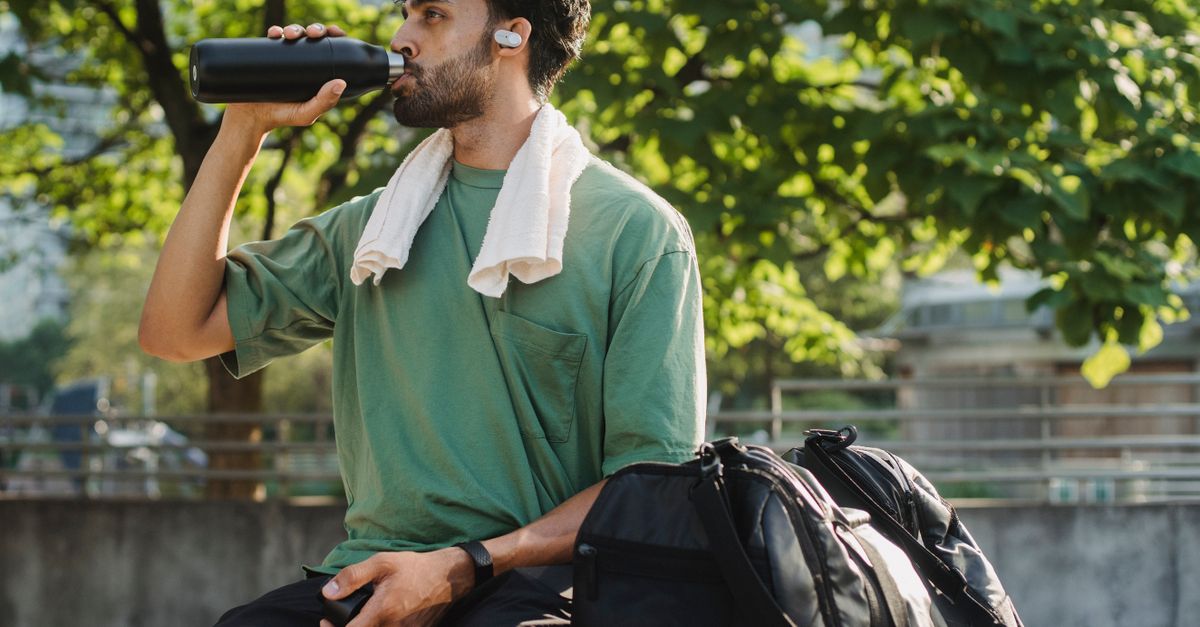
There is no single schedule that fits everyone. How much you need depends on your body size, how long and how hard you train, the heat, and how heavily you sweat. For most sessions under an hour, being normally hydrated beforehand and drinking to thirst covers it. Long, hot or repeated sessions need more thought.
Hydration schedules are usually written as though everyone sweats at the same rate. They do not. Two people doing the same session in the same room can lose very different amounts of fluid, which is why a fixed number of millilitres on a chart is a starting point at best.
Why does no fixed hydration schedule work for everyone?
Fluid loss during exercise is mostly sweat, and sweat rate is governed by how hard you are working, how hot and humid it is, what you are wearing, how big you are and how used to the heat you have become. Change any one of those and the number changes with it.
Credible guidance therefore gives ranges per kilogram of body weight, and the most useful measurement is one you take on yourself.
| What changes it | How much it matters | Why |
|---|---|---|
| Session length | The largest single factor | Losses accumulate. Thirty minutes rarely builds a deficit worth correcting |
| Heat and humidity | Large | Humid air limits evaporation, so you sweat more for the same cooling |
| Intensity | Moderate to large | Heat production climbs steeply with effort, and sweat follows |
| Body size | Moderate | Bigger bodies shed more heat, which is why guidance scales per kilogram |
| Clothing and kit | Underrated | Layers, packs and heavy gear trap heat and push sweat loss up |
| Heat acclimatisation | Counterintuitive | People used to heat sweat earlier and more freely, with less sodium in it |
| Your own sweat rate | Large and personal | The one variable no chart can hand you |
How much should you drink before you train?
The most widely quoted figures come from the American College of Sports Medicine position stand on exercise and fluid replacement: roughly 5 to 7 millilitres per kilogram of body weight at least four hours before exercise, with a further 3 to 5 millilitres per kilogram about two hours out if no urine has been produced or it is still dark.
For a 70 kilogram person that is about 350 to 490 millilitres. A glass or two, hours ahead rather than gulped at the door. The timing leaves room to absorb what you need and pass what you do not, so you start topped up rather than sloshing.
In practice, if you drink normally across the day and your urine is pale, you arrive already hydrated and the pre workout ritual changes very little. The numbers earn their place for people training early before drinking much, training in real heat, or going back for a second session the same day.
What should you drink during a session, and how often?
Under about an hour, water is the answer and thirst is a reasonable guide. The deficit most people build in that time, in ordinary conditions, is small and easily corrected afterwards.
Past an hour, two things start to matter alongside the fluid. Carbohydrate supports the effort, and sodium affects how much of what you drink you actually keep. This is where a sports drink stops being marketing and becomes a reasonable tool, though salted water alongside something to eat does much the same job for a fraction of the price.
| Session | Fluid | Sodium or electrolytes | Carbohydrate |
|---|---|---|---|
| Weights, 45 to 60 minutes | Water when you want it | No | No |
| Under 60 minutes, moderate effort | Water, guided by thirst | Rarely | No |
| 60 to 90 minutes, hard effort | Water, guided by thirst | Helps if sweating heavily | Marginal |
| Over 90 minutes, or hot conditions | Planned sips, not thirst alone | Yes, sodium aids retention | Yes, for the effort |
| Two sessions in one day | Replace deliberately between them | Yes | Depends on the second |
Small sips rather than large gulps is a comfort rule rather than a physiological one. Big volumes taken quickly sit in the stomach and feel unpleasant during effort, which is reason enough. If you pair conditioning with lifting, the order you put cardio and weights in changes how long you are out there and therefore how much of this applies.
Does mild dehydration really hurt your performance?
Less reliably than the standard framing suggests, and this one is still argued about. The threshold everyone quotes, a loss of around 2 percent of body weight, comes largely out of laboratory work in which participants knew perfectly well whether they had been kept short of fluid. That is a problem when the thing being measured is how hard someone chooses to push.
Studies built to remove that problem have not agreed. One blinded trial that delivered fluid through a nasogastric tube, so participants could not tell which condition they were in, still found impaired endurance cycling performance. Other blinded work using intravenous rehydration reported no effect in the heat at similar and larger deficits.
Where that leaves an ordinary reader: starting a session properly hydrated is worth doing, the cost of a modest deficit during an hour in an air conditioned gym is probably small, and it grows with heat and duration. Nobody selling an electrolyte sachet has an interest in the middle clause.
How do you replace what you lost afterwards?
The only way to know what you lost is to weigh yourself before and after in similar clothing and treat the difference as fluid. A kilogram down is roughly a litre gone. Do it across two or three typical sessions and you will know your own rate better than any calculator.
The same position stand suggests around 1.5 litres for every kilogram lost when you need to recover quickly, the extra half litre covering what you pass as urine while rehydrating. That is aimed at a fast turnaround, such as a second session the same day. If the next one is tomorrow, drinking normally with meals restores it without arithmetic.
Food does part of this quietly. Fluid taken with sodium is retained better than plain water, and a meal supplies both that and the potassium in fruit and vegetables. Eat something and drink normally is boring advice and also the accurate kind.
Can you drink too much water around exercise?
Yes, and it is the version that actually puts people in hospital. Drinking more than you lose across a long effort dilutes the sodium in your blood, a condition called exercise associated hyponatremia. A 2017 review in Frontiers in Medicine describes sustained overdrinking during exercise as the primary cause of every form of it, and notes that it has turned up after events far shorter than ultra distance races.
The uncomfortable part is that the early symptoms, headache, nausea and feeling generally off, look a great deal like dehydration. Someone who assumes they have fallen behind and drinks more makes it worse. This is the strongest argument for thirst over a fixed schedule: thirst is hard to override in the direction that harms you, and a schedule is not.
How can you tell whether you are actually hydrated?
Four cheap signals, none of them perfect on its own.
| Signal | What it tells you | What it does not |
|---|---|---|
| Urine colour | Pale straw suggests you are broadly topped up | B vitamins turn it bright yellow, and one dilute sample after a big drink means nothing |
| Thirst | A safe default for ordinary sessions | It blunts with age and can lag during long efforts in heat |
| Morning body weight | A drop of more than a percent overnight is usually fluid | Nothing as a single reading, only as a trend |
| Weight across a session | The only direct measure of what you lost | Requires weighing twice, which most people never do |
Underneath all of this sits your background intake. The NHS suggests six to eight cups or glasses of fluid a day and advises drinking extra after sweating through physical activity, with tea, coffee and lower fat milk counting towards the total. The British Dietetic Association covers the same ground in more detail.
Does coffee before a session dehydrate you?
Not at the amounts people actually drink. Caffeine has a mild diuretic effect and the fluid in the cup more than covers it, which is why coffee and tea count towards daily intake rather than against it. A coffee before training is a caffeine decision, not a hydration one. Alcohol is the real exception, and the reason a heavy night before a hot session is a worse idea than it feels at the time.
Does any of this affect weight loss?
Less directly than the drinks aisle implies. Fluid moves the scale by a kilogram or more within a single day in either direction, and none of that movement is fat. Worth knowing before reading anything into a number that changed overnight. Why the scale moves slowly even when you eat less covers the same confusion from the other side, and weight loss versus fat loss covers why the two separate.
Water does not burn fat, and nothing stirred into it does either. What being hydrated does is let you train the way you intended and feel less wrung out afterwards. Real, and modest. Whether warm or cold water makes any difference looks at one popular version of the bigger claim, and the answer there is the same as it is here.
Frequently asked questions
How much water should I drink before a workout?
Published guidance puts it at roughly 5 to 7 millilitres per kilogram of body weight at least four hours ahead, which is about 350 to 490 millilitres for a 70 kilogram person. If you have drunk normally through the day and your urine is pale, you are already there and the extra ritual adds little.
Do I need a sports drink for an hour in the gym?
For an hour of ordinary training indoors, no. Water covers it. Carbohydrate and sodium start to earn their place past about an hour, in heat, or when you are training twice in a day, and even then a salted drink with food does much the same job.
Is it bad to drink water during weight training?
No. Drinking during a lifting session does not interfere with anything. The only real issue is comfort, since a large volume taken quickly sits in the stomach and feels unpleasant under load. Small amounts when you want them are fine.
How do I work out my own sweat rate?
Weigh yourself before and after a session in similar clothing, add on any fluid you drank during it, and the total is roughly what you lost. A kilogram is about a litre. Repeat across a few typical sessions and you will have a figure that applies to you rather than to an average.
Does dark urine always mean I am dehydrated?
No. It is a rough guide rather than a test. B vitamin supplements turn urine bright yellow, some medicines change the colour, and the first sample of the morning is concentrated in almost everyone. Persistently dark urine alongside thirst and tiredness is more meaningful than one reading.
Can you drink too much water?
Yes. Drinking more than you lose across a long session can dilute blood sodium, which is a genuine medical emergency at the severe end. Early symptoms resemble dehydration, so drinking harder in response makes it worse. Drinking to thirst rather than to a schedule is the safest general approach, and anyone who feels confused or very unwell during prolonged exercise needs medical attention rather than another bottle.
This article is general information, not medical advice, and is not a substitute for care from a qualified healthcare professional. Speak to your doctor about your own situation, particularly if you have a heart, kidney or blood pressure condition that affects how much fluid or salt is right for you.
Leave a Reply