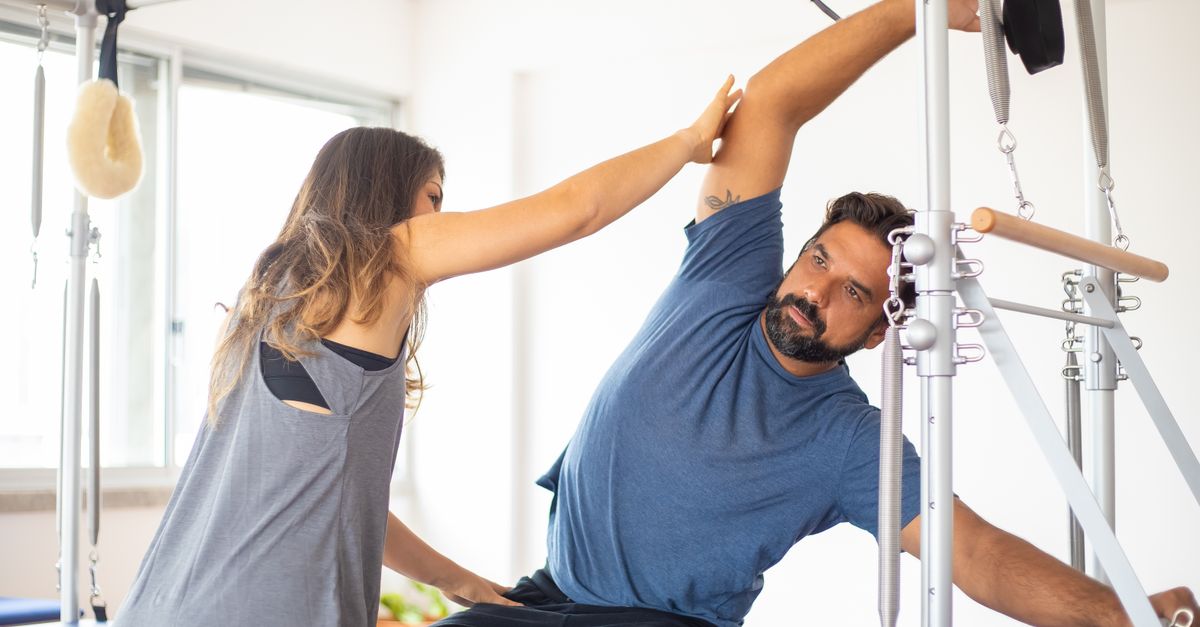
Pilates builds core strength, control and mobility, and the evidence is strongest for chronic low back pain, where it beats doing very little and roughly matches other exercise. What it does not do is burn many calories or lengthen a muscle. Treat it as skilled movement training rather than a fat loss programme and it delivers.
That is a narrower promise than the one on most studio websites, and it is the one that survives contact with the research. Whether Pilates works depends entirely on what you were hoping it would do.
What is Pilates actually training?
Pilates is a system of slow, controlled movement built around trunk stability, breathing and precise joint alignment, using either your own bodyweight on a mat or a sprung machine. Joseph Pilates assembled it in the first half of the twentieth century from gymnastics, boxing, self defence and some strong opinions about what modern life does to a spine. The version taught today has been through several decades of physiotherapy since, which has improved it considerably.
What separates it from a gym circuit is not the exercises, which frequently look unremarkable, but the instruction wrapped around them. A Pilates class spends its attention on where your ribs are, whether your pelvis has quietly tipped, and whether a movement is being driven by the muscle you intended or by momentum and one very willing hip flexor. That focus trains the deep muscles that stabilise the spine and pelvis, including the transverse abdominis, the multifidus, the pelvic floor and the diaphragm, along with everything around the hips and shoulders that has to hold still while something else moves.
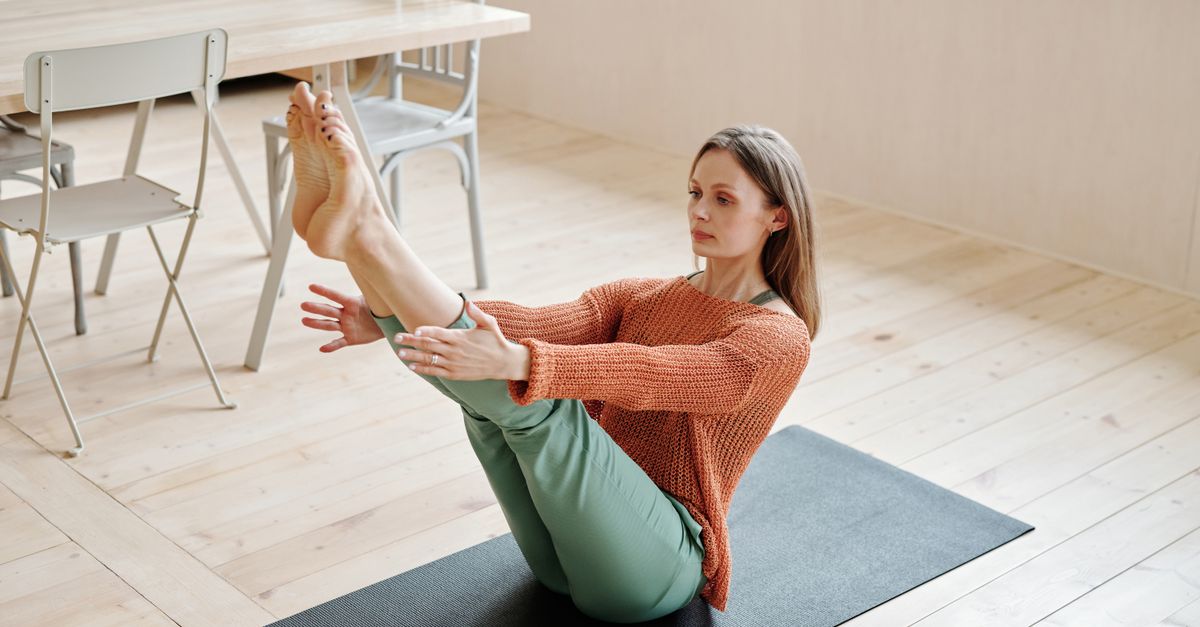
This is genuinely useful, and it is also why the first class is humbling. The Hundred looks like lying on the floor waving your arms. It is not.
Does Pilates help back pain?
This is the claim with real evidence behind it, so it is worth being precise about what that evidence says.
A Cochrane review of Pilates for low back pain pooled ten randomised trials covering 510 people with chronic non specific low back pain. Against minimal intervention, meaning usual care or not much at all, Pilates reduced pain and disability, with effects the reviewers graded small to medium. Against other forms of exercise, it was not clearly better. The reviewers found no high quality evidence for any comparison and rated what they did find as low to moderate quality. Where trials looked for harms, they reported minor events or none.
Read that again, because it is better news than the hedging makes it sound. Exercise helps chronic low back pain, and Pilates is a form of exercise people actually keep turning up to, in a room where somebody is watching their form. A programme you attend beats a theoretically superior one you abandon in week two. The reviewers concluded that the choice can reasonably come down to preference and cost, which is a more honest sentence than most of what is written about this.
Two things it is not. It is not a treatment aimed at a specific diagnosed spinal condition, and it is not a substitute for assessment. Back pain that is new or severe, pain radiating down a leg, numbness, leg weakness or any change in bladder or bowel control needs a doctor rather than a class.
How many calories does Pilates burn?
Fewer than the internet would like you to believe.
The Compendium of Physical Activities, the reference list researchers use when they need to assign an energy cost to an activity, puts traditional mat Pilates at 1.8 METs and Pilates in general at 2.8 METs. One MET is roughly what you burn sitting still. For comparison, the same list gives a standard weights session of multiple exercises at 3.5 METs and vigorous power lifting or body building at 6.0. Pilates sits in the light to moderate band, and traditional mat work sits near the bottom of it.
So an hour of it is a modest amount of energy for most people, and nowhere near the four hundred and five hundred calorie figures that class timetables quote with such confidence. Those numbers usually come from a wrist tracker, and a wrist tracker is guessing hardest at precisely this kind of activity: slow, largely isometric, low in heart rate and full of effort it has no way of seeing.
None of that makes Pilates pointless for how your body looks. It means the contribution runs through strength, consistency and moving well enough to keep doing everything else, rather than through the calorie column. What actually shifts body fat is a different mechanism and mostly a different conversation.
Should you do mat or reformer Pilates?
The honest answer is that the better one is the one you will attend. They train the same ideas with different tools, and the differences that matter are practical.
| Mat Pilates | Reformer Pilates | |
|---|---|---|
| What you need | A mat and floor space | A sprung carriage machine, so a studio |
| Where the load comes from | Bodyweight and gravity | Springs, which can resist or assist |
| Listed intensity | 1.8 METs for traditional mat work | Not listed separately, general Pilates is 2.8 METs |
| Typical cost | Free at home, cheap in a class | Usually the priciest thing on the timetable |
| Best for | Learning the patterns and repeating them often | Loading a movement, or unloading one you cannot yet do |
| The catch | A video cannot see your pelvis tipping | Cost, and often a waiting list |
The common assumption is that the reformer is advanced mat work. It is not. Springs can take weight off you as easily as they add it, which is why clinical and physiotherapy led Pilates leans on the machine for people who are rebuilding rather than showing off. The apparatus looks like something confiscated from a Victorian sanatorium and behaves like an extremely patient training partner.
If money is the deciding factor, mat work at home plus occasional supervised sessions to correct what you have drifted into is a sensible compromise. The NHS beginners Pilates video is free and will tell you within about ten minutes whether the method appeals to you.
Does Pilates give you long lean muscles?
No, and this is the claim worth pushing back on, because it is painted on the wall of half the studios in the country.
A muscle attaches to bone at each end. Training does not relocate those attachments. What changes is how much force the muscle can produce, how well your nervous system recruits it, and how much of it there is. No spring, tempo or breathing pattern makes muscle tissue longer.
Flexibility does improve, and that is a separate and real thing. Range of motion is trainable, and slow controlled work through a full range is a good way to train it. You are getting better at using the range you have, not growing new muscle to fill it.
What people are pointing at when they say long and lean is also real. It is a ribcage sitting over a pelvis instead of in front of it, stronger muscle, and slightly less fat on top. Part of it is simply that Pilates alone is not a large enough stimulus to build much size, which is a limitation marketed as a feature.
Is Pilates enough on its own?
For core control, mobility and body awareness, yes. For a complete week of movement, not quite, and the gaps are predictable ones.
- Cardiovascular fitness. At under 3 METs, most Pilates is not loading your heart and lungs hard enough to count as the aerobic part of your week. Walking, cycling or swimming fills that.
- Heavier loading. Muscle and bone respond to progressively heavier resistance. Springs and bodyweight take you a certain distance and then stop being challenging.
- Protein and overall intake. No exercise class compensates for these. They set what happens to your body composition, and Pilates does not change that arithmetic.
The week that works is usually unglamorous: some walking, some resistance work, and Pilates for the qualities the other two do not train. It was never designed to be the whole thing, and the people who train it seriously do not treat it as one.
How often should you do Pilates, and who should check with a doctor first?
Consistency matters more than frequency. The trial programmes in the Cochrane review ran from around ten days to three months, so judge the method over a few weeks rather than a few sessions. Two or three sessions a week is a common structure and is enough to learn the patterns, and anything you can sustain beats a schedule you quietly abandon.
Speak to a doctor or a physiotherapist before starting if you are pregnant or recently postpartum, if you have osteoporosis or reduced bone density, since forward bending and rolling movements of the spine are a common caution in that situation, if you have had recent surgery, or if you have a back or joint problem that has not been assessed. Tell the instructor before the class rather than during it. A competent teacher will change the exercise for you, and a class that cannot is the wrong class.
Beyond that, the entry requirements are low. Fitted clothing so somebody can see your alignment, a floor, and a tolerance for being told that the thing you thought was your abdominals was actually your neck.
Frequently asked questions
Is Pilates suitable for complete beginners?
Yes, and beginner classes are the norm rather than the exception. The movements are slow and low impact, and almost all of them can be made easier. The difficulty is mental more than physical at first, because the instructions are unusually specific and most people are not used to being asked to move one part of themselves at a time.
Does Pilates burn belly fat?
Not directly, because nothing does. Fat is lost across the whole body according to a pattern set largely by genetics and hormones, and it responds to overall energy balance rather than to which muscles you worked. Pilates strengthens the muscles underneath and improves how you carry yourself, both of which change how your midsection looks without removing fat from it.
What is the difference between Pilates and yoga?
They overlap in the floor work and diverge in the intent. Yoga grew from a spiritual and philosophical tradition and holds positions, often with a breathing and meditative element. Pilates was built as physical conditioning and rehabilitation, moves continuously, and is far more prescriptive about alignment. Pilates also has the machines, which yoga does not.
Is reformer Pilates better than mat Pilates?
It is different rather than better. The springs let an instructor add resistance or take weight off you, which makes the reformer useful both for progressing a movement and for making one accessible to someone who cannot yet do it on the floor. Mat work is cheaper, needs no equipment and is easier to do often. Frequency tends to beat equipment.
Can Pilates fix bad posture?
It can improve it, which is the accurate version of the claim. Posture is partly habit and partly strength and endurance in the muscles that hold you upright, and both of those are trainable. What it cannot do is change the underlying shape of your skeleton, and structural spinal conditions are a matter for a doctor or physiotherapist rather than a class.
How long before I notice a difference?
Body awareness and the ability to do the exercises properly tend to shift first, often within a few weeks, and that is worth watching for because it is easy to miss. Strength and mobility changes take longer and vary widely between people. Anyone offering you a fixed timeline is guessing.
This article is general information, not medical advice, and is not a substitute for care from a qualified healthcare professional. Speak to your doctor about your own situation.
Leave a Reply