
A weight loss plateau is rarely a broken metabolism. The measured studies point to four ordinary causes arriving together: a smaller body burns less, appetite climbs as weight falls, food tracking quietly drifts, and water can hide fat change for weeks. The metabolic slowdown is real but mostly modest; appetite is the stronger force.
Listen to this article, about 9 minutes. A synthetic voice reads the article and announces each section title as it begins; tables are read row by row and the questions at the end are left out.
Recorded 2 October 2026 from the article as published that day. Press a chapter to jump there; the highlighted line is what is playing. A play button sits beside every section heading, and once you scroll past this player a bar at the bottom of the screen keeps the controls in reach. Tap or click any sentence to hear the reading start from there.
On this page: the measured size of each plateau cause, from a 54 kcal metabolic adaptation in an ordinary diet study to a 47 percent gap in food diaries, set out in one cited table.
Think you already know this? Five questions, one minute.
Every answer is on this page. Answer from what you know now; the page fills in the rest.
-
1. In the review of 80 weight loss trials with at least a year of follow up, at about what point did the average curve flatten?
The systematic review of 80 trials found average weight loss plateaued at approximately six months across diets and medicines. Read the section
-
2. In the Martins study of 171 women, how large was the average metabolic adaptation after weight loss?
Resting burn ran about 54 kcal a day below prediction and did not predict regain, per Martins and colleagues; the larger figures come from the extreme televised competition cohort. Read the section
-
3. In the canagliflozin analysis, by roughly how much did eating rise for each kilogram of weight lost?
Polidori and colleagues estimated about 100 kcal a day per kilogram lost, more than three times the matching drop in energy burned. Read the section
-
4. In the New England Journal of Medicine study, by how much did people describing themselves as diet resistant under report their intake?
They under reported intake by 47 percent and over reported activity by 51 percent, and their metabolism was not abnormal, per Lichtman and colleagues. Read the section
-
5. How much water is glycogen described as being stored with?
Kreitzman and colleagues described glycogen held in hydrated form with three to four parts water, which is why early losses and regains are partly water. Read the section
The internet has a remedy for every stall, and most of them involve confusing your body: zigzag calories, a cheat day, a tea that promises to wake your metabolism up as if it had overslept. The studies below suggest something less exciting and more useful. Nothing is asleep. Several measurable things are happening at once, and each has a size.
What is a weight loss plateau, and when do most of them start?
A plateau is a stretch where weight stops falling even though the eating and moving that produced the earlier change carry on, or seem to. The clinical review of management of weight loss plateau on the NIH Bookshelf describes plateaus arriving weeks to months into a programme, and it notes that most interventions reach their largest effect at around six months, after which weight tends to hold or creep back.
That timing is not a quirk of one study. A systematic review of 80 weight loss trials with at least a year of follow up found the same shape across diets and medicines: the average curve flattened at about six months. A flattening curve is the normal shape of the graph, not evidence that something has gone wrong with the person on it. For why the final stretch in particular feels slow, see why the last few kilos are the hardest to shift.
How much does metabolism really slow when weight comes off?
Some, and it helps to separate two things that get lumped together. A smaller body costs less to run, which is arithmetic rather than adaptation. On top of that, researchers measure whether resting burn falls further than the new body size predicts. That extra is called adaptive thermogenesis, and it is the part people mean when they say their metabolism has slowed.
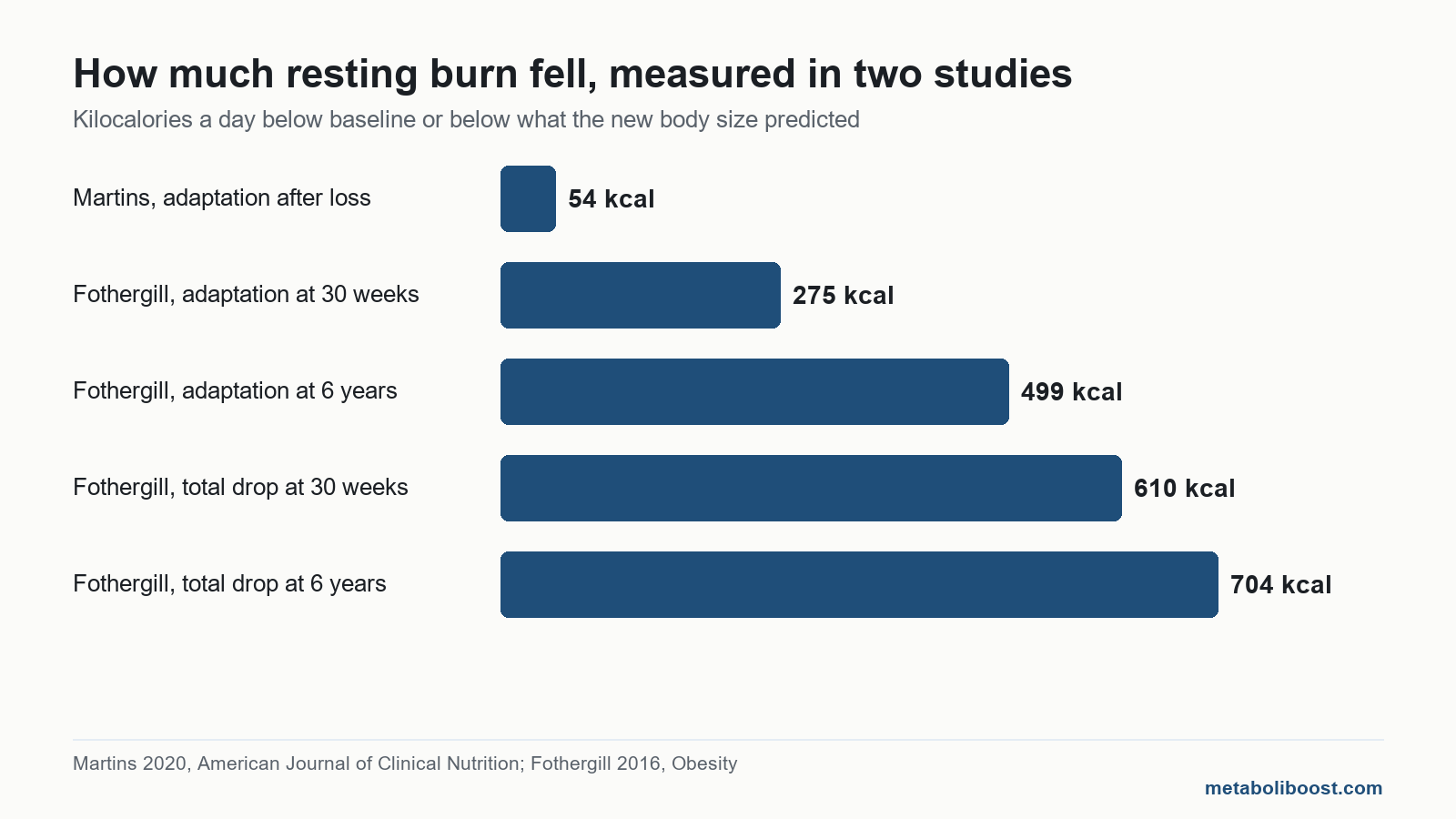
The study everyone quotes is the extreme case. Fothergill and colleagues followed 14 contestants from a televised weight loss competition. At the end of the 30 week competition their resting metabolic rate had fallen by an average of 610 kcal a day, of which 275 kcal was adaptation beyond what their new size predicted. Six years later resting rate was 704 kcal a day below baseline and the adaptation had grown to 499 kcal, even though most of the weight had returned.
Now the ordinary case. In a study of 171 women by Martins and colleagues, who lost weight on a supervised low calorie diet, adaptation after the loss averaged 54 kcal a day, less than a slice of toast. At one and two years it was no longer statistically different from zero, and it did not predict who regained. Fourteen people on a televised extreme protocol and 171 people on a supervised diet are telling different stories, and the second is far closer to most readers. More on what can and cannot move resting burn is in our look at how much BMR can actually be raised.
Why does appetite matter more than metabolism in a plateau?
Because it is bigger. Polidori, Hall and colleagues used a clever setting to measure it: 153 people with type 2 diabetes taking canagliflozin, a medicine that makes the body pass glucose in urine, so energy leaves without anyone choosing to eat less. Their calculated eating rose in proportion to the weight they lost, by about 100 kcal a day for every kilogram, which the authors put at more than three times the matching drop in energy burned.
That is the quiet engine behind most plateaus. Nobody decides to eat more. Portions edge up, the afternoon snack reappears, and the deficit narrows from the intake side while everyone is watching the metabolism side. It is also why describing a plateau as a failure of willpower gets the physiology backwards: the pull is real, measurable and roughly proportional to the progress already made.

How much of a plateau is tracking drift rather than biology?
Often a lot, and with no dishonesty involved. In a well known study in the New England Journal of Medicine, people who described themselves as unable to lose weight on very little food had their actual intake and expenditure measured. They under reported what they ate by an average of 47 percent and over reported their activity by 51 percent. Their metabolism was not abnormal; the food diary was.
The same pattern turns up in trial data. When Hall and colleagues modelled the weight curves of published diet trials, the plateau that usually appears at six to eight months only made sense if people had progressively relaxed the original cut in intake. Their mathematical model found metabolic adaptation alone could not produce that shape. For how the usual calorie formulas overstate progress in the first place, see why calorie deficit formulas keep disagreeing.
| What gets blamed | What the measurement found | Source |
|---|---|---|
| My metabolism has shut down | Resting burn ran about 54 kcal a day below prediction after weight loss in 171 women, and the gap did not predict regain | Martins 2020 |
| My metabolism has shut down, the extreme case | Resting burn was 275 kcal a day below prediction at the end of a 30 week televised competition, 499 six years later | Fothergill 2016 |
| I have no willpower | Eating drive rose by about 100 kcal a day for every kilogram lost, over three times the drop in energy burned | Polidori 2016 |
| I eat almost nothing and still do not lose | People describing themselves as diet resistant under reported intake by 47 percent and over reported activity by 51 percent | Lichtman 1992 |
| The plateau is my body defending itself | Modelling of trial data found the six to eight month plateau fits adherence relaxing better than metabolic adaptation | Hall 2011 |
| I lost fast at first, so something broke | Glycogen is stored with three to four parts water, so early losses are partly water and early regains can be too | Kreitzman 1992 |

Is it a plateau, or is water hiding the change?
Sometimes, and only a reading over several weeks can tell. The body stores carbohydrate as glycogen, and Kreitzman and colleagues described it being held with three to four parts water. A change in carbohydrate intake, a salty meal, a new exercise routine that leaves muscles inflamed and holding fluid, or a point in the menstrual cycle can each move the scale up or down independently of fat.
That cuts both ways. A quick early drop on a low carbohydrate plan is partly water leaving, and a flat fortnight can be fat leaving while water arrives. A single weigh in is a noisy instrument. A weekly average of several weigh ins taken in the same conditions is a less noisy one, and a fuller explanation of the water part is in what the scale is really showing.
Which plateau causes are worth checking, and when is it a doctor question?
The checklist below this section lists the measured causes from this page, so the question becomes which of them is plausibly in play rather than which trick to try next. None of it is a plan, and none of it promises the scale will move by any amount or on any date.
The calorie arithmetic changes as the body does, which is why weight loss slows even while eating less. Eating ever less to chase the old pace runs straight into the appetite feedback described above, which grows with every kilogram lost, and holding a lower weight is where most programmes struggle, the subject of why keeping weight off is the hard part.
Some stalls are not a plateau at all. A change in weight that is unexplained, a plateau that arrives with new tiredness, feeling cold, changes in periods or other new symptoms, or one that began after starting a new medicine, is a question for a GP rather than a website. Do not stop or change a prescribed medicine without speaking to the prescriber. If tracking food or the number on the scale has started to feel distressing or controlling, that is also worth raising with a doctor.
Nothing sold as a plateau breaker, from fat burners to detox teas, appears in any of the studies cited here as a fix for the physiology they describe, and this site does not recommend any supplement, including the site’s own. The honest answer is that it depends, and this page sets out what it depends on.
Which measured plateau causes could be in play?
Each line is a cause one of the studies on this page measured. Ticking them is a way to see which apply, not a plan.
This lists what studies measured. It does not score, diagnose or predict any change in weight, and it endorses no product.
Frequently asked questions
How long does a weight loss plateau last?
There is no fixed length. The trial reviews describe average curves flattening around six months and then holding, which reflects a new balance between intake and expenditure rather than a timer that runs out.
Does a cheat day or calorie cycling break a plateau?
No study cited here tested cheat days as a plateau treatment. Whether intake is spread evenly or in peaks, the measured drivers are the same: a smaller body, higher appetite, tracking accuracy and water.
Is starvation mode real?
A small adaptation is real and measurable. The popular version, in which the body refuses to release fat, is not what the studies show; fat stores are drawn on whenever intake falls short of expenditure.
Does exercise help during a plateau?
Movement adds to energy expenditure and supports muscle, but the same reporting study found activity was over reported by about half, so the burn a tracker shows is best treated as a rough estimate.
Can a thyroid problem cause a plateau?
Thyroid conditions can affect weight, and only a blood test ordered by a doctor can show it. A plateau that comes with new symptoms such as tiredness or feeling cold is a reason to speak to a GP.
Is gaining muscle the reason the scale is stuck?
Occasionally in people new to hard resistance training, but the amount of muscle most adults add in a few weeks is small next to ordinary water swings, so it rarely explains a long flat stretch on its own.
Finished the page? The same five questions from the top, to see what stuck.
This article is general information, not medical advice, and is not a substitute for care from a qualified healthcare professional. Speak to your doctor about your own situation.
Leave a Reply