
How to reduce subcutaneous fat has one honest answer: an energy deficit, held long enough to matter. You do not get to choose the compartment it comes out of. Most of what you lose is subcutaneous simply because that is where almost all of your fat is, and no cream, garment or device has been shown to change that.
Listen to this article, about 12 minutes. A synthetic voice reads the article and announces each section title as it begins; tables are read row by row and the questions at the end are left out.
Recorded 25 September 2026 from the article as published that day. Press a chapter to jump there; the highlighted line is what is playing. A play button sits beside every section heading, and once you scroll past this player a bar at the bottom of the screen keeps the controls in reach. Tap or click any sentence to hear the reading start from there.
On this page: a cited row by row comparison of the two fat compartments, the two meta-analyses that disagree with the popular version of which one goes first, and three enforcement actions showing what regulators made the cream and shapewear sellers stop claiming.
Think you already know this? Five questions, one minute.
Every answer is on this page. Answer from what you know now; the page fills in the rest.
-
1. In the published reference values for healthy adults aged 20 to 30, roughly what share of total body fat was visceral in men?
Visceral fat came to 2.6 percent of body fat in men and 1.2 percent in women in the DXA reference values published for 421 healthy European adults. Almost everything else is subcutaneous, which is why it dominates what a mirror shows. Read the section
-
2. A meta-analysis of 110 studies compared the two compartments across diet, exercise, weight loss drugs and bariatric surgery. What did it report?
The review found that subcutaneous fat loss is greater than visceral fat loss across all four intervention types. An earlier systematic review of 61 studies found no compelling evidence that any one approach selectively targets the visceral compartment. Read the section
-
3. In the 2023 trial that added torso work to matched running, which measurement differed between the two groups?
Trunk fat fell by 1,170 grams in the group doing abdominal work and did not change measurably in the running only group, while leg fat and total fat did not differ between them, in a randomised controlled trial of 16 men. The authors note there was no dietary control and that their scanner could not separate visceral from subcutaneous fat. Read the section
-
4. In participants whose body weight did not change, how did exercise and diet compare on visceral fat?
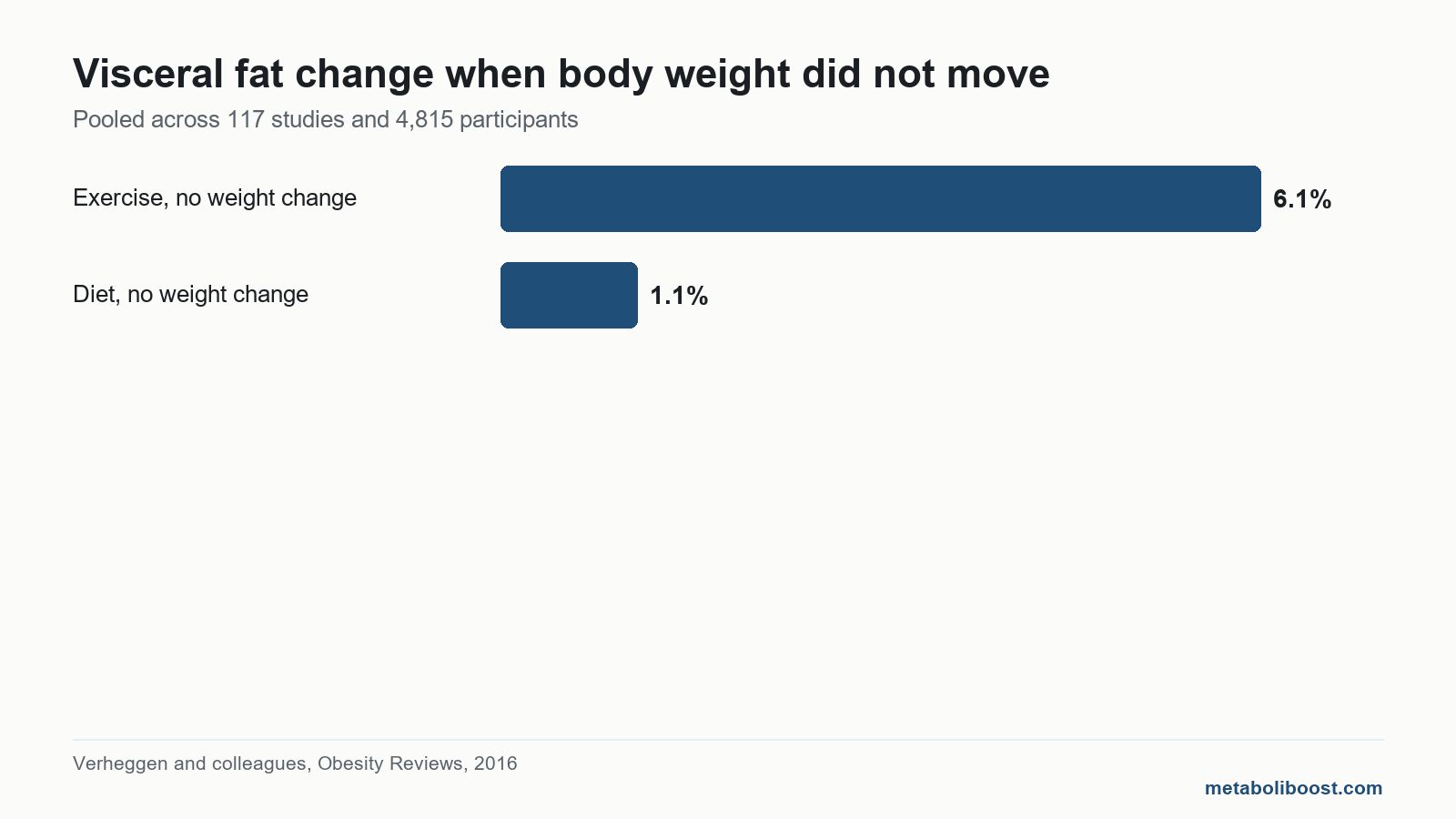
Pooling 117 studies covering 4,815 people, exercise was associated with a 6.1 percent fall in visceral fat where weight held steady, against 1.1 percent for diet. Diet produced more total weight loss. The two interventions are not interchangeable. Read the section
-
5. What did the 2014 consent order against a cosmetics company selling two almond creams prohibit?
The final consent order bans claims that a product applied to the skin causes substantial weight or fat loss or a substantial reduction in body size, and the company paid 450,000 dollars in redress. The products themselves were not banned. Read the section
What is subcutaneous fat, and how is it different from visceral fat?
Subcutaneous fat is the layer under your skin. It is the part you can pinch, the part that changes how clothes fit, and the part almost everybody means when they say they want to lose fat. Visceral fat is the other one, packed deep in the abdomen around the organs, and it is the one with the worse reputation, deservedly.
The two get written about as if they were rivals for the same space. They are not. In the reference values published for healthy European adults aged 20 to 30, visceral fat came to 2.6 percent of total body fat in men and 1.2 percent in women. Everything else, give or take the small amounts held in muscle and bone marrow, is subcutaneous. That single ratio explains most of what follows, including why the deeper compartment can improve a great deal while the mirror stays unimpressed.
That figure comes from young, healthy people. In adults carrying more weight, and in men particularly, the visceral share runs higher, so read it as the shape of the thing rather than your own number. The direction does not change: the visible layer is the big one.
| Question | Visceral fat | Subcutaneous fat | Source |
|---|---|---|---|
| Where does it sit | Deep in the abdomen, around and between the organs | Directly under the skin, everywhere on the body, including the abdomen | Fox 2007 |
| How is it actually measured | CT or MRI is the reference standard. DXA estimates track MRI volumes closely, with a reported R squared of 0.94, while bioimpedance manages 0.49 | The same imaging separates it by depth. At home, a tape measure and skinfold calipers reach only this layer | Ulbrich 2023 and Kaul 2017 |
| How much of your body fat is it | In healthy adults aged 20 to 30, 2.6 percent of body fat in men and 1.2 percent in women | Nearly all of the remainder, which is why it dominates what the mirror shows | Kaul 2017 |
| How does it respond to an energy deficit | Falls, and often by a larger percentage early on, though that preference shrinks as total weight loss grows | Supplies the larger absolute loss across diet, exercise, weight loss drugs and bariatric surgery | Merlotti 2017 and Chaston 2008 |
| How does it respond to exercise | In people whose weight did not change, exercise was associated with a 6.1 percent fall, against 1.1 percent for diet | Tracks total fat loss rather than the training itself, which is why the visible layer lags the bloodwork | Verheggen 2016 |
| What is it associated with in health terms | An adverse metabolic and lipid profile in 3,001 scanned adults, beyond what waist size alone explains | A more benign profile, and lower body subcutaneous fat is independently associated with a protective lipid and glucose picture | Fox 2007 and Manolopoulos 2010 |
If the deep compartment is what you were reading about, our article on what visceral fat actually is and what moves it covers it from the other side.
Does a deficit take fat from the subcutaneous layer or the visceral one?
Here is where the popular version and the evidence part company. The popular version says visceral fat goes first. The published record is more awkward than that, and more useful.
A systematic review of 61 studies, covering 98 cohort time points with imaging before and after weight loss, looked for any intervention that preferentially strips visceral fat. Its principal finding was that there is no compelling evidence any one approach targets the visceral compartment more than another. A later meta-analysis of 110 studies went further and reported that subcutaneous fat loss is the greater of the two, across dieting, exercise, weight loss drugs and bariatric surgery alike.
Both things can be true at once, and the resolution is worth holding on to. Measured as a percentage of what was there to begin with, the visceral store often does shrink faster, particularly with modest weight loss, and that advantage narrows as weight loss grows. Measured in grams, subcutaneous fat supplies most of the loss, because there is vastly more of it. Percentages and grams are answering different questions, and the internet has been running them together for twenty years.
For the reader, the practical translation is blunt. The deficit decides how much fat leaves. Your genetics, sex and hormones decide the order it leaves in, and you have no vote. This is the same mechanism behind why the last few kilograms are the hardest to shift, and it is the reason the part you most want gone is usually the part that goes last.

Can you reduce subcutaneous fat in one specific place?
Short answer: mostly no, and the exceptions are smaller than anyone selling you a programme would like. Sit ups do not drain the fat sitting above the muscle doing them. Our article on targeted fat loss and what the trials found walks through the classic studies one at a time, including a needle biopsy trial that measured fat cell diameter at trained and untrained sites and found them falling together.
One result does cut the other way and deserves an honest hearing. In a 2023 randomised controlled trial, 16 men trained four days a week for ten weeks, with running time matched between groups so both burned roughly the same energy. The group that added torso work lost 1,170 grams of trunk fat, about 7 percent, while the running only group showed no measurable trunk change. Leg fat and total fat did not differ between the groups.
Sixteen men, no dietary control, and a DXA scanner that cannot separate visceral from subcutaneous fat, which the authors say plainly. It is a real finding and it is not a licence to skip the deficit. Treat it as a crack in a wall rather than a door.
Does exercise do something to fat that eating less does not?
Yes, and this is the most genuinely encouraging thing on this page. In a meta-analysis of 117 studies covering 4,815 people, diet and exercise came apart: in participants whose body weight did not change, exercise was associated with a 6.1 percent reduction in visceral fat, while diet alone managed 1.1 percent. Diet produced more weight loss overall. Exercise did more to the compartment that carries the risk.
A separate analysis of 15 exercise only trials in 852 overweight adults found the same direction, with moderate to high intensity aerobic training the strongest performer and low intensity work showing no significant effect. So the person who trains consistently and sees the scale refuse to move is not wasting their time. They are improving the part that does not show.
What that does not mean is that training reduces the subcutaneous layer on its own. The visible layer follows total fat loss, and total fat loss follows the energy balance. Exercise helps create that balance and protects muscle while it happens. It does not replace it.
How can you measure subcutaneous fat without a scanner?
You cannot separate the two compartments at home, and any device claiming to do it precisely is estimating. What you can do is track the visible layer honestly, which is mostly what subcutaneous fat is.
- A tape measure at the waist, taken at the same landmark, at the same time of day, once a month rather than daily. Our guide to taking measurements that mean something covers the technique.
- Waist to height ratio. NICE guidance classifies 0.4 to 0.49 as healthy central adiposity, 0.5 to 0.59 as increased and 0.6 or above as high, for people with a BMI under 35, across both sexes and all ethnicities.
- Skinfold calipers, which reach the subcutaneous layer and nothing deeper. Useful for direction over months, unreliable between two different people holding them.
- Photographs in the same light and the same position. Unscientific, and often the only thing that registers a change the tape is too coarse to catch.
If you want the fuller picture on estimation methods and how far apart they can land, our article on working out your body fat percentage sets out what each method can and cannot see.
Waist to height ratio, worked with your own two numbers
Enter your waist and your height in the same units. This divides one by the other and tells you which band the published guidance puts that number in. It is a classification, not a target, and it sets no goal and no timeline.
Bands as published by NICE for people with a BMI under 35, across both sexes and all ethnicities. Nothing is stored and nothing leaves this page. A number in any band is a prompt for a conversation with a clinician, not a verdict.
What do the public records show about creams, shapewear and fat freezing?
Subcutaneous fat is the visible layer, which makes it the layer every cosmetic product on earth promises to shift. That promise has a paper trail, and the paper trail is the most informative thing in this article.
In 2014 the US Federal Trade Commission settled charges against L’Occitane over two almond creams advertised as able to trim inches and reshape the silhouette. The final consent order bans claims that any product applied to the skin causes substantial fat loss or a substantial reduction in body size, and the company paid 450,000 dollars in consumer redress.
The same year, the FTC settled with two sellers of caffeine infused shapewear. Norm Thompson Outfitters had advertised reductions of up to two inches at the hip and one inch at the thigh, and Wacoal America had claimed a substantial reduction in thigh measurements from its iPants. Wacoal paid 1.3 million dollars in refunds, Norm Thompson 230,000 dollars. Both had claimed the garments destroyed fat cells.
Devices are a different matter, and the honest version is more interesting than either side of the argument makes it. Cryolipolysis, ultrasound, radiofrequency and low level laser do produce measurable local change in trials. A review of the evidence records a cumulative girth loss of 2.15 cm for low level laser and a 4.6 cm fall in waist circumference at three months for one ultrasound device. The same review records a paucity of higher quality evidence behind any of them, with most published studies sitting at the lowest evidence level. These are procedures for reshaping an area. They are not treatments for obesity and they do not produce weight loss.
There is also a complication worth knowing about before anyone signs a consent form. Cryolipolysis, the fat freezing procedure, occasionally produces paradoxical adipose hyperplasia, where the treated area grows a firm bulge in the shape of the applicator instead of shrinking. A 2025 systematic review pooling 28 studies and 13,078 patients put the incidence at 0.22 percent, 95 percent confidence interval 0.10 to 0.47, roughly one in 455, which the authors note is about six and a half times the most recent manufacturer figure of 0.033 percent. It does not resolve on its own and correction generally means liposuction or excision. Anyone considering one of these procedures should discuss the risks with a qualified clinician first.
Three enforcement actions and one evidence review, pointing the same way. The creams and the garments that promised local fat loss were made to stop and to pay refunds. The devices that do change the shape of an area rest on thinner evidence than their price suggests and carry a complication that needs surgery to undo. Not one of them removes the need for the deficit, which stays unglamorous, unpatentable and the actual mechanism.
Frequently asked questions
Is subcutaneous fat dangerous?
It is associated with less metabolic risk than visceral fat, and lower body subcutaneous fat is independently associated with a more favourable lipid and glucose profile. That is a statement about populations, not a verdict on any individual. Total adiposity still matters, and a clinician who knows your history is the right person to interpret your own numbers.
Why can I still pinch fat after losing a lot of weight?
Because subcutaneous fat is most of your fat to begin with, and it is the compartment that remains once the deeper store has given up what it will. A smaller person still has a subcutaneous layer. Skin that has been stretched for a long time also takes time to retract, and some of what is being pinched is skin rather than fat.
Does drinking more water reduce subcutaneous fat?
No. Water can change what the scale says overnight by shifting fluid, and it may help with appetite regulation for some people, but it does not remove stored fat. If a claim depends on the scale moving by tomorrow morning, it is describing water.
Do fat burner supplements reduce the subcutaneous layer?
No supplement has been shown to remove fat from a specific layer or a specific place. Where individual ingredients have trial evidence, it is for small effects on energy expenditure or appetite, not for changing where fat leaves from. This site does not recommend supplements, including its own.
Does building muscle reduce subcutaneous fat?
Not directly. Resistance training helps preserve lean mass during a deficit, which means more of the weight you lose is fat rather than muscle, and it changes the shape underneath the layer. The fat itself still leaves through the energy balance.
Is there any way to control where fat comes off?
Not by anything you do. Distribution is governed largely by sex, genetics and hormones, which is why two people in the same deficit change in different orders. What you control is whether there is a deficit and whether you keep it long enough for the order to stop mattering.
Finished the page? The same five questions from the top, to see what stuck.
This article is general information, not medical advice, and is not a substitute for care from a qualified healthcare professional. Speak to your doctor about your own situation.
Leave a Reply