
There is no way to know my body fat percentage exactly, only to estimate it, and every method carries an error range worth seeing before you trust the figure. A scan is the practical reference. A home scale is precise but can sit several points off. The trend from one method beats any single number.
Listen to this article, about 13 minutes. A synthetic voice reads the article and announces each section title as it begins; tables are read row by row and the questions at the end are left out.
Recorded 25 September 2026 from the article as published that day. Press a chapter to jump there; the highlighted line is what is playing. A play button sits beside every section heading, and once you scroll past this player a bar at the bottom of the screen keeps the controls in reach. Tap or click any sentence to hear the reading start from there.
On this page: every method with the one column the others leave out, how far each can sit from the reference, why a bathroom scale can be precise and wrong at once, the formula that says when a change is real, what six people who compared a scan with a scale reported, and what is worth tracking instead.
Think you already know this? Five questions, one minute.
Every answer is on this page. Answer from what you know now; the page fills in the rest.
-
1. What does an estimate from BMI actually measure?
The CDC describes BMI as a calculated measure of weight relative to height. Even the DXA reference has a range: repeat scans varied by 0.7 to 2.6 percent and two manufacturers read about 1.4 points apart on the same person. Read the section
-
2. In the fifteen device study, what was odd about the five scales that reported almost perfect precision?
The British Journal of Nutrition study put 73 adults through fifteen devices: precision error ran from 0.0 to 0.49 points while constant error against a four compartment reference ran from 3.5 points low to 11.7 points high. Precise and correct are not the same property. Read the section
-
3. What is the least significant change for a scale with a precision error of 0.49 percentage points?
The formula bone density clinics use is 2.77 times the precision error. A drift from 28.0 to 28.9 has told you nothing; a drift to 29.6 is probably real. The catch is that no consumer manufacturer publishes a precision error, so the one number the sum needs is the one nobody prints on the box. Read the section
-
4. What is the one rule this page gives for tracking change with scans?
The device conversion study is behind that rule, and the British Heart Foundation puts a UK DEXA scan at least 100 pounds and an air displacement pod from about 40. Affordable once, expensive as a habit. Read the section
-
5. Which figure does a home scale measure directly rather than model?
Waist to height ratio needs only a tape and speaks to where fat sits; strength and how clothes fit do not drift with hydration. Pick one tool, use it under the same conditions every time, and read it over weeks rather than days. Read the section
What are the real ways to know my body fat percentage?
The methods a person can actually reach fall into three groups: formulas that measure nothing, devices that measure something related to fat and model the rest, and scans that image the body directly. Most articles list them. Almost none say how far each one can be from the answer, which is the only column that changes what you do next. Here is that column, compiled from the studies that measured it, in percentage points of body fat unless a row says otherwise.
| Method | What it actually measures | How far the estimate can sit from a reference | Source |
|---|---|---|---|
| Estimate from BMI | Nothing. It is height and weight put through an equation. | Standard error of estimate of 4.1 percentage points in adults, in the study that produced the formula | Deurenberg, British Journal of Nutrition, 1991 |
| Consumer impedance scale, foot to foot | Weight, plus resistance to a small current through the legs | Across fifteen devices, constant error against a four compartment reference ran from 3.5 points low to 11.7 points high | Fifteen device comparison, British Journal of Nutrition |
| Multi frequency impedance, hand to foot | Weight, plus resistance at several frequencies through the whole body | Mean bias of 2.54 points against a scan, with individual readings spread from 2.67 points low to 7.74 points high | 148 Malaysian adults, Frontiers in Analytical Science |
| Skinfold calipers | The thickness of a pinch of skin and fat at set sites | Depends on who is holding them. Expert measurement error stayed under the 5 percent limit; a novice went over 7.5 percent at the abdomen and hip | Expert versus novice raters, Sport Sciences for Health |
| Tape measure, circumference formula | Neck, waist and hip girths | Reported standard error of 3 to 4 points, running low in men and high in women | Marine Corps body composition survey |
| Air displacement, the pod | Body volume, converted to fat using an assumed density | Reported to underestimate by roughly 2 to 3 points against multi compartment models | Air displacement review, American Journal of Clinical Nutrition |
| DXA scan | How two X-ray energies pass through tissue, region by region | The practical reference, not the truth. Repeat scans reported between 0.7 and 2.6 percent variation, and two manufacturers read about 1.4 points apart on the same person | Precision study and device conversion study |
Two things fall out of that table. The estimate from BMI is not a measurement at all: the CDC describes BMI as a calculated measure of weight relative to height, and the equation that converts it to body fat shipped with a standard error of about four points. And even the reference method has a range. Nobody here is handing out the truth, only estimates with different error bars, and the honest ones say so.
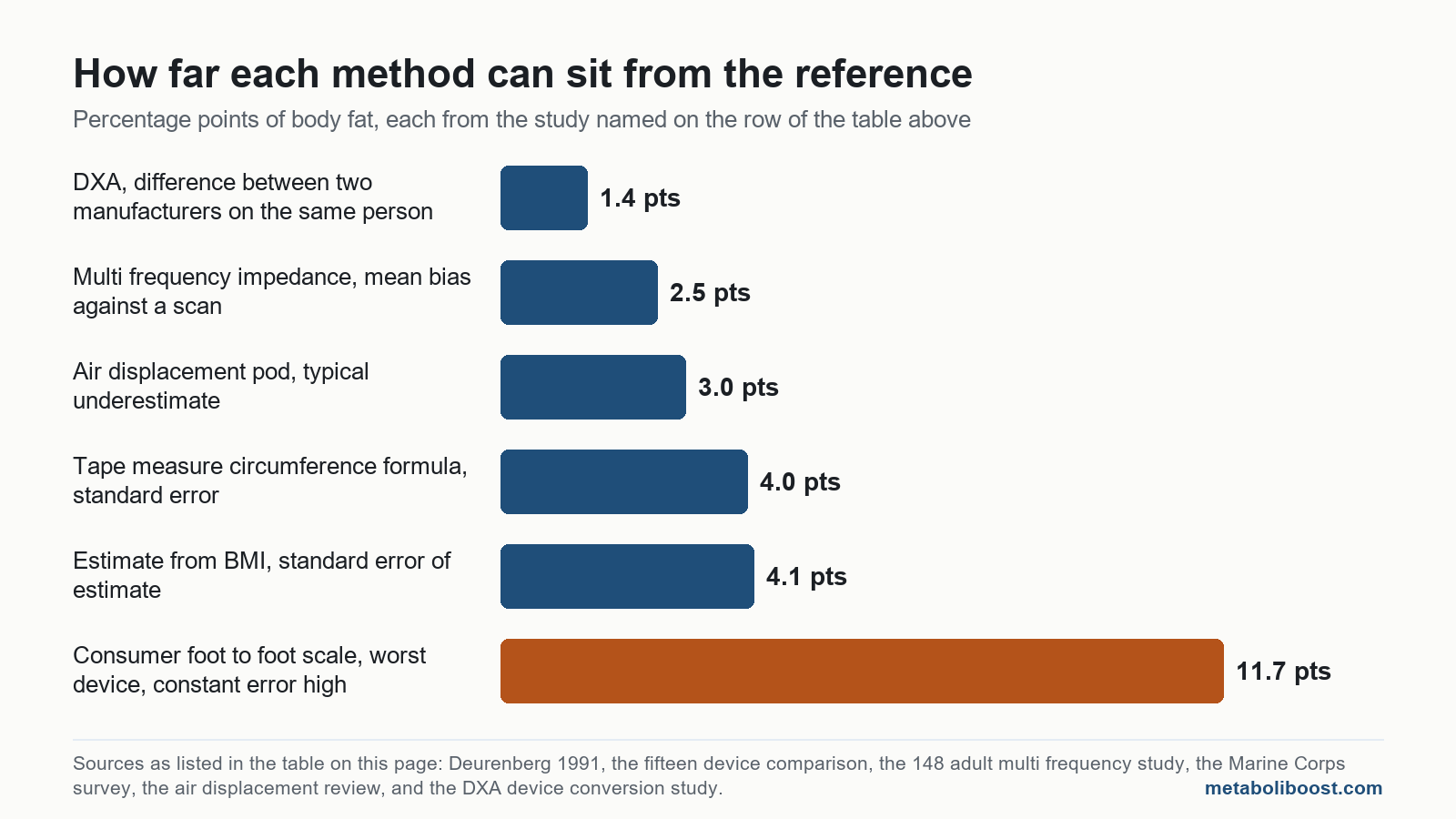
Why does the number on my bathroom scale move so much?
A consumer impedance scale has exactly two real inputs. It weighs you, and it sends a small current up one leg and down the other to measure resistance. Fat mass, muscle mass, bone mass and that alarming visceral fat figure are all modelled from those two numbers by an equation fitted to a reference group of people. If you are not much like that reference group, the model is guessing politely.
Resistance depends on water, so anything that moves your water moves the reading: a large drink, a salty dinner, a session that leaves you a litre down in sweat. That part is well known. The odd result that turns up when researchers test these devices properly is not.
A British Journal of Nutrition study of fifteen impedance devices put 73 adults through every one of them and compared the output with a four compartment reference model. The repeatability was excellent: precision error ran from 0.0 to 0.49 percentage points. The accuracy was not. Constant error against the reference ran from 3.5 points low to 11.7 points high depending on the device. Precise and correct are not the same property, and a scale can be one without being the other.
The detail worth stealing from that paper is what the authors said about five of the foot to foot devices, which reported precision between 0.0 and 0.11 points. They flagged it as suspicious, suggesting the algorithm may simply be restricting how much the output is allowed to vary. A scale that never disagrees with itself is not being careful. It is being quiet. And a device that will not move cannot show you a change either.

How much does the number have to move before the change is real?
This is the question nobody answers, and it has a standard formula. Bone density clinics use least significant change, which is 2.77 times the precision error of the instrument. Below that, a change is measurement noise at 95 percent confidence. Above it, something real probably happened. The same arithmetic works on any body composition tool, if you can find its precision error.
Run it on the numbers above. A scale with a precision error of 0.49 percentage points gives 2.77 times 0.49, which is about 1.4 points. So a reading that drifts from 28.0 to 28.9 has told you nothing. A drift to 29.6 is probably real. Run it on the DXA figures and the units change, because scan precision is reported as a percentage of the fat mass measured rather than in percentage points: at the reported 0.7 to 2.6 percent variation, a person carrying 25 kg of fat needs roughly 0.5 to 1.8 kg of change before the scan can see it.
The catch is why this calculation almost never gets run. No consumer scale manufacturer publishes a precision error, so the one number the sum needs is the one nobody prints on the box. Independent studies are the only place it exists.
Is the change real, or is it noise?
The least significant change formula from this page: 2.77 times the precision error of the instrument. Enter two readings and the precision error, and the tool says whether the difference clears it at 95 percent confidence.
0.49 is the largest precision error measured across fifteen consumer impedance devices in the study on this page; no consumer manufacturer publishes its own. Precise and correct are different properties: this tells you whether the device moved, not whether it is right.
What do people who compared a scan with a scale actually report?
I read the review pages for four body composition companies on Trustpilot and three threads in the r/loseit community, and pulled every account naming a body fat figure or a direct comparison. Six were specific enough to use. These are accounts, not evidence: nobody here had their measurement audited, and none of it is a finding about how these devices perform in general.
On Trustpilot, a reviewer posting as Karol B wrote on 28 August 2026 that a scan had put them at 17 percent while their scale kept showing 11, and objected to the manufacturer advertising a 99 percent correlation with DXA. On the same page, a reviewer posting as Jame Humie wrote on 5 September 2026 that the readings swung from 4.6 percent one day to 9.4 percent the next, and went back to calipers. On another brand page, a reviewer posting as LRP wrote on 29 July 2026 that the scale sat about 7 points above a scan and called impedance measurement misleading.
In an r/loseit thread from June 2026 about comparing scans with home scales, a commenter posting as Yummytastic argued that scales which look consistent often achieve it through algorithm tricks that restrict the output range, and that the extra steadiness is theatre rather than accuracy. That is a stranger on the internet arriving independently at the same conclusion the fifteen device study reached, which is not proof of anything but is a coincidence worth noticing. In the same thread, a commenter posting as Strategic_Sage said they had stopped using body fat figures at all and tracked weight, tape measurements and gym performance instead.
The accounts that cut the other way matter as much. In a September 2025 thread, a poster comparing a foot to foot scale with their first scan found the body fat figures landed within about two points of each other and the fat free mass within a few pounds, and said they would not tell anyone to bin their scale on that evidence. Their scale was badly wrong on visceral fat, reporting a figure many times what the scan gave. In the same thread, a commenter posting as CuteAmoeba9876 reported the opposite experience: across a year of lifting, dropping weight and losing two trouser sizes, their scale moved the body fat figure by a single point, so they threw it out.
The six together sit with the studies rather than against them. They agree on direction: the scale is a rough locator. They disagree on how rough, one within two points and one seven points out, which is about the spread the fifteen device comparison measured. Nobody in these accounts could tell in advance which of the two they would be.
Is a DXA scan worth paying for?
It depends what you want from it. As a one off picture of where fat sits and how much lean mass you carry, a scan tells you things no scale can. The British Heart Foundation puts a UK DEXA scan at least 100 pounds and an air displacement pod from about 40 pounds, and a reviewer of a US scanning service quoted 60 dollars on 3 September 2026. Affordable once, expensive as a habit.
As a way of tracking change, a scan has one rule that is easy to break. Machines from different manufacturers have been reported to read about 1.4 percentage points apart on the same person, because calibration and algorithms are proprietary and differ. Compare one clinic with another and part of the difference belongs to the hardware. Same machine, or no comparison.
One thing to hold separately from all of the arithmetic. If watching this number is causing distress, or driving eating patterns that worry you or the people around you, that is worth raising with a doctor or a registered dietitian. Measurement accuracy is not the relevant problem in that situation, and no figure from any device is.
What is worth tracking instead?
Not that measurement is hopeless. A trend from one consistent method beats a single precise sounding number from any of them. Pick one tool, use it under the same conditions every time, and read it over weeks rather than days.

Alongside it, track what can be measured well. Weight is one: the only figure a home scale measures directly rather than models, and accurate to grams. Waist to height ratio needs only a tape, is flagged by the British Heart Foundation as a useful alternative, and speaks to where fat sits rather than how much there is. It is only as good as the placement, though, and our guide to taking body measurements the same way every time sets out where the published protocols put the tape and why they disagree. Strength in the gym and how clothes fit are crude, but they do not drift with hydration, which is more than the impedance figure can claim. Our note on weight loss versus fat loss works through which of these answers which question.
Two other pieces here are worth reading beside this one. Differences in how men and women carry fat explain part of why the same device errs in opposite directions by sex, covered in the role of testosterone and body fat. And if your figure has stopped moving despite everything going right, why the last few kilograms are the hardest deals with the physiology rather than the measurement.
Frequently asked questions
Does drinking water or eating before I step on a body fat scale change the reading?
Yes, because an impedance scale infers body composition from resistance to a current, and water conducts. A drink, a meal or a sweaty session all shift the resistance and therefore the estimate. Measuring under identical conditions every time will not make the number accurate, but it does remove one source of the day to day swing.
Why do two body fat scales in the same house give different numbers?
Because each brand uses its own equation, fitted to its own reference group. The study of fifteen impedance devices found their constant error against a reference model ran from 3.5 points low to 11.7 points high, so two devices could disagree by more than ten points on the same person without either one being broken.
Can I work out my body fat percentage from my BMI?
You can run the number, but it is a prediction rather than a measurement. The original adult equation was published with a standard error of estimate of 4.1 percentage points, meaning a typical prediction misses by around four points in either direction. That is wider than most of the changes people are trying to detect.
Do skinfold calipers work if I pinch myself?
Self measurement removes the biggest advantage calipers have, which is a trained hand doing the same thing at the same site every time. Research comparing experienced and inexperienced raters found the novice exceeded the accepted error limit at the abdomen and hip, and several sites on the back and trunk are impossible to reach on yourself.
Is the visceral fat figure on my scale worth anything?
Treat it as the least reliable figure on the display. It is modelled from weight and one resistance reading rather than measured, and it is the number that forum posts comparing scales with scans most often report as wildly off. A tape measure around the waist gives you more for less.
Should I throw my body fat scale away?
Not necessarily. A scale that repeats well is a reasonable trend tracker even when the absolute figure is several points out, and the weight it reports is genuinely accurate. The mistake is treating the body fat percentage as a measurement of you rather than as a rough index that moves in roughly the right direction.
Finished the page? The same five questions from the top, to see what stuck.
This article is general information, not medical advice, and is not a substitute for care from a qualified healthcare professional. Speak to your doctor about your own situation.
Leave a Reply