
Quick weight loss methods do one of two things. The ones that reach fat all work through the same energy gap, however they are dressed. The rest, laxative teas, saunas, sweat suits and most cleanses, move water and gut contents that come straight back. Speed on the scale mostly measures how much water left first.
Listen to this article, about 12 minutes. A synthetic voice reads the article and announces each section title as it begins; tables are read row by row and the questions at the end are left out.
Recorded 25 September 2026 from the article as published that day. Press a chapter to jump there; the highlighted line is what is playing. A play button sits beside every section heading, and once you scroll past this player a bar at the bottom of the screen keeps the controls in reach. Tap or click any sentence to hear the reading start from there.
On this page: why the fastest methods remove the least fat, every method in one table with what it removes and its source, what the FDA and the FTC found in fat burners and detox teas, what sixty buyers of one tea reported, and the trial that tested whether fast loss means fast regain.
Think you already know this? Five questions, one minute.
Every answer is on this page. Answer from what you know now; the page fills in the rest.
-
1. How much water does the body store with its glycogen, per the 1992 paper?
The paper, pointedly titled Glycogen storage: illusions of easy weight loss, describes the early drop reversing when carbohydrate comes back, which is why a keto start and a juice cleanse can produce similar looking first weeks. Read the section
-
2. What did the 1983 study find about purging that produced litres of diarrhoea?
Laxative and detox teas move water and stool; the calories mostly stay absorbed. Read down the middle column of the table and the pattern appears: the methods that feel fastest remove the least fat. Read the section
-
3. In the 2018 JAMA Network Open analysis of FDA warnings, how many weight loss supplements contained undeclared sibutramine?
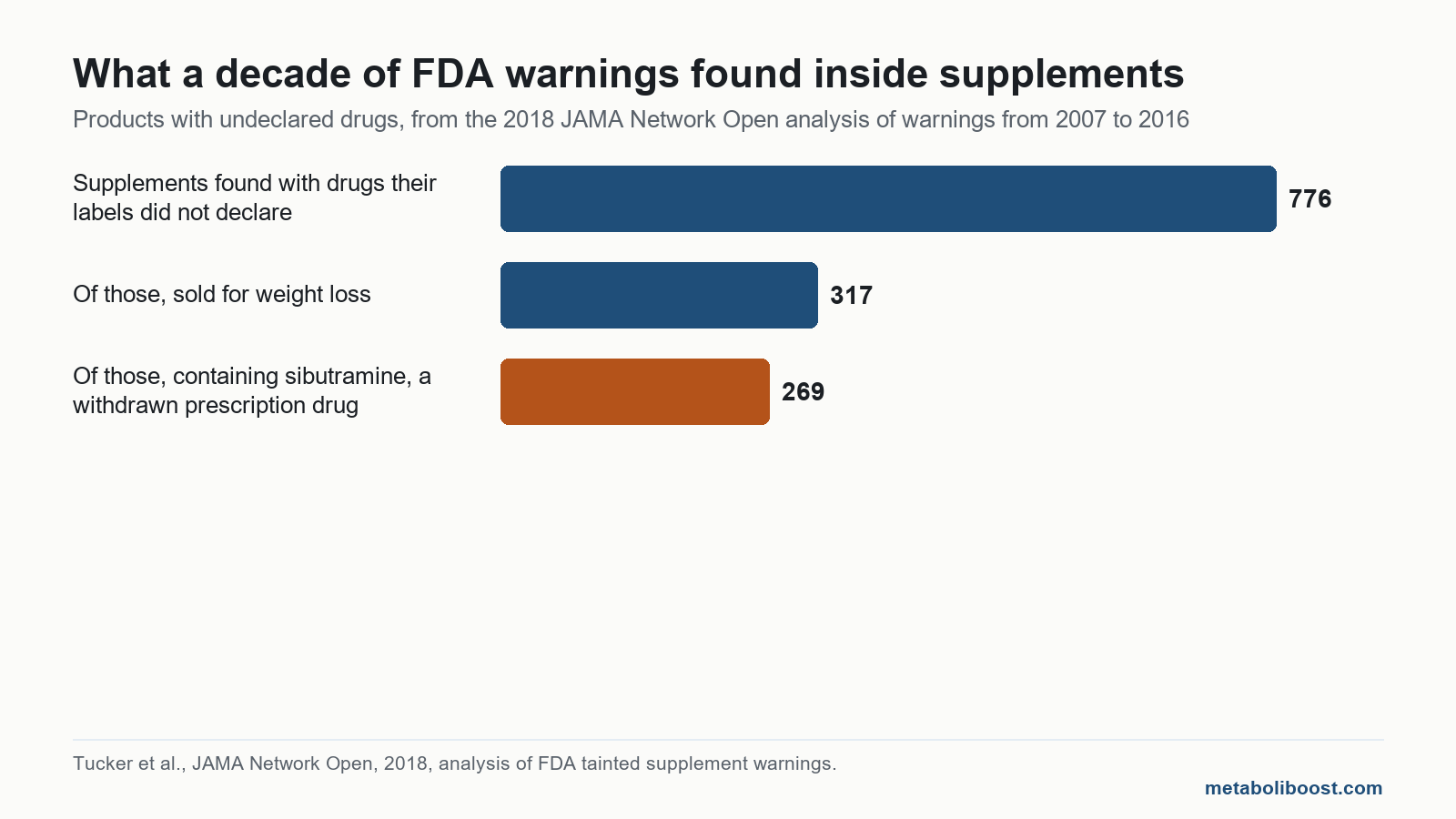
The study found 776 supplements with drugs their labels did not declare between 2007 and 2016, weight loss products the largest group. The FTC’s Teami case carried a 15.2 million dollar judgment, suspended once the company paid one million, and refunds to more than 20,000 buyers. Read the section
-
4. In the 2014 Lancet Diabetes and Endocrinology trial of 200 adults, what happened to regain after three years?
The trial found slow and steady did not protect against regain, and neither did fast. What speed did cost showed up in body composition: Vink and colleagues reported fat free mass loss of 8.8 percent in the fast group against 1.3 percent in the slower one. Read the section
-
5. Why does the NIDDK say fast weight loss raises gallstone risk?
Going long periods without eating does the same. Weight falling without trying is a reason to see a doctor in its own right, and anyone with diabetes, a heart or kidney condition, a history of an eating disorder, who is pregnant or on regular medication has particular reasons to speak to one before a steep cut or a fast. Read the section
Every list of quick weight loss methods is the same few levers wearing different outfits. Some reach fat, slowly and at a price. Others rearrange water, which is why the scale can look spectacular for a few days and then quietly hand it all back.
Why do quick weight loss methods seem to work so well at first?
Because the first thing most of them remove is not fat. The body keeps a reserve of carbohydrate called glycogen in the liver and muscles, and it stores it wet. A 1992 paper in the American Journal of Clinical Nutrition, pointedly titled Glycogen storage: illusions of easy weight loss, excessive weight regain, and distortions in estimates of body composition, describes glycogen as held with three to four parts water. Cut carbohydrate or cut food sharply and the body draws that reserve down, and the water bound to it leaves too.
The authors made the point diet marketing skips: the early drop reverses when carbohydrate comes back, and the regain can look exaggerated if someone then loads up on it. None of that is fat, in either direction. It is also why two methods with nothing else in common, a keto start and a juice cleanse, can produce similar looking first weeks. Both empty the glycogen store. Neither has done anything special yet.
Fat loss runs on a less photogenic rule: the body has to use more energy than it takes in, for long enough to add up. Every method below either creates that gap, and works the way a plain diet does, or it does not, and whatever it removes is coming back. More on the two numbers in our piece on whether weight loss or fat loss is the one that matters.
What does each quick weight loss method actually remove?
Here is the whole field in one table, compiled from primary sources with the citation on every row. The middle column is the one the ranking lists leave out.
| Method | What leaves first | What the evidence says | Source |
|---|---|---|---|
| Steep calorie cut or very low calorie diet | Glycogen and its water, then fat and a share of lean tissue | Faster loss cost more lean mass in one trial; long term regain matched slower loss in another | Vink 2016, Purcell 2014 |
| Keto or very low carb start | Glycogen and the water stored with it, as carbohydrate drops | Glycogen is held with three to four parts water, so the early drop is largely water | Kreitzman 1992 |
| Juice cleanse or detox diet | Gut contents and water; fat only if calories fall low enough | No compelling research supports detox diets for weight management | NCCIH |
| Water fasting | Glycogen, water, fat and lean tissue together | Long spells without food and fast loss both raise gallstone risk | NIDDK |
| Fat burner capsules | Usually nothing measurable | Little scientific evidence that weight loss supplements work; some contain undeclared drugs | NIH ODS, Tucker 2018 |
| Laxative or detox teas | Water and stool | Purging that produced litres of diarrhoea cut calorie absorption by only about 12 percent | Bo-Linn 1983 |
| Saunas and sweat suits | Sweat | What leaves in the heat is body fluid, and drinking puts it back | Sauna body mass study |
Read down the middle column and a pattern appears: the methods that feel fastest remove the least fat. The two that change body composition at all, a steep calorie cut and a fast, do it through the same energy gap as an ordinary diet, just with sharper edges. There are fuller pieces here on what water fasting does and who should avoid it, what ketosis really changes, the egg fast and the 7 day GM diet, if one of them is the method on the table for you.
Which method is on the table for you?
Pick one and the row from the table above answers, with what leaves first and what the evidence says.
Every row’s source is linked in the table above. Nothing here is a recommendation for or against any method; the medical lines are stated as the regulators state them.
What do regulators say about fat burners and detox teas today?
Two categories on that list have attracted enforcement rather than mere scepticism, and the regulators’ own records, checked on 22 September 2026, say more than any product page.
Fat burner capsules. A decade of US Food and Drug Administration warnings, 2007 to 2016, was analysed in a 2018 study in JAMA Network Open, which found 776 supplements containing drugs their labels did not declare. Weight loss products were the largest group, 317 of them, and 269 of those contained sibutramine, a prescription appetite suppressant withdrawn from the US market over heart risks. Where a product drew more than one warning, most had a new undeclared ingredient by the second or third: the recipe changed, the business did not. The NIH Office of Dietary Supplements adds that there is little scientific evidence weight loss supplements work, and that some interact with medicines. A capsule that works suspiciously well is, on this record, a reason to ask what else is in it. Our look at what a fizzy weight loss tablet actually does comes at the same problem sideways.

Detox teas. In March 2020 the Federal Trade Commission sued Teami, LLC in the US District Court for the Middle District of Florida, matter number 182-3174, over claims that its 30 day detox pack would help people lose weight, claims the FTC said the company lacked reliable scientific evidence for. The order carried a $15.2 million judgment, suspended once the company paid $1 million because it could not pay the rest. In February 2022 the FTC sent refunds to more than 20,000 buyers, averaging just over $45 each. The influencers promoting it had not clearly said they were paid, so the glowing post was an advert, and the tea was a tea.
Using laxatives, diuretics or repeated sweating to control weight carries real risks, including dehydration, and it is a recognised feature of eating disorders. If that pattern sounds familiar, the NHS guide to eating disorders explains the signs and where to get help, and in the UK the charity Beat runs a helpline. A GP is a good place to start that conversation.
What do people who bought a detox tea actually report?
The ranking pages describe what detox teas do; none say what buyers said. On 22 September 2026 we read three pages of reviews of Teami, the company in the FTC case, on Trustpilot, about 60 accounts, on a profile rated 1.2 out of 5 from 92 reviews. This is what reviewers report, not findings, and review sites lean toward complaints. Most of the 60 were about orders that never arrived and refunds refused, including a December 2022 review describing cramps from the detox tea alongside a subscription the reviewer said had restarted without being asked. An August 2023 reviewer said the detox tea was not as advertised and that no refund followed.
The accounts about the tea’s effects cluster in 2019 and 2020, the period whose claims the FTC challenged. A June 2019 reviewer described severe diarrhoea and cramping on the 30 day detox and said it ended in a hospital visit. A January 2019 reviewer reported abdominal pain from the colon tea, and an April 2020 reviewer reported nausea, vomiting and bloating and called it money wasted.
They were not unanimous. An August 2020 reviewer gave five stars, reported losing weight and no side effects, and a January 2019 reviewer said the detox helped with bloating while grumbling about a broken tumbler lid. Of roughly 60 reviews, eight described what the tea did: six bad, two good.
Where these accounts agree with the official record: the complaints, cramps, urgency and diarrhoea, are the side effects NCCIH lists for laxatives and colon cleansing. Where they part company: the one reviewer who reported losing weight had no way to tell water from fat, and neither does a bathroom scale, which is exactly what the table above is for.
Does losing weight faster mean regaining it faster?
Not in the best trial on the question, though speed is not free either. In a 2014 randomised trial in The Lancet Diabetes and Endocrinology, 200 adults with obesity were assigned either a very low calorie programme or a slower one. More of the fast group reached the trial’s target, and three years later both groups had regained similar proportions of what they had lost. Slow and steady did not protect against regain. Neither did fast.
What speed does cost shows up in body composition. A 2016 trial by Vink and colleagues in Obesity ran a very low calorie diet against a moderate one until both groups had lost a similar amount. The authors report fat free mass loss of 8.8 percent in the fast group against 1.3 percent in the slower group, and regain afterwards was similar. Fat free mass includes muscle, so the fast route bought the same scale result with more of it from the wrong place. Neither trial predicts what happens to any one person, and both were supervised programmes, not a plan copied off a video. Pooled across seven randomised trials the lean tissue gap is smaller and less certain than Vink’s single result suggests, which is one of the things we weigh up in what chasing speed actually costs on the scan.
When does fast weight loss become a medical matter?
Very low calorie diets are used in medicine, under supervision, and the supervision is part of why they are used safely. The National Institute of Diabetes and Digestive and Kidney Diseases notes that losing weight quickly raises the risk of gallstones, because the liver releases extra cholesterol into bile and the gallbladder may not empty properly, and that going long periods without eating does the same.

Anyone with diabetes, a heart or kidney condition, a history of an eating disorder, who is pregnant, or who takes regular medication has particular reasons to speak to a doctor before a steep cut or a fast. Weight falling without trying is a reason to see a doctor in its own right.
So what actually governs how fast weight comes off?
It depends, and the honest version of that answer is more useful than any number. Four things govern it. First, how much water and glycogen leaves at the start, which depends mostly on how much carbohydrate someone was eating before. Second, the size of the energy gap, which depends on body size and activity as well as food, so the same menu does different things in different people. Third, how much of the loss is fat rather than lean tissue, which the Vink trial suggests gets worse as the gap gets extreme. Fourth, and most of all, how long the approach can be kept up.
That fourth one is where the quick methods fail hardest, since several are designed to be stopped. A cleanse ends, a fast ends, a sauna session ends, and the water walks back in. Our piece on why the final stretch of weight loss slows down picks up the story from there.
Frequently asked questions
Is water weight real weight?
It is real in the sense that the scale counts it. It is not fat, and it returns when fluid and carbohydrate return, which is why a fast early drop tells you very little about what happens next.
Why did the scale go up after I stopped a cleanse?
Mostly because the glycogen store refilled and brought its water with it, and because the gut is carrying food again. Fat does not come back overnight any more than it left overnight.
Are fat burners safe if a big retailer sells them?
Being on a shelf is not a safety check. In the US, dietary supplements do not need approval before they are sold, and the study of regulator warnings described above found hundreds of weight loss products carrying undeclared drugs.
Why do doctors ever use very low calorie diets?
Because for some patients a supervised programme is a useful tool, and supervision lets the risks be managed. The NIDDK notes, for example, that a medicine can be used to help prevent gallstones in people losing weight rapidly.
Is intermittent fasting a quick weight loss method?
It is a way of arranging an energy gap by shortening the eating window, not a separate mechanism. Our article on whether intermittent fasting works covers the trials.
How can I tell if a weight loss product claim is false?
Warning signs include a promised amount in a set time, no change to food needed, and testimonials standing in for trials. The FTC case against Teami turned on exactly that: claims made without reliable scientific evidence.
Finished the page? The same five questions from the top, to see what stuck.
This article is general information, not medical advice, and is not a substitute for care from a qualified healthcare professional. Speak to your doctor about your own situation.
Leave a Reply