
A visceral fat level on a home scale is a brand’s own rating, modelled from your weight, height, age and the electrical resistance through your body, not a measurement of the fat around your organs. Each brand uses its own range, and studies against MRI and CT found the rating tracked visceral fat only loosely.
Listen to this article, about 12 minutes. A synthetic voice reads the article and announces each section title as it begins; tables are read row by row and the questions at the end are left out.
Recorded 9 November 2026 from the article as published that day. Press a chapter to jump there; the highlighted line is what is playing. A play button sits beside every section heading, and once you scroll past this player a bar at the bottom of the screen keeps the controls in reach. Tap or click any sentence to hear the reading start from there.
On this page: the visceral fat bands Tanita and Omron publish, checked on 9 November 2026, beside what MRI and CT studies found when they tested the rating, worked through as a share of the differences between people.
Think you already know this? Five questions, one minute.
Every answer is on this page. Answer from what you know now; the page fills in the rest.
-
1. How does Tanita describe the visceral fat rating its scales print?
Tanita’s support page says the rating is not measured directly by the device but estimated. Read the section
-
2. On Omron’s published bands, which range is labelled High?
Omron’s FAQ lists 1 to 9 as Normal, 10 to 14 as High and 15 to 30 as Very High; 13 to 59 is Tanita’s too high band. Read the section
-
3. In the 2011 MRI study of 120 adults, how did a tape at the waist compare with the scale ratings for women?
In Browning and colleagues’ study the midpoint waist tape correlated 0.75 with MRI visceral fat in women, against 0.64 and 0.61 for the two Tanita ratings. Read the section
-
4. What did the September 2026 r/loseit poster say about their eight pad scale?
The r/loseit post is one person’s report, not a finding: they doubted the number and valued the trend. Read the section
-
5. What does NICE guideline NG246 say about bioimpedance in adults?
NICE NG246, recommendation 1.9.9, advises against using bioimpedance in place of BMI; it uses waist to height ratio for central adiposity. Read the section
Step on a modern bathroom scale and it hands you a small dashboard: weight, body fat, muscle, water, bone, a “metabolic age” and a visceral fat level, all to one decimal place, all in under ten seconds. That is a lot of confidence for a device you bought with the bath mat. This page is about one of those numbers: what it is, where it comes from, and what the people who tested it against real scans found.
What is a visceral fat level on a scale?
It is a score, not a quantity. Visceral fat is the fat packed inside the abdomen around the liver, gut and other organs, as opposed to the fat under the skin that you can pinch. Our explainer on why visceral fat matters more than the fat you can see covers the health side. A scan can measure it as an area in square centimetres or a weight in grams. A home scale cannot, so it prints a rating on a ladder its maker designed, with bands the maker chose.
That is why two scales can show you 7 and 14 on the same morning and both be working as intended. The numbers are not in the same units, because they are not in any units at all.
How does a scale estimate fat it cannot reach?
By guessing, cleverly. A scale with metal pads sends a tiny current through your feet and times how hard it is to push through. Water rich lean tissue conducts well and fat conducts poorly, so the resistance says something about body composition. Then the scale feeds that resistance, your weight, and the height, age and sex you typed in during setup into an equation built from people who were scanned.
The current on a foot to foot scale mostly travels up one leg and down the other. It barely visits the abdomen, which is where visceral fat lives. So the visceral figure is largely an inference. Tanita’s own support page says it is “not measured directly by the device” but estimated from all the data the scale collects. That is an honest description, and worth knowing before you treat the number like a blood test.

What do the scale makers say their numbers mean?
Here is what two of the best known makers publish today. We checked both pages on 9 November 2026 and copied the bands as they word them.
| Maker | Range printed | Bands, in the maker’s own words | What the maker says it is | Checked |
|---|---|---|---|---|
| Tanita support page | 1 to 59 | 1 to 12 “a healthy level”, 13 to 59 “too high” | “Not measured directly” but estimated; 1 point said to equal 10 square centimetres of visceral fat on an MRI slice | 9 Nov 2026 |
| Omron weight management FAQ | 1 to 30 | 1 to 9 Normal, 10 to 14 High, 15 to 30 Very High | Fat stored in the abdominal cavity; the page does not explain how the level is calculated | 9 Nov 2026 |
Two things stand out. The ranges do not line up: a 12 is “healthy” on one ladder and “High” on the other. And only Tanita ties its score to anything physical, saying that 1 point corresponds to 10 square centimetres of visceral fat on an MRI scan. Omron’s page lists the bands and, separately, warns that its body composition results can be off for people with a fever, swelling, very low bone density, pregnancy, dialysis, highly trained athletes and growing children.
They are not a clinical classification, and no guideline we found uses them.
How closely does the scale number match an MRI or CT scan?
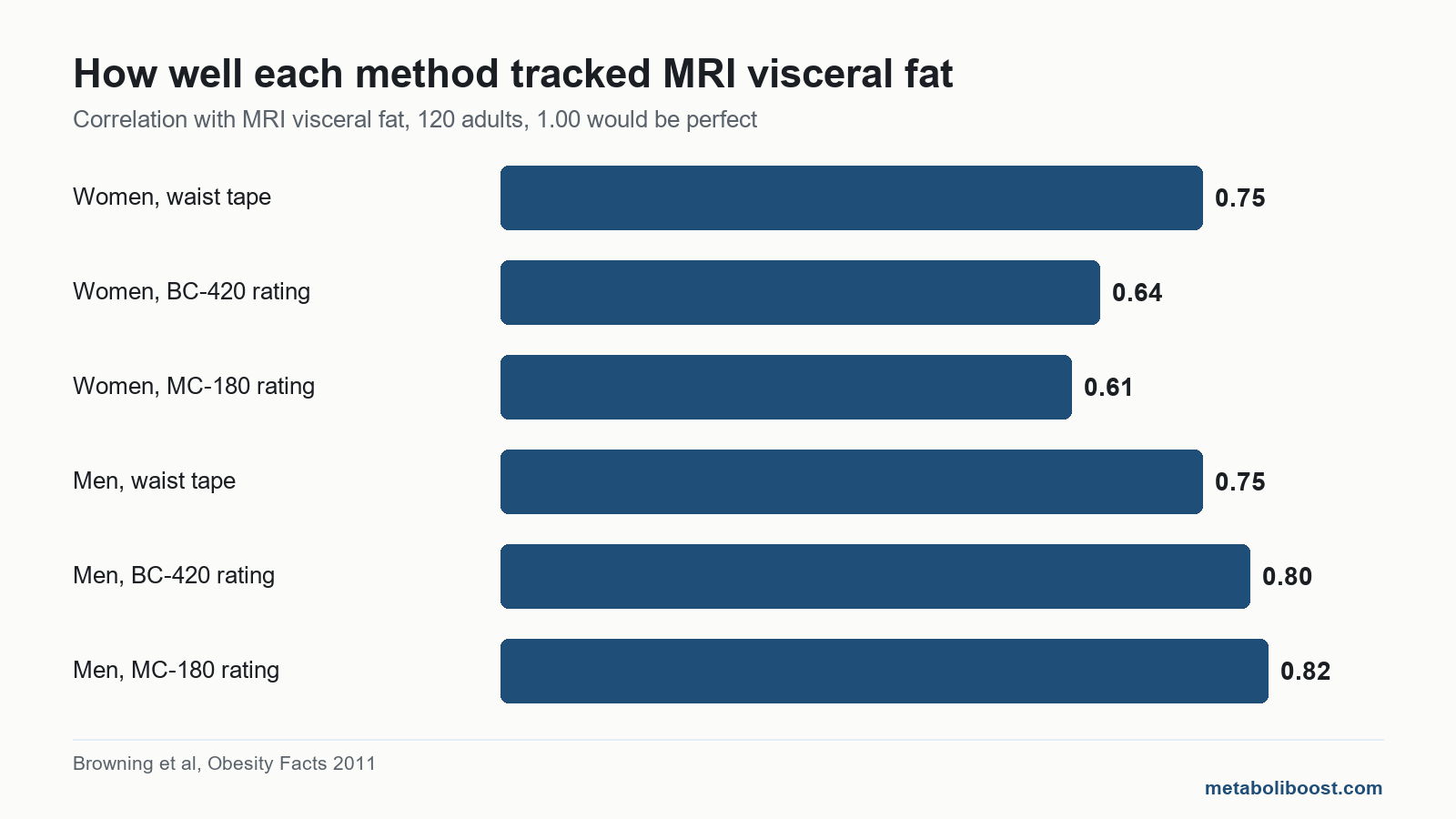
Loosely, and less well for women. The largest head to head we found is a study by Browning and colleagues in Obesity Facts in 2011, which put 120 adults in Cambridge through MRI and several simpler methods on the same visit. It tested two whole body Tanita analysers that print the same style of visceral fat level as home scales. Their conclusion was blunt: none of the simpler techniques showed strong correlations with visceral fat measured by MRI.
| Study | Who and what | Reference scan | What it found |
|---|---|---|---|
| Browning and colleagues, Obesity Facts, 2011 | 120 adults in Cambridge, two whole body Tanita analysers (BC-420 and MC-180) | MRI | Ratings correlated 0.80 to 0.82 with visceral fat in men but 0.61 to 0.64 in women; a tape at the waist managed 0.75 in both |
| Browning and colleagues, Obesity, 2010 | The same 120 adults, a belt style abdominal device (AB-140) | MRI | Its “visceral fat level” tracked total belly fat (0.94 in men) far better than visceral fat (0.65) |
| Xu and colleagues, BMJ Open, 2021 | 414 adults aged about 40 to 82 in Beijing, a Tanita BC-554 scale | CT | Agreement called poor; at the maker’s cut-off of 13 the scale flagged 10% of the women and 52% of the men whom CT classed as having visceral obesity |
The numbers in that first row are worth a worked example. A correlation of 0.64, squared, is about 0.41, which means the rating accounted for roughly 41% of the differences in visceral fat between the women. For the men, 0.80 squared is 0.64, so about 64%. A plain tape measure at the waist, at 0.75, accounted for about 56% in both. The cheapest tool in the room did as well as the scale for men and better for women.
Tanita’s conversion does roughly hold on average. In the same study the women’s mean MRI visceral fat was 93 square centimetres and their mean BC-420 rating was 8.8, which works out at about 10.6 square centimetres per point. The men came out at 147 square centimetres over a rating of 12.6, about 11.7 per point. Averages are not people, though, and the spread around them is exactly what the correlations describe.
The CT study by Xu and colleagues in BMJ Open is the harder one to read for anyone who trusts the green zone. Using a Tanita BC-554 scale, it found that at the maker’s own threshold of 13, the scale caught only 10% of the women whom CT classed as having visceral obesity. For men it was 52%. In other words, a reassuring number missed most of the women it should have flagged.
One caution in the other direction: the devices in these studies are a decade or more old, and newer models may do better. We could not find a published validation of any current home scale’s visceral rating against MRI or CT, and the makers’ pages we checked cite none.
What do people who track these numbers actually report?
We read three recent threads and around 30 comments on Reddit about scale readings and scans. None compared a home scale’s visceral rating with a scan directly, which says something in itself. What people describe is consistent, with a few exceptions. These are personal reports, not findings.
- In a September 2026 r/loseit post, a poster with a cheap eight pad scale wrote that the absolute number was probably wrong but the daily trend kept them motivated. Their own log shows the fat mass reading rising 0.6 kg between two mornings two days apart, far faster than fat itself changes.
- In a November 2025 r/loseit thread asking whether smart scales read too low, one commenter reported two different body composition machines, two hours apart, disagreeing by five percentage points. Another said their scale drifted well above a DEXA result once they started lifting.
- The same thread had the counter view: one person said their scale’s athlete setting came close to a DEXA result, and another said a gym analyser and their scale agreed. The general advice that came out of it was to trust the trend, not the number.
- In an October 2026 r/bodyspec thread, someone getting regular DEXA scans saw their visceral fat reported as 0.7 lb, then 0.4 lb, then 0.0 lb. A reply from the scanning company said small amounts round down to zero, and that zero does not mean none.
The research supports using the same device consistently and focusing on trends rather than exact numbers. However, there is no solid evidence that home scales reliably track visceral fat. Even scans have some rounding differences.

What can the visceral fat number not tell you?
Rather a lot. It cannot tell you how much visceral fat you have in grams or square centimetres. It cannot be compared with a friend’s scale, a gym analyser or a DEXA report. It does not diagnose anything, and a number in the maker’s green zone does not rule anything out, as the CT study showed. The same caution applies to the scale’s body fat figure, which our guide on how far each body fat method can sit from a scan sets out.
What guidelines use instead is simpler. NICE guideline NG246 tells clinicians not to use bioimpedance in place of BMI as a measure of general adiposity in adults, in recommendation 1.9.9, and uses waist to height ratio alongside BMI to assess central adiposity. The NHS waist to height calculator uses that ratio for adults with a BMI under 35, and NICE classes 0.5 to 0.59 as increased central adiposity and 0.6 or more as high. If you want to understand what BMI does and does not show at your height, that is covered separately. A tape is also noisy day to day, as our page on why a waist tape can jump in a week explains, but it is at least measuring the right place.
The checklist below separates what the number can and cannot do. It sets no target and reads nothing into your result.
What your scale’s visceral fat number can and cannot do
Tick each one you already knew. It sets no target and reads nothing into your result.
General information only. Worries about weight or visceral fat belong with a doctor, not a scale.
When is visceral fat worth raising with a doctor?
The NHS suggests speaking to a GP if your waist is more than half your height and you would like help with your weight, particularly if you also have a condition such as type 2 diabetes or high blood pressure. A GP can look at waist, blood pressure and blood tests together, which tells far more than any single scale reading. If a scale number is worrying you, that worry is a reasonable thing to take to a doctor, and the scale’s printout is not a reason to skip the appointment.
Frequently asked questions
Is my visceral fat level of 10 good or bad?
That depends on whose scale printed it. On Tanita’s ladder 10 sits inside its healthy band; on Omron’s it is in the High band. Neither band is a diagnosis, and a doctor can assess your risk with waist, blood pressure and blood tests.
Can I compare a reading from one brand with another?
No. Tanita rates from 1 to 59 and Omron from 1 to 30, with different cut-offs and different equations behind them, so the numbers are not interchangeable.
Why did my visceral fat level change from one day to the next?
Visceral fat does not change overnight. A home scale’s reading shifts with hydration, recent food and drink, and the time of day, which is why measuring under the same conditions each time matters.
Is a DEXA visceral fat result the same thing?
No. DEXA estimates visceral fat as a mass or area from an X-ray image of the trunk, while the scale prints a brand rating. DEXA is closer to the real thing, but it is still an estimate and small amounts can round to zero.
Who should not rely on a body composition scale?
Omron lists people with a fever or swelling, pregnant women, dialysis patients, people with very low bone density, highly trained athletes and growing children among those whose results may be inaccurate.
Does a reading in the healthy band mean my health is fine?
Not on its own. In a CT study the maker’s cut-off missed most of the women with visceral obesity, so a green number is not a reason to skip a check with a GP.
Finished the page? The same five questions from the top, to see what stuck.
This article is general information, not medical advice, and is not a substitute for care from a qualified healthcare professional. Speak to your doctor about your own situation.
Leave a Reply