
If you are searching how to lose 2 inches off waist in 5 days, the honest answer is that fat does not leave that fast. What moves a tape in five days is gut contents, water, breath, posture and where the tape sits, and one review found tape errors of up to 9.2 cm from the same measurer.
Listen to this article, about 11 minutes. A synthetic voice reads the article and announces each section title as it begins; tables are read row by row and the questions at the end are left out.
Recorded 24 October 2026 from the article as published that day. Press a chapter to jump there; the highlighted line is what is playing. A play button sits beside every section heading, and once you scroll past this player a bar at the bottom of the screen keeps the controls in reach. Tap or click any sentence to hear the reading start from there.
On this page: the waist tape error ranges from a published review in a table, the energy arithmetic that rules out two inches of fat in five days, a cited table of what moves the tape, and three dated r/loseit accounts.
Think you already know this? Five questions, one minute.
Every answer is on this page. Answer from what you know now; the page fills in the rest.
-
1. According to the textbook rule tested by Kevin Hall, roughly how much cumulative deficit goes with one pound of weight lost?
Hall’s 2008 analysis examined the 3,500 kcal per pound rule and found it roughly fits people with more than about 30 kg of body fat but overestimates the deficit needed in leaner people. Read the section
-
2. What range of measurement error did the Verweij review report for waist circumference overall?
The Public Health Nutrition review states that the measurement error may vary between 0.7 cm and 15 cm, and 0.7 to 9.2 cm even for the same measurer. Read the section
-
3. Which factors did the 2009 Obesity study recommend standardising when measuring a waist?
Agarwal and colleagues measured 123 adults eleven ways and suggested the site, posture, phase of respiration and time since last meal be standardised. Read the section
-
4. In the six week abdominal exercise trial, what changed significantly in the ab group?
Vispute and colleagues found no significant effect on abdominal circumference or fat, while the ab group managed 47 curl ups against 32 in the control group. Read the section
-
5. At which point in the breath is a waist usually measured?
The usual protocol, covered in the WHO expert consultation, takes the reading at the end of a normal expiration, because the belly wall moves with each breath. Read the section
When you search for this question, the results are surprisingly misleading. Many top links appear on university or software-company websites but carry the same copied, rewritten article promising to melt two inches in just five days. It is hard to find reliable advice among all these claims. So, let’s cut through the hype and look at what you actually need to know.What a tape can show in five days, and how much of it is noise.
Can you really lose 2 inches off your waist in 5 days?
Not as fat, no. Fat tissue is stored energy, and it leaves only as fast as that energy is used. The textbook rule says roughly 3,500 kcal of cumulative deficit per pound of weight lost. Kevin Hall’s analysis in the International Journal of Obesity found that rule roughly fits people carrying more than about 30 kg of body fat and overestimates the deficit needed in leaner people, because more of their loss is lean tissue and water. Either way, it is a rule about the whole body.
Run the arithmetic on a 500 kcal daily gap, a common textbook example rather than a target. Five days of it is 2,500 kcal. By the 3,500 kcal rule that does not reach one pound of tissue, and that tissue comes from the whole body, arms and face included, not only from under the tape. The body does not take requests about where. No arithmetic turns that into two inches of fat off the waist.
So any big five day change on the tape is mostly something else, and the useful question is what that something else is. If the difference between weight and fat is new territory, our piece on whether weight loss or fat loss matters more covers it.
How big is the error when a tape measures a waist?
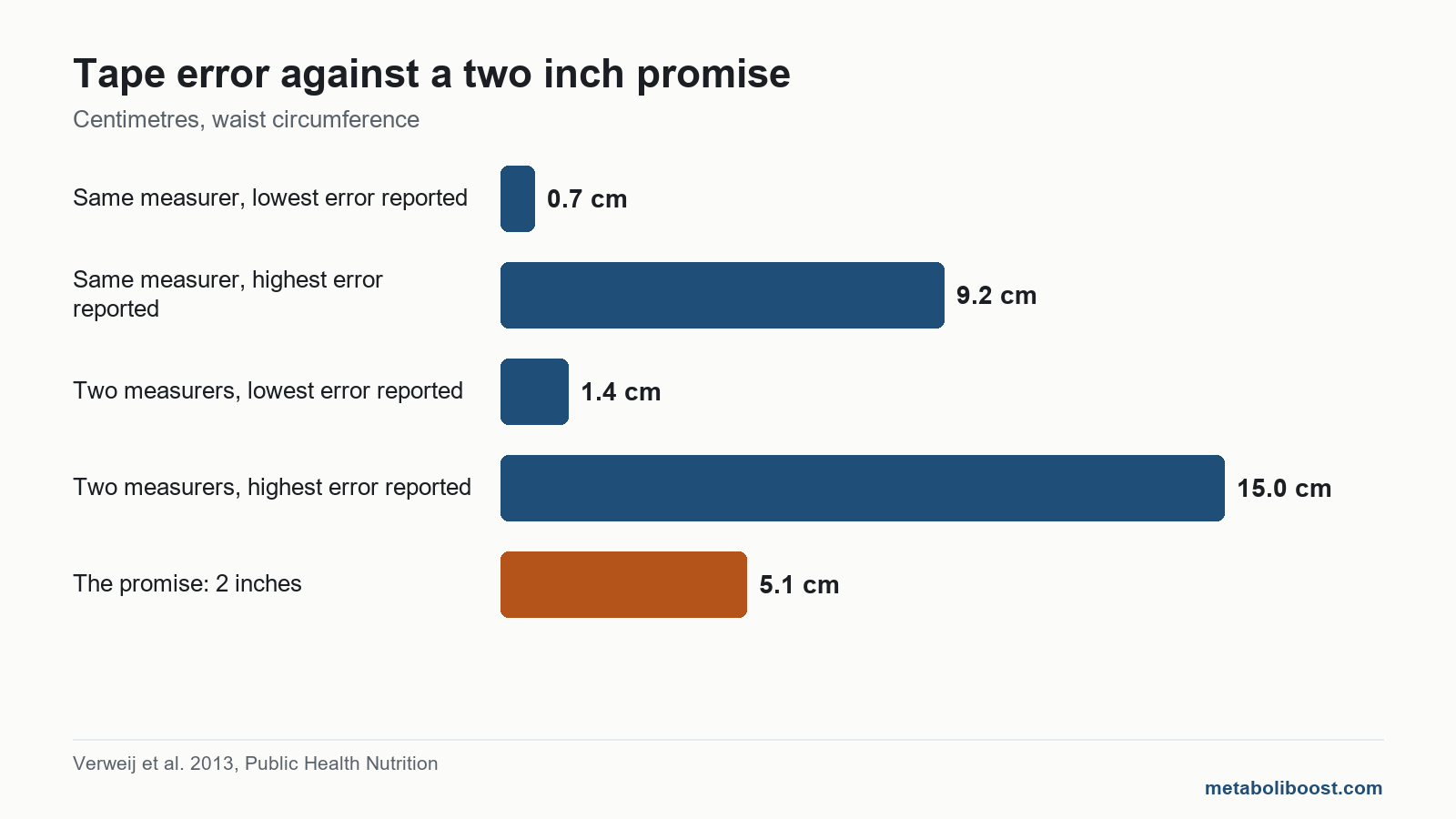
Bigger than most people expect. A review in Public Health Nutrition by Verweij and colleagues pulled together waist measurement studies published from 1975 to February 2011 and concluded that “the measurement error may vary between 0.7 cm and 15 cm”. Even when the same trained person measured the same waist twice, the reported error ranged from 0.7 to 9.2 cm.
Two inches is 5.1 cm. That sits comfortably inside the range of error a single measurer can produce. The authors went further: they said it may be difficult to tell a clinically relevant change from measurement error in one person, and they put a short term relevant change at 3.0 to 6.8 cm depending on waist size. That is a change researchers would care about, and it overlaps the noise.
| What was compared | Range reported | In inches | Source |
|---|---|---|---|
| Same person measuring twice | 0.7 to 9.2 cm | about 0.3 to 3.6 | Verweij 2013 review |
| Two different people measuring | 1.4 to 15 cm | about 0.6 to 5.9 | Verweij 2013 review |
| Short term change the authors call clinically relevant (5 percent of a 60 to 135 cm waist) | 3.0 to 6.8 cm | about 1.2 to 2.7 | Verweij 2013 review |
| The promise on the spun pages | 5.1 cm | 2 | the pages themselves |
Nobody is saying a tape is useless. The review’s own advice is a uniform method, training and repeated measurements. It is saying a single reading on day one and another on day five cannot carry the weight of a two inch claim.
What actually moves the tape over a few days?
Everything that is not fat, mostly. A study in Obesity measured 123 healthy adults eleven different ways, varying the landmark, posture, breathing phase and time since the last meal. The means came out statistically different, the authors said the differences were mostly small, and they recommended that all four factors be standardised in any protocol. Put another way, the tape responds to how and when you measure, not just to what is underneath.

| What changes | Is it fat? | Why it moves the tape | Source |
|---|---|---|---|
| Where the tape sits (rib, navel, hip bone) | No | Different landmarks give different numbers on the same body | Agarwal 2009 |
| Breath in or out | No | The belly wall moves with each breath | Agarwal 2009 |
| Time since the last meal | No | Food and drink take up space under the tape | Agarwal 2009 |
| Gas and bowel contents | No | Fizzy drinks, some vegetables, constipation and swallowed air all add volume | NHS bloating page |
| Stored carbohydrate and its water | No | Each gram of muscle glycogen is stored with at least 3 g of water | Fernández-Elías 2015 |
| Fat tissue | Yes | Shrinks only as stored energy is used, which is slow | Hall 2008 |
Two of these deserve a closer look because they are what the five day plans quietly rely on. The first is gut contents. The NHS bloating page lists gas from some vegetables and fizzy drinks, swallowed air, constipation and periods among the common causes of a bloated tummy. A plan that cuts food volume and fizzy drinks for five days will usually shrink the tape a little, and every bit of that comes back with normal meals.
The second is stored carbohydrate. A study of nine trained cyclists in the European Journal of Applied Physiology found each gram of muscle glycogen stored with at least 3 g of water. Cut carbohydrate sharply and some of that water goes, which shows up on the scale far more than on the waist, since most glycogen sits in muscle elsewhere. Our article on what the scale is really showing when water weight drops walks through that part.
Do ab exercises or a waist wrap shrink the waist itself?
Not in the trial that tested it. In a randomised study published in the Journal of Strength and Conditioning Research, 24 sedentary adults were split into a control group and an ab group doing seven abdominal exercises, two sets of ten, five days a week for six weeks, with diet held steady. There was no significant effect on abdominal circumference, abdominal fat or skinfolds. The ab group did get better at curl ups, 47 against 32 at the end. Strong muscles, same tape.
Six weeks of crunches could not move it, so five days of a plan was never going to. That is not a reason to skip ab work, which has its own uses; what belly exercises can and cannot do goes into those. As for the waist wrap and the sweat belt: a wrap squeezes, and when it comes off, so does the effect. Sweating out water is not losing fat, and you drink it back by dinner.
What do people who track their waist actually report?
Their accounts line up with the error research rather than with the spun pages. We read three r/loseit threads from the past year with about 25 replies between them. These are what people report, not findings.
- In a July 2026 thread, a poster found their waist reading up by about an inch with no change on the scale. Replies suggested bloating, the menstrual cycle, constipation or measurement error, and one person said their own waist shifts more than that in a day after a cup of tea. One reply cut the other way: since the poster’s clothes felt tighter too, measurement error alone seemed less likely.
- In an April 2026 thread, a poster had dropped into smaller clothes over several months while the tape at the waist had not moved at all. Several replies described the same thing, with hips, thighs or chest changing long before the waist, and one admitted doubting their own technique.
- In a January 2026 thread, a poster whose scale had fallen a long way reported the same waist number as at the start. Replies said other sites, such as the face and forearms, often changed first, and advised measuring several places, not just one.
Where they agree with the research: a single waist reading jumps around, and it changes for reasons that have nothing to do with fat. Where they go beyond it: forum claims about which fat goes first are personal observation, not something these threads can show. None of the posters described a quick two inch drop that stayed.
How do you measure a waist so the number means something?
By making every reading the same in every way except time. The WHO expert consultation on waist circumference covers measurement protocols, and the usual instruction is to measure at the midpoint between the lowest rib and the top of the hip bone, at the end of a normal breath out, with the tape level. The checklist below turns that into a routine, and it predicts nothing; it only makes the number honest.
Then the trick is patience. Compare the average of a few readings taken weeks apart, not one reading against another five days later. If the goal is the waist itself, the slow version is in our guide to what actually works for belly fat.

Waist measuring routine
Tick each step before you write a number down. It makes repeat readings comparable; it predicts nothing and sets no target.
A single reading can be off by more than two inches. If your waist keeps growing without an obvious reason, or bloating comes with pain, vomiting or weight loss you did not intend, speak to a doctor.
When is a change in your waist worth asking a doctor about?
Most day to day changes are harmless. Some are not, and this part is not a place for jokes. The NHS advises seeing a GP if you feel bloated regularly, if changing your diet has not helped, or if bloating comes with weight loss you did not intend, and getting urgent help if it comes with vomiting, a fever, a lump in the tummy, or a swollen stomach with sudden severe pain. A waist that keeps growing without an obvious reason is worth raising with a doctor too, rather than measuring it more often.
Frequently asked questions
Why does my waist measure smaller in the morning?
Your stomach and bowel are emptier after the night and you have not eaten or drunk yet. The study in Obesity found time since the last meal changes the reading, which is why measuring at the same time of day matters.
Does drinking more water shrink the waist?
No trial cited here tested that. Drinking normally will not add fat, and a large drink right before measuring can add volume under the tape for a while, so measure before breakfast and before a big drink.
Can a waist trainer reduce inches permanently?
No good evidence says so. It compresses the area while worn, and the measurement returns when it comes off. Tight compression for long periods can be uncomfortable, so anyone with concerns should ask a doctor.
Is a cloth tape or a retractable tape more accurate?
Neither guarantees accuracy. What matters most is using the same tape, at the same landmark, with the same tension, at the same point in the breath, each time.
How often is it worth measuring my waist?
Weekly or less often is plenty for most people, taking two or three readings each time and keeping the average. Daily readings mostly record gut contents and breathing.
Why do the spun pages promise two inches in five days?
Because a number and a deadline sell. The pages ranking for this query are copies of the same text on hijacked subdomains, with no author, no sources and no method.
Finished the page? The same five questions from the top, to see what stuck.
This article is general information, not medical advice, and is not a substitute for care from a qualified healthcare professional. Speak to your doctor about your own situation.
Leave a Reply