
How to get rid of overnight weight gain, mostly, is to wait. A dinner that puts the day 1,500 kcal over maintenance can add at most about 0.2 kg of fat. The rest of a morning jump is food still in the gut and water held by glycogen and salt, and ordinary eating clears it, not a skipped meal.
Listen to this article, about 12 minutes. A synthetic voice reads the article and announces each section title as it begins; tables are read row by row and the questions at the end are left out.
Recorded 15 October 2026 from the article as published that day. Press a chapter to jump there; the highlighted line is what is playing. A play button sits beside every section heading, and once you scroll past this player a bar at the bottom of the screen keeps the controls in reach. Tap or click any sentence to hear the reading start from there.
On this page: the arithmetic for a 1,500 kcal surplus dinner worked four ways, a table of what the next morning scale is really weighing, the Orsama weekend weight data, and three dated r/loseit accounts of the overnight jump.
Think you already know this? Five questions, one minute.
Every answer is on this page. Answer from what you know now; the page fills in the rest.
-
1. On the 3,500 kcal per pound figure, roughly how much fat could a day 1,500 kcal over maintenance add at most?
1,500 divided by about 7,700 kcal per kilogram is about 195 g, the ceiling if every surplus calorie were stored; Hall 2008 explains where the figure comes from and where it overstates. Read the section
-
2. According to the 2015 muscle biopsy study, how much water is stored with each gram of glycogen?
Fernández-Elías and colleagues concluded that each gram of glycogen is stored with at least 3 g of water, which is why a carbohydrate heavy meal shows on the scale as water, not fat. Read the section
-
3. In the Orsama 2014 study of 4,657 daily weights, on which days was weight highest?
Orsama and colleagues found weight peaking on Sunday and Monday and falling from Tuesday, and concluded weekend rises should be read as normal rather than as gain. Read the section
-
4. Across the three forum threads used on this page, what happened to the overnight jump each poster reported?
Every poster in the three threads, from the May 2026 late dinner thread on, reported the number settling with ordinary eating. This is what people reported, not a measurement. Read the section
-
5. What does the NHS 12 week weight loss plan say about weighing every day?
The NHS 12 week plan says weight can fluctuate from day to day, so daily weighing may not give a true picture, and suggests once a week. Read the section
Can one big dinner really add fat overnight?
No, and the arithmetic is short enough to do before the kettle boils. Say a usual dinner is about 700 kcal, and tonight it was a 2,200 kcal restaurant meal with dessert and two drinks, so the day ends about 1,500 kcal above what the body used. That is a generous evening, the kind that ends with someone suggesting a digestif.
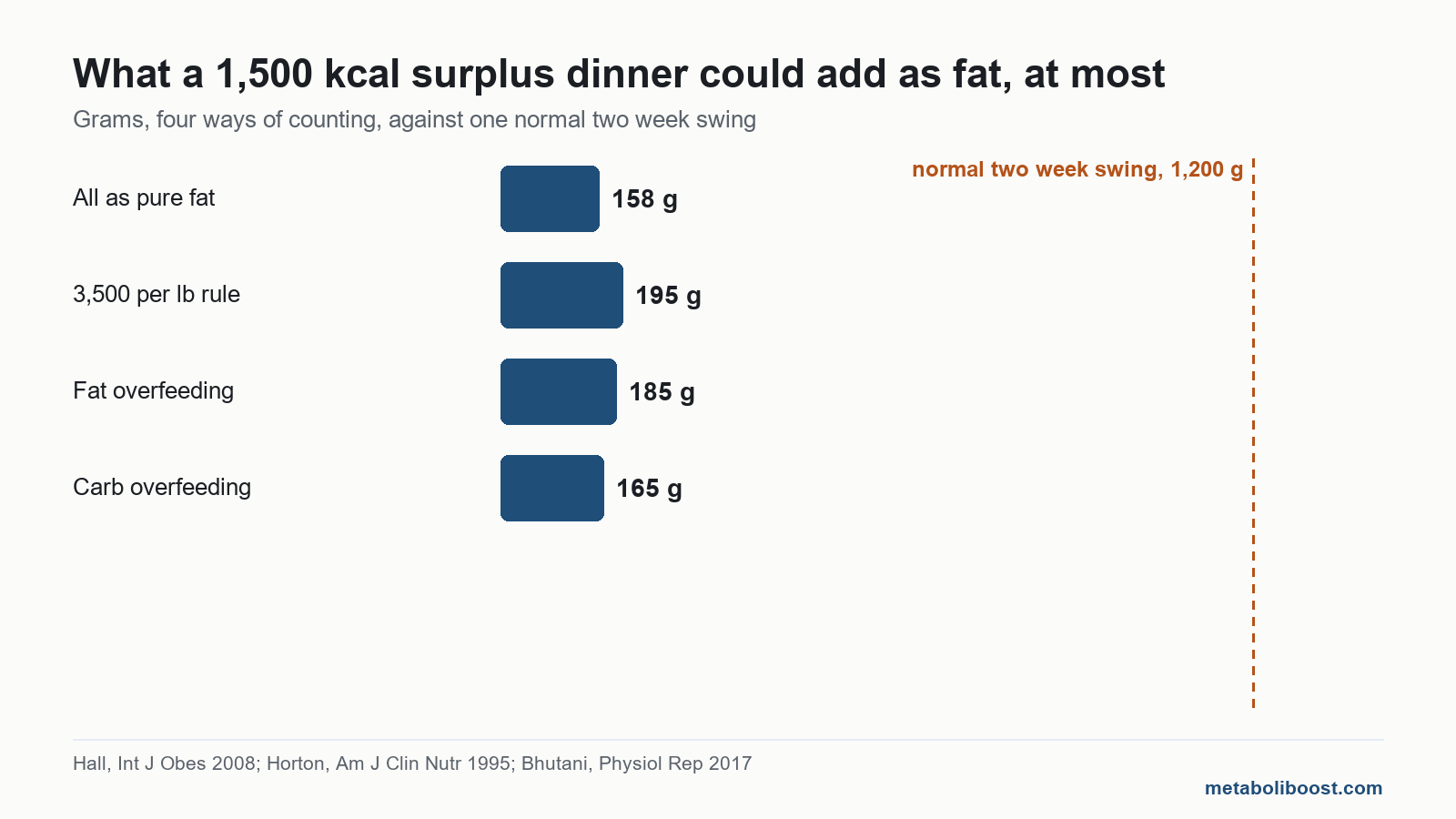
Now pretend the body stored every one of those calories as fat, which it does not. Hall’s 2008 paper in the International Journal of Obesity traces the old rule to a figure of 9.5 kcal per gram of fat. Divide 1,500 by 9.5 and the ceiling is about 158 g. Use the more familiar 3,500 kcal per pound, roughly 7,700 per kilogram of fat tissue, and the ceiling is about 195 g. Either way, less than the weight of a mug of tea. And 3,500 is only one of several figures, since a pound of lean tissue or of glycogen and its water holds far less, as the tissue by tissue count of how calories in a pound add up shows.
Real storage is lower than that ceiling. In Horton and colleagues’ 1995 study, men overfed by 50 percent for 14 days stored 90 to 95 percent of the excess when it came as fat and 75 to 85 percent when it came as carbohydrate. Those figures describe two weeks of steady overfeeding, not one evening, and good measurements of a single meal are scarce, so treat them as an upper bound rather than a prediction.
| Way of counting the 1,500 kcal surplus | What it assumes | Fat it could add at most |
|---|---|---|
| Every surplus calorie becomes pure fat | 9.5 kcal per gram of fat, the figure Hall 2008 traces back to Wishnofsky | About 158 g |
| The 3,500 kcal per pound rule | About 7,700 kcal per kilogram of fat tissue, which Hall notes fits people with more body fat | About 195 g |
| Storage at the efficiency of two weeks of fat overfeeding | Horton 1995 measured 90 to 95 percent of excess fat energy stored | About 175 to 185 g |
| Storage at the efficiency of two weeks of carbohydrate overfeeding | The same study measured 75 to 85 percent stored | About 145 to 165 g |
| What the scale often says the next morning | Forum accounts below report rises of one to three pounds | About 450 to 1,400 g on the scale, mostly not fat |
The last row is the point. The scale can show a kilogram or more the next morning, which is several times more than the dinner could have turned into fat even on the most pessimistic count. Something other than fat is doing most of the work, and the next section names it.
What is the scale actually weighing the next morning?
Everything that is in you, which after a big late dinner is quite a lot. The scale does not know the difference between fat, water and a cheesecake that is still on its way through. Most of the overnight number is the last two.
| What is on the scale | How big it can be | Is it fat | Source |
|---|---|---|---|
| The meal and drinks themselves, still in the gut | Roughly the weight of what was eaten and drunk; a litre of any drink is a kilogram | No | Arithmetic |
| Water stored alongside refilled glycogen | At least 3 g of water with every gram of glycogen | No | Fernández-Elías 2015 |
| Water held after a salty meal | Varies with the salt and the person | No | Water weight article |
| Stool not yet passed | Median wet stool mass of 128 g a day | No | Rose 2015 review |
| Fluid around the period | Self reported retention peaked on the first day of flow; weight was not measured | No | White 2011 |
| New fat from the surplus | About 0.2 kg at most for a 1,500 kcal surplus | Yes | Horton 1995 |
The first row is the one people forget. Food has mass. A large meal with drinks can easily weigh more than a kilogram before a single calorie of it is stored anywhere, and the time food takes to pass all the way through is commonly quoted at around a day or more. This article could not confirm one figure for that against a primary source, so take it as approximate. Eat late, weigh early, and much of dinner is weighed with you.
The second row is the quiet one. Carbohydrate refills glycogen, the store in muscle and liver, and glycogen is held with water. Fernández-Elías and colleagues tested the long quoted ratio in muscle biopsies in 2015 and concluded that each gram of glycogen is stored with at least 3 g of water. So every 100 g of glycogen a pasta night tops up can bring 300 g or more of water with it. That is weight, it is real, and it is not fat.

Salt holds water too, and the water weight article already covers the salty meal, so it will not be repeated here. Around the period, the White 2011 cohort of 62 women found self reported fluid retention peaking on the first day of flow. That study scored how women felt, not what they weighed, so it supports the timing and not a number. Any detox tea promising to flush all this out is mostly selling a timing coincidence: the water was leaving anyway.
How much does body weight swing on its own?
More than most people expect, which is why one reading tells you so little. In 2017, Bhutani, Schoeller and colleagues weighed adults two weeks apart while they lived as normal. The average change was 0.26 kg, consistent with energy balance, but the standard deviation was 1.2 kg. A person doing nothing different can drift a kilogram either way across a fortnight without a single gram of fat being involved.
The week has a shape as well. Orsama and colleagues analysed 4,657 daily weights from 80 adults and found weight highest on Sunday and Monday, rising from Saturday and falling from Tuesday. The pattern was strongest in people who were losing or holding their weight, and the authors concluded that weekend rises should be read as normal rather than as gain. A big Saturday dinner showing up on Sunday morning is not a warning. It is the study, reproduced at home.

So the honest answer to how to get rid of overnight weight gain is that the body already has a plan for it. Normal meals, normal drinking and an ordinary day let digestion, glycogen and salt settle back. Skipping breakfast to punish the scale mostly teaches the scale nothing. The holiday weight piece shows the same thing over a longer stretch: the real gain underneath is small, and the noise on top is large.
Scale noise filter: what did your week actually do?
Enter seven morning weights, in kilograms or pounds, using the same unit for all seven. The tool shows the average, the gap between the highest and lowest day, and the straight line trend through the week, so one high morning can be seen beside the rest. It does not set a target and does not predict anything.
Seven readings are a short series. In the Bhutani 2017 cohort the two week change had a standard deviation of 1.2 kg in adults at energy balance, so a week can move without any change in fat. This is arithmetic on your inputs, not a verdict, a target or a plan.
What do people who saw the jump actually report?
The forums are where this question lives, so four r/loseit threads from May to September 2026 were read for this page, about 20 comments in all. What follows is testimony, not evidence. Nobody in these threads was measured, and the replies come from other members, not clinicians.
In a May 2026 thread, a poster who ate a large team dinner very late described waking up puffy, with the scale well up, and said it usually came back down by the next day. The top reply pointed out that food eaten later has had less time to be digested, and another listed carbohydrate, salt, training and the menstrual cycle as things that move the number without fat.
In a September 2026 thread, a poster logged about 1,800 kcal across an anniversary dinner and worried it had undone weeks of work. The most upvoted reply did the arithmetic this page did: a pound of fat needs far more surplus than one meal supplies, and the day may barely have cleared maintenance. A commenter back from a week of holiday eating reported a first weigh in only a little above the pre trip number, which then settled.
In another September 2026 thread, a man saw about three pounds appear overnight after starting a fibre supplement, and three more by that evening, then reported a few days later that it had gone. He also mentioned that his usual next morning swing after a normal day was one to two pounds.
A fourth thread, from August 2026, described a far larger rise over two weeks of overeating and is left out of the pattern here because it is about weeks, not one night. Across the three that are, the reported jumps ran from one pound to about three, every poster saw the number come back without doing anything unusual, and the most upvoted replies warned against eating less the next day to compensate. That matches the arithmetic and the Orsama data. Where the accounts go further than the evidence is in timing: “by tomorrow” is a hope, not a measurement, and one commenter described salt bloat arriving two or three days later.
Should you weigh every day or once a week?
Here the sources genuinely disagree, which is worth knowing before anyone tells you there is one right way. The NHS 12 week weight loss plan says weight can fluctuate from day to day, so weighing yourself daily may not give a true picture, and its fix is to weigh once a week.
The Orsama data point the other way on one detail. If weight peaks on Sunday and Monday, a once a week weigh in on a Monday samples your high tide every single time. Daily weighing averaged across the week smooths that out, and the study authors read the weekend rise as normal rather than as gain. Both approaches can work. The weekly one is calmer; the daily average is more accurate. The worst option is a single daily number read as a verdict.
Whichever you choose, keep the conditions the same: same scale, same place, first thing in the morning after the toilet and before breakfast. And if the daily number starts deciding what you eat that day, the NHS weekly rule exists for exactly that reason.
When is a sudden jump on the scale worth a call to a doctor?
Most overnight rises are digestion and water. A small number are not. The NHS heart failure page lists sudden weight gain among the symptoms, together with swelling in the feet, ankles, legs or tummy and breathlessness during everyday activity or when lying down. It advises an urgent GP appointment or NHS 111 for breathlessness of that kind or sudden weight gain, and 999 for severe difficulty breathing.
So a jump that keeps climbing over several days, comes with swelling or breathlessness, or appears without any big meal, salt, period or new supplement to explain it, is a reason to speak to a doctor rather than to wait. This article cannot tell those cases apart, and a scale cannot either.
The same applies the other way. If an overnight number regularly leads to skipped meals, fear of eating or weighing several times a day, that is worth raising with a GP too. Nothing on this page is a target, and no reading on a Monday morning is a reason to eat less on Monday.
Frequently asked questions
Is overnight weight gain fat or water?
Mostly water and food still being digested. On the arithmetic above, a 1,500 kcal surplus can add at most about 0.2 kg of fat, so a rise of one kilogram or more the next morning is largely the meal itself and the water stored with glycogen and salt.
Why do I weigh more in the evening than in the morning?
Because during the day you add the mass of everything eaten and drunk, and overnight some of it is used, breathed out as water vapour or passed. That is why weighing guidance asks for the same time each day, usually first thing in the morning.
Does eating late at night cause more weight gain than eating early?
Eating late mostly means more of the meal is still in the gut when you weigh in the morning, which shows as a higher reading. Whether the timing itself changes fat gain is a separate and debated question that the overnight scale cannot answer.
Does drinking more water get rid of water weight faster?
This article found no trial showing that extra water speeds up the loss of water held after a salty or large meal. Ordinary drinking and ordinary meals let the body rebalance on its own, and the weight water adds while you drink it shows on the scale too.
Can alcohol make the scale go up overnight?
Drinks have mass and calories, and evenings with alcohol often come with salty food and a late meal, which add to the next morning reading. The calories count toward the day’s surplus in the arithmetic above; the drink’s weight leaves with everything else.
How many calories does it take to gain a pound of fat?
The commonly quoted figure is 3,500 kcal above what the body uses, roughly 7,700 kcal per kilogram. Hall 2008 showed that figure fits people with more body fat better than leaner people, but either way one dinner falls well short of it.
Finished the page? The same five questions from the top, to see what stuck.
This article is general information, not medical advice, and is not a substitute for care from a qualified healthcare professional. Speak to your doctor about your own situation.
Leave a Reply