
To eat below BMR means eating fewer calories than your body burns at complete rest. Most ordinary deficits never get there, because a deficit is taken from total daily expenditure, which sits well above BMR. Whether yours crosses that line depends mostly on your activity level and the multiplier your calculator used.
Listen to this article, about 12 minutes. A synthetic voice reads the article and announces each section title as it begins; tables are read row by row and the questions at the end are left out.
Recorded 1 November 2026 from the article as published that day. Press a chapter to jump there; the highlighted line is what is playing. A play button sits beside every section heading, and once you scroll past this player a bar at the bottom of the screen keeps the controls in reach. Tap or click any sentence to hear the reading start from there.
On this page: a worked table of BMR against total daily expenditure at the three FAO activity levels for two example adults, the measured BMR fall in a 40 percent deficit trial, the current NICE limits on low energy diets, and what two r/loseit threads reported.
Think you already know this? Five questions, one minute.
Every answer is on this page. Answer from what you know now; the page fills in the rest.
-
1. What did the 2005 systematic review conclude about the Mifflin-St Jeor equation?
The Journal of the American Dietetic Association review found it within 10 percent of measured resting energy in more people than any other equation, with noteworthy errors for individuals. Read the section
-
2. What physical activity level range does the FAO report give for a sedentary or light activity lifestyle?
Table 5.3 of the FAO, WHO and UNU report puts sedentary or light activity at 1.40 to 1.69, so the 1.2 used by many calculators sits below it. Read the section
-
3. In the Friedlander trial, what happened to the men’s measured BMR over 21 days at a 40 percent deficit?
The American Journal of Physiology trial reported BMR falling from 1,898 to 1,670 kcal a day, with negative nitrogen balance and lean mass lost. Read the section
-
4. In the six year follow up study, how did metabolic slowing relate to weight kept off?
Fothergill and colleagues in Obesity found greater concurrent slowing in those maintaining more weight loss, and read it as a proportional but incomplete response. Read the section
-
5. According to NICE NG246, how long should low energy and very low energy diets last at most?
NICE NG246 says they should be nutritionally complete, last no more than 12 weeks and include ongoing clinical support and supervision. Read the section
The internet has turned BMR into a sort of electric fence. Step under it and, depending on which platform you read, your metabolism shuts down, your muscles shrink or nothing happens at all. The truth is less dramatic: BMR is an estimate, and the real question is how big a deficit is compared with everything you burn in a day. Checked against the papers and the NICE guideline on 1 November 2026.
What does it mean to eat below BMR?
Basal metabolic rate is the energy your body uses lying still, awake, warm and not digesting: heart, lungs, brain, liver and the rest of the quiet machinery. Almost nobody measures theirs. The number a calculator gives you comes from an equation, and the one most of them use was published by Mifflin, St Jeor and colleagues in 1990 from 498 healthy adults aged 19 to 78. For women it is 9.99 times weight in kilograms, plus 6.25 times height in centimetres, minus 4.92 times age, minus 161. For men the last term is plus 5. Our step by step BMR calculator runs it on your own numbers.
It is a good equation, and still an estimate. A 2005 systematic review in the Journal of the American Dietetic Association found it the most reliable of the formulas tested, landing within 10 percent of measured resting energy in more people than any other, while warning of noteworthy errors when it is applied to individuals. So when someone says they ate exactly 30 calories below their BMR, the honest reply is that nobody knows their BMR to within 30 calories, including them.
Does a normal calorie deficit take you below BMR?
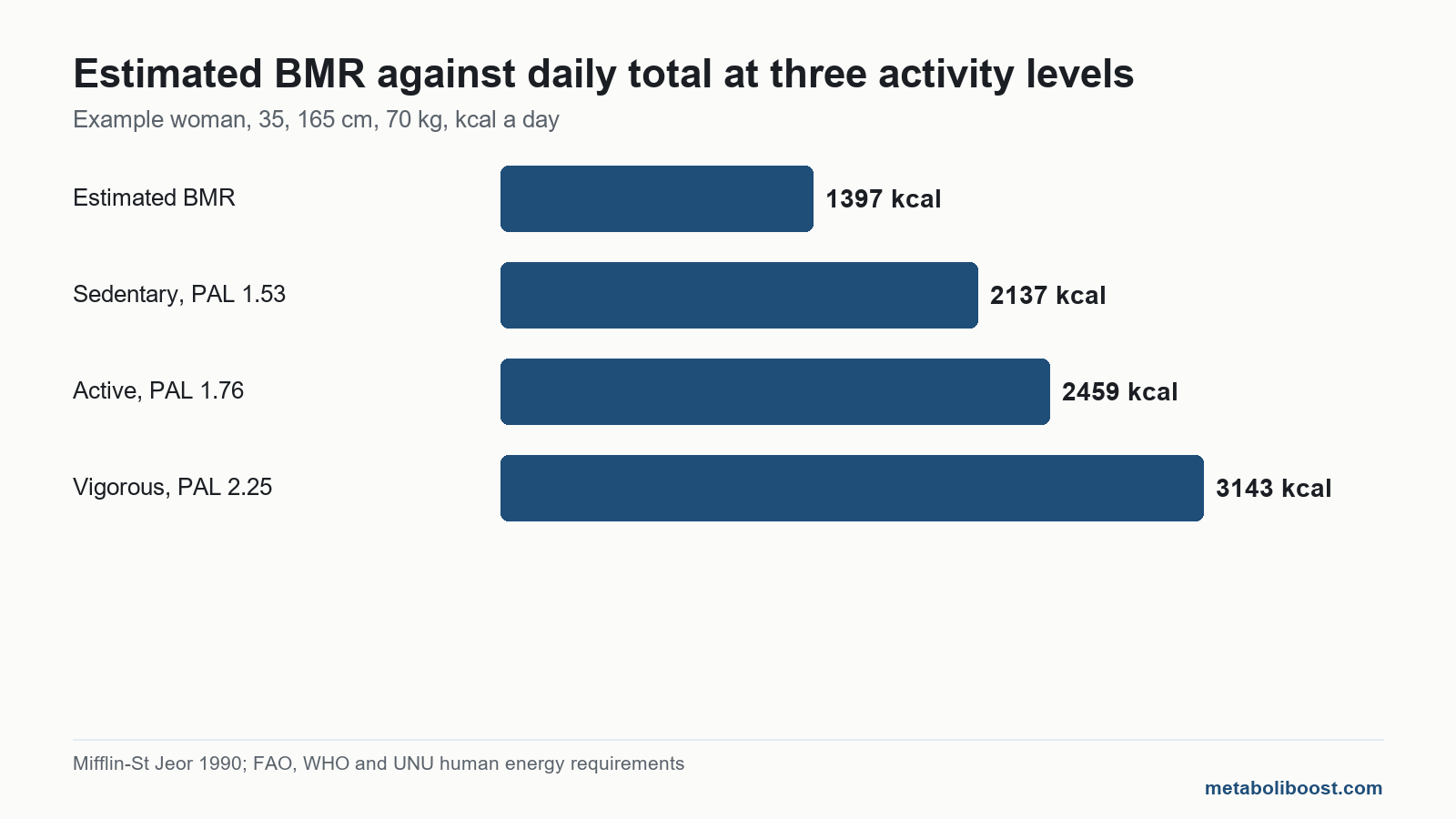
Usually not, and this is the arithmetic the ranking pages skip. A deficit is subtracted from total daily energy expenditure, which is BMR multiplied by a physical activity level. The FAO, WHO and UNU expert report on human energy requirements classes sustained lifestyles in three bands: 1.40 to 1.69 for sedentary or light activity, 1.70 to 1.99 for active or moderately active, and 2.00 to 2.40 for vigorous. Its own worked example days come out at 1.53, 1.76 and 2.25.
Here are two example adults run through those multipliers: a 35 year old woman, 165 cm and 70 kg, with an estimated BMR of 1,397 kcal, and a 40 year old man, 178 cm and 85 kg, at 1,770 kcal. The gap column is how far intake would have to fall below total expenditure before it reached BMR, with that gap as a share of the day.
| Activity level | PAL | Woman: total kcal | Woman: gap to BMR | Man: total kcal | Man: gap to BMR |
|---|---|---|---|---|---|
| Sedentary or light (FAO example day) | 1.53 | 2,137 | 740 (35%) | 2,708 | 938 (35%) |
| Active or moderately active | 1.76 | 2,459 | 1,062 (43%) | 3,115 | 1,345 (43%) |
| Vigorous | 2.25 | 3,143 | 1,746 (56%) | 3,982 | 2,212 (56%) |
Even the sedentary woman has a gap of about 740 kcal, roughly a third of her day, before her intake touches BMR. For the vigorous man the gap is more than half. A modest deficit simply does not reach the line. That is the point most arguments about this miss.
Now the twist. Many online calculators use 1.2 for sedentary, as one of the threads below shows, and that sits below the lowest band the FAO report describes as sustainable for free living adults. At 1.2 the same woman’s total comes out at about 1,676 kcal, a gap of only 279. At 1.40 it is about 1,956 and a gap of 559. Same woman, same body, and whether a deficit looks like it is below BMR depends largely on a number somebody picked for a dropdown menu. Our guide to how a calorie deficit actually works covers the other half of that sum.

See the gap between your BMR and your daily total
This runs the Mifflin-St Jeor equation, multiplies it by a physical activity level from the FAO report, and shows the room between the two. It is arithmetic on population estimates, not a measurement of you, and it does not give a calorie target, a deficit or a timeline.
Mifflin-St Jeor coefficients as published in 1990; activity levels from the FAO, WHO and UNU report on human energy requirements. Both are estimates with real individual error.
What happened when lean men ate 40 percent below their needs?
This is the closest thing to a direct test. In a 2005 trial in the American Journal of Physiology, Friedlander and colleagues underfed nine normal weight young men by 40 percent of the calories they needed to hold their weight, for 21 days, with protein held at 1.2 grams per kilogram a day. Run that 40 percent through the table above and it would put the sedentary example woman at about 1,282 kcal, below her estimated BMR.
What the researchers measured is the useful part. Measured BMR fell from 1,898 to 1,670 kcal a day on average. Nitrogen balance stayed negative throughout, which means the men were losing body protein, and lean mass made up about half of what they lost. Arm endurance dropped by 20 percent. Aerobic fitness, oddly, held up fine.
Two cautions keep this honest. It was nine lean young men, who have little fat to draw on, so the result may not carry over to people with more stored fat. And the trial tested a large deficit, not the BMR line itself. What it shows is that a deficit that deep, in people that lean, cost real muscle and dropped resting expenditure within three weeks.
Does eating below BMR put the body in starvation mode?
Not in the way the phrase suggests. Resting expenditure does fall when intake falls, partly because there is less body to run and partly because the body economises. But a lower BMR shrinks a deficit; it does not reverse it. The men in the Friedlander trial kept losing weight while their BMR dropped. If the scale has stopped for you, the more usual explanations are in our piece on eating in a deficit and not losing weight, and our weight loss plateau guide covers the stall that comes later.
The adaptation can be large, though. One much quoted study followed 14 contestants from a televised weight loss competition. Six years on, Fothergill and colleagues reported in Obesity that their resting expenditure was still about 499 kcal a day lower than their body composition and age predicted. Those who had kept more weight off showed more slowing, not less. The authors read it as a proportional but incomplete response to keeping weight down, not as damage that stops loss. It was an extreme regime under cameras, which is a fair reason not to treat it as what happens to everyone.
What do people on r/loseit report about eating below BMR?
We read two 2026 threads on r/loseit in full, about 40 replies, and around a dozen described the writer’s own intake. This is testimony, not evidence, and it is paraphrased.
In a January 2026 thread, a tall man in his thirties with a calculated BMR far above most people’s asked whether eating around 2,000 kcal was unsafe because it sat below his BMR. Replies split. Several long term members called the BMR rule a forum myth. A petite woman said that for her, eating under BMR would mean very little food, so the rule felt different at her size. Another said some people report feeling terrible below BMR and others fine, depending on activity and size.
In an April 2026 thread, a sedentary woman in her thirties said she was hungry all day after taking a deficit from a calculator total that was barely above her BMR, which landed her slightly under it. Her figures put total expenditure at about 1.2 times BMR, exactly the dropdown setting described above. Most replies were about food choice: more protein, more fibre, bulkier low energy foods. Several said hunger eases after a few weeks; a few said it never fully goes.

Where the accounts agree with the evidence: the BMR line is not a switch, and the size of the deficit relative to the person matters more than the label. Where they part from it: several replies treated feeling fine as proof of safety, and feeling fine says nothing about lean mass, which is what the Friedlander men lost without noticing much.
When do guidelines allow intakes this low?
The current NICE guideline on overweight and obesity draws its own lines, and they are below BMR for most adults. In NG246, updated in 2025, NICE says to consider low energy diets of 800 to 1,200 kcal a day only within a specialist weight management service with long term support, and very low energy diets under 800 kcal a day only for people with a clinically assessed need to lose weight rapidly. Both must be nutritionally complete, last no more than 12 weeks, and include ongoing clinical support and supervision with access to a registered dietitian or nutritionist.
Notice what that means for the example woman. Her estimated BMR of 1,397 kcal is above the top of NICE’s low energy band. The guideline does not treat the BMR line as forbidden; it treats intakes this low as a clinical tool with a doctor attached, a time limit and a plan for afterwards. NICE also asks clinicians to explain the risks first, including weight cycling, regain, and for very low energy diets constipation, fatigue and hair loss.
If you take medicine for diabetes or blood pressure, a large drop in food intake can change how those medicines act, so speak to your GP or diabetes team before cutting deeply. The same goes for anyone who is pregnant, breastfeeding, under 18 or living with a long term condition.
If eating less has started to feel like a rule you are frightened to break, or food is taking over your thoughts, the NHS describes the signs of an eating disorder and where to get help. Speaking to a GP is a good first step.
For everyone else, the takeaway is the arithmetic: see where your estimated BMR sits against a realistic total for the life you lead, and notice how much room there usually is between them. Our average BMR by age and sex page shows how widely that varies.
Frequently asked questions
Is BMR the same as resting metabolic rate?
Not quite. BMR is measured under stricter conditions, fasted and fully at rest, while resting metabolic rate is a looser measure. The two usually sit close together and calculators often treat them as one.
Does eating below BMR burn muscle?
Any large deficit can cost lean mass, especially in lean people. In the Friedlander trial, lean mass made up about half of what nine lean young men lost on a 40 percent deficit.
Why do calculators give different BMR numbers for me?
They use different equations or different coefficients. Mifflin-St Jeor and Harris-Benedict can differ by a noticeable amount for the same person, and neither is a measurement.
Can a doctor measure my BMR directly?
Yes, with indirect calorimetry, which measures oxygen used and carbon dioxide produced. The 2005 review suggests it where an equation fails someone in a clinically relevant way.
Is 1,200 calories a day below BMR?
For many adults, yes. The example 35 year old woman here has an estimated BMR of about 1,397 kcal, so 1,200 sits under it, which is why NICE places that band inside specialist care.
Does BMR go back up after a diet ends?
Some of the fall comes from having less body to run and stays with the lower weight. The extra slowing beyond that persisted for years in the televised competition study, which was an extreme case.
Finished the page? The same five questions from the top, to see what stuck.
This article is general information, not medical advice, and is not a substitute for care from a qualified healthcare professional. Speak to your doctor about your own situation.
Leave a Reply