
Short fasts do not slow a woman’s metabolism. Resting energy use edges up slightly during the first day or two without food. What genuinely lowers it is a long stretch of eating too little, whatever schedule sits on top, plus the muscle lost along the way. The window is not the problem. The weekly total is.
Listen to this article, about 10 minutes. A synthetic voice reads the article and announces each section title as it begins; tables are read row by row and the questions at the end are left out.
Recorded 25 September 2026 from the article as published that day. Press a chapter to jump there; the highlighted line is what is playing. A play button sits beside every section heading, and once you scroll past this player a bar at the bottom of the screen keeps the controls in reach. Tap or click any sentence to hear the reading start from there.
On this page: what actually happens to energy use in the first days without food, the 2024 pooled analysis that tested the fragile female metabolism claim, the three things that genuinely lower metabolic rate, the 30 kcal per kg threshold behind the real female specific risk, and what the Cochrane review found.
Think you already know this? Five questions, one minute.
Every answer is on this page. Answer from what you know now; the page fills in the rest.
-
1. What happened to resting energy expenditure in lean volunteers fasted for four days?
Per the study in the American Journal of Clinical Nutrition; increases reported in the 18 to 36 hour window sit at roughly 3 to 14 percent above baseline. Read the section
-
2. What did the 2024 pooled analysis of seven crossover studies find about day to day variability in women?
Per the analysis in the Journal of Applied Physiology, the data do not show greater within individual variation in females for those outcomes, resting metabolic rate included. Read the section
-
3. Which of these does the page list as genuinely lowering energy expenditure?
Adaptive thermogenesis is real but modest, and resistance training with enough protein is what preserves lean mass in trial after trial, whatever the eating schedule. Read the section
-
4. Below roughly what energy availability is the pulsing release of luteinising hormone disrupted?
Per the 2024 review of functional hypothalamic amenorrhoea; fasting does not cause it by itself but makes it easy to walk into, because a narrow window makes eating too little easy to do without deciding to. Read the section
-
5. What did the Cochrane review of 18 studies covering 1,125 adults conclude?
Per the Cochrane review; the National Institute on Aging reaches a similar verdict that human trials so far have been short. Read the section
What happens to a woman’s metabolism in the first day without food?
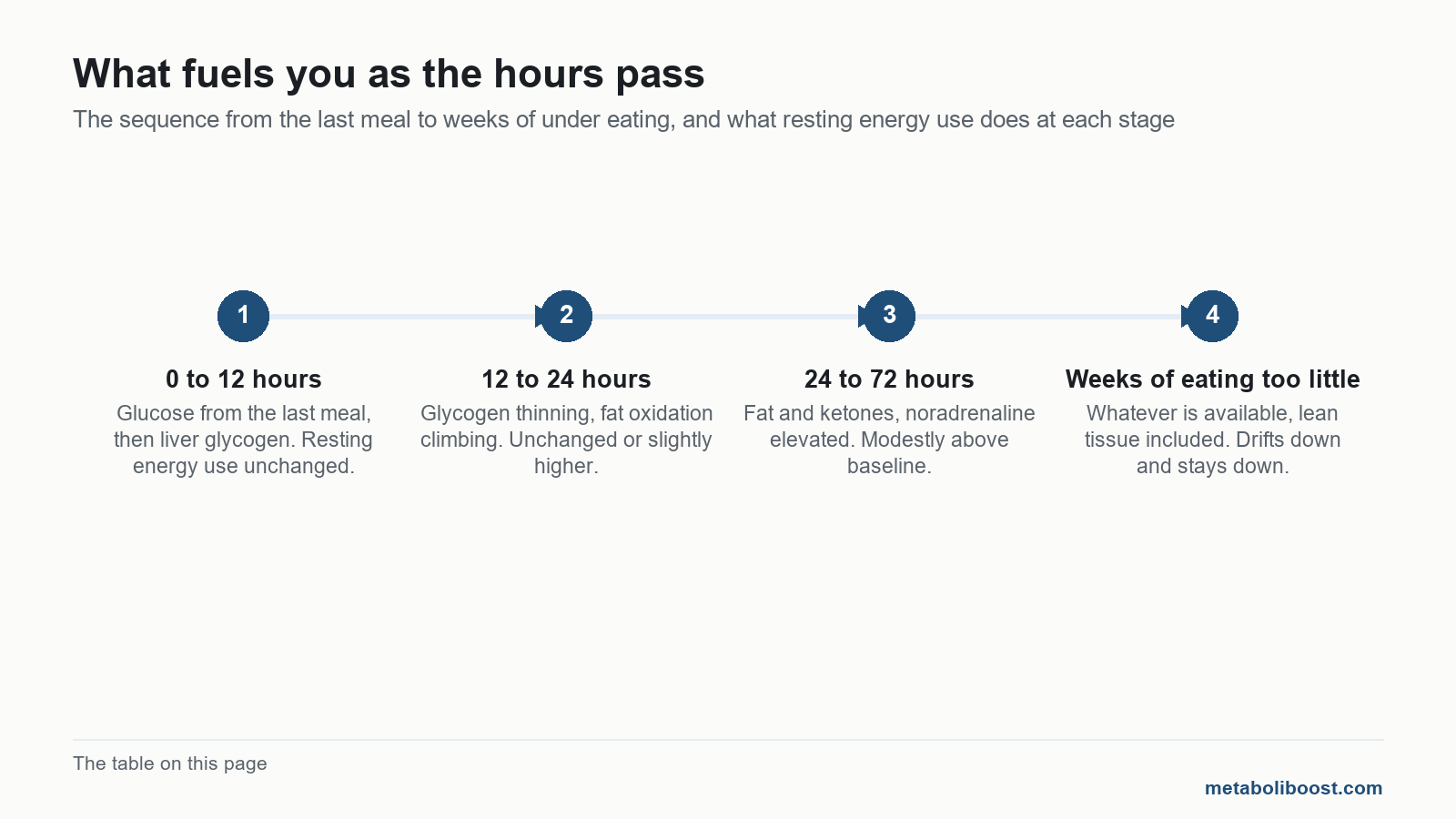
The sequence is not mysterious. Blood glucose falls, insulin falls with it, and the liver starts handing over stored glycogen. Somewhere in the twelve to sixteen hour region that glycogen runs thin and fat becomes the main fuel.
Here is the part that tends to surprise people, because it is the opposite of what the fasting conversation assumes. Energy expenditure goes up. In lean volunteers fasted for four days, resting energy expenditure rose rather than fell, driven by a sharp climb in noradrenaline, and increases reported in the eighteen to thirty six hour window sit at roughly three to fourteen percent above baseline. The body is not shutting the lights off to conserve. It is going through the cupboards with the lights on.
What you actually feel in those hours, the irritability, the cold fingertips, the sudden and very firm opinion about biscuits, is a blood sugar and adrenaline story. It is not a reading of your metabolic rate. Feeling sluggish and having a slow metabolism are two different things that unhelpfully share a vocabulary.
| Time without food | What is mostly fuelling you | Resting energy use |
|---|---|---|
| 0 to 12 hours | Glucose from the last meal, then liver glycogen | Unchanged |
| 12 to 24 hours | Glycogen thinning, fat oxidation climbing | Unchanged or slightly higher |
| 24 to 72 hours | Fat and ketones, noradrenaline elevated | Modestly above baseline |
| Weeks of eating too little | Whatever is available, lean tissue included | Drifts down and stays down |
Is a woman’s metabolism really more fragile than a man’s?
This is the load bearing claim under most of the fasting-is-different-for-women content online, and it carries the weight less well than the confidence around it suggests.
A 2024 pooled analysis of seven crossover studies in the Journal of Applied Physiology compared day to day variability in women and men across fasting glucose, insulin, triglycerides, fatty acids, body mass and resting metabolic rate. The women’s sex hormones varied a great deal more, exactly as you would expect. Their fasting metabolic measurements did not. The authors concluded that the data do not show greater within-individual variation in females for those outcomes, resting metabolic rate included.
The companion claim, that fasting research has only ever been done on men, does not hold up either. Plenty of the better known time restricted eating and alternate day fasting trials recruited majority female samples. The mouse studies people cite for the sex difference were, admittedly, done on mice, who do not have a lot of say in the matter.
None of this makes sex irrelevant. It moves the real difference somewhere else, out of the furnace and into reproductive endocrinology, which is covered further down.
So what actually slows metabolism down?
Three things, and none of them is the clock.
- The size and duration of the energy deficit. A body running on less fuel for months spends less. That happens on a 16:8 schedule, on three meals a day and on a soup diet from 1987. The schedule is not what the body is responding to.
- Lost muscle. Lean tissue is the expensive tissue. Lose a chunk of it and resting expenditure falls with it, permanently until the muscle comes back.
- Adaptive thermogenesis. After sustained weight loss, energy expenditure tends to sit a little lower than body size alone predicts. Thyroid output shifts, and unconscious movement, the fidgeting and stair climbing and pacing while on the phone, quietly drops off. The effect is real. It is also modest, and it is not the reason a plateau lasts eight months.

Which is why the practical answer to metabolic slowdown is dull and physical rather than schedule based. Resistance training and enough protein are what preserve lean mass during weight loss, in trial after trial, regardless of whether the eating is spread across the day or squeezed into eight hours of it.
| Commonly blamed | What the evidence supports |
|---|---|
| Skipping breakfast | No independent effect on metabolic rate |
| Eating after 8pm | Matters for appetite and sleep, not for resting energy use |
| Fasting for 16 hours | No slowdown on its own |
| Months of eating too little | Genuine downward drift in energy expenditure |
| Losing weight without resistance training | Lean mass lost, resting expenditure lower with it |
| A slow thyroid caused by one long fast | Not a thing. Chronic energy restriction lowers T3, a single fast does not |
What is the genuine female specific risk from fasting?
It is not metabolic rate. It is low energy availability, which is the energy left for basic physiology once exercise has taken its share, scaled to lean body mass.
Below a threshold of roughly 30 kcal per kg of fat free mass per day, the pulsing release of luteinising hormone is disrupted. Oestradiol falls, ovulation stops and periods become irregular or disappear, a pattern clinicians call functional hypothalamic amenorrhoea. A 2024 review of its dietary and lifestyle management sets out that threshold and the mechanism behind it. Left in place, the same energy deficit affects bone density and fertility.
Fasting does not cause this by itself. Fasting makes it easier to walk into, because compressing eating into a narrow window makes eating too little very easy to do without ever deciding to.
The direct human evidence on fasting and reproductive hormones is thin. A review of human trials found intermittent fasting lowered androgen markers and raised sex hormone binding globulin in premenopausal women with obesity, while noting how few trials there are and how short they run.
Anyone whose periods become irregular or stop, anyone trying to conceive, and anyone with a thyroid condition, diabetes, a history of disordered eating, or who is pregnant or breastfeeding, should talk to a doctor before fasting rather than adjusting the window and waiting to see.
Should fasting be timed to the menstrual cycle?
Cycle synced fasting plans circulate widely, each with confident hour counts for the follicular phase, ovulation and the luteal phase. They are plausible on paper. Resting energy expenditure does rise modestly in the second half of the cycle, and appetite rises with it.
What does not exist is a trial testing whether obeying those specific hour counts produces better results than ignoring them. The underlying physiology is real. The protocol built on top of it has never been checked, and the precision of the numbers is doing a lot of work it has not earned.
Worth saying plainly: appetite climbing in the week before a period is a measurable physiological change, not a collapse of willpower. Eating in response to it is not a relapse.

Does fasting beat ordinary calorie counting for weight loss?
The most careful look at this is a Cochrane review of intermittent fasting, which pooled 18 studies covering 1,125 adults without cardiovascular disease. People fasting intermittently may lose slightly more weight at three months than people carrying on as usual, but there may be no difference between intermittent fasting and plain calorie restriction. The certainty of that evidence was rated low. The US National Institute on Aging reaches a similar verdict: human trials so far have been short, and the long term picture is not settled.
Which is either deflating or freeing, depending on the day. Fasting is a scheduling tool, not a metabolic lever. If skipping breakfast makes eating less feel effortless, it is a good tool for you. If it produces an evening that undoes the entire morning, it is a bad one, and that is a fact about the schedule rather than about you.
What are the warning signs that a fasting routine has gone too far?
These are the signals worth taking seriously, whatever the window says:
- ❌ Periods becoming late, unusually light, or stopping altogether
- ❌ Noticeably more hair in the brush than usual
- ❌ Feeling cold when nobody else in the room is
- ❌ Waking at three or four in the morning and not getting back to sleep
- ❌ Strength in the gym dropping week after week rather than holding
- ❌ Dizziness or a grey out on standing up
- ❌ An eating window that reliably ends in an episode that feels out of control
Each of these has causes other than fasting, so none of them is a diagnosis. They are reasons to eat more and to book an appointment, not reasons to tighten the window further.
What is the short version?
Fasting does not slow a woman’s metabolism because it is fasting. Chronic under eating slows anyone’s metabolism, and a narrow eating window is simply an efficient way to under eat by accident. Keep the weekly food total honest, keep the protein up, keep lifting something heavy twice a week, and the window becomes what it always was: a matter of convenience rather than a metabolic strategy.
This article is general information, not personal medical advice. Fasting is not appropriate for everyone, and anyone with a medical condition, a history of disordered eating, or concerns about their weight, cycle or metabolism should speak to a qualified professional about their own situation.
Finished the page? The same five questions from the top, to see what stuck.
Does a 16 hour fast slow your metabolism?
No. Resting energy expenditure is unchanged or slightly higher at that point, because noradrenaline rises as glycogen runs low. A 16 hour fast only causes trouble if it shrinks the day’s total food intake far below what your body needs, week after week.
Can fasting stop your periods?
Fasting itself does not, but the low energy availability that a narrow eating window makes easy to fall into can. Below roughly 30 kcal per kg of fat free mass per day, luteinising hormone release is disrupted and cycles can become irregular or stop. Missed periods warrant a doctor’s appointment.
Is intermittent fasting better than counting calories for women?
The Cochrane review found people may lose slightly more weight with intermittent fasting than with usual eating, but no clear difference against ordinary calorie restriction, on low certainty evidence. Choose whichever one you can actually keep doing.
Does fasting raise cortisol and cause belly fat?
Cortisol does rise during a fast, as it does during exercise and on waking. A short term rise in a stress hormone is not the same as fat gain, and no trial shows fasting adding abdominal fat while energy intake is held constant. Chronic under sleeping and chronic under eating are the more plausible culprits.
Should women fast differently at different points in the cycle?
Energy expenditure and appetite do rise in the luteal phase, so eating more then is physiologically sensible. The specific hour counts prescribed by cycle synced fasting plans have not been tested in a trial, so treat the exact numbers as a guess rather than a finding.
How do you fast without losing muscle?
Resistance training and adequate protein are what preserve lean mass during weight loss, and the eating schedule matters much less than either. Muscle is metabolically expensive tissue, so keeping it is the most direct way to keep resting energy expenditure where it is.
The weekly total, not the window
The habits this page says protect metabolic rate whatever the eating schedule. Tick each one that is true of the current week.
A habit list from this page, not a fasting plan. Fasting is not appropriate for everyone. Ticks are saved on this device only.
Leave a Reply