Heat, not laziness. In hot weather your body diverts blood to the skin and spends energy on cooling, so the same walk costs more and feels harder. Sleep degrades on hot nights as well. What follows is less unplanned movement across the day, and that matters far more than any change in your metabolism.
Listen to this article, about 10 minutes. A synthetic voice reads the article and announces each section title as it begins; tables are read row by row and the questions at the end are left out.
Recorded 10 October 2026 from the article as published that day. Press a chapter to jump there; the highlighted line is what is playing. A play button sits beside every section heading, and once you scroll past this player a bar at the bottom of the screen keeps the controls in reach. Tap or click any sentence to hear the reading start from there.
On this page: a comparison of common summer fatigue explanations, an NHS guide on hydration, and a checklist to adapt your workouts to hot weather.
Think you already know this? Five questions, one minute.
Every answer is on this page. Answer from what you know now; the page fills in the rest.
-
1. Why does humid heat feel harder than dry heat at the exact same temperature?
Sweat cools you when it evaporates, not when it forms, and humid air slows evaporation. Read the section
-
2. Which of the common explanations for summer sluggishness has the strongest scientific support?
Hot nights wrecking your sleep is well supported and probably the largest single item on the list. A 14 day study showed that each 1 degree Celsius rise came with roughly 2 percent more sedentary time and roughly 2 percent lower sleep efficiency. Read the section
-
3. According to the Houston study, how does a 1 degree Celsius rise in temperature affect daily activity?
The researchers found that each 1 degree Celsius rise came with roughly 2 percent more sedentary time and roughly 2 percent lower sleep efficiency. Read the section
-
4. What is the official NHS guidance for daily fluid intake?
NHS guidance is to aim for 6 to 8 cups or glasses of fluid a day, with more needed in a hot environment or when you are physically active. Read the section
-
5. Which of the following is a sign of heat exhaustion rather than ordinary sluggishness?
The NHS lists tiredness together with dizziness, headache, feeling sick or being sick as signs of heat exhaustion and heatstroke. Read the section
The honest version is that it depends on how hot it is, how humid, how well you slept, and how much of your day can move out of the worst hours. Those govern it. None of them is willpower.
What is the heat actually doing to your body?
Your body holds its core temperature inside a narrow range, and in hot weather that costs something. Blood is redirected toward the skin so heat can leave through it, which leaves less of it for working muscle. Heart rate at any given workload sits higher. Sweating draws on fluid you then have to replace. None of it is dramatic alone. Together it means an ordinary walk is a bigger job than the same walk in spring.
Humidity does more of this than temperature does. Sweat cools you when it evaporates, not when it forms, and humid air slows evaporation. Thirty degrees dry and thirty degrees humid are different problems, which is why the number on a weather app is a poor guide to how a day will feel.
The consequence is that the same activity at the same pace registers as harder work. People do slightly less of it, and go slightly slower inside what they keep. Neither is a decision anyone makes on purpose, which is why it gets read as laziness.
Which of the usual explanations hold up?
Almost every article on summer energy lists the same five causes. They are not equally well supported, and the weak ones tend to crowd out the strong ones.
| The usual explanation | What the evidence supports | What that means in practice |
|---|---|---|
| Your body burns energy staying cool | Real. Sweating, skin blood flow and a higher heart rate at the same workload all cost something | The same session is harder work than it was. Judge it by effort, not by pace |
| Dehydration slows your metabolism | Weak. The figure quoted everywhere traces to one small study and was never established | What mild fluid loss does reliably do is raise perceived effort and dent mood and alertness |
| Sweating drains your electrolytes | Partly. Sodium losses in sweat are real and can be large over long hot sessions. Potassium losses are small | Relevant to repeated sweaty training. Not an explanation for a flat afternoon at a desk |
| Heat gives you muscle cramps | Contested. The electrolyte story is popular, but the evidence points at least as strongly at neuromuscular fatigue | Treat cramp as a signal about load and conditions rather than a mineral you are missing |
| Hot nights wreck your sleep | Well supported, and probably the largest single item on this list | Bedroom temperature is one of the few things here you can change tonight |
The pattern worth noticing is that the two best supported entries, sleep and perceived effort, are the two that nobody sells a product for.
Why does sitting more matter more than your metabolism?
Because the energy you spend on unplanned movement across a day, walking to things, standing, tidying, running errands, is a large and highly variable share of daily energy use. It is also the part heat trims quietly. You do not decide to skip it. The walk to the shop becomes a ride, the errand waits for the evening, the afternoon happens sitting down.
There is direct measurement of this. In a 14 day study, 30 adults in Houston wore wrist accelerometers that logged the temperature each person was actually exposed to rather than the city forecast, and the researchers found that each 1 degree Celsius rise came with roughly 2 percent more sedentary time and roughly 2 percent lower sleep efficiency. The sedentary effect climbed between 25 and 30 degrees and then flattened out. It is one small study in one city, so hold the exact numbers loosely. The direction is what matches what people describe.
What that adds up to in weight terms depends on the person and everything else in their week, and anyone quoting a figure for it is guessing. The shape is what to keep: heat works on your total movement across weeks, not on the rate at which any particular hour burns fuel. It is why the arithmetic of a calorie deficit does not change in summer even though everything about carrying it out does.
How much should you actually be drinking?
NHS guidance is to aim for 6 to 8 cups or glasses of fluid a day, with more needed in a hot environment or when you are physically active for long periods. Tea, coffee, milk and the water in food all count toward that total. The two to three litre figure that circulates every summer is not the NHS number, and it usually ignores food entirely.
In ordinary conditions thirst and urine colour are a workable check, pale being unremarkable and dark being a prompt to drink. Long or repeated sessions in real heat are the narrow case where sodium losses in sweat start to matter, a much smaller situation than the sports drink shelf implies. Drinking well beyond what you need buys nothing.
When is summer tiredness not a motivation question?
This is the part worth reading slowly, because heat illness begins looking like ordinary tiredness and the difference is in what arrives alongside it. The table below is not a diagnostic tool. It is here so the second column is familiar if you ever see it.
| Ordinary heat sluggishness | Signs the NHS lists for heat exhaustion | |
|---|---|---|
| How it feels | Slow, flat, hard to get going | Tiredness together with dizziness, headache, feeling sick or being sick |
| Skin | Normal, sweating about as you would expect | Pale and clammy, with excessive sweating |
| Other signs | Nothing in particular | Cramps, strong thirst, a raised temperature, irritability |
| Recovery | Eases in shade with a cool drink and a pause | Should improve within 30 minutes of active cooling |
| What it calls for | Adjusting the timing and intensity of the day | Cooling, fluids, and help if there is no improvement |
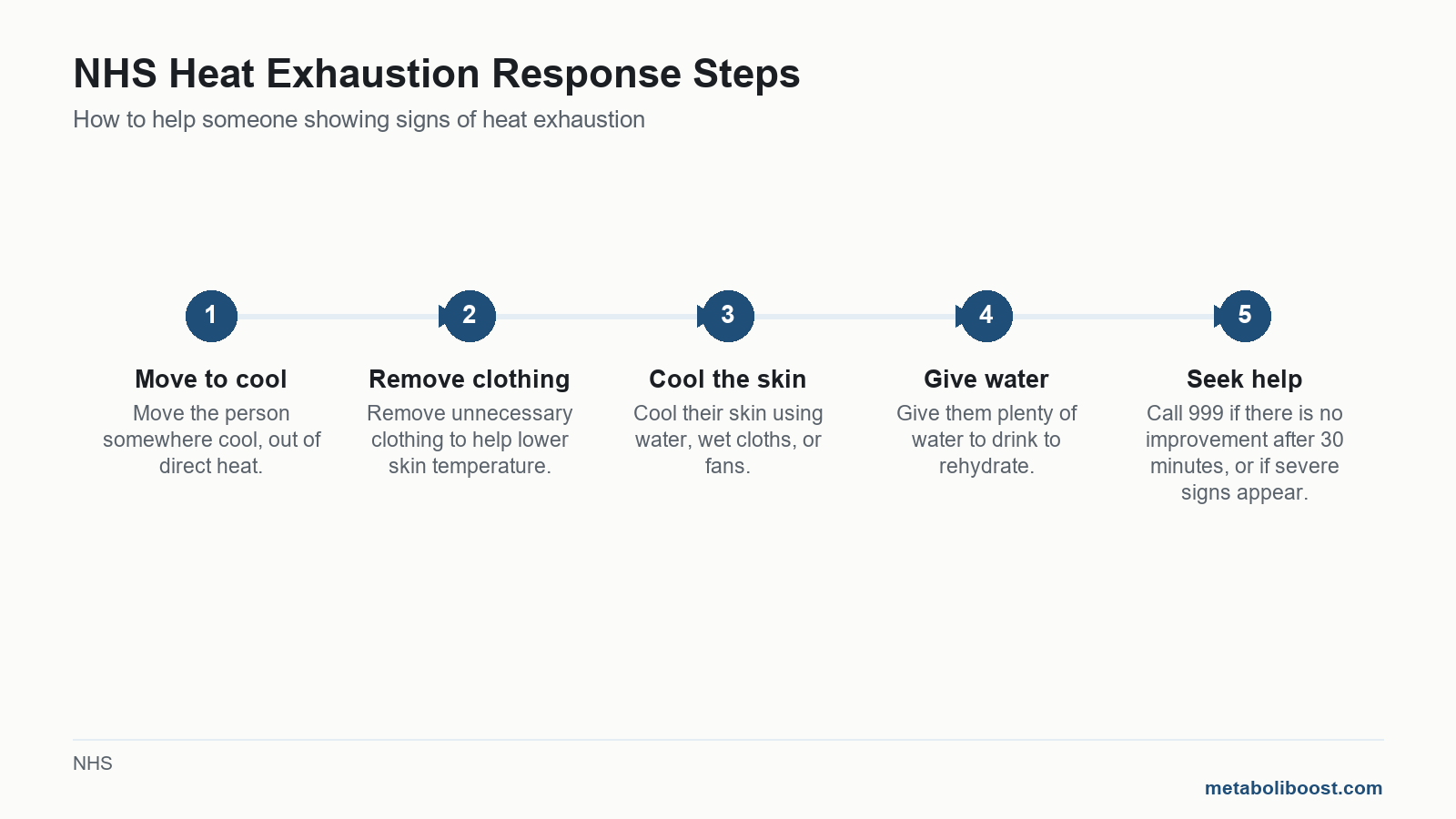
NHS advice on heat exhaustion and heatstroke is to move the person somewhere cool, remove unnecessary clothing, cool their skin and give them plenty of water, and to call 999 if there is no improvement after 30 minutes, or if there is a very high temperature, hot skin that is not sweating, a fast heartbeat or breathing, confusion, seizure or loss of consciousness. NHS 111 covers the cases in between.
Separately: tiredness that does not track the temperature, or that has been there since spring, is worth an appointment rather than another article. Several ordinary and treatable causes present as exactly this, and they are found by testing, not by reading.
What actually works when the weather will not cooperate?
- Move the session, not the standard. Early morning and the hour after sunset are the windows where the same work costs less. Shifting the time is a far smaller concession than shortening the season.
- Judge by effort, not by pace. Your usual pace in heat is more work than your usual pace in mild weather. Holding it is not consistency, it is a quiet escalation, and the most common reason summer sessions end badly.
- Use shade, water and air conditioning on purpose. In the Houston study it was the temperature each person was actually exposed to that predicted behaviour, and frequent air conditioning lowered it. The forecast is not the number that governs you.
- Protect sleep before anything else. A cooler, ventilated, darker room is the single item here with the most evidence behind it, and it pays out tomorrow rather than next month. How sleep and fat loss interact is covered separately.
- Give it a fortnight before drawing conclusions about yourself. Adaptation to heat is well described and builds over roughly one to two weeks of repeated exposure, which is why the first hot week of the year feels worse than the fifth at the same temperature.
- Keep the floor low. On the worst days the useful target is not your normal session. It is anything above nothing, because what you are protecting is a habit that has to survive the season.
If you take one item from this page, take the sleep one. It is the best supported entry on the list, it is inside your control in a way the weather is not, and it pays out tomorrow.
Your Summer Activity Adaptation Checklist
Use these six evidence-based strategies from the article to keep moving safely without burning out.
Ticks are saved on this device only.
Does appetite explain any of it?
Appetite often falls in hot weather, and eating noticeably less for days on end tends to produce more of the tiredness you were trying to solve, not less. Cold, water rich foods such as fruit, salads and yoghurt count toward fluid as well as food, which makes them sensible to lean on in a heatwave. That is the whole of the claim. Nothing on a plate cools your metabolism.
Summer sluggishness is a real response to real conditions, and more discipline is not the answer to it. Cooler hours, effort instead of pace, sleep defended first, and a lower ceiling accepted for a few weeks will all outperform trying harder. The people who stay active through a hot summer are mostly not the determined ones. They are the ones who changed the timetable.
Frequently asked questions
Is feeling lazy in summer real, or am I making excuses?
It is real. Heat raises the energy cost and the perceived effort of the same activity, and hot nights degrade sleep. Both reduce how much you move without any conscious decision being taken, which is what makes it feel like a character flaw rather than a condition.
Does hot weather slow your metabolism?
There is no good evidence that heat slows it. If anything, cooling yourself costs energy rather than saving it. What changes is how much you move across the day, and that is the part that accumulates.
Does dehydration really slow your metabolism?
The figure quoted for this traces back to a single small study and has never been well established, so it is not a claim to build anything on. What mild fluid loss does reliably do is raise perceived effort and dent mood, alertness and concentration.
How much water should I drink in hot weather?
NHS guidance is 6 to 8 cups or glasses of fluid a day, with more needed in a hot environment or when active for long periods. Tea, coffee, milk and the water in food all count. Thirst and urine colour are a workable everyday check.
When is summer tiredness worth seeing someone about?
Tiredness arriving with dizziness, headache, nausea, cramps or pale clammy skin is the picture the NHS describes for heat exhaustion, and it needs cooling plus help if it does not improve within 30 minutes. Tiredness that persists regardless of the weather is worth a doctor’s appointment.
Is it better to exercise in the morning or the evening in summer?
Whichever is cooler where you are and whichever you will actually do. Both avoid the peak of the day, which is the point of choosing. Consistency across the season matters more than which end of it you pick.
Finished the page? The same five questions from the top, to see what stuck.
This article is general information, not medical advice, and is not a substitute for care from a qualified healthcare professional. Speak to your doctor about your own situation.
Leave a Reply