
How to lose double chin fat depends on what the fullness is. If it is fat, losing body fat overall is the only free route, and one prescription injection is approved for that spot. If it is loose skin or jaw shape, neither works, and no exercise, strap or gadget has trial evidence behind it.
Listen to this article, about 13 minutes. A synthetic voice reads the article and announces each section title as it begins; tables are read row by row and the questions at the end are left out.
Recorded 7 November 2026 from the article as published that day. Press a chapter to jump there; the highlighted line is what is playing. A play button sits beside every section heading, and once you scroll past this player a bar at the bottom of the screen keeps the controls in reach. Tap or click any sentence to hear the reading start from there.
On this page: what the FDA label for the only approved chin fat injection actually reports, trial by trial, a table of seven options with the record behind each, what a facial exercise trial measured and missed, and what about two dozen people on r/loseit said happened to their double chin.
Think you already know this? Five questions, one minute.
Every answer is on this page. Answer from what you know now; the page fills in the rest.
-
1. According to the StatPearls chapter on neck rejuvenation, which features should be identified before neck surgery because they lead to poor outcomes?
The StatPearls chapter says these should be identified first and are not usually corrected by neck rejuvenation procedures. Read the section
-
2. In the 2011 spot reduction trial, what did six weeks of abdominal exercise added to a diet do to abdominal fat?
The 2011 trial in the Journal of Strength and Conditioning Research found abdominal exercise alone did not reduce abdominal fat beyond the diet. Read the section
-
3. In the 2018 JAMA Dermatology facial exercise trial, what happened to the jawline and neck volume ratings?
In the trial jawline moved from 1.8 to 1.4 and neck volume from 1.9 to 1.4, neither significant; fat was not measured. Read the section
-
4. In the pooled trials on the Kybella label, how often did marginal mandibular nerve injury occur in treated people?
The FDA prescribing information lists nerve injury in 4% of treated people against under 1% on placebo, all resolving on their own with a median of 44 days. Read the section
-
5. According to the NHS, which of these is a reason to see a GP about a swollen gland?
The NHS swollen glands page lists glands that are getting bigger, have not gone down within 1 week, or feel hard or do not move when pressed. Read the section
Search for this and you get chin straps, jaw trainers and five minute routines promising a jawline by the weekend. The FDA paperwork is less breathless and more useful. Here is what it, the trials and people who have been through it say, checked on 7 November 2026.
What is a double chin actually made of?
A double chin is a shape, not a single tissue. Under the jaw there are two layers of fat, one just under the skin and one deeper, below a thin sheet of neck muscle called the platysma. A 2025 anatomical review of double chin treatment sorts the causes into three groups: congenital build, changes after jaw surgery, and excess fat under the chin. It also notes that where the platysma divides wide, deep fat can bulge forward even in a slim neck.
Then there is the scaffolding. A short or set back lower jaw, a small chin and a low sitting hyoid bone in the neck all soften the angle between chin and neck. The StatPearls chapter on neck rejuvenation says retrognathia, microgenia and an unfavourable hyoid position should be identified before surgery, because they lead to poor outcomes and are not usually corrected by neck procedures. Add skin that loosens with age, and you have four different things that all photograph as the same double chin.
Each one answers to a different fix, and three of the four do not answer to fat loss at all. It is the same story as what changes how a face looks, concentrated in one inch of neck.
Does losing weight get rid of a double chin?
If the fullness is mostly fat, losing body fat overall is what shrinks it. Fat comes off the body in an order set largely by your genes and sex, not by which muscle you work, and the face and neck are simply one of the places it leaves from. You cannot choose the queue.
Trials of spot reduction keep finding the same thing. In a 2011 trial in the Journal of Strength and Conditioning Research, six weeks of abdominal exercise added to a diet did not reduce abdominal fat any more than the diet alone. Nobody has run the equivalent trial for the chin, because there is no mechanism to test: working a muscle does not draw fat out of the layer above it. Our page on what the spot reduction trials show goes through the rest of that evidence.
Two honest caveats. Fat loss cannot remove fullness caused by jaw shape or loose skin, and it can make loose skin more visible once the fat that was filling it has gone. And nobody can tell you how much fat loss changes a particular chin, or when, because that depends on the four factors above.
Do chin exercises, jaw exercisers and chin straps work?
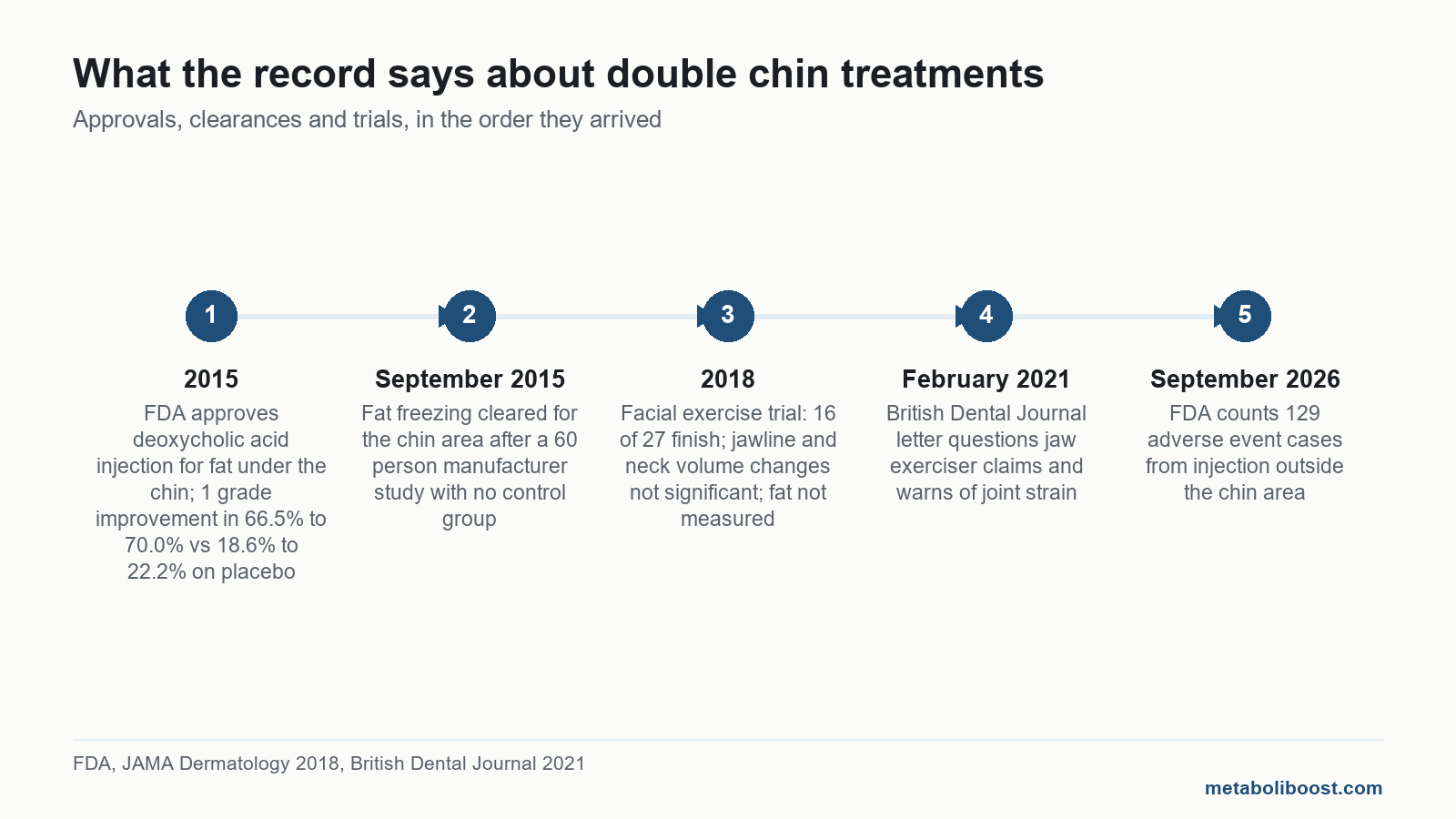
The best facial exercise study is a small one. In a 2018 trial published in JAMA Dermatology, 27 women started a 20 week facial exercise programme and 16 finished it. Upper and lower cheek fullness improved on photo ratings. Jawline at rest moved from 1.8 to 1.4, which was not statistically significant, and neck volume from 1.9 to 1.4, also not significant. Fat was never measured; the authors suggested muscle growth as a possible reason the cheeks looked fuller.
Jaw exercisers, the rubber or silicone bite toys, have no trial behind the chin claim. In a February 2021 letter in the British Dental Journal, two dental clinicians warned that one popular device was marketed as a face and neck toning tool with claims that lacked medical backing, and that heavy repeated use could add stress to the jaw joint in a way they compared to tooth grinding. If you already have jaw pain, clicking or locking, that is a question for a dentist before any chewing device.
Chin straps and wraps compress the area while you wear them. We found no controlled trial showing they reduce fat, and nothing about squeezing fat for a few hours explains how they would. A strap that worked would be the first piece of elastic in history to outperform a calorie deficit.

What did the FDA actually approve for fat under the chin?
One prescription drug: deoxycholic acid injection, sold in the US as Kybella. Its FDA prescribing information gives the indication as improvement in the appearance of moderate to severe convexity or fullness associated with submental fat in adults, with initial US approval in 2015. Use for fat anywhere else “has not been established and is not recommended”.
The label also reports the two pivotal trials, which pooled 513 people on the drug and 506 on placebo. Twelve weeks after the final session, at least a one grade improvement on both the clinician’s and the patient’s rating was seen in 70.0% and 66.5% of the drug groups, against 18.6% and 22.2% on placebo. A two grade improvement was far rarer: 13.4% and 18.6%, against under 0.1% and 3.0%. On MRI, 43% of treated people had at least a 10% drop in fat volume, against 5% on placebo. Participants could have up to six sessions at least a month apart, and 59% had all six.
Two details rarely make the clinic pages. People with excessive skin laxity were not in the trials, so the numbers say nothing about loose skin. And the side effects are not trivial: swelling in 87%, bruising in 72%, numbness in 66%, marginal mandibular nerve injury, which shows as an uneven smile, in 4%, and difficulty swallowing in 2%. The label says every nerve injury in the trials resolved on its own, with a median of 44 days.
On 15 September 2026 the FDA added a further warning. Its drug safety communication counts 129 cases of adverse events from use outside the area under the chin since approval, including reduced vision after injection near the eyes, and 117 cases of injection site nodules or masses that had not resolved. It urges people not to use unapproved fat dissolving injection products.
Fat freezing is a device, which the FDA clears rather than approves. The CoolSculpting system was cleared for the area under the chin in September 2015 under 510(k) K151179. The study behind it, Kilmer and colleagues in Lasers in Surgery and Medicine, treated 60 people with no control group and found a mean 2.0 mm thinner fat layer on ultrasound; the manufacturer sponsored it. The rare complication to know is paradoxical adipose hyperplasia, where the treated fat grows instead; a 2025 meta-analysis in Aesthetic Surgery Journal Open Forum put it at 0.22% across all body areas. Our page on what fat removal procedures take out covers the same devices on the belly.
How do the double chin options compare?
| Option | What it acts on | What the record shows | Recorded downside |
|---|---|---|---|
| Losing body fat overall | Fat under the chin, along with fat everywhere else | Reduces fat in no order you can pick; spot work adds nothing in trials | Cannot change jaw shape; can reveal loose skin |
| Face and chin exercises | Facial muscles | Jawline and neck volume changes not significant; fat not measured (JAMA Dermatology 2018) | Time; 11 of 27 starters dropped out |
| Jaw exercisers | Chewing muscles | No trial for chin fat; BDJ 2021 letter questions the claims | Possible strain on the jaw joint with heavy use |
| Chin straps and wraps | Nothing lasting | No controlled trial found on 7 November 2026 | Money |
| Deoxycholic acid injection | Fat under the chin only | 1 grade improvement in 66.5% to 70.0% vs 18.6% to 22.2% on placebo (FDA label) | Swelling, bruising, numbness; nerve injury in 4% |
| Fat freezing | Fat under the chin | Mean 2.0 mm fat layer reduction, 60 people, no control group (Kilmer 2016) | Paradoxical fat growth, 0.22% pooled |
| Liposuction | Fat under the chin | The NHS says it is not a treatment for obesity and suits firm, elastic skin | Surgical risks; loose skin is not removed |
Notice what the table does not contain: anything that fixes a set back jaw, a low hyoid or loose skin. Those are a surgeon’s assessment, made in person, and a fair reason to be wary of anyone selling a single answer to a question with four.
Questions to ask before any chin fat procedure
Tick each one once you have a clear answer. This is a list of questions, not a recommendation for or against any procedure.
General information only. A qualified clinician who has examined you is the person to answer these for your situation.
What do people who lost weight report about their double chin?
We read one January 2026 thread on r/loseit in which people who had lost a large amount of weight described what happened to their double chin. Around two dozen replies described their own outcome. About half said the double chin went entirely or almost entirely. Roughly a third reported some loose skin or sag under the jaw, which several said eased over the following months, and one in her forties said she had developed exactly the neck she had worried about but preferred it to her old weight. A few said they had a double chin even at a much lower weight, years earlier, and put it down to family build.
Genetics came up again and again, unprompted. One person noted that face changes lagged well behind the scale. Some who took collagen credited it, while others who took nothing got the same result, which is what you would expect if collagen was not doing the work.
For the injection, RealSelf’s own Kybella cost page reports a Worth It rating of 42% from its reviewers, against 92% for chin liposuction, and an average reported cost of $1,228 across 559 reviews. Its reviewers who regretted it mostly cite small results, sagging skin or long lasting numbness. These are self reported figures from a commercial platform, read on 7 November 2026.
These are what people report, not findings. They agree with the official record that loose skin and build decide a lot, which the clinic pages rarely mention.
When is fullness under the chin worth seeing a doctor about?
Most fullness under the chin is fat, skin or build. Some is not.

The NHS page on swollen glands says to see a GP if a swollen gland is getting bigger, has not gone down within a week, or feels hard or does not move when pressed. A usually painless swelling at the front of the neck can be a goitre, an enlarged thyroid. A face and neck that have rounded quickly, with fat building at the back of the neck, easy bruising or purple stretch marks, can be a sign of Cushing’s syndrome, including the kind caused by steroid medicine.
Swelling in the neck with difficulty breathing or swallowing needs urgent help: NHS 111, or 999 if breathing is hard. This list is not a diagnosis, and these conditions are uncommon. If the area under your chin has changed in a way you cannot explain, see a doctor before trying anything else. Our guide to what actually changes fat in the face covers fluid, sleep and salt.
Frequently asked questions
Can a double chin be genetic?
Yes. The shape of the jaw and chin, the position of the hyoid bone and where your body stores fat are all largely inherited, which is why some slim people have a double chin and some heavier people do not.
Does chewing gum slim the jaw or chin?
No trial shows that chewing gum removes fat under the chin. Heavy chewing works the chewing muscles, and dentists warn that a lot of forceful chewing can strain the jaw joint.
Does posture make a double chin look worse?
Tilting the head down or forward folds the soft tissue under the jaw and makes any fullness look bigger, which is why the same chin looks different in different photos. Posture changes the look, not the fat.
Is Kybella the same as fat dissolving injections sold online?
No. Kybella is a prescription drug approved for fat under the chin. The FDA urges people not to use unapproved fat dissolving injection products, whose contents and safety are unknown.
Does the double chin come back after injections or fat freezing?
The treated fat cells are destroyed, but the fat cells that remain can still grow if body fat increases, so the area can fill again with weight gain.
Who decides whether an injection or procedure is suitable?
A qualified clinician who has examined you, taking into account your skin, jaw, medicines and health history. No article, including this one, can make that call for you.
Finished the page? The same five questions from the top, to see what stuck.
This article is general information, not medical advice, and is not a substitute for care from a qualified healthcare professional. Speak to your doctor about your own situation.
Leave a Reply