
Meal replacement drinks have real trial evidence behind them, but not for the bottle on its own. The trials tested structured programmes: shakes standing in for set meals, regular sessions with a dietitian or coach, and a planned route back to food. Take that scaffolding away and you have a portion controlled meal you can drink in two minutes.
Listen to this article, about 11 minutes. A synthetic voice reads the article and announces each section title as it begins; tables are read row by row and the questions at the end are left out.
Recorded 6 November 2026 from the article as published that day. Press a chapter to jump there; the highlighted line is what is playing. A play button sits beside every section heading, and once you scroll past this player a bar at the bottom of the screen keeps the controls in reach. Tap or click any sentence to hear the reading start from there.
On this page: what the Astbury review and the DiRECT trial actually tested, a table of the support built into each programme, and what three 2026 Reddit threads report about life after the shakes.
Think you already know this? Five questions, one minute.
Every answer is on this page. Answer from what you know now; the page fills in the rest.
-
1. Under the UK rules for the meal replacement for weight control claim, how much energy must a product supply per meal?
The retained EU regulation 2016/1413 sets 200 to 250 kcal per meal, with protein supplying 25 to 50 percent of the energy. Read the section
-
2. What did the DiRECT trial test?
DiRECT, published in The Lancet in 2018, ran a whole programme in GP practices, not a product on its own. Read the section
-
3. In the 2019 Astbury review, which meal replacement programmes pulled furthest ahead of the comparison diets?
The Obesity Reviews meta-analysis found the largest difference where meal replacements came with enhanced support. Read the section
-
4. Of DiRECT participants in remission at two years, what share were still in remission at five?
The 2024 five year extension reported 26 percent, which is why the plan for after the shakes matters. Read the section
-
5. Which risk does the NIDDK link to very low calorie diets and rapid weight loss?
The NIDDK page on dieting and gallstones says very low calorie diets raise gallstone risk and advises talking to a doctor first. Read the section
Search for them and the first page is mostly shops. What almost none of it says is what the research actually put to the test, which turns out to be the interesting part. Every source below was checked on 6 November 2026.
What counts as a meal replacement drink, and what does not?
Three quite different products end up in the same aisle, and the label is the only thing that tells them apart. A protein shake is a supplement to a diet. A meal replacement is built to stand in for a meal. Total diet replacement means formula products replace every meal, for a fixed period, under supervision.
In Britain the line is drawn in law. The retained EU rules on meal replacement for weight control say a product carrying that claim must supply between 200 and 250 kcal per meal, with protein providing 25 to 50 percent of its energy and fat no more than 30 percent. In the United States there is no equivalent standard for the phrase. A liquid can be sold as a food or a dietary supplement, and FDA’s 2014 guidance on liquid dietary supplements says the labeling decides which.
| Product | What it is for | Composition rules | Where the evidence sits |
|---|---|---|---|
| Protein shake | Adding protein to a diet | None specific to meals; many say they are not a meal replacement | Not tested as a meal substitute |
| Meal replacement drink | Replacing one or two meals a day | 200 to 250 kcal per meal for the UK claim; no US standard | Astbury and colleagues, 2019: 23 trials of programmes |
| Total diet replacement | Replacing all food for a set period | Formula products, about 800 to 900 kcal a day in the NHS programme | DiRECT, 2018, run inside primary care with clinical oversight |
If a tub of protein powder has been standing in for breakfast and lunch feels far away, this is probably why. It is a fine way to add protein to a diet, not a whole meal.
What did the meal replacement trials actually test?
The most useful single paper is the 2019 systematic review and meta-analysis in Obesity Reviews led by Nerys Astbury at Oxford. It pooled 23 randomised trials with 7,884 adults and compared programmes that included meal replacements with weight loss programmes that did not, measured at one year. It left out total diet replacement, so it is about replacing some meals, not all.
The finding was that programmes including meal replacements did better at one year than the comparison programmes. Read the methods, though, and the thing being tested is a programme: a plan, contact with staff, and the shakes. Only 6 of the 23 trials were judged at low risk of bias in every domain, which is worth knowing before anyone quotes the result as settled.
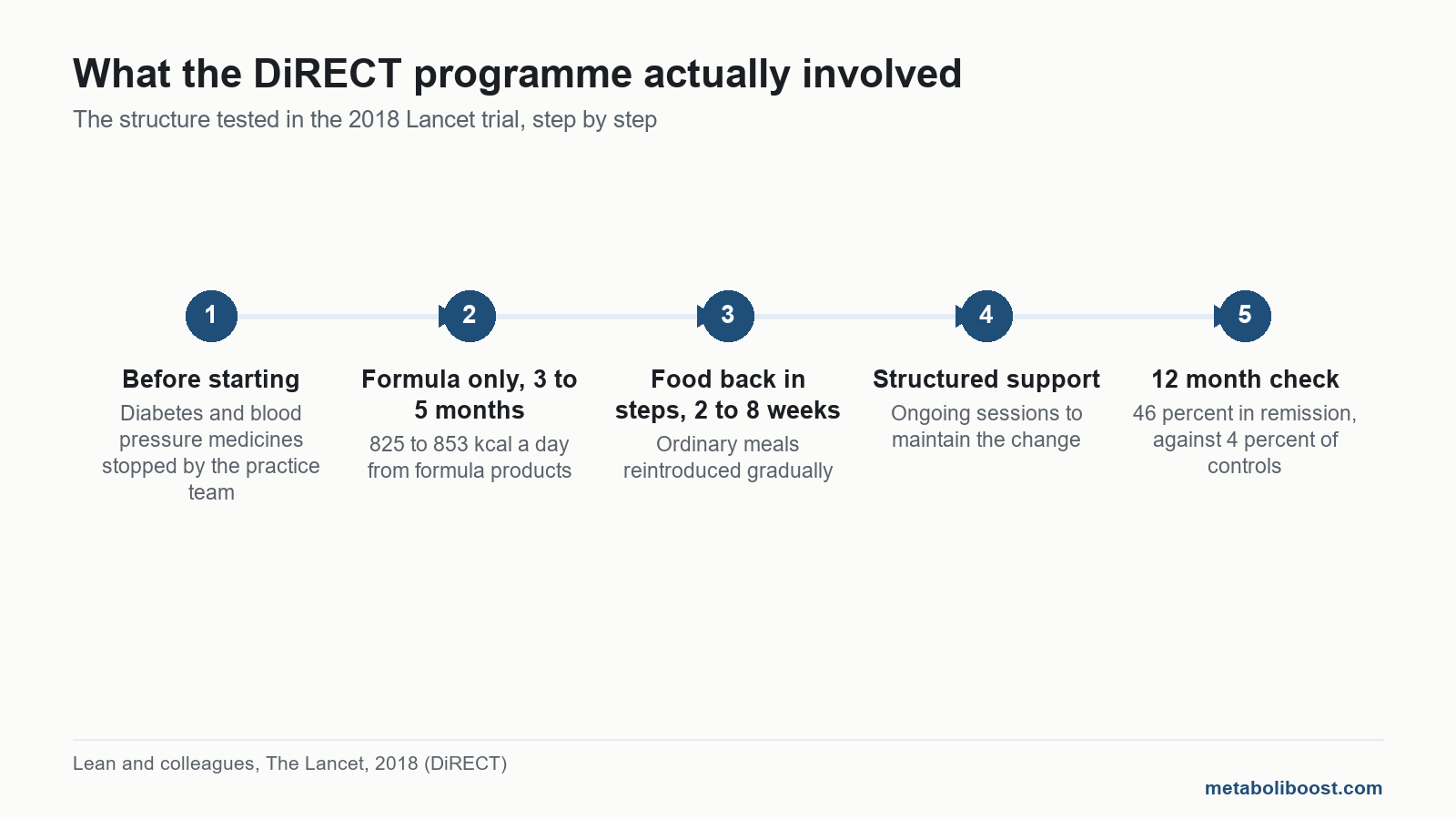
The best known total replacement trial is DiRECT, published in The Lancet in 2018. It ran in 49 GP practices in Scotland and Tyneside and recruited adults aged 20 to 65 who had been diagnosed with type 2 diabetes within six years. The programme had three parts: a formula diet of 825 to 853 kcal a day for three to five months, food reintroduced in steps over two to eight weeks, then structured support to maintain the change.
At 12 months, 46 percent of the programme group were in diabetes remission, against 4 percent of the control group. That result belongs to the whole package. Nobody in DiRECT was handed a case of shakes and wished luck.
| Trial or programme | What was replaced | Support built in | Route back to food | Source |
|---|---|---|---|---|
| 23 trials, pooled | Some meals, not all | Varied; regular or enhanced support | Not the focus | Obesity Reviews, 2019 |
| DiRECT | All meals, 3 to 5 months | Practice nurse or dietitian, medicines reviewed | Stepped, 2 to 8 weeks | The Lancet, 2018 |
| NHS Path to Remission | All meals, first 12 weeks | Coaching for 12 months, in person or digital | Planned, with clinicians and coaches | NHS England |

Why does the support around the shake matter so much?
Inside the Astbury review the size of the advantage moved with the amount of help people got. Meal replacement programmes with enhanced support pulled furthest ahead of the alternatives, and those with regular support did better than the comparison diets by a smaller margin. The shake was the same kind of product in both. The people around it were not.
The explanation is not mysterious chemistry. A meal replacement removes a decision. It has a known energy content, which helps with the arithmetic of a calorie deficit, and it does not need cooking. What it cannot do is teach anyone how to eat the other meals, how to handle a bad week, or what to do on day one after the programme. Support is where those parts live, which is also why the detox tea with a 14 day plan printed on the box is not running the same experiment.
What do people who used meal replacement drinks report?
We read three Reddit threads from 2026, covering roughly 45 replies, and the accounts split the way the trials would predict. These are what people report, not findings.
In a September 2026 r/loseit thread, the poster had swapped breakfast for a protein shake with the right calories and found themselves hungry all morning, then eating a normal breakfast on top. The most upvoted replies made the same distinction as the label table above: a protein shake is a supplement, not a meal, and many packs say so. One commenter said their doctor and dietitian had both advised them not to drink their calories.
A May 2026 r/loseit thread came from someone working night shifts who wanted one replacement shake to cover the hours where snacking crept in. Replies split. Some said a shake reduces the mental load of deciding what to eat; others predicted that the weight comes back once the shakes stop, because nothing about everyday eating has changed. Several replies recommended specific brands in the tone of a product page, which is worth reading the way you would read an advert.
The most telling account came from a September 2026 r/type2diabetes thread about the NHS remission programme. People who had finished it described the 12 weeks of soups and shakes as well structured and hard, with real hunger early on. Three said they regained the weight after the support ended. One said they had kept it off and credited the education sessions on habits and triggers, not the shakes. Another worried the products would do nothing for a difficult relationship with food.
What happens when the shakes stop?
This is the part the product pages skip. The committee behind NICE guideline NG246 flagged a high likelihood of weight regain, particularly when food is reintroduced after total meal replacement, and its guideline says low and very low energy diets should not be used as a long term strategy for managing weight.
DiRECT’s own five year extension, published in 2024 shows the same slope. Of the participants in remission at two years, 26 percent were still in remission at five. In the group that kept receiving maintenance support, 13 percent were in remission at five years, against 5 percent of the original control group. Better than nothing, far from permanent.
So the useful question is less which shake and more what the plan is for the month after the last one. A steady approach to the quality of everyday food is the dull answer that keeps turning up.

What should you read on a meal replacement label?
A label cannot tell you whether a product will work for you, but it does tell you what you are buying. Look first for whether it is sold as a meal replacement at all, or carries the familiar line saying it is not one. Then energy, protein, fibre, sugar, and whether vitamins and minerals are listed.
In the UK a drink making the legal claim should sit inside the rules quoted above. In the US, check whether the panel says Nutrition Facts or Supplement Facts, because that tells you which rulebook applies. Any label or advert that promises a specific amount of weight by a specific date is selling a promise, not describing a product.
Meal replacement label checker
Tick each item once you have found it on the pack. This checks what a label says, nothing more.
This does not rank brands or say which to buy. If you take medicines or plan to replace every meal, speak to your doctor first.
Who should not try total diet replacement without a doctor?
Total diet replacement is a medical intervention, and the official programmes treat it as one. The NHS Type 2 Diabetes Path to Remission Programme is offered to adults aged 18 to 65 diagnosed within the last six years, through their GP or diabetes team, with clinical checks before starting. In 2024 to 2025 over 13,000 people were enrolled, almost double the 6,401 of the year before. Of those who completed it and were measured twice, 32 percent were in remission at one year, a figure that leaves out everyone who dropped out.
If you take medication for diabetes or blood pressure, very low calorie eating can change how those medicines act, which is why DiRECT stopped them under the practice team before the diet began. Speak to your doctor before replacing all meals.
The NIDDK notes that very low calorie diets and rapid weight loss raise the risk of gallstones, and that people starting one should talk with their doctor about lowering that risk.
NICE advises assessment for eating disorders or other mental health issues, where they may be present, before a very low energy diet. If counting, skipping or replacing meals has started to feel out of your control, the NHS eating disorders page explains the signs and where to get help.
For everyone else, meal replacement drinks make some meals simpler. Paired with support and a plan for real food, as in any structured eating pattern, they have evidence. On their own, they are a quick lunch.
Frequently asked questions
Can I use a protein shake as a meal replacement?
A protein shake is designed to add protein, not to replace a meal, and many say so on the pack. It usually lacks the energy, fibre and vitamins that a product sold as a meal replacement is built to carry.
Are meal replacement drinks the same as the NHS soups and shakes diet?
No. The NHS programme is total diet replacement for 12 weeks inside a 12 month programme with clinical checks and coaching. Buying shakes in a shop gives you the product without that structure.
Do I need to see a doctor before replacing one meal a day?
Replacing one meal is generally treated as an ordinary dietary change, but anyone taking medicines for diabetes or blood pressure, or with a medical condition, is best checking with a doctor first.
Are meal replacement drinks regulated?
In the UK, products claiming to be a meal replacement for weight control must meet set composition rules. In the US there is no specific standard, and a shake may be regulated as a food or a supplement.
Why do I feel hungry after a shake?
Many people report that drinking a meal feels less filling than chewing one, and a low energy or low fibre shake makes that more likely. Satiety varies a lot from person to person.
Is total diet replacement safe for everyone?
No. Very low calorie diets carry risks such as gallstones and can interact with medicines, and NICE recommends assessment for eating disorders first. They are meant to be supervised.
Finished the page? The same five questions from the top, to see what stuck.
This article is general information, not medical advice, and is not a substitute for care from a qualified healthcare professional. Speak to your doctor about your own situation.
Leave a Reply