
How to lower BMI comes down to one lever: height stays fixed, so BMI falls only when body weight falls. One BMI point is about 5 pounds at 5 ft and about 8 pounds at 6 ft 4 in. How fast it moves depends on energy balance and on the body adapting, not on any product or trick.
Listen to this article, about 14 minutes. A synthetic voice reads the article and announces each section title as it begins; tables are read row by row and the questions at the end are left out.
Recorded 19 October 2026 from the article as published that day. Press a chapter to jump there; the highlighted line is what is playing. A play button sits beside every section heading, and once you scroll past this player a bar at the bottom of the screen keeps the controls in reach. Tap or click any sentence to hear the reading start from there.
On this page: a table of how many pounds one BMI point is at nine heights from 5 ft to 6 ft 4 in, worked from the CDC formula, with the CDC and NICE cut offs in pounds and three dated forum accounts of BMI misreading real bodies.
Think you already know this? Five questions, one minute.
Every answer is on this page. Answer from what you know now; the page fills in the rest.
-
1. What does the BMI formula actually use?
BMI is weight divided by height squared; the CDC FAQ gives the pounds version as weight over height in inches squared, times 703. It knows nothing about fat or waist. Read the section
-
2. Roughly how many pounds is one BMI point at 6 ft 4 in?
76 inches squared, divided by 703, is about 8.2 pounds per point, using the CDC formula. At 5 ft 0 in it is about 5.1. Read the section
-
3. What did the 2011 Lancet model by Hall and colleagues show about the 3,500 calories per pound rule?
The Hall model showed energy spending adapts as weight falls, so a fixed 3,500 calories per pound overstates what a steady deficit removes over time. Read the section
-
4. What did the AMA’s June 2023 policy say about BMI?
The AMA policy called BMI imperfect, said it loses predictability at the individual level, and named measures such as visceral fat and waist circumference to use alongside it. Read the section
-
5. Under NICE guideline NG246, where does obesity start for people of South Asian family background?
NICE NG246 uses lower thresholds for several ethnic groups: overweight from 23 to 27.4 and obesity from 27.5. Read the section
What does BMI actually measure?
Less than its fame suggests. BMI is your weight divided by the square of your height. The CDC writes the imperial version as weight in pounds divided by height in inches squared, times 703, and gives the example of an adult at 5 ft 8 in and 200 pounds, whose BMI is 30.4. That is the whole calculation. It has no idea whether those pounds are muscle, fat, bone or last night’s takeaway.
The CDC adult categories run from underweight below 18.5, through healthy weight from 18.5 to less than 25 and overweight from 25 to less than 30, to obesity at 30 or greater. The same page calls BMI “a screening measure” that “should be considered with other factors.” Screening means it flags who might need a closer look. It does not diagnose anything, and it was never meant to be a personal scorecard.
So the honest version of the question has two parts. How does the number move? And does moving it change the thing you actually care about? This page takes them in that order.
How much weight is one BMI point at your height?
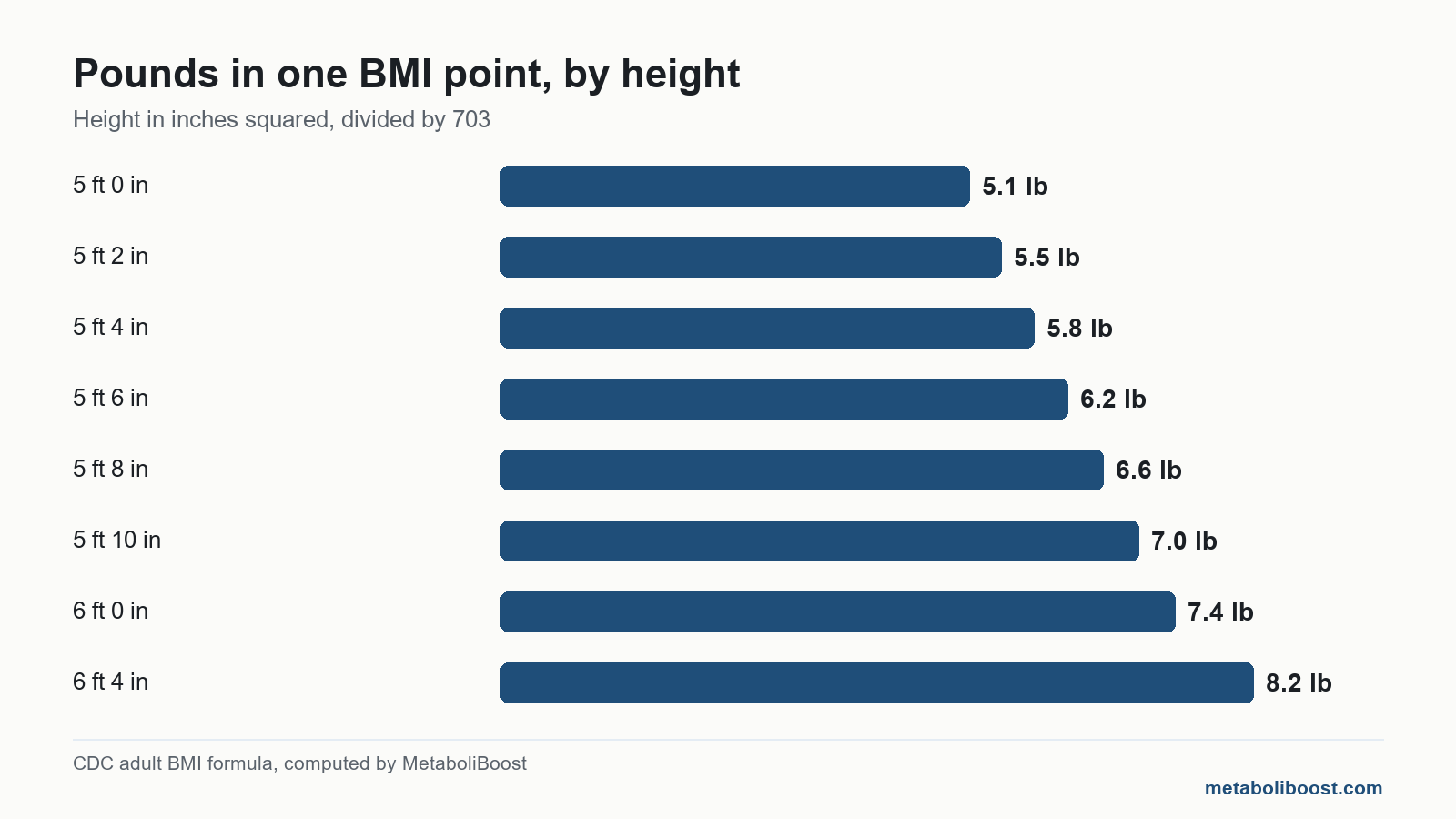
Here is the figure most BMI pages skip, worked out for a range of heights. Because height is squared in the formula, a point of BMI is worth more pounds on a taller frame. Every number below comes straight from the CDC formula.
| Height | Pounds per BMI point | Pounds at BMI 24.9 | Pounds at BMI 29.9 | Pounds at BMI 22.9 | Pounds at BMI 27.4 |
|---|---|---|---|---|---|
| 5 feet | 5.1 | 127.5 | 153.1 | 117.3 | 140.3 |
| 5 feet 2 inches | 5.5 | 136.2 | 163.5 | 125.2 | 149.8 |
| 5 feet 4 inches | 5.8 | 145.1 | 174.2 | 133.4 | 159.6 |
| 5 feet 6 inches | 6.2 | 154.3 | 185.3 | 141.9 | 169.8 |
| 5 feet 8 inches | 6.6 | 163.8 | 196.7 | 150.6 | 180.2 |
| 5 feet 10 inches | 7.0 | 173.6 | 208.4 | 159.6 | 191.0 |
| 6 feet | 7.4 | 183.6 | 220.5 | 168.9 | 202.1 |
| 6 feet 2 inches | 7.8 | 194.0 | 232.9 | 178.4 | 213.4 |
| 6 feet 4 inches | 8.2 | 204.6 | 245.7 | 188.2 | 225.1 |
Read across a row and the arithmetic gets concrete. At 5 ft 4 in, the gap between the top of the healthy range and the top of the overweight range is 29.1 pounds. At 6 ft 2 in it is 38.9 pounds. In metric terms, one BMI point is about 2.3 kg at 5 ft 0 in and about 3.7 kg at 6 ft 4 in.

Two side effects of the formula are worth knowing. First, normal day to day scale wobble of 2 pounds moves BMI by about 0.3 at 5 ft 8 in, so a BMI that bounces between readings is mostly water and gut contents, not fat. Second, height errors matter. At 180 pounds, the same person comes out at 27.4 if measured at 5 ft 8 in and 26.6 at 5 ft 9 in. The cheapest way to lower a BMI is, regrettably, to measure your height properly. It is also the only “instant results” claim on this page.
BMI arithmetic for your own height and weight
Enter a height and a weight. The tool runs the CDC formula, prints every step, and shows what one BMI point weighs at that height and where the CDC and NICE cut offs fall in pounds. It is arithmetic only: no goal, no daily deficit, no date.
Formula from the CDC: weight in pounds divided by height in inches squared, times 703. The 22.9 and 27.4 lines are the top of the lower ranges NICE uses for some ethnic groups. BMI is a screening number for adults aged 20 and over, not a diagnosis; questions about your own weight belong with a doctor.
What actually governs how fast BMI comes down?
Not the things the adverts name. With height fixed, BMI follows weight, and weight follows energy balance over weeks and months: what is eaten against what is spent. The detox tea, the fat burner and the one weird trick all work on the scale, if at all, through water and the bathroom. Neither of those is fat, and both come back.
The part that makes every promised timeline wrong is that the body is not a fixed calculator. A model published in The Lancet in 2011 by Kevin Hall and colleagues showed that as weight falls, energy spending falls with it, so the old rule of a fixed 3,500 calories per pound overestimates how much weight a steady deficit removes over time. Why calorie deficit calculators disagree and what is really happening at a weight loss plateau cover that slowdown in detail.
The same research group built the NIH Body Weight Planner, which models this adaptation with personal inputs instead of a straight line. It is a research tool, not a promise, and it is a useful corrective to any site claiming a set number of BMI points by a set date. Nobody can honestly print that number for you, because it depends on your starting size, your intake, your activity, your sleep, your medicines and your biology. This page will not either.
Does a lower BMI always mean less body fat?
No. Because BMI counts all weight the same, it can fall when muscle is lost and stay high when fat is replaced with muscle. In June 2023 the American Medical Association adopted a policy calling BMI an imperfect way to measure body fat in multiple groups, noting that it “loses predictability when applied on the individual level” and is based mainly on data from earlier generations of non Hispanic white populations. It recommends using BMI alongside measures such as visceral fat, body composition and waist circumference.
In January 2025 a commission of 58 experts in The Lancet Diabetes and Endocrinology went further. It argued that BMI can both overestimate and underestimate body fat, and that excess fat should be confirmed with another measure, such as waist circumference or a body scan, before anyone is labelled with obesity. It also split excess fat that is not yet affecting the body from obesity that is already harming organs or daily life.
| Measure | What it actually captures | What it misses | Who says to use it |
|---|---|---|---|
| BMI | Total weight relative to height | Muscle versus fat, and where the fat sits | CDC, as a screening measure |
| Waist to height ratio | Fat carried around the middle | Fat elsewhere; not validated above BMI 35 in the NICE guidance | NICE NG246, for BMI under 35 |
| Body composition scan | Fat mass and lean mass, estimated | Accuracy varies by method and by hydration | AMA 2023 policy names body composition among other measures |
| Clinical assessment | Whether excess fat is affecting organs or daily life | Needs a clinician, not a calculator | Lancet commission, January 2025 |
In practice, this means a falling BMI is good news only if what was lost was mostly fat. Strength training and adequate protein are the usual ways people protect muscle while weight comes down, and the waist measurement is the quickest check on whether the middle is shrinking too. The two big beer belly studies show how much of the risk story lives at the waist rather than on the scale.
Are the BMI cut offs the same for everyone?
Not in the UK. NICE guideline NG246 uses lower thresholds for people of South Asian, Chinese, other Asian, Middle Eastern, Black African or African Caribbean family background: overweight from 23 to 27.4 and obesity from 27.5. The reason given is that these groups tend to carry more fat around the middle and face higher cardiometabolic risk at a lower BMI. That is why the table above carries the 22.9 and 27.4 columns.
NICE also recommends the waist to height ratio for adults with a BMI under 35, of any sex, ethnicity or muscle mass. A ratio of 0.4 to 0.49 is classed as healthy, 0.5 to 0.59 as increased, and 0.6 or more as high. In plain terms: keep your waist under half your height. The NHS shows how to measure your waist for it, and all it costs is a tape and some honesty about where your belly button is.
What do people who reached a healthy BMI report?
Three Reddit threads from the past year, with about 56 comments read between them, show the gap between the BMI number and the body it describes. These are accounts of what individuals report about themselves, not findings.
In a January 2026 r/loseit thread, a woman at BMI 21 said she still saw herself as heavy beside others of similar height and weight. Replies pointed to muscle lost through years of yo yo dieting, loose skin, and how hard it is to judge your own body fairly. Several suggested building muscle rather than chasing a lower number.

In a September 2026 r/loseit thread, a woman of 39 at 5 ft 8 in and a healthy BMI of about 24 said a mirrored fitness class left her feeling “misled by BMI.” She later reported a body composition scan over 35 percent fat, mostly around the middle. One reply pointed her to the NHS waist to height ratio as a second number.
In a September 2026 r/WorkoutMotivation thread, a man at 5 ft 8 in and BMI 33.1 posted a bioimpedance scan reading 18.1 percent body fat. Here the replies split. Some agreed BMI ignores muscle; others said those scans are not very reliable, and one argued BMI is still a useful guide for most people, who tend to underestimate their own fat.
The pattern lines up with the AMA and the Lancet commission: BMI misreads individuals in both directions. Where the threads go beyond the evidence is in treating a single scan reading as exact. Home and gym scans carry their own error, so a scan is a second opinion, not a verdict.
When is a BMI number worth taking to a doctor?
When it falls under 18.5, when it is rising without an obvious reason, when it sits in the obesity range, or when it comes with symptoms such as breathlessness, joint pain or tiredness that does not lift. A doctor can look at blood pressure, blood sugar, waist and history, which is the assessment the Lancet commission says BMI alone cannot do, and can discuss treatment options, including medicines, that are outside the scope of this page.
If trying to lower your BMI has started to feel like it controls your eating, or you are already in the healthy range and still restricting, that is worth raising with a doctor or an eating disorder service. BMI is a poor guide for eating disorders, a point the AMA’s 2023 review of BMI also raises. A number on a chart is never a reason to skip that conversation, and the average BMR figures on this site come with the same caveat: averages describe crowds, not you.
Frequently asked questions
Is BMI calculated the same way for men and women?
Yes. The adult formula and the adult categories are the same for both sexes. Women carry more body fat on average at the same BMI, which is one reason the AMA and the Lancet commission say BMI should be read alongside other measures.
Does BMI work for children and teenagers?
Not with the adult cut offs. The CDC uses BMI for age percentiles for people aged 2 to 19, because body fat changes as children grow and differs between girls and boys.
Can you lower BMI by building muscle?
Usually not. Muscle adds weight, so BMI stays level or rises even as body fat falls. That is the main reason a waist measurement or a body composition check tells you more than BMI during strength training.
Why does my BMI change between different calculators?
Mostly because of rounding and the height entered. At 180 pounds, an inch of height moves BMI by about 0.8, which is more than most day to day weight changes do.
Is a BMI of 25 bad?
It is the point where the CDC overweight category starts, not a diagnosis. NICE notes that health risk at a given BMI differs by ethnic background, and the waist to height ratio adds the information BMI leaves out.
Can a supplement or detox lower BMI?
This page found no good trial evidence that any supplement or detox lowers body fat in a way that matters. Products that move the scale quickly usually do it through water or the bowel, and that weight returns.
Finished the page? The same five questions from the top, to see what stuck.
This article is general information, not medical advice, and is not a substitute for care from a qualified healthcare professional. Speak to your doctor about your own situation.
Leave a Reply