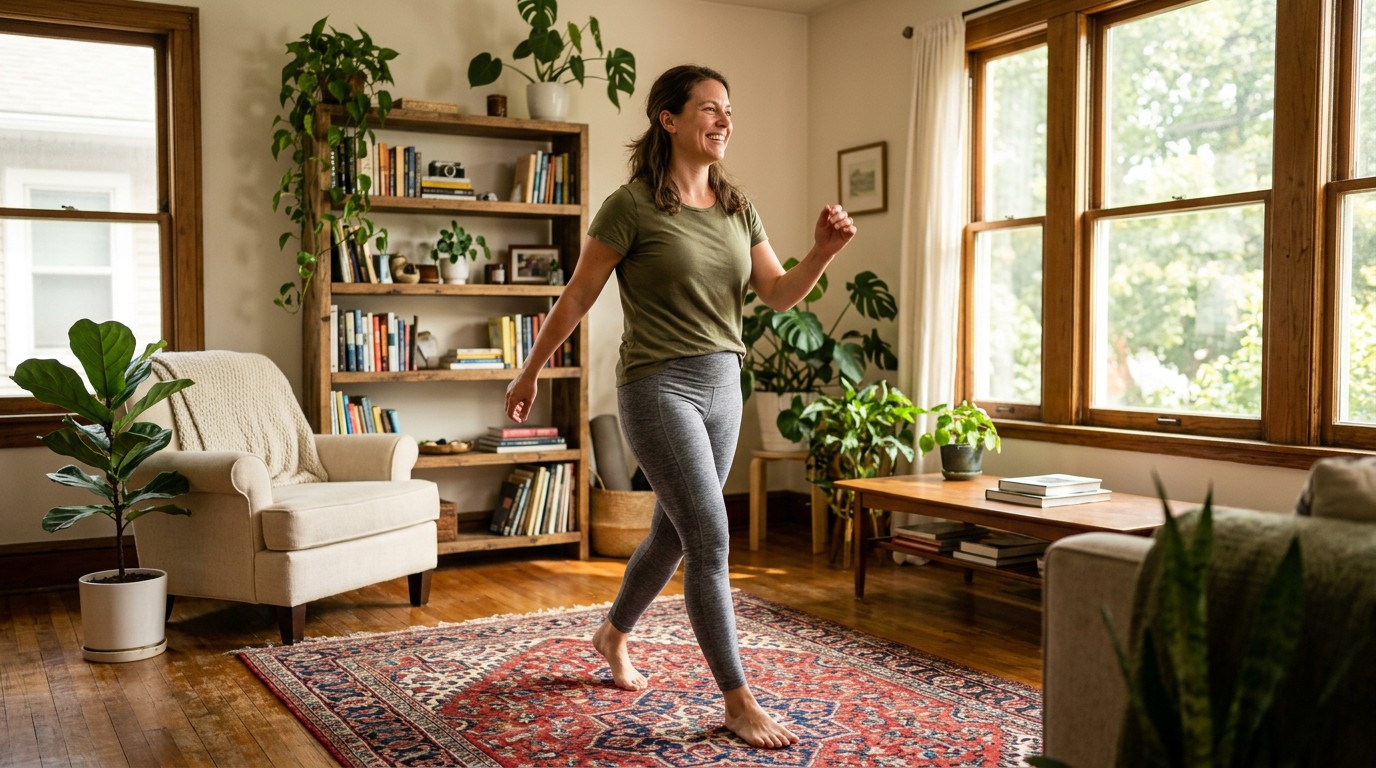
Does walking in place burn calories? Yes. In the best known lab study to measure it, stepping in place used about 258 kcal an hour, roughly 85 percent of what the same adults burned walking at 3 mph, and about three times their resting rate. Your body weight and how hard you march decide your own number.
Listen to this article, about 12 minutes. A synthetic voice reads the article and announces each section title as it begins; tables are read row by row and the questions at the end are left out.
Recorded 13 October 2026 from the article as published that day. Press a chapter to jump there; the highlighted line is what is playing. A play button sits beside every section heading, and once you scroll past this player a bar at the bottom of the screen keeps the controls in reach. Tap or click any sentence to hear the reading start from there.
On this page: the best known lab study of walking in place, its numbers turned into calories at four body weights with the sum shown, what a six month trial found, and two forum threads on marching at home.
Think you already know this? Five questions, one minute.
Every answer is on this page. Answer from what you know now; the page fills in the rest.
-
1. In the 2012 lab study, how much energy did stepping in place use per hour?
Steeves and colleagues measured 258 kcal an hour stepping in place, against 81 sitting watching TV and 304 walking at 3.0 mph. Read the section
-
2. Dividing the lab’s stepping figure by its resting figure gives walking in place at roughly how many times rest?
258 over 79 is about 3.3, from the Steeves lab figures; 4.8 is the Compendium value for jogging in place. Read the section
-
3. In the six month TV commercial stepping pilot, what happened to body weight?
The 2012 randomised pilot reports that body weight did not change, while daily steps rose in both groups. Read the section
-
4. How were steps counted during the lab hour of TV commercial stepping?
The lab study abstract says actual steps were counted with a hand tally counter. Read the section
-
5. What simple test does the NHS give for moderate intensity activity?
The NHS adult guidelines describe moderate activity as being able to talk but not sing. Read the section
Most pages answering this question quote a tidy range, three to five calories a minute, with no source. It is the answer for a person of no particular size marching at no particular speed. Here is what the lab measured, what it means at four body weights, and what happened when people kept it up for six months.
How many calories does walking in place actually burn?
The study everyone half remembers is Steeves, Thompson and Bassett, published in Medicine and Science in Sports and Exercise in 2012. The University of Tennessee team put 23 adults, average age 27.8, in a lab with a gas analyser and measured them lying at rest, sitting, standing, stepping in place and walking on a treadmill at 3.0 mph.
The results, as the abstract reports them: reclining rest cost 79 kcal an hour, sitting and watching TV cost 81, stepping in place cost 258, and treadmill walking at 3.0 mph cost 304. So marching on the spot used about 85 percent of the energy of a steady walk. Not a consolation prize. More like the same prize with slightly less shiny wrapping.
Then came the part that made the press. Volunteers watched an hour of television and stepped in place through every advert break. That hour cost 148 kcal, against 81 for an hour of sitting through the same shows, and produced an average of 2,111 steps in 25.2 minutes of activity. That is about 67 kcal more than the sofa version of the same evening, which is real, modest and no kind of miracle.
One caution sits inside those averages. The stepping in place figure carried a standard deviation of 76 kcal an hour, because a treadmill sets everyone’s pace and a living room does not. How hard you step moves the number more than anything else on this page.
How does walking in place compare with walking at 3 mph?
A lab figure in kcal an hour belongs to the people in that lab. METs make it travel: the cost of an activity as a multiple of resting. The 2024 Adult Compendium of Physical Activities, published by Herrmann and colleagues, lists 1,114 activities this way. It does not, as far as we could find on 13 October 2026, list walking in place. Its walking codes stop at real ground covered, and its running codes carry jogging in place, code 12025, at 4.8 MET.
So we derived one. Divide the Steeves stepping figure by the same volunteers’ resting figure, 258 over 79, and walking in place comes out at about 3.3 times rest. The same sum for their treadmill walk, 304 over 79, gives 3.85, and the Compendium rates walking at 2.8 to 3.4 mph at 3.8 MET under code 17190. That near match is the reason to trust the derived figure, within its wide spread.
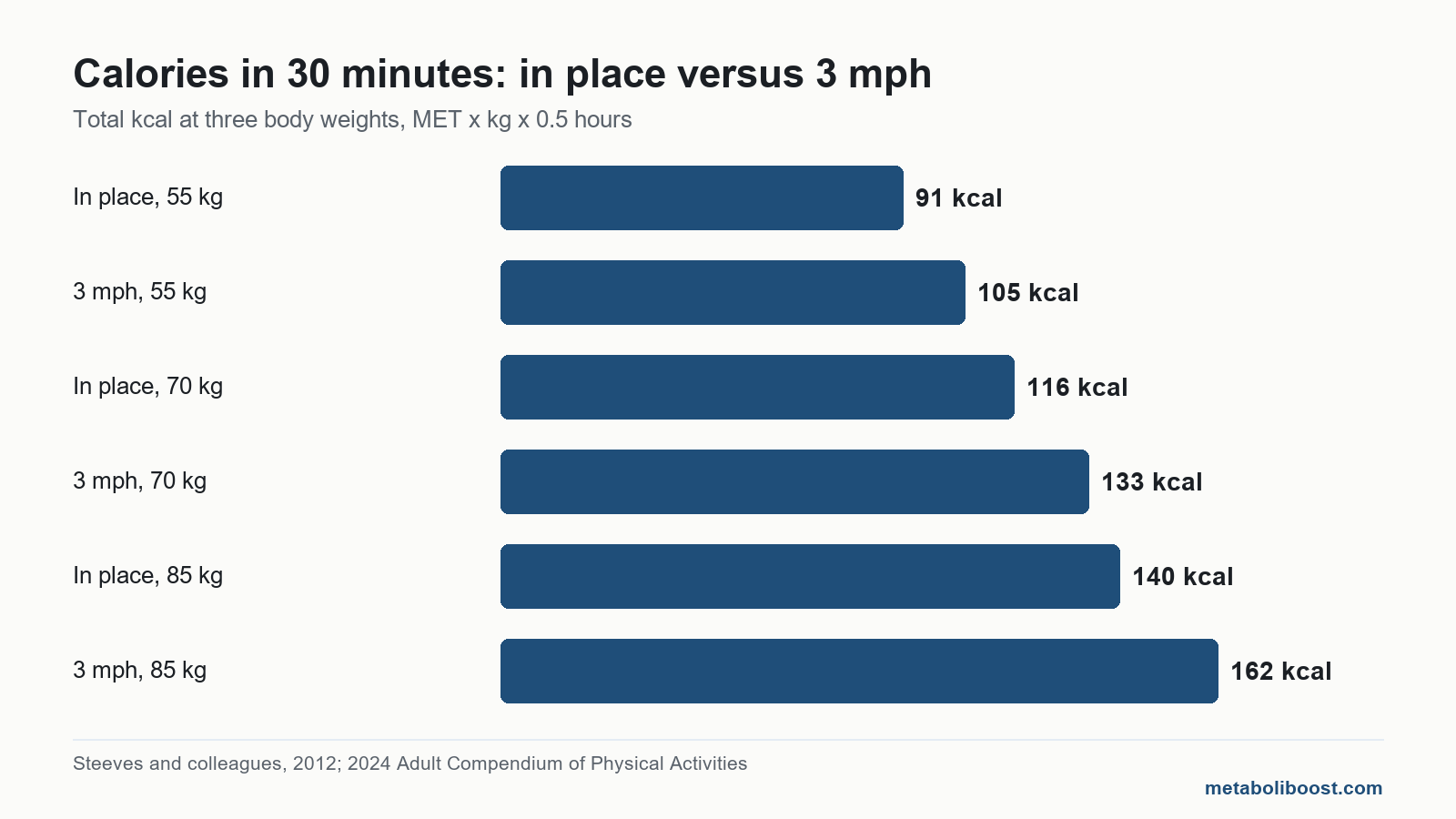
With one MET treated as 1 kcal per kilogram per hour, the sum is MET times weight in kilograms times hours. Here it is for 30 minutes at four body weights.
| Body weight | Sitting, 1.0 | Walking in place, 3.3 | Walking at 3 mph, 3.8 | Jogging in place, 4.8 |
|---|---|---|---|---|
| 55 kg (121 lb) | 28 kcal | 91 kcal | 105 kcal | 132 kcal |
| 70 kg (154 lb) | 35 kcal | 116 kcal | 133 kcal | 168 kcal |
| 85 kg (187 lb) | 43 kcal | 140 kcal | 162 kcal | 204 kcal |
| 100 kg (220 lb) | 50 kcal | 165 kcal | 190 kcal | 240 kcal |
Two things jump out. A heavier body uses more energy for the same march, so a single calories per minute figure is only right for one weight. At 70 kg the derived figure works out at about 3.9 kcal a minute; at 55 kg it is about 3.0 and at 100 kg about 5.5. The commonly quoted three to five range covers the middle of the table and misses both ends.
Second, every total includes the energy the body would use sitting still. Take away one MET and 30 minutes of walking in place at 70 kg is about 81 kcal more than sitting. Our walking calorie calculator explains why that extra to rest figure is the honest one, and it runs the same arithmetic for every outdoor pace.
Run the walking in place arithmetic on your own numbers
This multiplies a MET value by body weight and time, exactly as in the table above, and shows the total and the part extra to sitting. It is a population estimate, not a measurement, and it gives no target, no deficit and no timeline.
The walking in place value is 258 kcal an hour over 79 at rest from one lab study of 23 adults, with a wide spread between people. Other values are from the 2024 Adult Compendium of Physical Activities, for adults aged 19 to 59.
What happened when people stepped in place for six months?
A lab hour proves the energy cost. It does not prove anyone keeps doing it. The same group ran that test in a six month randomised pilot published in the International Journal of Behavioral Nutrition and Physical Activity in 2012. It enrolled 58 sedentary adults with an average BMI of 33.5 and an average age of 52. Half were told to step in place during TV adverts, half to walk briskly, each aiming for at least 150 minutes a week.
At six months, 47 of the 58 were still in the study. Daily steps rose in both groups, to an average of 7,605 for the commercial steppers and 7,865 for the walkers, with no significant difference between them. Both groups reported watching about an hour less television a day. Both met their activity goal on about four days a week.
And then the line the infomercials would never print: in the paper’s own words, body weight did not change. Waist and hip measurements fell in both groups, and body fat percentage dropped between three and six months. So the habit moved people and changed some markers of health, while the scale stayed where it was. The trial was small and short, and it was not built to test weight loss, so read it as what one study found rather than a verdict.
Does a watch or pedometer count steps taken in place?
Mostly, with caveats. The lab study trusted no device: steps were counted with a hand tally counter. In the six month pilot, participants wore a pedometer the authors describe as validated for stepping in place, yet they still flag a possible undercount for slow stepping, and asked everyone to step briskly.
Wrist devices add their own problem. They read steps partly from arm movement, so a march with your arms still, holding a phone or a sleeping toddler, gives the sensor less to work with. We found no study that tested wrist trackers on walking in place specifically, so treat that as a likely weakness rather than a measured one. Calorie figures are shakier still: a Stanford test of seven wrist worn devices found none estimated energy expenditure to within 20 percent.
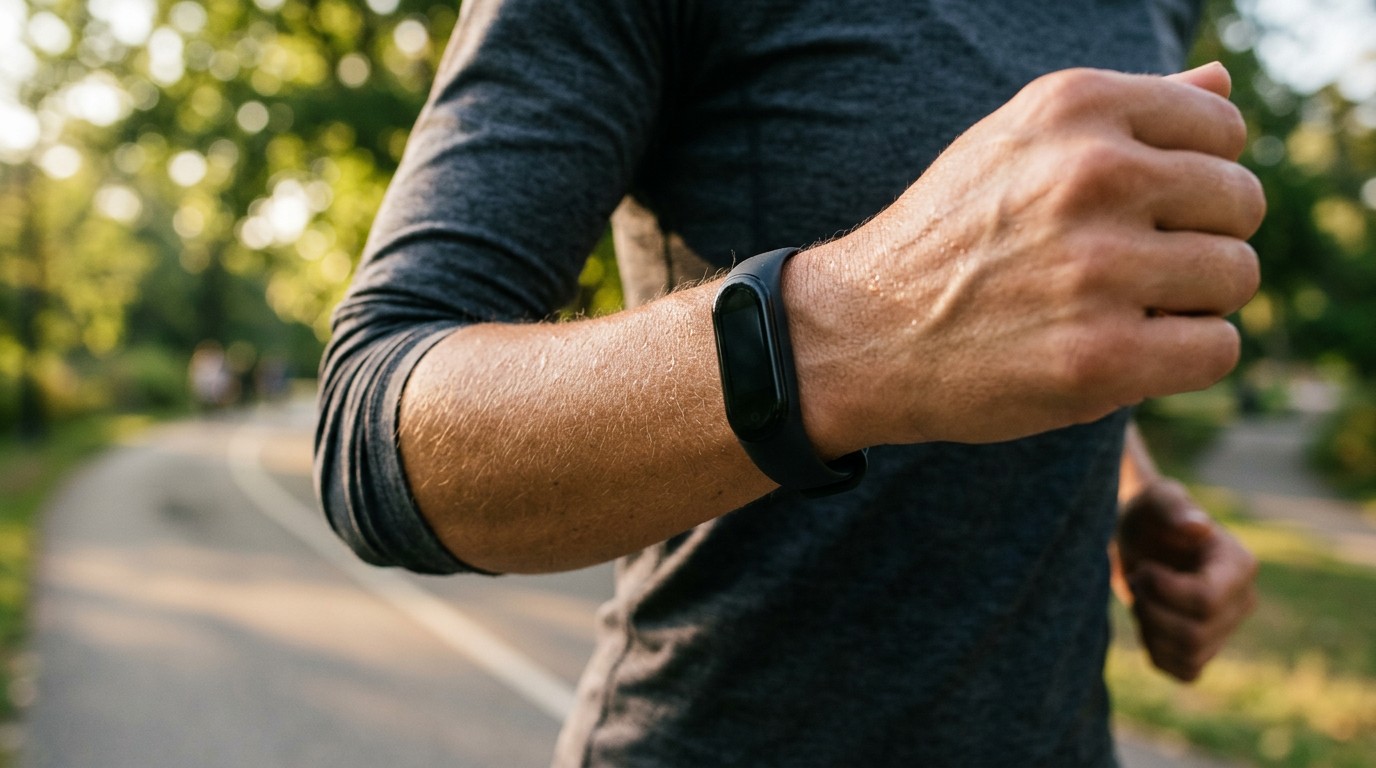
So the step count from a living room march is a rough tally, and the watch’s calorie figure a rougher one. The step count trials and what they actually found are a better guide than any single reading.
What do people who walk in place at home report?
Forums are where people describe actually doing this, so we read two recent threads on Reddit’s r/loseit, about 78 comments in all. These are reports, not findings.
- In an August 2026 thread, someone too unwell to leave the house reached a 10,000 step day by walking circles around a room and asked whether it counted. Most of the 68 replies said yes, movement is movement.
- In the same thread, several people with small homes reported that they could not reach the pace, stride or heart rate indoors that they managed outside, so they assumed each indoor step cost less.
- A commenter who said they work in human nutrition pushed back: with pace, stride and incline equal, indoor and outdoor walking cost the same, and the location itself changes nothing.
- Another reported that the step counter on a YouTube walking video never matched their own watch, and they went with the watch.
- In an April 2026 thread, someone jogging in place needed walk breaks to reach ten minutes and asked if it counted toward 30 minutes of moderate activity. Replies split: one said needing breaks suggested vigorous effort, one said they would not count the calories at all to be safe, and one said it was better than nothing.
Where the accounts agree with the evidence: the nutrition commenter is right that location does not change the energy cost, and the small room crowd is right that pace does, which is exactly the 76 kcal spread the lab saw. Where they part company is the split over whether it counts. The NHS guideline for adults aged 19 to 64 asks for at least 150 minutes of moderate activity a week and to break up long periods of sitting, and its own test of moderate is that you can talk but not sing. A march that passes that test counts, whatever the room.

Can walking in place help with weight loss?
It depends, and here is what actually governs it. Walking in place adds energy use, the table above says how much, and energy use is one side of the balance. The other side is food, and the body adjusts both over time, which is why the calorie deficit sum is less tidy than it looks. Nobody can honestly put an amount or a date on what a daily march will do for a particular person, and the six month trial above is a useful reminder: steps went up, waists came down, and weight held still.
Where walking in place earns its keep is on days that would otherwise be all sitting: dark evenings, bad weather, unsafe streets, a body that cannot manage a long walk, much like the short walk after a meal. If a treadmill is in reach, incline changes the sum far more than speed. And no detox tea, fat burner or one weird trick changes what a march costs, whatever the label promises.
Anyone with a heart condition, a joint problem, a balance problem or who has not exercised for a while should speak to a GP or doctor before starting, and should stop and get advice if a march brings on chest pain, dizziness or unusual breathlessness.
This article is general information, not personal medical advice. Speak to a doctor, dietitian or other qualified professional about your own situation.
Frequently asked questions
Is walking in place as good as walking outside?
For energy, close but not equal. In the Steeves lab study stepping in place used about 85 percent of the energy of treadmill walking at 3 mph. Walking outside also covers ground, which some people find easier to sustain.
How many steps is 30 minutes of walking in place?
It depends on cadence. In the TV advert study, volunteers took an average of 2,111 steps in 25.2 minutes of stepping, about 84 a minute, which would be roughly 2,500 in 30 minutes at that pace. A brisker march would log more.
Does jogging in place burn more than walking in place?
Yes. The Compendium of Physical Activities lists jogging in place at 4.8 MET, against about 3.3 for walking in place derived from the lab study, so it uses roughly 45 percent more energy for the same time.
Does marching with high knees burn more calories?
Probably, because lifting the legs higher takes more work, and the wide spread in the lab results suggests effort varies a lot between people. No study we found measured high knee marching separately.
Does walking in place count toward the 150 minutes a week?
If it reaches moderate intensity, yes. The NHS test is that you can still talk but cannot sing. A gentle shuffle may not reach it, while a brisk march usually does.
Is walking in place safe for older adults?
For many people it is a low impact option, but balance matters on the spot. Standing near a counter or chair helps, and anyone with a balance, heart or joint condition should ask a GP first.
Finished the page? The same five questions from the top, to see what stuck.
This article is general information, not medical advice, and is not a substitute for care from a qualified healthcare professional. Speak to your doctor about your own situation.
Leave a Reply