
The evidence on apple cider vinegar and weight loss is thin: a handful of small, short trials, the most quoted one run by a vinegar company, and a widely shared 2024 trial retracted in September 2025. Any effect seen was small and faded when people stopped. What governs weight is still the whole diet, sleep and activity.
Listen to this article, about 12 minutes. A synthetic voice reads the article and announces each section title as it begins; tables are read row by row and the questions at the end are left out.
Recorded 10 October 2026 from the article as published that day. Press a chapter to jump there; the highlighted line is what is playing. A play button sits beside every section heading, and once you scroll past this player a bar at the bottom of the screen keeps the controls in reach. Tap or click any sentence to hear the reading start from there.
On this page: every trial behind the apple cider vinegar weight claim in one table, with who ran it, how big it was and what has happened to it since, including the 2024 trial retracted in September 2025.
Think you already know this? Five questions, one minute.
Every answer is on this page. Answer from what you know now; the page fills in the rest.
-
1. Who ran the 2009 Japanese vinegar trial that most weight loss claims trace back to?
The Kondo 2009 paper lists its authors at the Central Research Institute of Mizkan Group, a vinegar maker. Read the section
-
2. What reason does the September 2025 retraction notice give?
The retraction notice says the authors’ analyses could not be replicated and multiple errors were identified. Read the section
-
3. How does the 2025 meta-analysis in Nutrients treat the retracted Lebanese trial?
The 2025 review was published on 19 September 2025, four days before the retraction notice, and the trial remains in its pooled analysis. Read the section
-
4. Which change did a 2021 meta-analysis of nine trials report with vinegar?
The 2021 meta-analysis found lower fasting plasma glucose and HbA1c, with high inconsistency between studies. Read the section
-
5. What did a laboratory study of vinegar varieties find on human tooth enamel?
The enamel study found that incubating enamel in vinegars released minerals from its surface, which is why dilution and rinsing are the usual precautions. Read the section
Most pages on this subject do one of two things. The clinic pages say the evidence is weak and stop. The pharmacy and wellness pages quote a trial with an impressive result and a buy button underneath. Neither shows you the trials themselves. So that is what this page does: every study the claims rest on, who ran it, how big it was, and what has happened to it since.
Does apple cider vinegar actually help with weight loss?
Probably not in any way you would notice. Mayo Clinic’s dietitian answer puts it plainly: studies have not found meaningful weight loss or lasting appetite control from apple cider vinegar, and many of the studies were small or flawed in other ways. A 2020 systematic review in the European Journal of Nutrition looked at 13 human studies and concluded that, for lack of high quality research, the evidence for the health effects of apple vinegar is insufficient.
That is not the same as saying vinegar does nothing. A few placebo controlled trials found small differences between groups. The honest summary is that the effect, if real, is small, short lived and swamped by everything else a person eats in a day. A tablespoon of vinegar does not get to outvote everything else on the plate. If you want the part that does move the needle, the plain explanation of a calorie deficit is the place to start.
Which trials do the ranking pages rely on?
Trace the claims back and they land on a short list. The table below is that list, with the detail the sales pages leave out.
| Study | Who and how many | What they drank, for how long | Compared with | Status and the catch |
|---|---|---|---|---|
| Kondo and colleagues, 2009 | Japan. 175 adults with obesity enrolled, 155 analysed | A 500 ml drink with 15 or 30 ml of apple vinegar daily, 12 weeks | Placebo drink, double blind | Published. Authors from the research institute of vinegar maker Mizkan. Weight and BMI were back at starting values four weeks after the drinks stopped |
| Khezri and colleagues, 2018 | Iran. 44 randomised, 39 in the published analysis | 30 ml a day alongside a calorie restricted diet, 12 weeks | Diet alone, no placebo drink | Published. Both groups dieted, and only one group knew it was drinking vinegar |
| Abou-Khalil and colleagues, 2024 | Lebanon. 120 recruited | 5, 10 or 15 ml a day, 12 weeks | Placebo | Retracted 23 September 2025: analyses could not be replicated, no prospective registration |
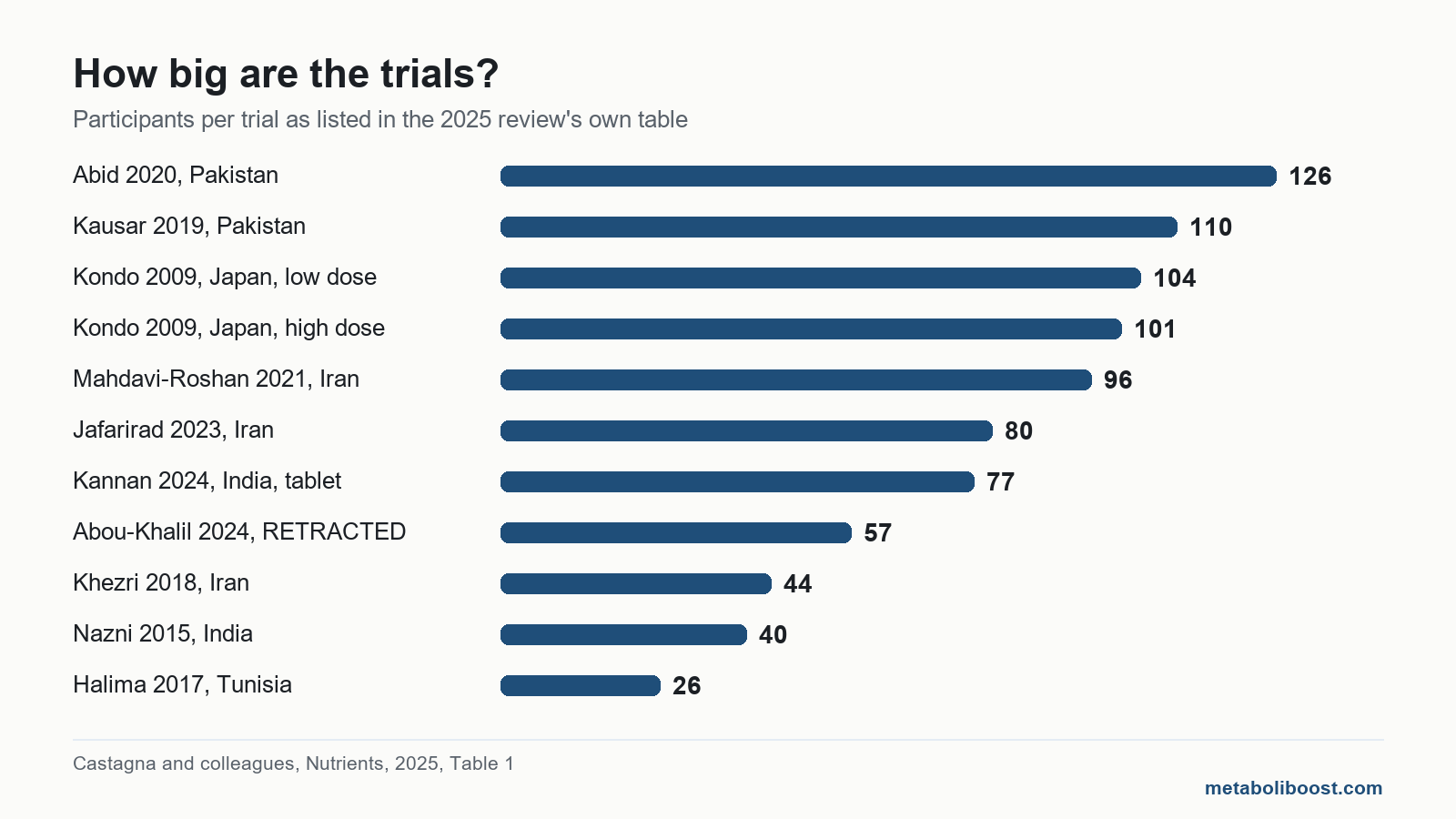
| Castagna and colleagues, 2025 | 10 trials. 789 participants in the abstract, 861 in its own table | Mostly liquid, one effervescent tablet trial, 4 to 12 weeks | Mixed | Published 19 September 2025, four days before the retraction. Includes the retracted trial |
| Launholt and colleagues, 2020 | 13 human studies reviewed | Various | Various | Concluded the evidence is insufficient because high quality research is lacking |
The trial everyone quotes is the 2009 Japanese one. It was a proper double blind study with a placebo drink flavoured to taste like vinegar, which is more care than most supplement research gets. It was also run by scientists at the Central Research Institute of Mizkan Group, one of Japan’s biggest vinegar makers. That does not make the result wrong. It does mean the result needs repeating by someone without a vinegar to sell, and every later trial in the 2025 review is smaller. The paper itself also reported that four weeks after the drinks stopped, body weight and BMI had returned to their starting values. The authors’ reading was that you would have to keep drinking it. Another reading is that a vinegar a day keeps nothing away for long.
The 2018 Iranian trial is often listed as a second confirmation. Read the design: everyone was on a calorie restricted diet, one group added vinegar, and there was no placebo drink. People who know they are taking the treatment tend to try a little harder at everything else, so that trial cannot separate the vinegar from the enthusiasm.
Why was the 2024 Lebanese trial retracted?
Because nobody could make its numbers work. The 2024 trial in Lebanese adolescents and young adults reported results far larger than any earlier vinegar study, and BMJ Group press released it to wide international coverage. Critics posted rapid responses and letters. The publisher’s integrity team then sent the study to statisticians, who tried to reproduce the analysis from the raw data.
They could not. The retraction notice in BMJ Nutrition, Prevention and Health, dated 23 September 2025, says the authors’ analyses could not be replicated and multiple errors were found. It lists patterns inconsistent with random allocation and improbably small p values for such a small study. The trial had also not been registered before it began, which breaks the journal’s own policy. The authors called the problems honest mistakes and agreed to the retraction.
The paper is gone. The headlines are not. Pages that sell vinegar products still quote its result, which is a useful test of any page you are reading: if it cites the Lebanese trial without the word retracted beside it, it has not checked its own sources.
Before you believe an apple cider vinegar weight claim
Questions to ask of any page, label or video making the claim. Each one comes from a problem documented on this page.
A claim that fails several of these is marketing. None of this tells you whether vinegar suits you; a doctor or pharmacist can, especially if you take medicines.
What does the 2025 meta-analysis add, and what does it miss?
On paper, a lot. Castagna and colleagues in Nutrients pooled 10 randomised trials, published on 19 September 2025, and reported that daily apple cider vinegar reduced body weight, BMI and waist circumference, with no effect on fat mass or the other body composition measures. The authors called vinegar a possible short term addition to weight management and said larger, longer trials are needed before its efficacy and safety can be established.
Look closer and four things stand out. The trials disagreed with each other a lot: the measure of inconsistency, called I squared, was 62 percent for body weight and 83 percent for BMI. Funnel plots were lopsided, which can mean small negative studies never got published. The participant count reads 789 in the abstract and 861 in the review’s own table, and the Japanese trial appears there as two comparisons of 104 and 101 people, numbers that seem to count its single placebo group twice. And the retracted Lebanese trial is in the pool, rated low risk of bias.
That last one is not quite the authors’ fault. The review came out four days before the retraction notice. But the review has not been updated since, and pages quoting it rarely mention either point.
How is vinegar supposed to work, if it works at all?
The proposed mechanisms are reasonable, which is part of why the idea survives. Acetic acid, the compound that makes vinegar sour, seems to slow how fast the stomach empties and blunt the rise in blood sugar after a starchy meal. A 2021 meta-analysis in BMC Complementary Medicine and Therapies of nine trials found lower fasting blood glucose and HbA1c with vinegar, again with high inconsistency between studies. A slower stomach can mean feeling full a little longer.

Notice what that chain needs to deliver weight loss: the fullness has to turn into eating less, day after day, without being made up later. That is the same route as eating more protein or more fibre, which are better studied and do not strip enamel. The evidence on a high protein diet is considerably stronger than anything in the table above. And no, it does not melt fat or detox anything; the detox claim fails on its own terms before vinegar even enters it.
Form matters too. Nearly every trial used liquid vinegar, and when the National Advertising Division reviewed a challenge by Bragg against Goli’s apple cider vinegar gummies in January 2022, Goli dropped the claim that two gummies equal one dose of liquid vinegar, and the division recommended it stop implying the gummies deliver the benefits of the traditional drink. A gummy is a sweet with a sour backstory. Capsules have their own labelling problem, covered in the article on apple cider vinegar pills.
What do people who tried it report?
Testimony is not evidence, so read this section as what people say, not as what vinegar does. We read about 30 comments across two Reddit threads and a few mentions in r/loseit, from October 2025 to September 2026. The range ran from no effect at all to genuine enthusiasm, and the enthusiasm almost always came attached to eating less.
- In a December 2025 r/Supplements thread, the original poster said they took apple cider vinegar tablets for cravings while losing weight and noticed no difference, and that their mother and sister tried it with the same result. They added that in India it is advertised as a craving control product.
- In the same thread, one commenter said two tablespoons in water helped them feel full enough to skip breakfast and eat smaller lunches. Asked directly, they agreed they were simply eating much less.
- Another said a morning glass in warm water sent them to the bathroom so often that they stopped, after which things settled back to normal.
- Several others said the only thing that had worked for them was eating less and moving more, with vinegar or without it.
- Under an October 2025 r/science post about the meta-analysis, the most upvoted comment pointed out that it included the retracted trial; a reply noted the retraction came after the review was written.

Where the accounts agree with the trials is the size of the thing. Nobody described vinegar doing the work on its own. Where they part company is fullness: some people clearly feel it, and the trials cannot say who will.
Who needs to be careful with apple cider vinegar?
Vinegar is an acid, and the problems follow from that. Undiluted vinegar on teeth is the obvious one; a laboratory study of vinegar varieties on human enamel found measurable mineral loss from the enamel surface. Diluting it in a glass of water and rinsing afterwards are the usual precautions.
Large amounts over a long time are a different matter. A 1998 case report in Nephron described a patient with low potassium and osteoporosis who had been drinking large amounts of cider vinegar. It is one case, but it shows the ceiling is real.
Because vinegar can lower blood sugar after meals, anyone taking insulin or another glucose lowering medicine needs to talk to their doctor before using it regularly, and the same goes for anyone on diuretics or other medicines that affect potassium. People with reflux, gastritis, an ulcer or difficulty swallowing may find acid makes things worse. Anyone with kidney disease needs medical advice first. And if your weight is changing without a reason you can explain, that is a reason to see a doctor, not to buy vinegar.
Frequently asked questions
Is apple cider vinegar better than other vinegar for weight?
There is no good evidence that it is. The trials used acetic acid as the active ingredient, and ordinary vinegars contain it at similar strengths. The apple version is preferred mostly for its taste.
Does the mother in unfiltered vinegar make a difference?
No trial has shown that the cloudy sediment called the mother changes body weight. It is a selling point, not a studied ingredient.
Does it matter what time of day you take it?
The studies that looked at blood sugar used vinegar with or just before meals. No trial has shown a morning dose on an empty stomach does anything for weight, and it is the timing people most often report as hard on the stomach.
Can apple cider vinegar replace weight loss medication?
No. Prescription weight loss medicines have been tested in large trials over years; vinegar has small, short ones. Any change to a prescribed medicine is a conversation for your doctor.
Why do so many sites still quote big results?
Many quote the 2024 Lebanese trial, which was retracted in September 2025, or the 2025 meta-analysis that still includes it. Checking whether a cited study has been retracted takes one search.
Is it safe to drink apple cider vinegar every day?
Reviews suggest small, diluted amounts are generally tolerated, but daily use is not risk free for teeth, the gut, or people on glucose or potassium affecting medicines. A doctor or pharmacist can say what applies to you.
Finished the page? The same five questions from the top, to see what stuck.
This article is general information, not medical advice, and is not a substitute for care from a qualified healthcare professional. Speak to your doctor about your own situation.
Leave a Reply