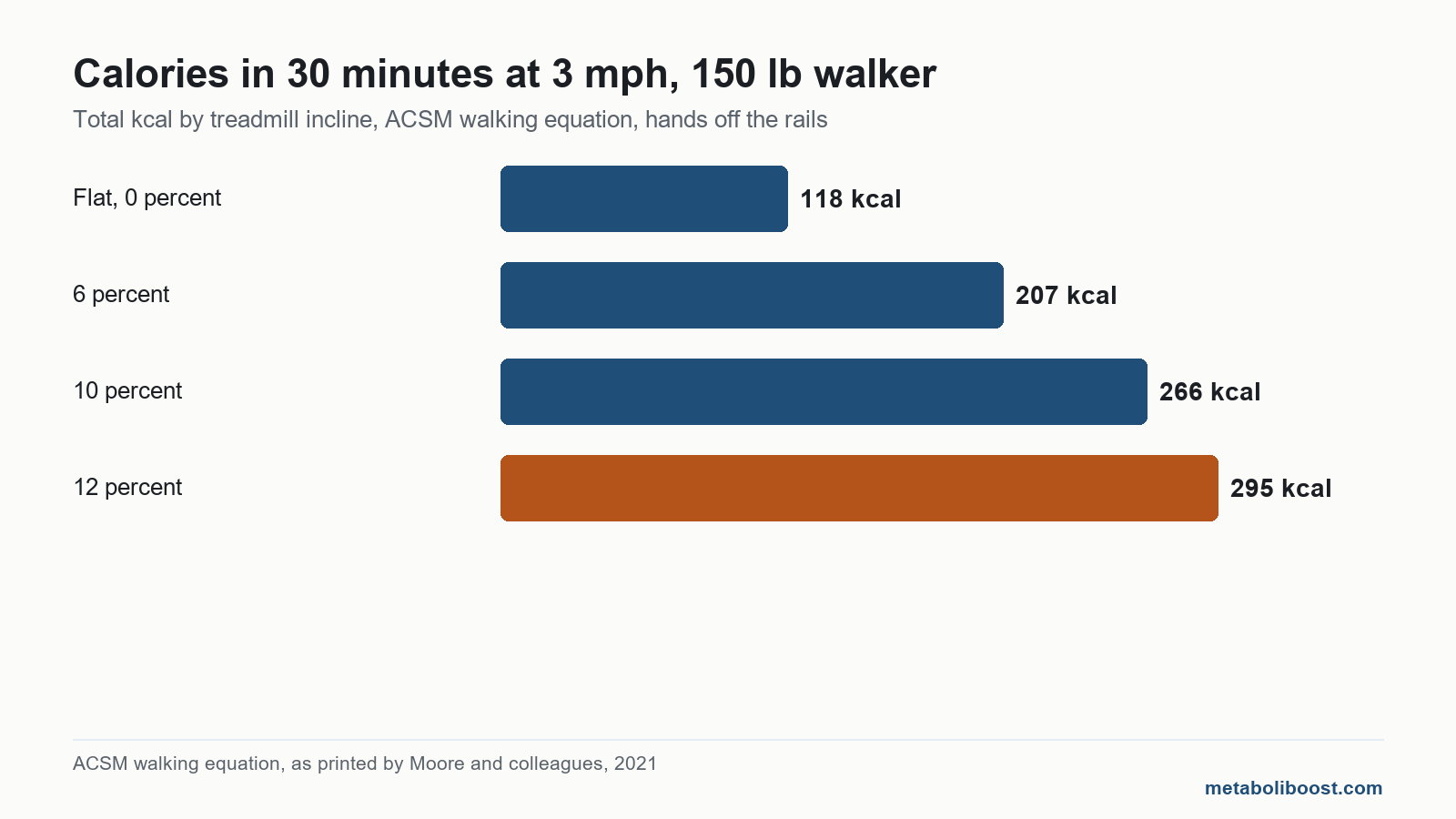
How to lose weight on a treadmill comes down to the usual sum: the belt adds calories burned, and eating decides most of the rest. Incline changes that sum far more than speed. At 3 mph, a 150 pound walker uses about 118 kcal in 30 minutes on the flat and about 295 at a 12 percent incline.
Listen to this article, about 12 minutes. A synthetic voice reads the article and announces each section title as it begins; tables are read row by row and the questions at the end are left out.
Recorded 8 October 2026 from the article as published that day. Press a chapter to jump there; the highlighted line is what is playing. A play button sits beside every section heading, and once you scroll past this player a bar at the bottom of the screen keeps the controls in reach. Tap or click any sentence to hear the reading start from there.
On this page: treadmill calories at six inclines worked out from the ACSM walking equation for three body weights with the sum shown, checked against the one lab study of 12-3-30, plus what the handrail studies measured.
Think you already know this? Five questions, one minute.
Every answer is on this page. Answer from what you know now; the page fills in the rest.
-
1. In the ACSM walking equation, roughly what does raising the incline from flat to 12 percent at 3 mph do to the calorie cost?
The equation as printed by Moore and colleagues gives about 3.3 MET on the flat and about 8.3 MET at 12 percent at 3 mph. Read the section
-
2. In the test of 235 adults on a level treadmill, how did the ACSM walking equation compare with measured oxygen use?
Moore and colleagues, 2021 found a mean bias of minus 2.11 mL/kg/min at normal walking speeds, a tendency to underpredict. Read the section
-
3. When 12-3-30 and self paced running were matched for total calories, what happened?
In the 2025 study by Wong and colleagues the run took 23.9 minutes and the walk 30.1 minutes for about the same 308 kcal. Read the section
-
4. In the 2015 study of stroke survivors, what did a firm handrail hold do to the net energy cost of walking?
IJmker and colleagues found a firm hold reduced net energy cost by 11.8 percent, while light touch did not change it. Read the section
-
5. What did the ACSM position stand conclude about 150 to 250 minutes a week of moderate activity?
The ACSM position stand found that range prevents weight gain but provides only modest weight loss, with more seen above 250 minutes. Read the section
Most pages answering this question are written by companies that sell treadmills, which is a bit like asking a bakery whether bread is filling. They tend to agree on two things: a round figure of about 500 calories an hour, and a social media routine called 12-3-30. Neither usually comes with any working.
So this page shows the working, from the equation exercise labs use, checked against the one lab study of 12-3-30. It is more useful than a round number, and a little less exciting.
How many calories does treadmill walking burn at each incline?
Here is the equation run for three body weights at 3 mph, the speed most incline routines use. Read across a row and the pattern is plain: the heavier walker burns more for the same setting, because the treadmill is asking them to lift more body up the same slope.
| Incline at 3 mph | MET | 130 lb walker, kcal in 30 min | 160 lb walker | 190 lb walker |
|---|---|---|---|---|
| 0 percent, flat | 3.3 | 102 | 126 | 149 |
| 3 percent | 4.5 | 141 | 173 | 205 |
| 6 percent | 5.8 | 179 | 220 | 262 |
| 10 percent | 7.4 | 230 | 283 | 337 |
| 12 percent, the 12-3-30 setting | 8.3 | 256 | 315 | 374 |
| 15 percent, the top of many home machines | 9.5 | 294 | 362 | 430 |
Read down a column and the incline does most of the work. For a 160 pound walker, going from flat to 12 percent multiplies the 30 minute figure by about two and a half. Speeding up on the flat does far less: the same equation puts that walker at about 140 kcal for 30 minutes at 3.5 mph with no incline.
What about 500 calories an hour? For a 150 pound walker the equation gives about 236 kcal an hour on the flat at 3 mph, about 414 at 6 percent and about 590 at 12 percent. So the round figure is roughly right for one person on one steep setting, and wrong for almost everyone else.
One honest subtraction. Every total above includes about 1 MET, the energy a body uses sitting still. Our walking calorie calculator explains why the extra to rest figure matters more: at 150 pounds, the 12 percent session is about 260 kcal more than the same half hour on the sofa, not 295.
Where do treadmill calorie numbers actually come from?
Most treadmill consoles and most online calculators use some version of the American College of Sports Medicine walking equation. As printed by Moore and colleagues in Medicine and Science in Sports and Exercise, 2021, oxygen cost equals 0.1 times speed, plus 1.8 times speed times grade, plus 3.5, with speed in metres a minute and grade as a decimal. The 3.5 is resting; the rest is moving forward and lifting the body uphill.
A worked example, for a 150 pound walker at 3 mph and 12 percent. 3 mph is 80.5 metres a minute. Forward cost: 0.1 x 80.5 = 8.0. Uphill cost: 1.8 x 80.5 x 0.12 = 17.4. Add the 3.5 at rest and the total is 28.9 millilitres of oxygen per kilogram per minute. At 68 kg that is about 1.97 litres a minute, and at roughly 5 kcal per litre, about 9.8 kcal a minute, or 295 kcal in 30 minutes.

How close is it? Moore and colleagues tested it against measured oxygen use in 235 adults walking on a level treadmill, and found it underestimated by an average of 2.11 mL/kg/min at normal walking speeds. On the steep end it can miss the other way. The 12-3-30 lab study below measured 10.23 kcal a minute in walkers averaging 75.4 kg, while the equation predicts about 10.9 for that weight, roughly 7 percent high. Treat the table as a good estimate, give or take a tenth.
It also does not quite match the other reference book. The Compendium of Physical Activities rates moderate walking around 3 mph at 3.8 MET, while the treadmill equation gives 3.3 MET on a flat belt. They were built from different measurements, so ignore the third digit of any calorie figure.
Run the treadmill equation on your own numbers
This is the ACSM walking equation worked through above, shown step by step with your inputs. It gives energy used, total and extra to rest. It gives no target, no deficit and no timeline.
Equation as printed by Moore and colleagues, 2021. Lab testing found it off by around 2 mL/kg/min for individuals; holding the rails lowers the real cost.
Is the 12-3-30 workout better than running?
12-3-30 means 12 percent incline, 3 mph, 30 minutes. It spread through a social media video and, by the authors’ count, about 14 million views before anyone tested it. The first lab test came from Wong and colleagues at the University of Nevada, Las Vegas, published in the International Journal of Exercise Science in 2025.
They had young, recreationally active adults do 12-3-30 one day and run at a pace of their own choosing on another, stopping the run when it matched the walk’s energy use. Fourteen of 16 completed both. The walk used 307.6 kcal in 30.1 minutes, about 10.2 kcal a minute. The run used 309.7 kcal in 23.9 minutes, about 13.1 kcal a minute. Participants were not allowed to hold the handrails.
The walk drew more of its energy from fat, about 41 percent against 33 percent for the run. That is the line that gets quoted, and it needs a footnote: the share of fuel burned during a session is not the same as body fat lost over months, which follows total energy balance. Both sessions burned the same number of calories. Running simply got there six minutes sooner.
The fair verdict is the authors’ own: 12-3-30 is less time efficient than running, and lower impact. For a non runner it is a genuinely hard workout; for a runner it is not a secret upgrade. The online answers are all over the place too. On a Quora thread asking what 12-3-30 burns, posted between about 2021 and 2024, estimates for walkers of 130 to 140 pounds run from 150 to 350 kcal. The equation puts that range at about 256 to 275.
Does holding the treadmill handrails cut the calories?
Probably some, and how much depends on how hard the grip is. The evidence is thinner than gym folklore suggests, and it does not all point the same way.
In a 2013 study in the Journal of Exercise Physiology online, 12 healthy adults aged 20 to 30 walked for 10 minutes at 3.5 mph with and without the rails, and oxygen use did not change significantly. That was a light hold on a gentle setting. In a 2015 study of stroke survivors by IJmker and colleagues, a firm handrail hold cut the net energy cost of walking by 11.8 percent, while a light fingertip touch did not change it.
Steep incline walking is where people tend to lean back and hang on, because 12 percent feels like a hill that has taken a personal dislike to you. Leaning back takes body weight off the legs, and the uphill term in the equation assumes the legs lift all of it. Nobody has published a clean figure for a hard grip at 12 percent, so the table is for hands off, and hanging on burns less by an unmeasured amount.
The practical fix is boring and works: lower the incline to a setting that can be walked with hands free, or a light touch for balance. A 10 percent walk done properly beats a 15 percent walk done hanging off the front of the machine like a reluctant water skier.
How much can treadmill walking change weight on its own?
Less than the calorie numbers make it look, which is the part treadmill brochures tend to skip. The American College of Sports Medicine position stand on physical activity and weight loss concluded that 150 to 250 minutes a week of moderate activity provides only modest weight loss, with clinically significant loss linked to more than 250 minutes, and that adding diet changes improves the result.
The Cochrane review of exercise for overweight or obesity, which pooled 43 trials with 3,476 participants, found the same shape: exercise helps weight, more so alongside changes to eating, and it improved heart risk factors even when weight did not change.
Why the gap between calories burned and weight lost? Partly because people tend to eat a bit more when they move more, and partly because the body adapts as weight changes. Our piece on why weight loss stalls even when the routine has not changed goes through that in detail, and the step count trials found walking mattered most for keeping weight off, not taking it off.
So the treadmill is a good tool with a modest job. What it cannot do is outrun a kitchen, and no incline setting changes that.
Who should check with a doctor before steep incline walking?
Steep incline walking raises heart rate and loads the calves, Achilles tendons and lower back more than flat walking. Anyone with a heart condition, high blood pressure, chest pain, dizziness or breathlessness on exertion, or a joint problem should speak to a GP before starting or stepping up this kind of exercise.

The NHS physical activity guidelines ask adults for at least 150 minutes of moderate activity a week and suggest building up gradually for anyone who has been inactive. On a treadmill that means starting low on the incline and adding a little at a time, not opening at 12 percent because a video did. Stop and seek medical advice for chest pain, faintness or pain that does not settle.
This article is general information, not personal medical advice. Speak to a doctor, dietitian or other qualified professional about your own situation before changing how you eat or exercise.
Frequently asked questions
Is it better to walk faster or raise the incline on a treadmill?
For calories at walking pace, the incline does more. In the ACSM walking equation, raising the grade from flat to 12 percent at 3 mph roughly multiplies the energy cost by two and a half, while going from 3 to 3.5 mph on the flat adds far less.
Are the calories on the treadmill display accurate?
They are estimates, usually from a version of the ACSM equation and the body weight entered. Lab testing found that equation off by around 2 mL/kg/min for individuals, and it assumes the handrails are not held. If no weight is entered, the console uses a default.
Is 12-3-30 safe for beginners?
It is hard for someone new to exercise, and steep incline loads the calves and Achilles tendons. Starting at a lower incline and building up is the gentler route, and anyone with a heart or joint condition should ask a GP first.
Does incline walking burn belly fat specifically?
No exercise burns fat from one chosen area. Incline walking uses more energy than flat walking, and fat is lost across the body as a result of overall energy balance, not from the area being worked.
Is walking on a treadmill the same as walking outside?
Close, at walking speeds. Outdoor walking adds small costs from wind and uneven ground, and the Compendium of Physical Activities rates flat walking at about 3 mph slightly higher than the treadmill equation does.
How often should someone walk on a treadmill for health?
The NHS guideline is at least 150 minutes of moderate activity a week for adults, which can be split into shorter sessions. Treadmill walking counts toward that total like any other brisk walking.
Finished the page? The same five questions from the top, to see what stuck.
This article is general information, not medical advice, and is not a substitute for care from a qualified healthcare professional. Speak to your doctor about your own situation.
Leave a Reply