
Most people who feel stuck do not have a broken metabolism. Daily calorie burn is driven by body size, lean mass and how much you move outside the gym, and it falls as you get smaller. Fixing a slow metabolism naturally means rebuilding those inputs rather than hunting for a switch.
Listen to this article, about 10 minutes. A synthetic voice reads the article and announces each section title as it begins; tables are read row by row and the questions at the end are left out.
Recorded 25 September 2026 from the article as published that day. Press a chapter to jump there; the highlighted line is what is playing. A play button sits beside every section heading, and once you scroll past this player a bar at the bottom of the screen keeps the controls in reach. Tap or click any sentence to hear the reading start from there.
On this page: the four parts of daily energy burn and which one you can actually move, what a below average resting rate really means, the six year follow up of television contestants that shows adaptation can outlast a diet, the honest arithmetic on muscle and resting burn, and what does not move the needle.
Think you already know this? Five questions, one minute.
Every answer is on this page. Answer from what you know now; the page fills in the rest.
-
1. Which component of daily energy burn does the page say you can move the most?
The biggest slice, resting metabolic rate at around 60 to 70 percent, is the one you influence least, and the slice you influence most is the one almost nobody counts. Read the section
-
2. In the six year follow up of television weight loss contestants, how far below their starting measurements were resting metabolic rates?
Per the study in Obesity: an extreme case from an unusually aggressive intervention, not a forecast for someone eating sensibly, but it establishes that adaptation can outlast the diet by years. Read the section
-
3. How does the review describe non exercise activity thermogenesis?
Per the review in the Journal of Exercise Nutrition and Biochemistry; it also falls on its own during a deficit, and no food diary records it. Read the section
-
4. Roughly what does resting muscle tissue cost to run, per the estimates on the page?
So a year’s realistic muscle gain adds tens of calories a day, not hundreds; the stronger case is that lean mass is the largest single predictor of resting rate, so protecting it keeps the biggest slice from sliding. Read the section
-
5. Why does eating six small meals rather than three not raise total daily burn?
Frequency can still help with appetite and routine, and the British Dietetic Association’s guidance on fad diets is a useful check on any plan that promises otherwise. Read the section
What does metabolism actually mean?
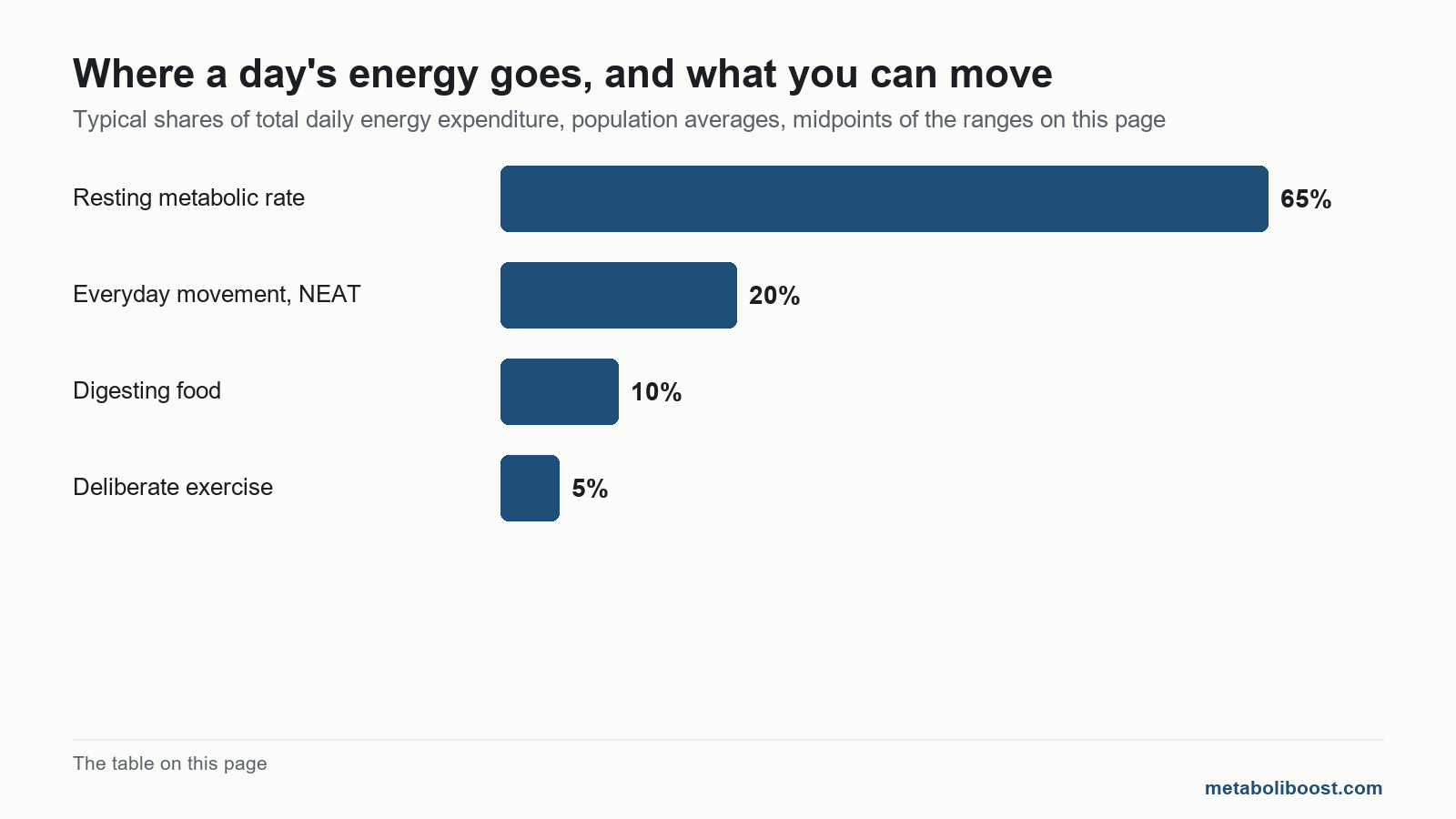
In everyday use, metabolism means total daily energy expenditure: the whole amount of energy your body spends in twenty four hours. It is not one dial. It is four separate things added together, and they differ enormously in size and in how much of each is within your reach.
| Part of daily energy burn | Typical share | How far you can move it | What actually changes it |
|---|---|---|---|
| Resting metabolic rate | Around 60 to 70 percent | Slowly, and by a modest amount | Body size, lean mass, age, sex, genetics |
| Everyday movement, or NEAT | Roughly 15 to 30 percent, sometimes far more | More than any other component | Steps, standing, chores, commuting, restlessness |
| Digesting food | Around 10 percent of what you eat | Slightly | Total intake, and how much of it is protein |
| Deliberate exercise | Often under 10 percent | Directly, but from a small base | Sessions per week, duration, intensity |
Those shares are population averages, not your numbers. A bricklayer and an office worker of the same weight can sit at opposite ends of the range. The useful thing the table shows is the mismatch: the biggest slice is the one you influence least, and the slice you influence most is the one almost nobody counts.
Is a slow metabolism a real thing?
Resting metabolic rates genuinely differ between people. Two adults matched for weight, age and sex will not burn identical amounts at rest, and at the extremes that gap can run to a few hundred calories a day. For most people it is considerably smaller, and smaller again than the week to week variation in what they eat and how much they move.
So a below average resting rate exists, but it is rarely the whole explanation for a stall. There is a second meaning of the phrase that is far more common and entirely normal: a resting rate that has fallen because you are now a smaller person than you were. That is not a fault in your body. It is the expected consequence of having lost weight, and it happens to everyone.
Why does weight loss stall when nothing seems to have changed?
Three things happen at once, and only the first is obvious.
The arithmetic changes. A smaller body costs less to keep alive and less to carry around, so the intake that once produced a deficit gradually becomes maintenance. This is also why the scale is a poor guide on its own, and why it is worth being clear about the difference between weight loss and fat loss.
The drop is often steeper than body size alone predicts. Researchers call this metabolic adaptation. A six year follow up of contestants from a televised weight loss competition, published in Obesity by researchers at the National Institute of Diabetes and Digestive and Kidney Diseases, found that fourteen participants still had resting metabolic rates around 700 calories a day below their own starting measurements, of which roughly 500 calories a day could not be explained by their body composition or age. That was an extreme case, achieved through an unusually aggressive intervention, and it is not a forecast for someone eating sensibly. What it does establish is the direction of travel, and that adaptation can outlast the diet by years.
The third cause is quiet and behavioural. Recorded intake drifts upward over months as portions creep and logging gets loose, while unplanned movement drifts downward. Neither of those arrives as a decision you would remember making.
How much does everyday movement really matter?

More than most people expect, and this is where the phrase slow metabolism is most often misapplied. A review of non exercise activity thermogenesis in the Journal of Exercise Nutrition and Biochemistry describes NEAT as the main variable component of total daily energy expenditure, the piece that differs most from one person to the next. Walking, standing, cooking, carrying shopping, pacing while on the phone: none of it is training, and together it routinely outweighs the gym.
It also falls on its own during a deficit. People eating less sit down sooner, take the lift more often and move less between tasks, without ever choosing to. That is a real reduction in daily burn, and no food diary records it.
What helps is making the invisible measurable:
- A step count you actually look at, so the drift becomes visible
- A floor you hold on bad days rather than a target you hit on good ones
- One or two habits that do not depend on motivation, such as walking part of a commute
- Standing or walking for calls and meetings that do not need a screen
The floor, not the target
Everyday movement is the most variable part of daily burn and the part that quietly falls during a diet. Log the count and whether the floor held, so the drift becomes visible.
A record of the most variable part of daily burn. It scores nothing, and the floor is yours to set. Kept on this device only.
Does strength training raise your resting metabolism?

A little, and that is not the strongest reason to do it. Resting muscle tissue is not especially expensive to run: estimates put it near 10 to 15 calories per kilogram per day, so the amount of muscle a person can realistically add over a year adds tens of calories to daily burn, not hundreds. Any claim of a large resting increase from lifting alone is overstated. We work that sum through the tissue rates in our breakdown of how much building muscle actually raises BMR.
The real case is different and much stronger. Lean mass is the single largest predictor of resting metabolic rate, so protecting the muscle you already have keeps the biggest slice of your daily burn from falling further than body size requires. Training through a deficit shifts more of the loss toward fat, and it preserves strength and function while the number on the scale moves. There is also a modest rise in energy expenditure in the hours after a hard session while the body recovers, though it is small next to the session itself. The longer case for weight training during fat loss covers the mechanisms in more detail.
Does reverse dieting rebuild a metabolism?
Partly, and far less precisely than the protocols imply. The underlying idea is sound. Adaptation is a response to being in a deficit, so leaving the deficit and eating at maintenance for a stretch allows some of it to reverse. Appetite signalling, thyroid output and spontaneous activity all respond to eating enough.
The specific method, adding a fixed small percentage of calories each week and watching the scale, has very little controlled evidence behind it. It may be no more than a structured way of returning to maintenance, which would have helped anyway. Trying it is reasonable. Presenting it as a proven metabolic repair programme is well ahead of the data, and anyone selling it as one is guessing.
What does not move the needle?
Meal timing and frequency come up constantly. Eating six small meals rather than three does not raise total daily burn, because the energy cost of digestion scales with how much you eat, not with how many sittings you spread it across. Frequency can still help with appetite and routine, which is a more honest reason to choose it.
Individual foods and drinks are the same story at a smaller scale. Chilli, green tea and caffeine have measurable short term effects on energy expenditure and appetite, and those effects are far too small to change a week’s balance. The British Dietetic Association guidance on fad diets is a useful check on any plan that promises otherwise.
Thermogenic and fat burner supplements are the weakest category of all. Ingredient studies run in isolated cells, in animals, or at doses no capsule delivers are routinely presented as though they validated a finished formula. They do not, and a study of one ingredient says nothing about the product it appears in. The measured effect sizes for the main metabolism supplement ingredients are collected in one table, and they are smaller than almost anyone expects.
When is it worth talking to a doctor?
When the picture does not fit. Thyroid conditions, some prescribed medications, sleep disorders and other diagnosable causes really do affect energy expenditure and body weight, and they are identified by testing rather than by matching symptoms to a list online. No article can tell you whether one of them applies to you.
That conversation is also the right place for the practical questions. Slower rates of loss preserve lean mass better than aggressive ones, and a ceiling of roughly one percent of body weight per week is often used in practice for that reason, but the right pace for an individual depends on their starting point, their health and their medication. The British Dietetic Association guidance on reaching a healthier weight is a reasonable place to read before that appointment.
Where does the effort actually pay off?
The parts of metabolism worth working on are the ones you can reach. Protecting lean mass keeps the largest component from sliding. Defending daily movement guards the most variable one. Not living in a deficit indefinitely limits how far adaptation goes. None of that is fast, and none of it is a switch, but the absence of a switch is not the same as being stuck. The part that decides the outcome is usually what happens after the loss, not during it.
Common questions about a slow metabolism
Can you actually speed up your metabolism?
You can raise total daily energy expenditure, which is what the question usually means. The lever is mostly movement, with a smaller contribution from protecting muscle. What you cannot do is push your resting rate far above what your body size and composition support.
Do metabolism boosting supplements work?
Not to any degree that changes a week. Most rest on ingredient studies done in cells or at doses far beyond what a capsule delivers, then presented as if they validated the finished product. Nothing in that category substitutes for intake and daily movement.
Does eating more often keep the metabolism active?
No. The energy cost of digestion tracks how much you eat, not how many times you sit down to eat it. Smaller frequent meals can help some people manage appetite and routine, which is a different and more honest reason to choose them.
Can a slow metabolism stop you losing weight entirely?
It is very rarely the whole story. Differences in resting rate between similar people are usually smaller than differences in intake and unplanned movement. When loss stalls, unrecorded eating and reduced daily activity explain more of it than resting metabolism does.
Could a thyroid problem be the cause?
It can be, and it is diagnosed with a blood test rather than by reading symptoms online. If weight, energy or temperature regulation have changed in a way that does not match what you are doing, that is a question for a doctor rather than for a search engine.
Does metabolism slow down with age?
Less, and later, than the folklore suggests. Once you adjust for body composition, daily energy expenditure holds fairly steady through adult middle age and declines more noticeably later in life. Much of what gets blamed on age is lost muscle and reduced movement instead.
Finished the page? The same five questions from the top, to see what stuck.
This article is general information, not medical advice, and is not a substitute for care from a qualified healthcare professional. Speak to your doctor about your own situation.
Leave a Reply