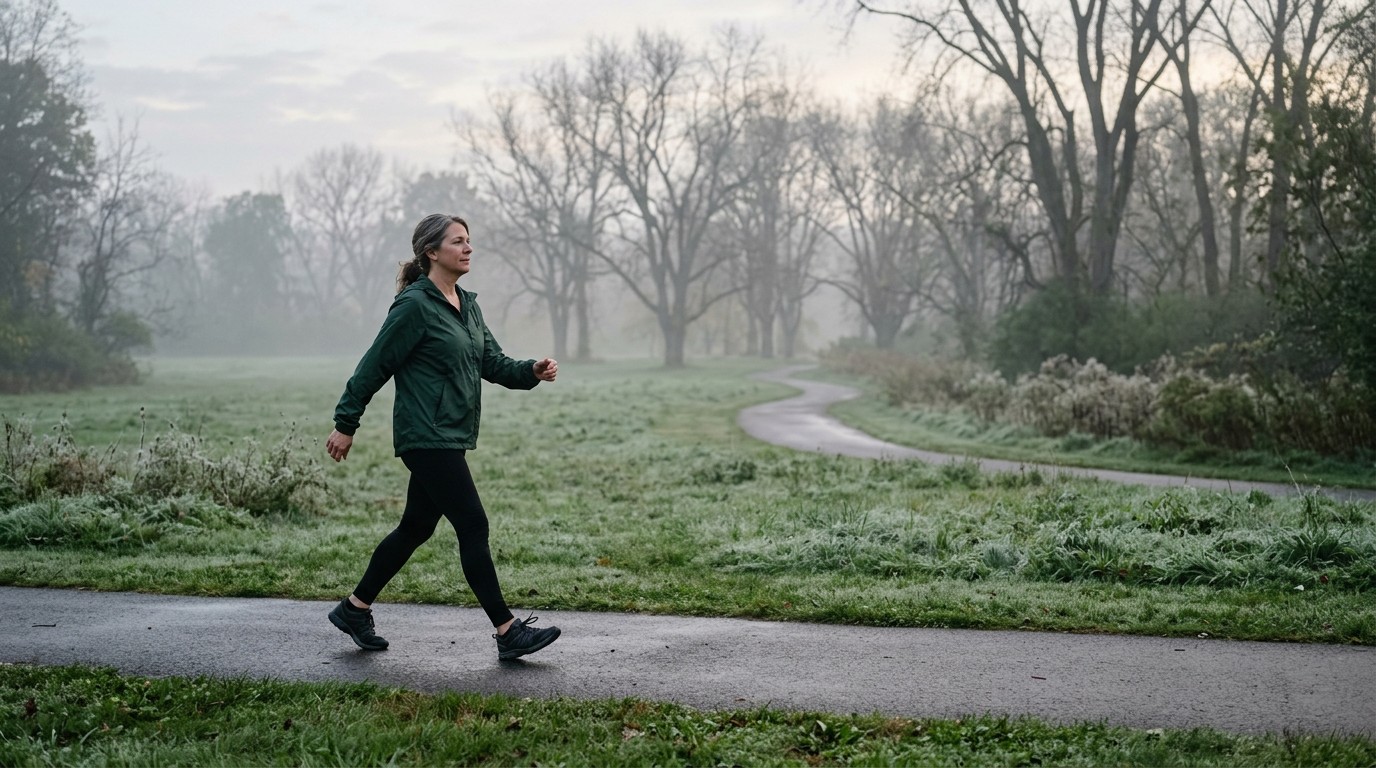
Walking while fasted usually shifts more of the fuel you burn during the walk towards fat, although one brisk walking trial found no clear difference. Over weeks, trials comparing fasted and fed exercise have not found more fat lost. Total energy balance governs fat loss, so the best time to walk is the one you keep.
Listen to this article, about 10 minutes. A synthetic voice reads the article and announces each section title as it begins; tables are read row by row and the questions at the end are left out.
Recorded 19 November 2026 from the article as published that day. Press a chapter to jump there; the highlighted line is what is playing. A play button sits beside every section heading, and once you scroll past this player a bar at the bottom of the screen keeps the controls in reach. Tap or click any sentence to hear the reading start from there.
On this page: six fasted and fed exercise studies in one table, the in session fuel results beside the weeks long body results with a source on every row, the carbohydrate figures from a 45 minute brisk walking trial, and what seven people on Reddit reported about walking before breakfast.
Think you already know this? Five questions, one minute.
Every answer is on this page. Answer from what you know now; the page fills in the rest.
-
1. In the first McIver brisk walking trial, what differed clearly between the fasted and fed walks?
In the International Journal of Obesity trial, carbohydrate use was higher when fed, while fat use showed no significant difference (P = 0.374). Read the section
-
2. In Schoenfeld’s four week trial, how did body composition change in the fasted and fed groups?
Schoenfeld and colleagues found both groups lost weight and fat mass, with no significant difference between them. Read the section
-
3. What pooled difference in fat used during a session did the 2016 meta-analysis find for fasted exercise?
The British Journal of Nutrition meta-analysis found higher fat oxidation when fasted, a pooled 3.08 grams, a real but very small amount. Read the section
-
4. In the 2019 Appetite trial, what happened to food intake over the 24 hours after a fasted walk?
The Appetite trial found no difference in 24 hour energy intake between fasted and fed walks. Read the section
-
5. Which medicines does the Cambridge University Hospitals guidance group together as ones to understand before exercising?
Cambridge University Hospitals names insulin and sulphonylureas as glucose lowering medicines whose effect on blood glucose matters during exercise. Read the section
The idea is tidy. No breakfast means less sugar in the blood, so the body reaches for its fat stores, so the walk burns fat instead of toast. Every step of that is roughly true, and the conclusion people draw from it still is not. The trick is to keep two questions apart that almost every page on this topic blends together: what you burn during the walk, and what you lose over the following weeks. Checked against the trials on 31 October 2026.
Does walking while fasted burn more fat during the walk?
Usually a little, though the walking trials themselves disagree. In a crossover trial published in the International Journal of Obesity, Victoria McIver and colleagues had 12 men walk briskly for 45 minutes on a treadmill, once with no breakfast and once after a bowl of cereal with milk. Carbohydrate use was clearly higher after breakfast, for example 1.16 against 0.87 grams a minute at the 30 minute mark. Fat oxidation, though, showed no significant difference between the two walks (P = 0.374).
A second trial by the same group, in Appetite in 2019, repeated the 45 minute walk four ways, morning and evening, fasted and fed. This time fat oxidation was higher throughout both fasted walks than both fed ones, and stayed higher until after lunch. Across many types of aerobic exercise, a 2016 meta-analysis in the British Journal of Nutrition concluded that exercising fasted induces higher fat oxidation than exercising fed, a pooled difference of 3.08 grams of fat.

Does fasted walking lead to more fat loss over weeks?
Not in the trials that have checked. In Brad Schoenfeld’s 2014 trial, 20 young women on the same reduced calorie diet did one hour of steady treadmill work three times a week for four weeks, half before eating and half after a shake. Both groups lost weight and fat mass, and the authors found the body composition changes similar whether or not people trained fasted. The difference in fat mass between the groups was nowhere near significant (P = 0.88).
A 2017 meta-analysis by Hackett and Hagstrom pooled five studies with 96 adults and found the difference between fasted and fed exercise on body mass and body fat was trivial, while warning that there were too few studies to be confident. And in a six week trial in the Journal of Clinical Endocrinology and Metabolism, men with overweight who cycled before breakfast burned more fat during sessions than men who cycled after it, yet weight change did not differ between the groups. That trial found one real difference, which we come back to below.
Here is everything above in one place, the in session results beside the weeks long ones, with the source on every row.
| Study | Who and what | What was measured | What it found |
|---|---|---|---|
| McIver, Int J Obes | 12 men, one 45 minute brisk walk, fasted or after cereal | Fuel used during the walk | More carbohydrate used when fed; fat use not significantly different |
| McIver, Appetite 2019 | 12 men, four 45 minute walks, morning and evening | Fuel used, appetite, next 24 hours of eating | More fat used when fasted; no difference in 24 hour intake |
| Vieira, Br J Nutr 2016 | Meta-analysis of single aerobic sessions | Fat used during the session | Higher when fasted, by 3.08 grams pooled |
| Schoenfeld, JISSN 2014 | 20 women, reduced calorie diet, 4 weeks of treadmill work | Weight, fat mass, lean mass, waist | Both groups changed; no difference between them |
| Edinburgh, JCEM | Men with overweight, 6 weeks of cycling | Fat use, insulin response, weight | More fat used and lower insulin after meals when fasted; weight change no different |
| Hackett and Hagstrom 2017 | Meta-analysis, 5 studies, 96 adults | Body mass and body fat | Trivial difference; too few studies to be sure |
The pattern is plain. Studies of fuel during the session found fasting tilting it towards fat, or at least not away. Studies of bodies over weeks found no meaningful difference. Whether walking at any hour changes belly fat is a separate question, and the CT scan trials on whether walking helps reduce belly fat answer it with group averages rather than fuel readings.
Why does more fat burned on the walk not add up?
Your body balances fat and carbohydrate use throughout the day. Even if you burn more fat during a morning walk before breakfast, what really matters for weight loss is how much you eat versus how much energy you burn over time. A 45-minute walk burns roughly the same calories whether you eat before or after it. For scale, a 45 minute brisk walk is only about half of 10,000 steps, and the worked figures on how long it takes to walk 10,000 steps at different paces put the full count at roughly 80 to 120 minutes.
Then there is the size of the effect. The pooled 3.08 grams from the meta-analysis is less fat than a teaspoon of butter holds. It is a real finding and a tiny one, the kind of number that fat burner adverts and the fat burning zone setting on a treadmill have been inflating for decades.
The one difference that held up in the six week trial was not about fat at all. The fasted group had lower insulin responses after meals, which the authors linked to better insulin sensitivity. That was in men with overweight who cycled, it has not been shown in women, and it is not a weight loss effect.
Does walking before breakfast make you hungrier later?
Not by much, in the two walking trials. In the first McIver trial, hunger was higher straight after the fasted walk, which nobody needed a laboratory to predict, but the gap had gone by later in the morning, and gut hormones such as ghrelin and PYY did not differ. In the Appetite trial, the men ate no more over the next 24 hours after a fasted walk than after a fed one.

Both trials were small and all men, so treat this as a hint, not a rule. If walking on an empty stomach sends you to the biscuit tin by ten, the fuel mix on the walk was never going to matter anyway. Some people find a short walk after meals easier, and our piece on walking after eating and what those trials measured covers the other half of this question.
What do people who walk before breakfast report?
We read two 2026 Reddit threads in full, 18 replies in all, and 7 of them described the writer’s own routine. This is testimony, not evidence, and it is paraphrased.
In a June 2026 thread on r/walking, a woman asked whether fasted walking was risky for women after reading that it breaks down muscle. The replies were strikingly undramatic. A 60 year old cyclist said they had always exercised before breakfast simply because they dislike moving on a full stomach. Someone who walks an hour at 5am and again at 5pm said the fasted and fed walks felt no different. A man who sets off before dawn every day said 13 months of it had brought him no drawbacks he had noticed, and that he adds weights to hold on to muscle. Another reply cut against the trend: that walker eats first, sometimes snacks halfway, and does so because they want the energy.
A May 2026 thread on r/Gymhelp went the other way. The poster described shaking during fasted cardio, and the replies told them, fairly bluntly, to eat something first, since fed cardio does as well in the studies. That was harder gym cardio, not a walk, but it is the one account where fasting clearly did not suit the person.
The accounts line up with the trials better than most forum threads do. People choose fasted or fed walking for schedule and comfort, and the one person who felt unwell was told to stop. Where a reply parted from the evidence, it was in claiming that fasted cardio forces the body to burn fat, which is true of the walk and not of the month.

Who should check with a doctor before walking fasted?
Anyone taking medicine that lowers blood glucose should ask their doctor or diabetes team before walking without eating. Guidance from Cambridge University Hospitals groups insulin and sulphonylureas, such as gliclazide, as medicines whose effect on blood glucose you need to understand before exercising, because exercise can push glucose lower. The same applies if you have ever felt faint, shaky or confused walking on an empty stomach: that is a reason to talk to a GP, not to push on.
If skipping breakfast to exercise has become a rule you feel anxious about breaking, or food and exercise have started to take over your days, the NHS describes the signs of an eating disorder and where to get help. Speaking to a GP is a good first step.
For everyone else, the plain version stands. The NHS guidelines for adults ask for at least 150 minutes of moderate activity a week and list brisk walking as one way to get it. They say nothing about breakfast. If you like walking before you eat, there is no evidence it costs you anything, and if you would rather have breakfast first, there is no evidence it costs you anything either. Our look at morning against evening exercise weighs the timing question more broadly.
Frequently asked questions
Is a black coffee before a fasted walk still fasted?
Most trials define fasted as no food since the night before, and black coffee has almost no energy. Adding milk or sugar makes it a small meal.
How long after waking counts as fasted?
The trials in this article used an overnight fast, typically walking first thing in the morning before any food. A walk several hours after a late breakfast is not the same thing.
Does fasted walking burn muscle?
At walking intensity there is no good evidence it does. The four week trial found no significant change in lean mass in either group.
Does walking faster while fasted burn more fat?
Faster walking burns more energy overall, but the share coming from fat falls as intensity rises. Total energy over days is what governs fat loss.
Is fasted walking better for belly fat?
No trial shows fasted walking taking fat from one area. Fat is drawn from stores all over the body.
Should I eat straight after a fasted walk?
The trials found no advantage either way for fat loss. Eat when it suits your day and your appetite.
Finished the page? The same five questions from the top, to see what stuck.
This article is general information, not medical advice, and is not a substitute for care from a qualified healthcare professional. Speak to your doctor about your own situation.
Leave a Reply