
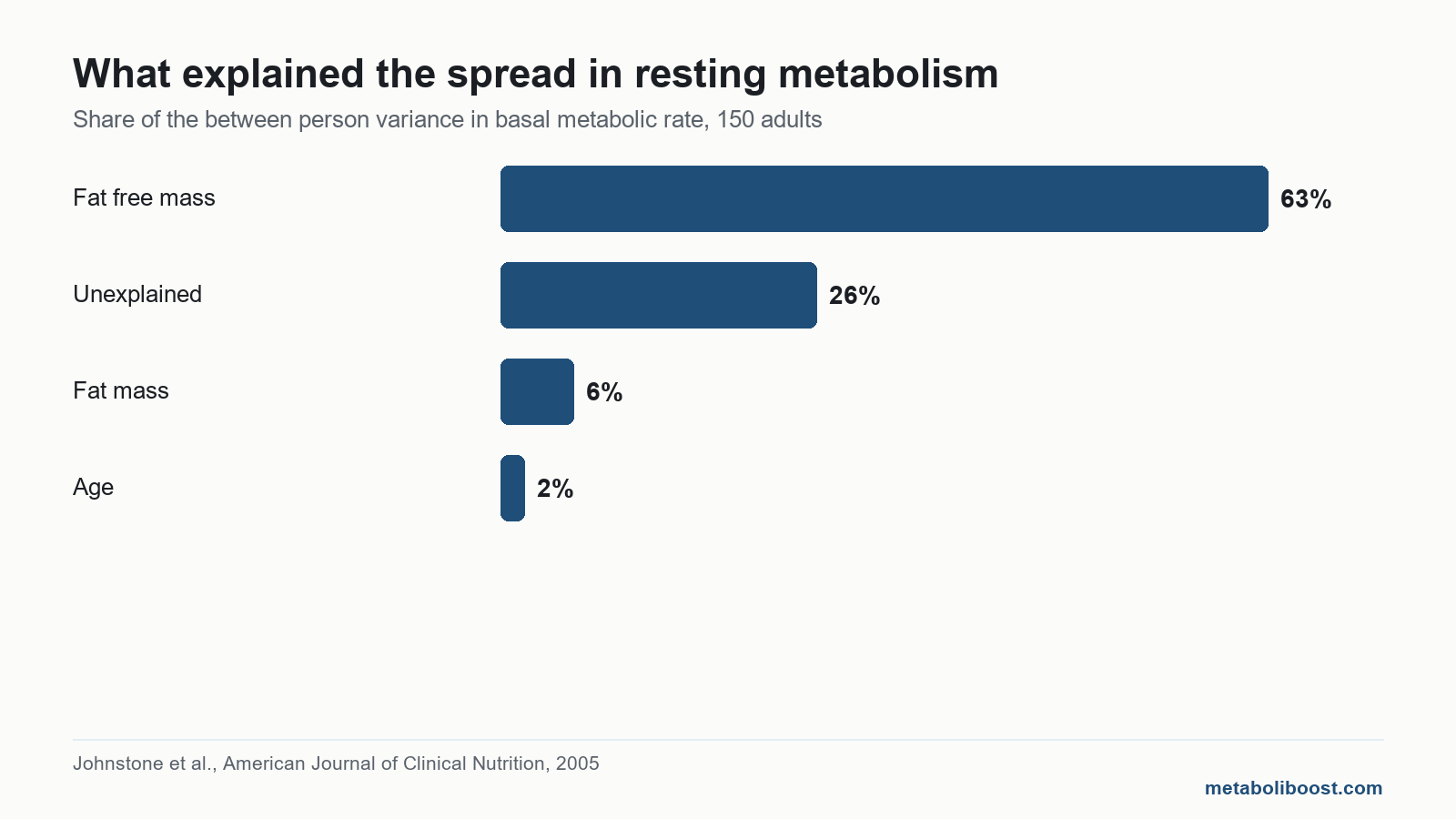
A high metabolism usually means a body that spends more energy than another of similar size. Measured resting rates do differ: in one study of 150 adults, lean mass explained 63% of the spread and 26% was left unexplained. Most of the gap people notice, though, comes from movement and appetite, not a faster engine.
Listen to this article, about 11 minutes. A synthetic voice reads the article and announces each section title as it begins; tables are read row by row and the questions at the end are left out.
Recorded 15 November 2026 from the article as published that day. Press a chapter to jump there; the highlighted line is what is playing. A play button sits beside every section heading, and once you scroll past this player a bar at the bottom of the screen keeps the controls in reach. Tap or click any sentence to hear the reading start from there.
On this page: how much resting metabolism really differs between people of the same build, from a 150 person study, a worked sum showing what lean mass alone is worth, the fidgeting finding, and what three Reddit threads report.
Think you already know this? Five questions, one minute.
Every answer is on this page. Answer from what you know now; the page fills in the rest.
-
1. In the 2021 analysis of 6,421 people, what happened to size adjusted energy use between about 20 and 60?
The Pontzer 2021 analysis in Science found size adjusted energy use held steady from about 20 to 60, then fell around 0.7% a year. Read the section
-
2. In the Johnstone study of 150 adults, how much of the between person spread in basal metabolic rate was left unexplained?
In Johnstone et al. 2005, fat free mass explained 63%, fat mass 6% and age 2%, leaving 26% unexplained. Read the section
-
3. In the Ravussin chamber study, how much daily energy did spontaneous fidgeting account for?
Ravussin et al. 1986 found fidgeting accounted for 100 to 800 kcal a day among its 177 subjects, independent of body size. Read the section
-
4. What did the Cochrane review conclude about green tea preparations and weight?
The Cochrane review of green tea preparations judged the effect small, statistically non-significant and not likely to be clinically important. Read the section
-
5. What does the NHS advise for someone with signs of an overactive thyroid?
The NHS overactive thyroid page says to see a GP if you have symptoms or signs, and a blood test can often show whether the thyroid is the cause. Read the section
Everybody knows someone who eats a second pudding and stays the same shape for twenty years. The usual explanation is a high metabolism, said with a mix of envy and resignation, as if it were a lottery win. The supplement aisle then offers to sell you a ticket. This page looks at what the measurements say instead: how far resting metabolism actually varies between people of the same build, where the rest of the difference hides, and why the fix on the label is usually not where the difference is.
What does a high metabolism actually mean?
Metabolism is the total energy your body uses in a day. Scientists split it into parts: the resting or basal rate that keeps organs running while you lie still, the energy spent digesting food, deliberate exercise, and everything else you do on your feet. When people say someone has a high metabolism, they usually mean only that the person seems to eat a lot without gaining weight.
Here is the first surprise. In absolute terms, bigger bodies burn more energy, not less, because there is more tissue to run. So the useful question is never whether one person burns more than another. It is whether they burn more than someone of the same size and make up. That is the question the studies below were built to answer.
Age matters less than people think. A 2021 analysis in Science led by Herman Pontzer of 6,421 people found size adjusted energy use held steady from about 20 to 60 and then fell around 0.7% a year. Our metabolism and age chart walks through those numbers. The midlife slowdown many people describe is mostly not in the furnace.
How much do resting metabolic rates differ between people?
The cleanest answer comes from a 2005 study in the American Journal of Clinical Nutrition by Alexandra Johnstone and colleagues at the Rowett Research Institute in Aberdeen. They measured the basal metabolic rate of 150 adults more than once, so they could separate real differences between people from day to day noise. Only 2% of the variation was within the same person, of which 0.5% was measurement error.
Of that between person difference, fat free mass, meaning muscle, organs, bone and water, explained 63%. Fat mass explained 6%, and age 2%. Sex made no significant difference once body composition was counted. That left 26% unexplained. The authors checked leptin and the thyroid hormone T3 and neither accounted for it. Thyroxine, T4, explained a quarter of the leftover spread in men and none in women.
So two things are true at once. Most of what looks like a fast or slow metabolism is simply body size and composition. And there is still a real, measurable difference between people built alike, about a quarter of the spread, that nobody in that study could pin on a hormone. The forums tend to say fast metabolisms are a myth. The data says they are real but smaller than the stories.
A worked example shows what lean mass alone can do. A 1986 respiratory chamber study by Eric Ravussin and colleagues of 177 people found fat free mass explained 81% of the difference in 24 hour energy use, and published the line 597 plus 26.5 times fat free mass in kilograms. These are two imagined people, not a way to work out your own number, since the line came from one group in one chamber.
| Illustration | Fat free mass | 597 plus 26.5 times fat free mass | Chamber estimate, kcal a day |
|---|---|---|---|
| Person A | 45 kg | 597 plus 1,192.5 | about 1,790 |
| Person B | 60 kg | 597 plus 1,590 | about 2,187 |
| Gap from lean mass alone | 15 kg | 26.5 times 15 | about 397 |
Fifteen kilograms of lean tissue is worth roughly 400 kcal a day in that sum. That is a bigger gap than most so called metabolism boosters even claim, and it comes from the body you already have, not a capsule.
If resting rate is not the answer, why do some people burn more?
The same Ravussin study had a second finding that gets far less attention. Even after adjusting for fat free mass, people still differed a lot, and a large part of that difference was spontaneous movement. The authors called it fidgeting, and it was worth 100 to 800 kcal a day among their subjects.
Then came a famous overfeeding experiment. James Levine and colleagues at the Mayo Clinic fed 16 lean volunteers 1,000 kcal a day above their needs for eight weeks. Two thirds of the rise in their energy use came from non exercise activity: posture, fidgeting and moving about. Changes in that activity explained a tenfold difference in how much fat people stored. Some bodies respond to a surplus by quietly getting busier. Others do not.
| Part of daily energy use | What drives it | How much it differs between people | Source |
|---|---|---|---|
| Resting (basal) metabolism, the largest part | Mostly fat free mass, then fat mass and age | 63% of the between person spread explained by fat free mass, 26% unexplained | Johnstone et al. 2005 |
| Digesting food (thermic effect) | Meal size and what is in it | About 10% of daily energy use, and about 1% lower in adults over 60 | Du et al. 2014 |
| Everyday movement that is not exercise | Fidgeting, posture, pacing, standing, chores | Fidgeting alone accounted for 100 to 800 kcal a day in one chamber study | Ravussin et al. 1986 |
| Movement when overfed | Unconscious extra activity | Two thirds of the rise in energy use; it predicted a tenfold difference in fat stored | Levine et al. 1999 |

Appetite is the other half. Someone who feels full early, forgets the second half of a biscuit and never snacks between meals can eat a large dinner in public and still eat less across a day. Our page on how to gain weight with a fast metabolism covers this from the other side, for people struggling to put weight on.
Can anything give you a high metabolism?
This is where the marketing walks in, usually carrying a tea. The honest answer is that the things which move daily energy use meaningfully are the ones in the table above, and most of them are slow and dull.
Lean mass is the biggest lever on resting rate, which is why strength training keeps turning up in good guidance. Everyday movement is the most variable part of the day, and it is the part a desk job removes. Food itself costs energy to process, about 10% of the day according to a Mayo Clinic study of 277 adults, but that is a property of eating, not a trick to unlock.
The pills fare worse. Green tea is the classic metabolism booster, so it is worth knowing that a Cochrane review of green tea preparations found the effect on weight was “small, statistically non-significant” and not likely to be clinically important. Fat burners and detox teas are mostly sold on ingredient studies, often by the people selling them, and a study of one ingredient is not evidence for a blend. Anyone promising to make your metabolism run high for 24 hours should be asked how they measured it. Our guide to what actually slows a metabolism goes through the claims one by one.

What do people who thought they had a fast metabolism report?
Forum accounts are testimony, not evidence, so read this section as what people say rather than what is proven. We read three Reddit threads from the past year, about 30 posts and replies in all, chosen because they asked this exact question.
In a June 2026 r/loseit thread, the poster described believing for years that her body simply held a set weight. She later connected it to a habit of pacing her room while daydreaming, which stopped when she moved in with a partner and an injury halted her workouts, and her weight changed without her noticing. A reply listed constant fidgeting and walking around the flat as the reason the writer stayed stable despite eating heavily on some weeks.
A November 2025 r/beginnerfitness thread argued that most people who claim a fast metabolism overestimate what they eat. One reply came from a tall, slim lifter who realised he ate big dinners but snacked far less than friends. Another said she and a coworker stayed slim by moving boxes all day. The poster later conceded that two people of the same weight do differ at rest, guessing by up to about 200 kcal, a figure that is their own estimate and not from a study.
A March 2026 r/PetPeeves thread pushed the other way. Slim posters said they eat full meals and snacks, are tired of being told they must not eat, and in one case wished they could gain weight. Others replied with relatives who stop eating the moment they feel full.
Put together, the accounts line up with the chamber studies on movement and appetite. Where the forums overreach is in calling fast metabolism a myth outright. The Johnstone data leaves a real unexplained difference between people built alike, so the slim posters who say it is not all willpower have a point.
When does a fast metabolism belong with a doctor?
Sometimes a body really is burning through energy faster than it should, and then it is a medical question, not a lifestyle one. An overactive thyroid is the best known cause. The NHS lists its signs as including weight loss often despite an increased appetite, a fast or irregular heartbeat, trembling, sensitivity to heat, difficulty sleeping, nervousness and a swelling in the neck. Its advice is plain: see a GP if you have symptoms or signs of an overactive thyroid. A blood test can often show whether the thyroid is the cause.
Unplanned weight loss, a racing heart or new heat intolerance are not things to explain away as a lucky metabolism. This page cannot tell you what is behind them, and no checklist can. A doctor can.
If none of that applies, the sensible reading of the evidence is calmer. Your resting rate is mostly your size and make up. The variable part of your day is how much you move without thinking about it, and our piece on the habits that really affect metabolism picks up from there.
Signs that belong with a GP, not a metabolism article
These are signs the NHS lists for an overactive thyroid. This is not a score and it cannot tell you what is going on.
The NHS advice is to see a GP if you have symptoms or signs of an overactive thyroid. Any of these, or anything else that worries you, is worth raising with a doctor.
Frequently asked questions
Is a high metabolism genetic?
Partly, through body size, build and how restless a person is, but the Johnstone study could not pin the unexplained 26% on any single hormone, and nobody can yet test for a fast metabolism gene.
Do men have a higher metabolism than women?
Men usually carry more fat free mass, so they burn more in total. In the Johnstone study, sex made no significant difference once body composition was accounted for.
Does a high metabolism mean you are healthy?
Not on its own. A high resting rate can come from more muscle, from more body tissue overall, or from a condition such as an overactive thyroid, which needs a doctor.
Can a smart watch tell me if I have a high metabolism?
No. Watches estimate energy use from heart rate, movement and your details. Resting metabolism is measured in a laboratory with indirect calorimetry, as in the studies on this page.
Does eating spicy food raise your metabolism?
Any meal raises energy use briefly as it is digested, about 10% of the day on average. No spice has been shown to turn an ordinary metabolism into a high one.
Why do I feel hot after eating if my metabolism is normal?
Digesting food produces heat, and a large or protein heavy meal produces more. Persistent heat intolerance with a racing heart is different and is worth raising with a GP.
Finished the page? The same five questions from the top, to see what stuck.
This article is general information, not personal medical advice. Speak to a doctor or another qualified professional about your own situation, especially about unplanned weight loss, a fast heartbeat or other symptoms. Study figures were checked against their published abstracts on 15 November 2026.
Leave a Reply