
No step count causes weight loss by itself, so the honest answer to how many steps a day to lose weight is the number someone can keep up while eating a little less. In the trials, extra walking did little for early weight loss, which diet drove, but higher counts went with less weight regained afterwards.
Listen to this article, about 12 minutes. A synthetic voice reads the article and announces each section title as it begins; tables are read row by row and the questions at the end are left out.
Recorded 5 October 2026 from the article as published that day. Press a chapter to jump there; the highlighted line is what is playing. A play button sits beside every section heading, and once you scroll past this player a bar at the bottom of the screen keeps the controls in reach. Tap or click any sentence to hear the reading start from there.
On this page: six popular step numbers traced back to where they came from in one table, the ACSM exercise minutes converted into steps with the sum shown, a converter for a reader’s own cadence, and five walker accounts from a 2022 forum thread.
Think you already know this? Five questions, one minute.
Every answer is on this page. Answer from what you know now; the page fills in the rest.
-
1. Where does the 10,000 steps a day goal most likely come from?
Lee and colleagues traced it to Manpo-kei, a pedometer name meaning 10,000 steps meter, chosen before any study had measured it. Read the section
-
2. In the Step-Up analysis of 260 adults, what were participants doing besides walking?
The 18 month programme Creasy and colleagues analysed combined a calorie restricted diet with prescribed physical activity, so the step results describe dieters. Read the section
-
3. What did the 2026 meta-analysis of 14 lifestyle trials find about steps?
Saadeddine and colleagues found walking more was not linked to greater loss in the dieting phase, while higher counts during maintenance went with less regain. Read the section
-
4. What cadence did CADENCE-Adults identify as the marker for moderate intensity walking?
The CADENCE-Adults study set 100 steps a minute as the moderate intensity threshold, which turns 150 minutes a week into about 15,000 steps. Read the section
-
5. Which ACSM statement do the forum accounts on slow 10,000 step walks line up with?
The ACSM position stand says 150 to 250 minutes a week provides only modest loss, which matches the small calorie figures walkers reported. Read the section
Search the question and the pages that come back agree on a number between 7,000 and 10,000, a tidy per 1,000 steps figure, and very little else. What they skip is where those numbers came from, which is the interesting part. One is a product name. Several are about living longer, not weighing less. And the one that is about weight comes from people who were dieting at the same time.
Where did 10,000 steps a day come from?
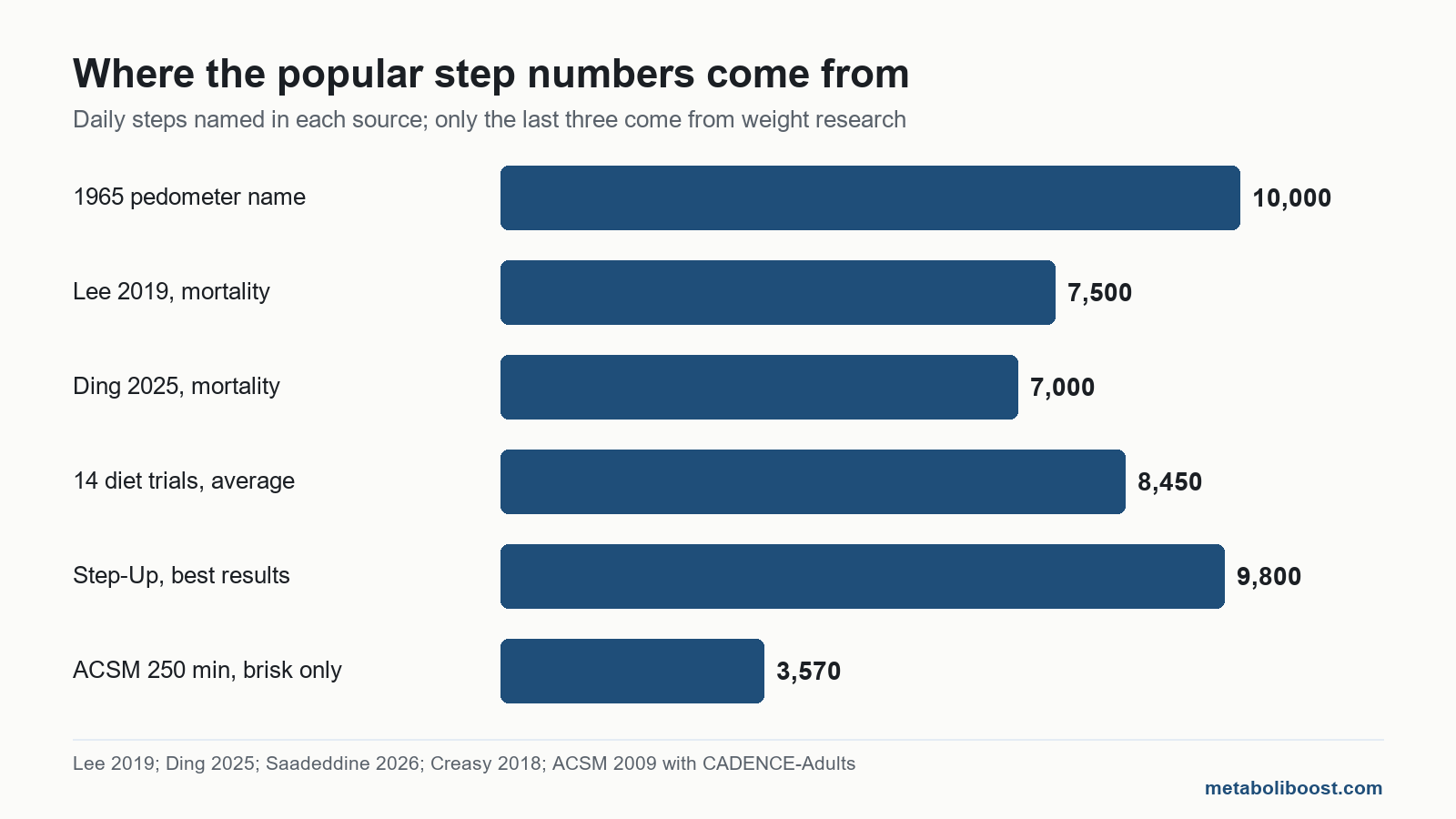
From a shop shelf. In their 2019 study of step counts and mortality, I-Min Lee and colleagues wrote that the goal most likely derives from the trade name of a pedometer sold in 1965 by Yamasa Clock and Instrument Company in Japan. It was called Manpo-kei, which translates as 10,000 steps meter. The number was chosen to sell a device. Nobody had measured anything.
Lee’s team then did measure something. They followed 16,741 women with a mean age of 72 who wore an accelerometer for a week. Those taking about 4,400 steps a day had lower death rates than those taking about 2,700, and the benefit kept growing until about 7,500 steps a day, where it levelled off. Walking faster added nothing clear once the total was accounted for. Weight was not the outcome.
Two larger pooled studies point the same way. A 2022 meta-analysis of 15 cohorts by Paluch and colleagues found the mortality benefit flattened at about 6,000 to 8,000 steps for adults aged 60 and over and about 8,000 to 10,000 for younger adults. A 2025 review of 57 studies led by Ding put the useful marker near 7,000. All three are good reasons to walk. None of them is an answer to the weight question, which is why so many confident step targets online borrow a mortality number and quietly relabel it.
| Step number | Source | What it actually measured | Weight result |
|---|---|---|---|
| 10,000 | Lee and colleagues, 2019, tracing the figure to a 1965 pedometer | A product name, Manpo-kei, meaning 10,000 steps meter | Nothing; no study set it |
| 7,500 | Lee and colleagues, 2019, 16,741 women, mean age 72 | Where the drop in death rates levelled off | Not measured |
| 7,000 | Ding and colleagues, 2025, 57 studies | Lower risk of death, heart disease and dementia against 2,000 steps | Not measured |
| 6,000 to 8,000 (60 and over), 8,000 to 10,000 (under 60) | Paluch and colleagues, 2022, 15 cohorts, 47,471 adults | Where the mortality benefit levelled off by age | Not measured |
| About 8,500 | Saadeddine and colleagues, 2026, 14 trials, 3,758 adults | Average steps reached in diet and lifestyle programmes | Not linked to more loss while dieting; linked to less regain |
| About 10,000, with about 3,500 in brisk bouts | Creasy and colleagues, 2018, 260 adults over 18 months | Steps among people already on a calorie restricted diet | Associated with more loss, alongside the diet |
What did the 18 month walking trial actually measure?
The trial most pages lean on for weight is Step-Up, run at the University of Pittsburgh. In the original trial, 363 adults with overweight or obesity were randomised; Creasy and colleagues later analysed the 260 who completed the 18 month programme. That programme was a calorie restricted diet plus prescribed physical activity. Everyone was dieting. The steps were measured on top of that.
At 18 months, the people with the best results averaged about 9,800 steps a day, and the group with the smallest losses averaged about 7,800. The authors concluded that about 10,000 steps a day, with about 3,500 of them taken in brisk bouts, was associated with enhanced weight loss in a behavioural programme. Associated is the honest word: this was a secondary analysis, so the people who lost more also walked more, and nobody can separate which way that ran.
That is the source of the per 1,000 steps figure that circulates. It describes walkers who were also on a reduced calorie diet, and repeating it as what steps do alone is a bit like crediting the passenger for the car’s mileage.
Do more steps mean more weight loss while dieting?
Mostly no, according to the newest pooled evidence. A 2026 systematic review and meta-analysis by Saadeddine and colleagues combined 14 randomised trials with 3,758 adults in diet and lifestyle programmes. Participants raised their steps to an average of about 8,450 a day while losing weight. Walking more was not linked to greater weight loss during that dieting phase. Where the step count did show up was later: higher counts during maintenance went with less weight regained.
The authors read this as calorie reduction driving the short term result, with walking earning its keep afterwards. They suggested working up to about 8,500 a day and holding it there. That fits what the weight loss plateau evidence shows about the body adapting once intake drops, and why keeping weight off is usually the harder half of the job.
The arithmetic agrees. A 30 minute walk at about 3 mph costs a 70 kg adult roughly 98 kcal above resting, as the walking calorie calculator works through, which a biscuit can cancel before the shoes are off. Steps are not useless for weight. They are slow, and they work best as the thing that stays once the diet relaxes.
How many steps does the exercise guidance work out to?
Exercise guidance is written in minutes, not steps, so the two rarely meet on the same page. The American College of Sports Medicine position stand on weight loss says moderate activity of 150 to 250 minutes a week helps prevent weight gain but provides only modest weight loss, that more than 250 minutes a week has been associated with clinically significant loss, and that 150 to 250 minutes improves loss in studies using moderate diet restriction but not severe restriction.
To turn minutes into steps, the CADENCE-Adults study found that about 100 steps a minute marks moderate intensity walking for adults aged 21 to 40, and a follow up confirmed the same threshold for ages 41 to 60. So 150 minutes at 100 steps a minute is 15,000 purposeful steps a week, about 2,140 a day. 250 minutes is 25,000, about 3,570 a day.
| ACSM band | Purposeful steps a week at 100 per minute | Per day, over 7 days | What the position stand says |
|---|---|---|---|
| 150 minutes a week (the floor) | 15,000 | about 2,140 | Prevents weight gain; only modest loss |
| 250 minutes a week | 25,000 | about 3,570 | Below this, only modest loss |
| More than 250 minutes a week | over 25,000 | over 3,570 | Associated with clinically significant loss |
Two things fall out of that sum. First, the guidance is about steps at a pace where talking is possible but singing is not, not about pottering between the kettle and the sofa. Second, 3,570 brisk steps a day lands almost exactly on the 3,500 brisk bout steps the Step-Up analysis singled out. Add an ordinary day’s movement and the total drifts towards 8,000 to 10,000, which is why that range keeps appearing. The calculator below does the same conversion with a reader’s own cadence.
Turn extra steps into walking time
This converts a change in daily steps into minutes of walking at a chosen cadence, using the same sum worked through above. It shows time only. It does not predict weight, set a goal or give a timeline.
To find a cadence, count steps for 60 seconds at a normal walking pace. The 100 steps a minute moderate intensity marker comes from the CADENCE-Adults research in adults aged 21 to 60.
What do people walking 10,000 steps a day report?
This section reports what people say, not what was measured. A MyFitnessPal community thread from August 2022 is the clearest recent example; it runs to 18 replies from about ten members, and five accounts are summarised here. It is just over three years old, and the arithmetic in it has not changed.
The original poster walked on a treadmill every day at a slow pace with no incline, always reached 10,000 steps, and asked whether that came to 500 kcal. After trying a walking calculator, they reported it put about 75 minutes of their walking at well under 400 kcal. A second member estimated roughly two hours for the full 10,000 at that pace, and called that much treadmill time mind-numbingly dull.
A third member, a cyclist, worked out that 500 kcal of walking would take them about eight miles, around two and a half hours, every day, and said that would not be remotely sustainable for most people. A community helper added that a routine needing two or more hours of daily exercise rarely survives jobs, family and the rest of life.
One account cut the other way. A member said their tracker logged the same calories for their walk to work whether they took 30 or 40 minutes, and argued distance mattered more than pace. Another disputed the reasoning, pointing out that heart rate is only the tracker’s proxy for energy.
Where these accounts agree with the evidence: walking burns less than the round numbers suggest, and the time cost of using it as the main lever is large, which matches the modest loss the ACSM describes. Where they miss it: the thread treats steps purely as calories, and says nothing about the regain finding, which is where the trials say steps matter most.

When is adding steps not the right first move?
Walking is low risk for most adults, but not for everyone, and this part is meant plainly. Anyone with a heart or lung condition, chest pain or breathlessness on exertion, diabetes treated with insulin or medicines that can cause low blood sugar, or joint pain that gets worse with walking should talk to a doctor or physiotherapist before raising their activity. The same goes for anyone recovering from surgery or an injury, and for pregnancy.
And for anyone whose weight is changing without an obvious reason, or who is losing weight they did not set out to lose, a step target is not the right response. That is a reason to see a doctor first.
So what number is worth aiming for?
The evidence supports a direction rather than a number. Whatever today’s count is, going up gradually towards the 7,000 to 10,000 range brings the health benefits the mortality studies describe, and moving some of those steps to a brisk pace meets the guidance in minutes. For weight, the steps do their best work alongside a moderate calorie deficit and, above all, afterwards, when the habit of walking is what helps hold the result. The pedometer company picked 10,000 because it sounded good. It turns out it was not far off; it was just answering a different question.
Frequently asked questions
Is 10,000 steps a day enough to lose weight on its own?
Not reliably. In the 2026 meta-analysis of 14 trials, walking more was not linked to greater weight loss during the dieting phase. Steps help with health and with holding weight off, while the early change mostly comes from eating less.
Do steps around the house count towards the total?
They count towards the daily total, and the mortality studies counted every step. The exercise guidance, though, refers to moderate intensity walking, which the CADENCE-Adults research put at about 100 steps a minute.
Is it better to walk faster or to walk more steps?
In Lee’s study of older women, walking faster added nothing clear once total steps were accounted for. The Step-Up analysis found brisk bouts were associated with better results among dieters. Both matter; total steps are the simpler place to start.
Does the recommended step count change with age?
The 2022 meta-analysis found the mortality benefit levelled off at about 6,000 to 8,000 steps for people aged 60 and over and 8,000 to 10,000 for younger adults. Those figures are about health, not weight.
Why does a fitness tracker say 10,000 steps burned 500 calories?
Trackers estimate energy from steps and heart rate using assumptions about pace and body size. For many people 10,000 steps at an easy pace costs noticeably less than 500 kcal above resting, and laboratory tests of wrist devices found large errors.
How quickly should daily steps be increased?
None of the cited studies set a safe rate of increase for everyone. Raising the count gradually from the current level is the cautious approach, and anyone with a heart, lung or joint condition should check with a doctor first.
Finished the page? The same five questions from the top, to see what stuck.
This article is general information, not medical advice, and is not a substitute for care from a qualified healthcare professional. Speak to your doctor about your own situation.
Leave a Reply