The Psychology of Cravings, Comfort, and Control
Emotional eating isn’t about food — it’s about feelings. Discover the deep psychology behind emotional hunger and learn practical, science-backed strategies to stop stress eating, rewire your brain, and build a peaceful relationship with food.
🌧️ The Hidden Battle Between Emotions and Food

You open the fridge, not because you’re hungry — but because you’re tired, stressed, lonely, or sad.
Maybe it’s the end of a long day. Maybe you’ve had an argument. Maybe you just feel empty.
You reach for something sweet, crunchy, or comforting. For a moment, it feels good.
Then guilt, frustration, and self-blame follow.
Sound familiar? You’re not alone.
Studies suggest that over 60% of people eat emotionally — using food to numb, distract, or comfort themselves rather than to satisfy true hunger.
The truth is:
Emotional eating is not about a lack of self-control — it’s about an unmet emotional need trying to be fed through food.
Understanding this distinction changes everything.
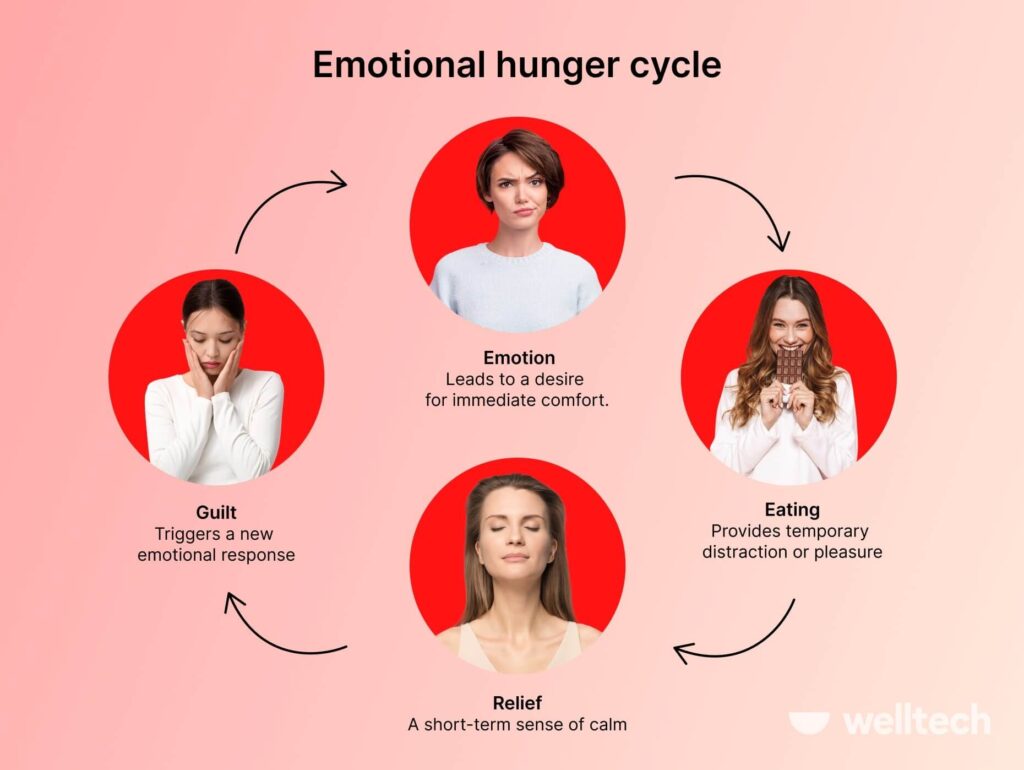
Emotional Hunger Cycle:
🧬 The Brain Science Behind Emotional Eating
When you eat something pleasurable — chocolate, pizza, or fried food — your brain releases dopamine, the “reward” neurotransmitter.
This chemical gives you a temporary rush of pleasure and calm — the same system activated by hugs, laughter, or success.
Over time, your brain learns that food = emotional safety.
So every time you feel low, anxious, or hurt, your brain sends the message:
“Eat. You’ll feel better.”
This is called “emotional conditioning.”
It’s not weakness — it’s wiring.
To break this pattern, you have to retrain the reward system, teaching your brain that comfort can come from other sources — not just food.
💭 Emotional Hunger vs. Physical Hunger
A crucial first step is learning to differentiate emotional hunger from physical hunger.
They feel similar, but they follow different rules.
| Physical Hunger | Emotional Hunger |
|---|---|
| Develops gradually | Comes suddenly |
| Any food satisfies it | Craves specific comfort food |
| You feel it in the stomach | You feel it in your mind or chest |
| Stops when you’re full | Keeps pushing even after fullness |
| Leads to satisfaction | Leads to guilt or regret |
Before you eat, pause and ask yourself:
“What kind of hunger is this — body hunger or emotional hunger?”
Even a few seconds of awareness can shift your response.
⚙️ Step 1: Identify the Triggers — What’s Really Eating You
Every emotional eater has unique triggers — events, moods, or thoughts that lead to eating without hunger.
Common triggers include:
- Stress: Cortisol (stress hormone) increases appetite and cravings for sugary, fatty foods.
- Loneliness: Food fills the emotional void when human connection feels distant.
- Boredom: Eating provides stimulation when life feels dull.
- Sadness or anxiety: Food acts as a temporary anesthetic.
- Fatigue: The brain confuses exhaustion with hunger.
👉 Keep a “Trigger Tracker” journal for a week:
- What were you feeling before eating?
- What were you doing or thinking?
- Did you eat fast or mindlessly?
- How did you feel afterward?
Patterns will emerge. Awareness is always the first therapy.
🧘♀️ Step 2: Pause and Create the “Feeling–Feeding Gap”
Between the feeling and the feeding lies your power to change.
Psychologists call this “response flexibility” — the ability to pause before reacting.
Try this:
When you feel the urge to eat emotionally, pause for 3 minutes.
Breathe deeply. Name the emotion. Ask:
“What do I truly need right now — food or comfort?”
Even if you still decide to eat afterward, that moment of mindfulness weakens the automatic habit loop.
Over time, your brain learns that you’re capable of choice, not compulsion.
💕 Step 3: Label the Emotion to Lessen Its Power
Research from UCLA (Lieberman et al., 2007) found that simply naming an emotion — for example, saying “I feel anxious” — reduces activity in the amygdala, the brain’s fear center, and activates the prefrontal cortex, which governs logic and self-control.
So when emotions rise, instead of escaping into food, try:
“I’m not hungry — I’m anxious and overwhelmed.”
“I feel lonely and need connection.”
Labeling creates emotional distance and allows the rational brain to re-engage.
🌿 Step 4: Rebuild Emotional Coping Mechanisms
If food has been your primary comfort for years, you need new coping tools.
Build what psychologists call a “Comfort Menu” — a list of soothing activities to reach for instead of food.
Examples:
- Journaling your thoughts
- Calling a trusted friend
- Taking a short walk or stretching
- Listening to calming music
- Practicing prayer or meditation
- Doing a creative hobby (art, writing, dance)
- Deep breathing or aromatherapy
The goal isn’t to suppress the emotion — it’s to comfort yourself without consumption.
🪞 Step 5: Heal the Inner Child Behind the Habit
Many emotional eaters carry a wounded “inner child” — a younger part of you that learned food equals love, comfort, or safety.
Perhaps as a child:
- You were rewarded with sweets for being good.
- You were comforted with food when you cried.
- You weren’t taught to express emotions safely.
As an adult, the same script plays out subconsciously.
Healing comes from reparenting yourself.
When cravings arise, imagine comforting your younger self:
“I know you’re hurt. I’m here for you. You don’t need food to feel safe anymore.”
This simple act of self-compassion rewires the emotional narrative.
🧠 Step 6: Rewire the Habit Loop (Cue → Routine → Reward)
According to behavioral psychology (Charles Duhigg’s Habit Loop model):
- A Cue (stress, sadness, boredom) triggers
- A Routine (eating for comfort), which gives
- A Reward (temporary emotional relief).
You can’t remove the cue, but you can change the routine.
Example:
When stressed → Instead of eating → Try deep breathing or walking → Feel calm.
Your brain still gets the reward (calmness), but through a healthier route.
Repeat this enough, and you’ll literally recode the neural pathway.
💤 Step 7: Strengthen Physical Foundations — Sleep, Nutrition & Hormones
Psychology doesn’t exist in isolation from biology.
If your body is exhausted, undernourished, or hormonally imbalanced, your emotional regulation weakens.
To support emotional control:
- Sleep: Lack of sleep increases ghrelin (hunger hormone) and decreases leptin (satiety hormone).
- Eat balanced meals: Include protein, fiber, and healthy fats at each meal to stabilize blood sugar.
- Stay hydrated: Dehydration can mimic hunger.
- Manage stress: Chronic cortisol surges heighten cravings for sugary foods.
When your physiology is steady, your mind gains resilience.
🪜 Step 8: Replace Guilt with Growth
One of the most damaging cycles of emotional eating is shame — eating to comfort pain, then feeling guilty afterward, which triggers more eating.
This self-criticism keeps the brain in stress mode, making change harder.
Instead, practice Reflective Self-Compassion:
“I slipped today, but I understand why. What was I feeling before I ate?”
Every episode becomes data — not failure.
This mindset encourages growth rather than self-punishment.
🌻 Step 9: Build Emotional Resilience Through Mindfulness & Therapy
Mindfulness-based practices like meditation, breathwork, and body scanning improve emotional tolerance — the ability to feel discomfort without reacting.
In fact, Mindfulness-Based Eating Awareness Training (MB-EAT) has been clinically shown to reduce binge and emotional eating by helping individuals tune into body sensations and emotions with non-judgment.
If deep emotions or trauma are at play, therapy — especially Cognitive Behavioral Therapy (CBT), Internal Family Systems (IFS), or trauma-informed counseling — can help you unlearn emotional patterns that drive overeating.
Healing the root of the emotion is more powerful than controlling the symptom of eating.
🌤️ Step 10: Redefine Food — From Comfort to Connection
Ultimately, breaking emotional eating is not about rigid discipline — it’s about building a new relationship with food.
Let food return to its original purpose: nourishment, energy, joy, and connection.
Eat because your body needs fuel — not because your heart needs distraction.
Remember:
You don’t have to “control” food — you just have to listen to yourself with more love than judgment.
💬 Final Words: Healing Is Not Linear
You may still have days when you eat emotionally — and that’s okay.
Each moment of awareness, each small pause, each compassionate reflection weakens the old pattern.
Breaking emotional eating isn’t a diet — it’s emotional freedom work.
And every time you choose to feel instead of feed, you’re not failing — you’re healing.
Leave a Reply