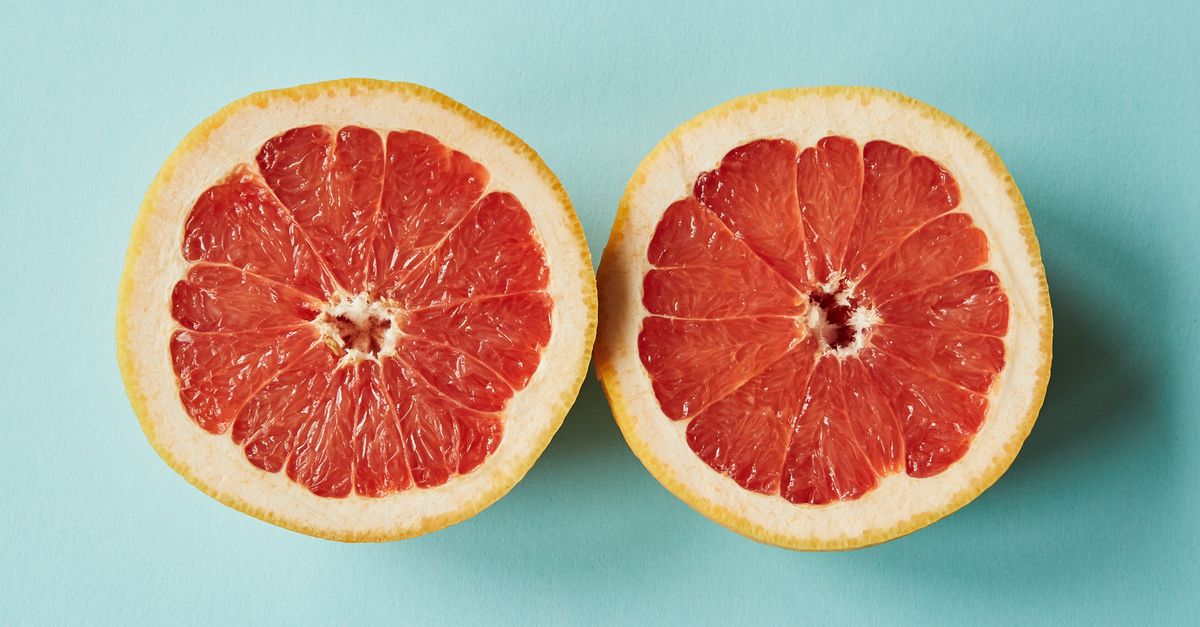
Grapefruit is a good fruit to eat and a poor weight loss strategy. Pooled randomised trial results show no significant difference in body weight between people given grapefruit and people given a control diet. What it does offer is low energy density, fibre and vitamin C, plus a drug interaction that matters far more than any fat burning claim.
What is actually in half a grapefruit?
Half a medium grapefruit is roughly fifty calories. It is around ninety percent water, carries about two grams of fibre, and delivers enough vitamin C to cover most of an adult’s daily requirement. That is a genuinely good nutritional profile for the calories involved.
It is also, more or less, the profile of most whole fruit. Nothing on that list is unique to grapefruit.
Energy density is the honest mechanism. Food that is mostly water and fibre takes up room on a plate and in a stomach without bringing many calories with it, so it can displace something denser. A grapefruit eaten instead of a pastry changes your day. A grapefruit eaten as well as the pastry does not, and no property of the fruit rescues that.

The bitterness gets sold as a mechanism, which it is not. Grapefruit tastes bitter largely because of naringin, and the claim that bitterness switches on satiety signalling in the brain runs well ahead of what has been shown in people. What bitterness reliably does is make grapefruit slower to eat than a biscuit. That is a small real advantage, and not a metabolic one.
What did the grapefruit trials actually find?
This is where the superfruit framing meets the evidence and does not survive it.
A systematic review and meta analysis of randomised clinical trials, published in Critical Reviews in Food Science and Nutrition, pooled three randomised controlled trials covering 250 overweight and obese participants. The pooled analysis found no significant difference in body weight between the grapefruit groups and the controls. The reviewers rated the trials as moderate quality and noted three limits on any conclusion: there are very few trials, the interventions were short, and no minimum effective dose has ever been established.
One consistent signal did come out of that pooling, and it was not weight. Systolic blood pressure was lower in the grapefruit groups by roughly two and a half millimetres of mercury, and unusually for this literature the trials agreed with each other on it. Small, real, and about blood pressure rather than fat.
The largest of the individual trials is worth reading directly, because its design is exactly the protocol the internet recommends. In a six week randomised controlled trial published in Metabolism, 74 overweight adults ate half a fresh Rio Red grapefruit with every meal, three times a day, following a three week washout period. There were no differences between the grapefruit group and the control group in weight, in blood pressure or in blood lipids.
Several measures did improve when each participant was compared against their own starting point, including waist circumference and cholesterol. That is precisely what a control group exists to see past, because people who join a nutrition trial change other things too. Against the controls, the difference was not there.
Nothing in this makes grapefruit a bad food. It makes it an ordinary one, which is a different and much less marketable claim.
How does grapefruit compare with what actually moves weight?
| What people try | What the evidence supports | Weight effect |
|---|---|---|
| Grapefruit before every meal | Trials pooled together show no weight difference against controls | Very little |
| Grapefruit instead of a denser snack | Fewer calories in the day, more fullness per calorie | Small but real |
| Overall energy intake across weeks | The route every working method runs through | Most of it |
| Enough protein | Better fullness, more muscle kept while losing fat | A lot |
| Sleep | Affects appetite regulation and whether you stick with anything | More than expected |
| Resistance training | Preserves muscle, which changes what the loss looks like | A lot, slowly |
| Daily walking | Unglamorous, and it accumulates across the week | A lot, quietly |
| Grapefruit detox water | Hydration, which plain water also provides | None |
| Naringenin as a fat burner | Cell culture and rodent work only | None you would notice |
The third row is the one every other row serves. What a calorie deficit actually is covers that properly, and how to burn belly fat deals with the version of this question people ask most often.
What about naringenin and fat metabolism?
Naringenin, the flavonoid grapefruit is best known for, is a real compound with real activity in laboratory work. It has been studied in cell cultures and in rodents, where it influences lipid handling and insulin signalling. That research is legitimate and interesting. It is not evidence that eating a grapefruit changes fat metabolism in a person.
The gap between the two is not a technicality. Doses used in animal work are frequently far beyond anything a diet delivers, rodents process these compounds differently from humans, and an isolated compound in a dish behaves differently from the same compound eaten inside a whole fruit alongside a meal.
This is the exact step where most food based fat burning claims break, and the shape is worth recognising because you will meet it again. It is the same shape as the apple cider vinegar story, and what the vinegar trials actually show runs the same test on that one. A mechanism is found in a laboratory, then described as though the outcome in people follows automatically. It does not follow. Here it was tested on the actual fruit, and it did not.
Why does grapefruit interact with medicines?
This is the part of the grapefruit story with actual consequences, and it usually appears as a two line footnote under a thousand words about burning fat.
Grapefruit contains furanocoumarins, which block an enzyme called CYP3A4 in the wall of the small intestine. That enzyme’s ordinary job is to break down a share of certain drugs before they ever reach the bloodstream. Block it and more of the dose gets through than the prescription assumed. The practical result is not subtle. It amounts to taking a larger dose than you were given.
Two details make this more awkward than most food and drug interactions:
- Waiting does not help. The enzyme is not simply occupied, it has to be replaced, which takes the better part of a day or longer. Taking the tablet in the morning and the grapefruit at night does not separate them.
- The amount is small. For some drugs a single glass of juice is enough to matter, so this is not a question of eating unusual quantities.
- It is not only grapefruit. Related citrus such as pomelo and Seville orange, the bitter orange used in marmalade, can act the same way.
Statins are the example most people meet. The advice differs between drugs in the same class, which is why a general rule is no use here. For simvastatin the NHS says, on a page reviewed 12 May 2026, to avoid grapefruit juice. For atorvastatin the NHS says, on a page reviewed 23 June 2026, you can eat as normal but should not have more than one or two small glasses of grapefruit juice a day.
| Medicine | Where the advice comes from | What it says about grapefruit |
|---|---|---|
| Simvastatin | NHS medicines guide | Avoid grapefruit juice |
| Atorvastatin | NHS medicines guide | Eat as normal, but no more than one or two small glasses of juice a day |
| Anything else you take | The leaflet in the box, and your pharmacist | Varies by drug, including within the same class |
Other drug groups carry grapefruit warnings too. The US Food and Drug Administration’s consumer page, current as of July 2021 when re-read on 11 October 2026, names some blood pressure medicines, some immunosuppressants used after a transplant, some drugs for anxiety, a corticosteroid used in Crohn’s disease, a heart rhythm drug, and an antihistamine that grapefruit makes less effective rather than stronger. Working from a list you found online is the wrong approach, because the only list that matters is the one for what you are actually taking.
Who else should be careful with it?
Grapefruit is acidic. For anyone who gets reflux or heartburn, a lot of citrus on an empty stomach is a dependable way to make a morning worse. That is a reason to notice how you respond, not to push through because an article called it a metabolism booster.
The other caution is about how grapefruit gets used rather than the fruit itself. It turns up repeatedly in very restrictive plans that pair it with a few hundred calories a day and describe the resulting hunger as a cleanse. The grapefruit is not the problem in those plans, and it is not the reason they appear to work briefly either.
So is grapefruit worth eating?
Yes, for ordinary reasons rather than special ones. It is low in calories, high in water and fibre, a good source of vitamin C, and it counts towards your fruit and vegetable intake. If you like it, eat it. If you are eating it while disliking it because you believe it burns fat, the belief is doing more work than the fruit is.
What decides whether you lose weight is not changed by which fruit you pick. It is overall energy intake across weeks rather than days, enough protein, enough sleep, some resistance training so that what you lose is mostly fat, and a version of all of that you can actually keep doing. The NHS healthy weight guidance covers the same ground without selling anything.
No fruit is load bearing here, and most of what is load bearing is boring. Grapefruit is a sharp, low calorie thing to eat with one property worth taking seriously, and that property is what it does to medication rather than what it does to fat.
What has changed since this was first published?
The trials are what they were. The medicines advice is the part that can move, so it is rechecked on the weekly refresh and the entries below carry the date and the source.
- 11 October 2026: both NHS statin pages re-read. Simvastatin, reviewed 12 May 2026: avoid grapefruit juice. Atorvastatin, reviewed 23 June 2026: avoid too much, no more than one or two small glasses a day. Neither has changed its position.
- 11 October 2026: the US Food and Drug Administration consumer page on grapefruit and medicines, current as of 1 July 2021, added as the source for the wider list of drug groups, which now includes a corticosteroid, a heart rhythm drug and an antihistamine that grapefruit weakens rather than strengthens.
- 11 October 2026: the two trial links on Europe PMC were checked and are live. Their wording was not re-read on this pass, and the pooled result stands as summarised.
Frequently asked questions
Does eating grapefruit before meals help you lose weight?
In the trial that tested exactly that habit, half a grapefruit with each of three meals for six weeks, there was no difference in weight between the grapefruit group and the control group. Eating it in place of something more calorie dense can help. Eating it in addition to everything else does not.
Does grapefruit burn fat?
No. No food burns fat in the sense that phrase implies. Fat loss happens when energy intake sits below what your body uses, sustained over time, and no single food decides that.
Is grapefruit juice as good as the whole fruit?
For the drug interaction they are equivalent, and that is the part that matters most. For everything else the whole fruit is better, because juicing removes most of the fibre and makes the calories much faster to consume.
Can I eat grapefruit if I take a statin?
It depends which statin. The NHS says to avoid grapefruit juice with simvastatin, and to have no more than one or two small glasses a day with atorvastatin. The advice differs within the class, so check the leaflet that came with your medicine and ask your pharmacist.
Is grapefruit good for anything other than weight?
The most consistent finding across the randomised trials was a small reduction in systolic blood pressure, on the order of a couple of millimetres of mercury. It is also a good source of vitamin C and counts towards daily fruit intake.
Does the bitter taste mean it is working?
No. The bitterness comes from naringin and related flavonoids and tells you nothing about any metabolic effect. It may make the fruit slower to eat than softer, sweeter foods, which is a mild and genuine advantage of a different kind.
This article is general information, not medical advice, and is not a substitute for care from a qualified healthcare professional. If you take any regular medication, or you have questions about your weight or metabolic health, speak to your doctor or pharmacist about your own situation.
Leave a Reply